
Traces That Keep Returning: In Conversation with Qin Shen
Memory, Migration, and Lingering Touches
Editor’s Note
This interview is based on a written conversation. The text has been lightly edited for clarity, while preserving the artist’s original tone and meaning.
On June 20, 2026, ArtEchive held a conversation with artist Qin Shen surrounding time, memory, cultural migration, and the traces that remain across bodies, objects, and landscapes.
The discussion explores how collected materials, personal histories, and natural remnants become vessels for memory within Shen’s practice. Moving through blackened oyster shells found at Rockaway Beach, crop remnants from her grandmother’s farmland in China, Buddhist learning, bodily sensitivity, and sculptural objects covered in glass beads, the conversation reflects on how experiences accumulate, erode, and resurface through repeated gestures of collecting, layering, pressing, tracing, and painting.
Rather than approaching memory as a fixed or linear narrative, the interview considers Shen’s art-making as a meditative process of returning to what has been marked, forgotten, transformed, or partially erased. Throughout the conversation, her creative practice emerges as a way of staying with uncertainty, pain, tenderness, and migration, allowing personal experience to unfold through the subtle connections between the body, the sea, the land, and the objects that continue to carry traces of time.
interviewee
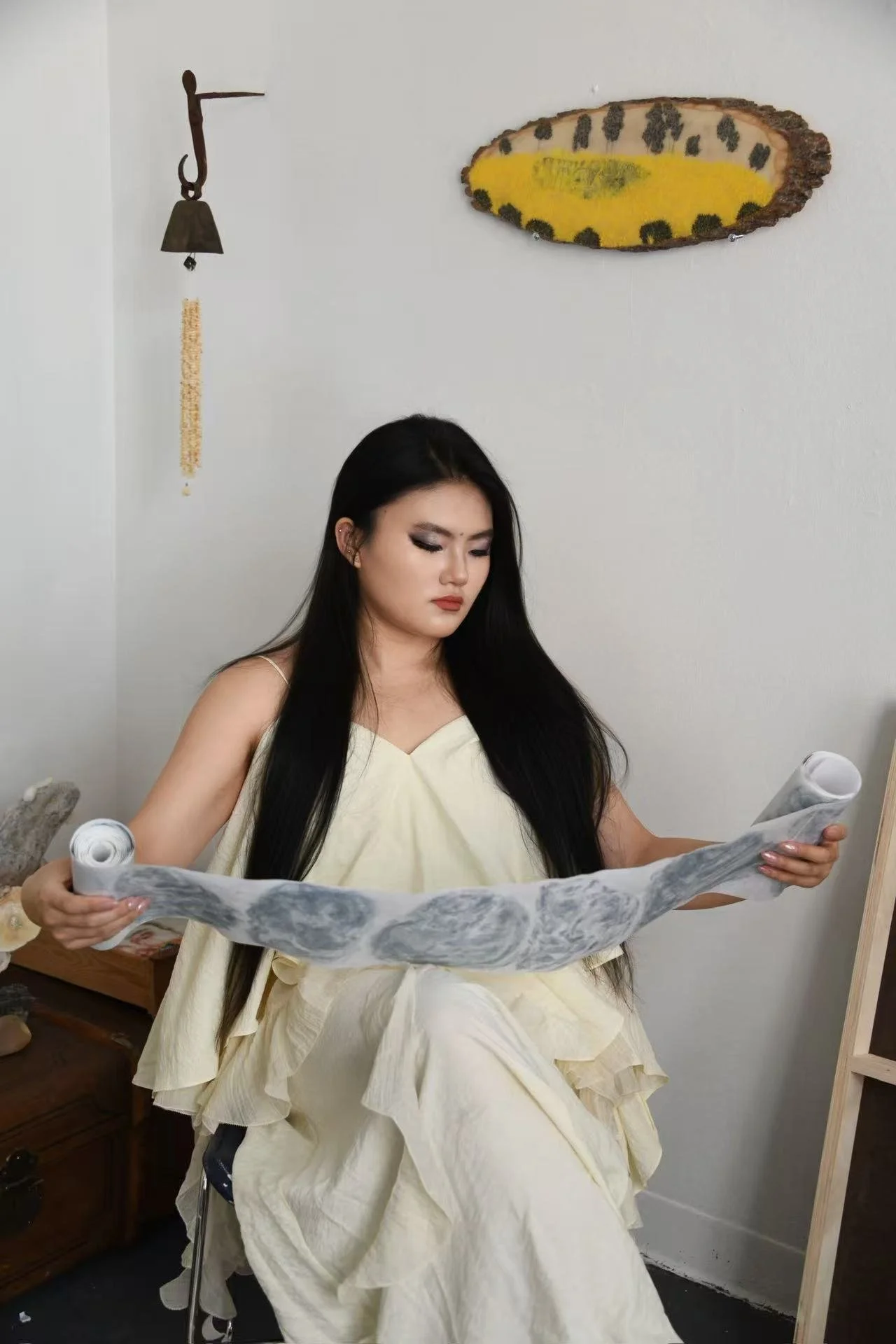
Qin Shen (b. 2001, China) works across printmaking, painting, drawing, sculpture, and installation. Her practice unfolds through acts of collecting, observing, and remembering, exploring the relationships between time, memory, and cultural migration. Working with found objects and materials gathered from both New York and her childhood landscapes in China, she creates layered spaces where personal histories, emotions, and lived experiences intersect. Through repetitive processes of accumulation, erosion, and transformation, Shen investigates how traces are left upon bodies, objects, and places, translating fleeting sensations and invisible connections into tangible forms.
Qin Shen
Objects, Memory, and Migration
ArtEchive
Your practice spans printmaking, painting, drawing, sculpture, and installation. What themes do you often return to?
Qin SHEN
My practice usually revolves around time, memory, cultural migration, and the ways in which personal experiences accumulate within the self. Through mixed-media monoprinting, painting, drawing, sculpture, and installation, I try to build a space-time where memory and lived experience are intertwined.
I often collect objects from different places and stages of my life. Some come from my current life in New York, while others are connected to my childhood in China. They may come from urban environments, natural sites, or domestic spaces. My process usually involves collecting, sorting, coating, pressing, and layering. For me, these repetitive gestures are not only methods of making, but also ways of processing memory.
Memory is never still. It accumulates, but it also erodes. Through these gestures, emotions and feelings are allowed to wander, react, and appear in ways that cannot be fully predetermined.
ArtEchive
Buddhist learning is an important part of your daily life. How does it influence your practice?
Qin SHEN
Buddhist learning is a very important part of my everyday life, and it deeply influences my practice. For me, studying Buddhism is a practice of self-exploration and healing. It teaches me to slow down and observe subtle, slow, repetitive experiences, including those that are difficult to explain through language.
I have a long-term project related to blackened oyster shells. One work within this project is a long scroll titled A Record of Lingering Touches. While making this work, I would listen to Buddhist lectures and chanting while observing and touching one oyster shell at a time. I wanted to see every line, every texture, and every mark on the shell, and then translate them onto paper through my brush.
This process became almost meditative for me. I was observing how time had left traces on the oyster shell, while also trying to build a connection with it through drawing.
Blackened Oyster Shells and Returning to the Sea
ArtEchive
How did your relationship with these blackened oyster shells begin?
Qin SHEN
I first encountered these blackened oyster shells while volunteering at Rockaway Beach. I saw many black oyster shells scattered across the beach and found them very unusual. I was curious about why they were black. The leader of the volunteer group was a geologist, and he told me that this was a very unique phenomenon.
These oysters had once been in oxygen-poor layers beneath the seabed. A long period of “suffocation” caused black sediment to form on the surface of their shells. But by the time I found them on the beach, they had already been pushed back to the shore by waves and tides. Some of the black sediment had been gradually worn away again by sand, seawater, and collision.
This process moved me deeply. It made me realize that the way time leaves traces on an object is not one-directional. Traces are layered, but they are also constantly being erased.
I began to feel that this was very similar to the way memory works within a person. Every experience, every detail, and every moment leaves some kind of influence on us, just as every wave leaves a mark on an oyster shell. But we are not always aware of these influences. Some experiences are too distant, while others are repeated so many times like daily habits that they become almost invisible.
That is why I feel deeply connected to these oyster shells. They made me realize that a person’s life narrative is not absolutely linear. A behavior or feeling in the present may be connected to one or several points in the long river of the past. Between different events, there are many invisible and intricate connections.
ArtEchive
Rockaway Beach seems to have opened up a deeper field of memory for you. What does the seaside mean to you?
Qin SHEN
While making observational drawings of the oyster shells and entering a meditative state, my thoughts kept returning to the past. I began to wonder why I felt such a special emotional attachment to the seaside.
Later, I remembered the first time I went to the sea. I was about four or five years old. One summer, my father drove through the night from our home in Changshu to Qingdao, where my mother was on a school trip. He brought me to the beach, handed me over to my mother, and then drove back.
I think that may have been the first time I strongly felt my father’s love. Later, as I grew up, my relationship with my father became increasingly complicated, entangled with both love and pain. During many painful moments, my thoughts would return to that summer, to that unfamiliar city, and to the beach.
So for me, the seaside is not just a place. It is more like a passage, connecting love, separation, childhood, pain, and the constantly changing self.
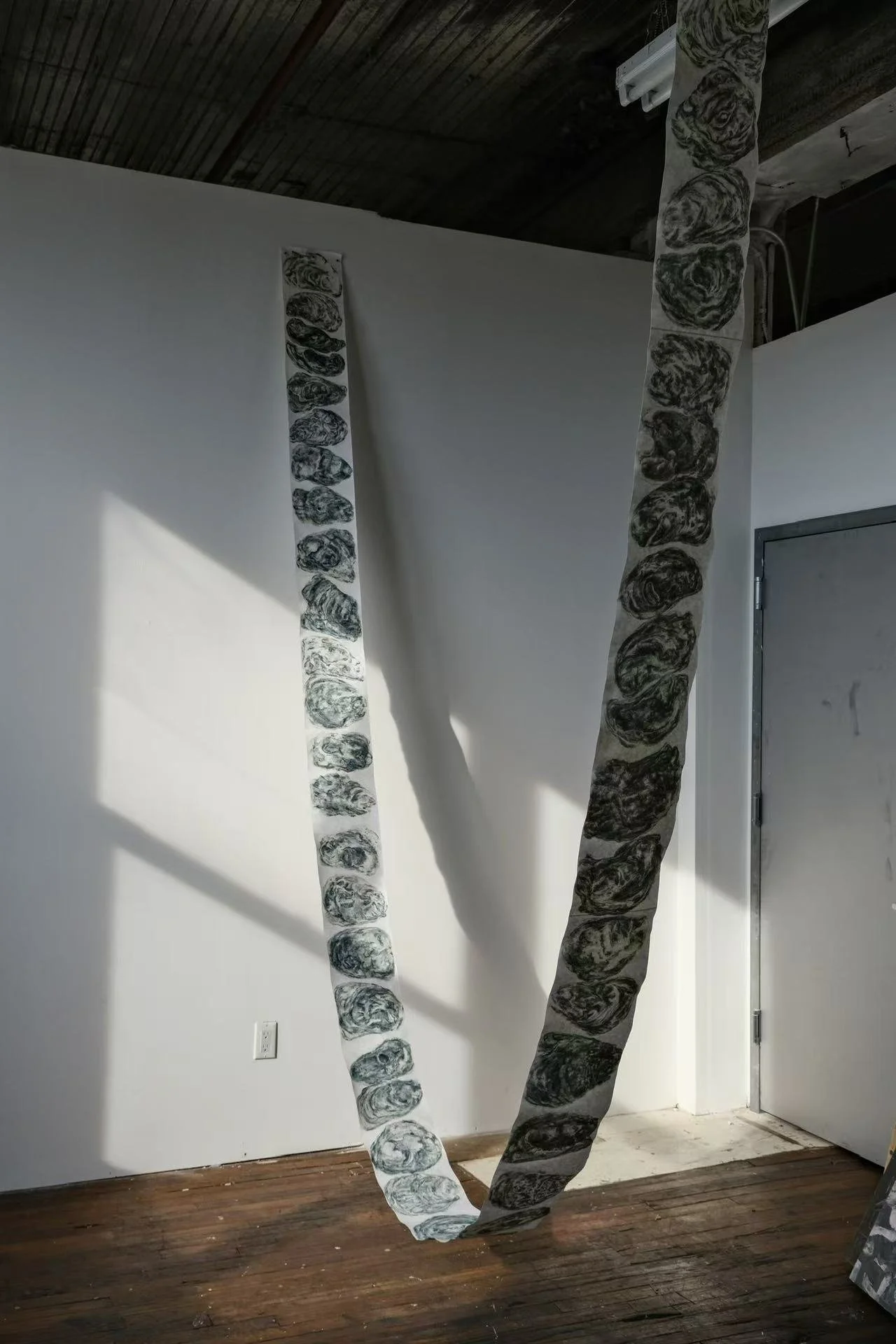
Qin Shen, A Record Of Lingering Touches, 2025.
Monoprinting, Pressure, and Unrepeatable Traces
ArtEchive
Could you talk about Shifting Footprints? What role does it play in your current practice?
Qin SHEN
Shifting Footprints is the first work in my thesis project. It consists of twelve mixed-media monoprints and serves as the foundation of my current practice. The work began as an intuitive and meditative experiment with materials and visual language.
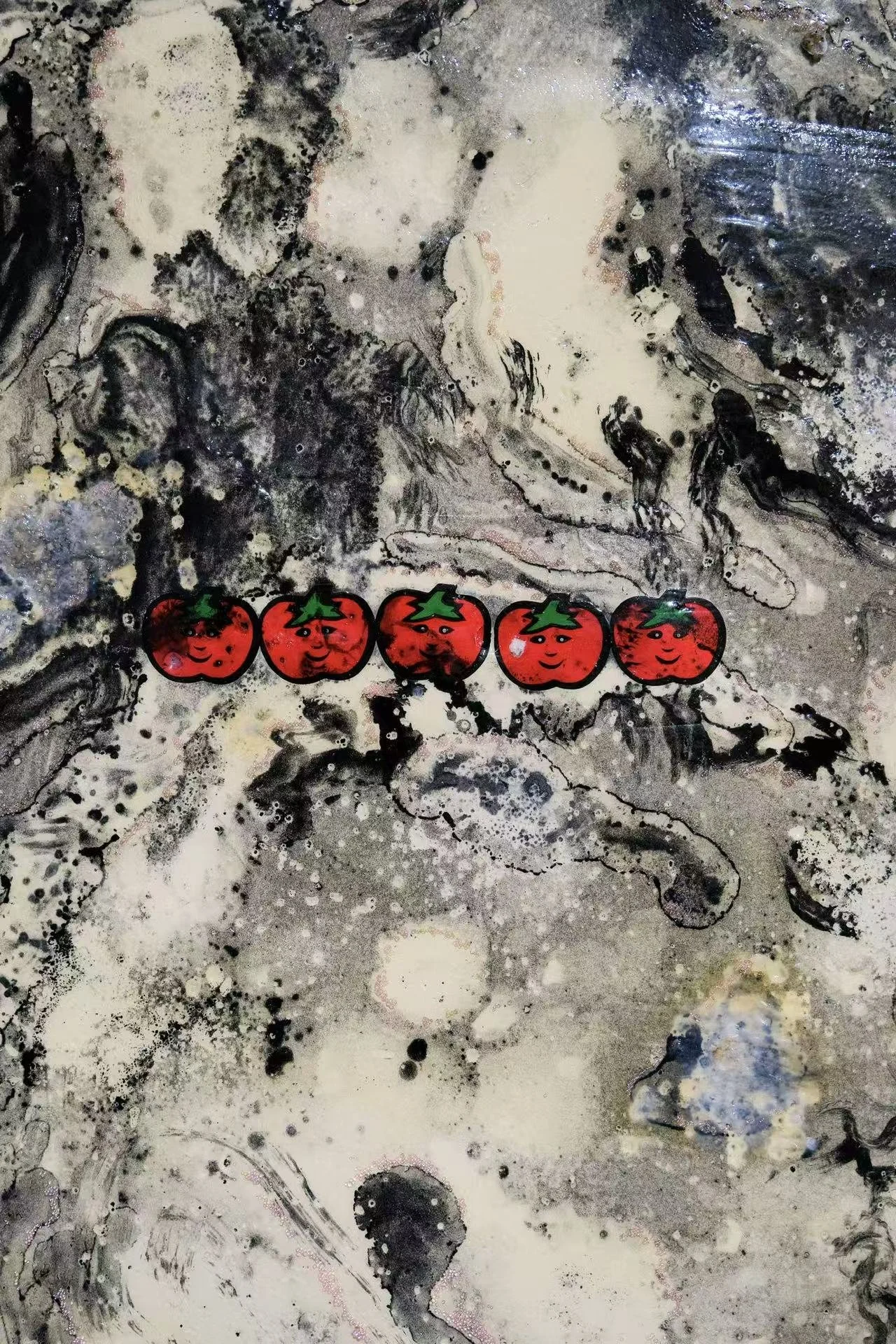
I used materials collected from Rockaway Beach in New York, as well as crop remnants from my grandmother’s farmland in China. These materials connect my present life in New York with my childhood memories in rural China. Through traces, ruins, and remnants, the work explores the passage of time and responds to shifting geological and cultural environments.
The central images in the prints are observational drawings of blackened oyster shells. For me, they are an important visual metaphor within this series. They suggest how time leaves marks on a being or object through layering, pressure, erosion, and disappearance.
ArtEchive
Why did you choose monoprinting as a method?
Qin SHEN
I am especially interested in monoprinting because it is a gesture with meaning embedded in the action itself. Through the pressure of the press machine, every object leaves a mark. Yet each mark is one and only; it can never be fully repeated.
In this process, objects, sites, and memories overlap and erode one another. They form new layers while also peeling away traces that were formed in the past. Particles such as rice and sand are temporarily held in place in the print only by pressure, and this brief suspension carries a strong temporal quality. It makes me think about how experience lives inside our bodies, and how memory keeps changing as it is recalled, processed, and forgotten.
The Sensitive Body and Memory Spaces in Painting
ArtEchive
Your paintings seem to move from external objects toward the body and interior experience. How did this shift happen?
Qin SHEN
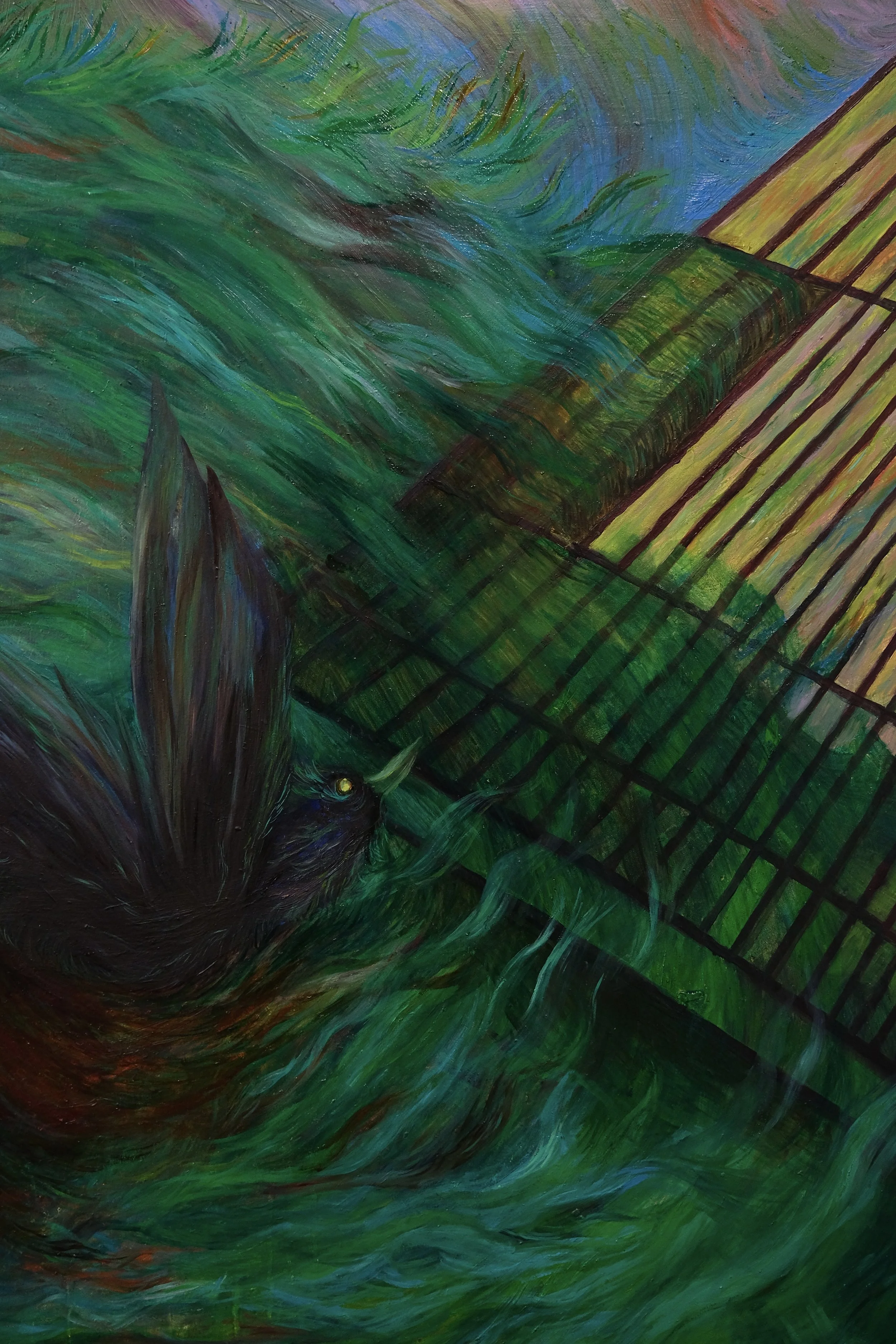
While making observational drawings of oyster shells and practicing meditation, my thoughts often entered a place that felt like a storage room of memory. It was like opening one door after another, searching for overlooked traces. Sometimes I did not know what I was looking for, but I felt a strong urge to investigate, to understand, or to hold onto some kind of certainty.
I then began to paint scenes from memory in oil. Gradually, my attention returned to myself, and I started to observe and feel my own sensitive body.
Since childhood, I have had a complicated fascination with physical pain. When I was in extreme emotional pain, physical sensation sometimes helped me maintain a connection to the real world. After coming to the United States, I developed neurodermatitis. Whenever I was under emotional stress, certain parts of my body would become red and itchy, and scratching would leave red marks. After crying, my eyelids and the sides of my nose would swell, redden, and peel. In anxious moments, even a small, continuous pain could pull me back into reality.
Later, I began to carefully observe and record these parts of my body. I saw them as parts of the body that loved and protected me. I painted them with vivid colors. Each trace became a constellation I had created myself. They are witnesses to the existence of my emotions and feelings, like galaxies that belong to me. I carry these galaxies with me as I continue to explore.
ArtEchive
Your paintings often bring together multiple times and spaces. How do you understand this way of composing images?
Qin SHEN
In my paintings, I often bring together scenes from different times and spaces: interrupted dreams, urban scenes from my life in New York, rural scenes from my childhood in China, and fragments from travel. I re-enter these scenes through similar emotional states and merge them into one image.
There is usually no clear or fixed narrative in my paintings. My own position also shifts. I move from being the person who experienced the event to becoming a third-person observer, almost like a reader of my own story.
The act of painting changes my relationship to my experiences. It allows me to reconsider how the self is layered and formed across constantly changing times and spaces.
I also trace the shadows of objects under sunlight onto the surface of my paintings. When I remember, I am sometimes afraid of falling too deeply into memory again. These acts of tracing become a way of pulling myself back into the present.
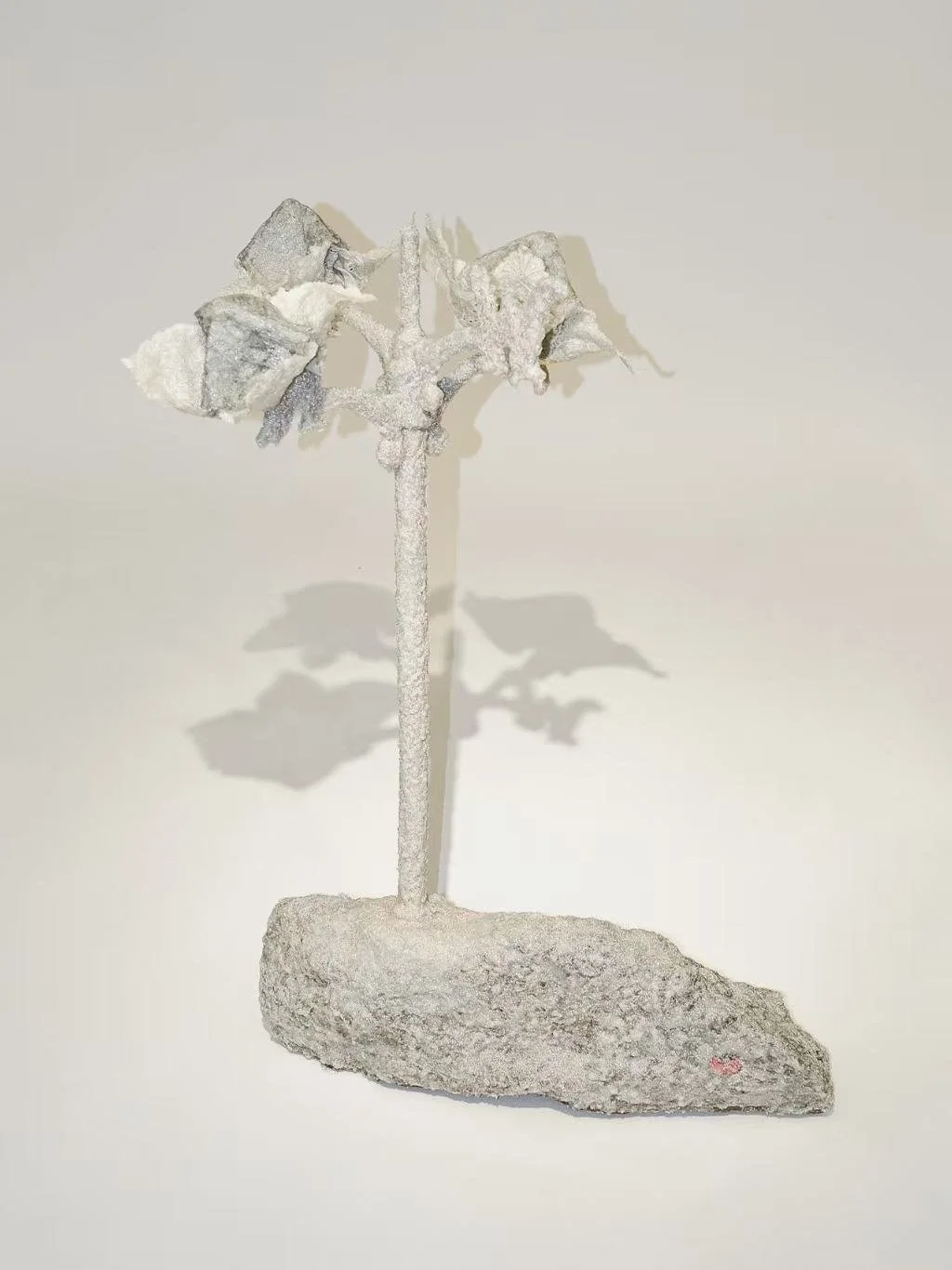
Qin Shen, My Frosted New-York Dream, 2026.
Frost, Sculpture, and a New York Dream
ArtEchive
How do your sculptures continue your thinking about memory, the body, and the self?
Qin SHEN
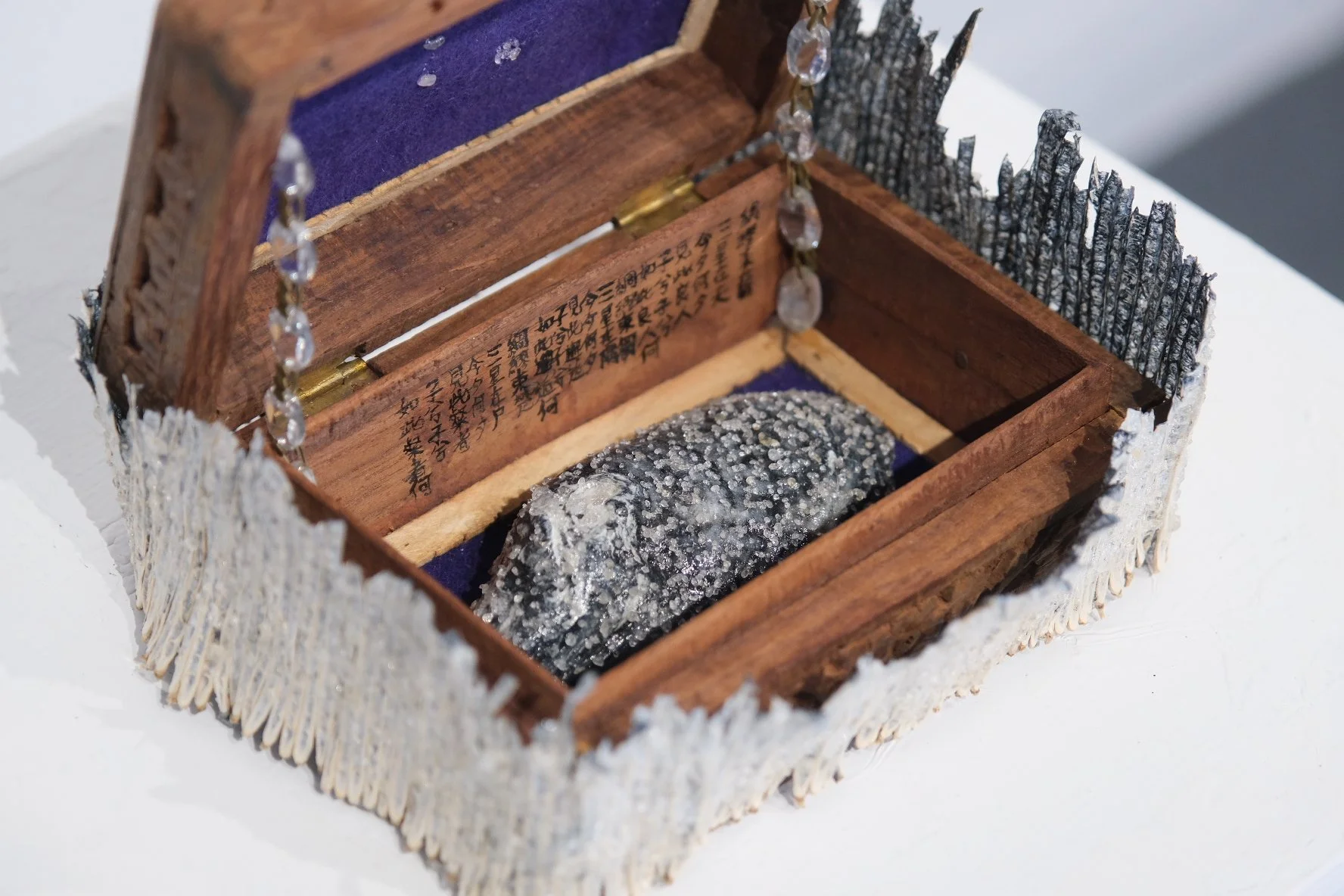
I see my sculptures as embodiments of the self. I create structures that may look dim and soft at first, but become sparkling and radiant under a spotlight. They are usually made from collected objects, then wrapped with glass beads to create a frosted visual effect.
“Frost” is a very important image for me. I grew up around my grandmother’s farmland, and the vegetables after winter frost were my favorite. They always tasted fresh and sweet. I have always felt that the brief, disappearing layer of white frost carried a kind of magic, as if it could turn bitterness into sweetness.
This feeling enters my sculptures. The objects are covered, wrapped, and illuminated, as if they have gone through a transformation. They make me believe that things that are painful, ordinary, or forgotten can also become tender, bright, and continue to exist in another form.
ArtEchive
Could you introduce My Frosted New York Dream?
Qin SHEN
My Frosted New York Dream is a confession of my love for New York. It is connected to my state of mind when I first arrived in the city. At that time, I came to New York with a big dream of becoming a future art star.
In this work, I used found materials from New York, including Manhattan schist, together with handkerchiefs, glass beads, and kindergarten stickers from my childhood. The structure of the work is somewhat like a sailing boat. It brings me back to the memory of how I navigated the city when I first arrived.
At that time, I wandered around and floated through the city, as if I had no real anchor point. When I was young, I often played with fortune tellers because it felt like a casual and relaxed way to make decisions. But my Western dream was never something that could be decided so easily.
When I walked through the streets of New York as a stranger from the East, the crystal sparkles in the city’s bedrock dazzled my eyes. They were like the Western world I had once imagined, where everything shone inside a dream.
This work is both a dream about New York and a work about drifting, desire, migration, and self-projection. It records how I was drawn to the city, and how I searched for my own position between brightness and uncertainty.