
Between Irony and Instinct: In Conversation with ruoyu Gong
Animals, Humor, and Material Detours
Editor’s Note
This interview was conducted in written form. The text has been lightly edited for clarity, while preserving the artist’s original tone and meaning.
On July 4, 2026, ArtEchive held a conversation with artist Ruoyu Gong surrounding painting, animal imagery, humor, material experimentation, and the indirect paths through which artistic language continues to evolve.
The discussion explores how animals become emotional and psychological stand-ins within his paintings, carrying traces of labor, vulnerability, instinct, aggression, and tenderness. Moving through topics such as visual storytelling, irony, discomfort, surface, texture, and chance, the conversation reflects on how Ruoyu Gong approaches painting not as a fixed medium, but as a field of continuous negotiation between image and abstraction, intention and accident, instinct and rationality.
Rather than treating detours as departures from painting, the interview approaches his practice as a process of returning through experimentation. From monotype printmaking and bas-relief sculpture to collage, found materials, coffee grounds, and oil paint, creative practice emerges not as a linear progression, but as a long way around—one that allows the artist to rediscover painting with greater openness, friction, and emotional depth.
interviewee
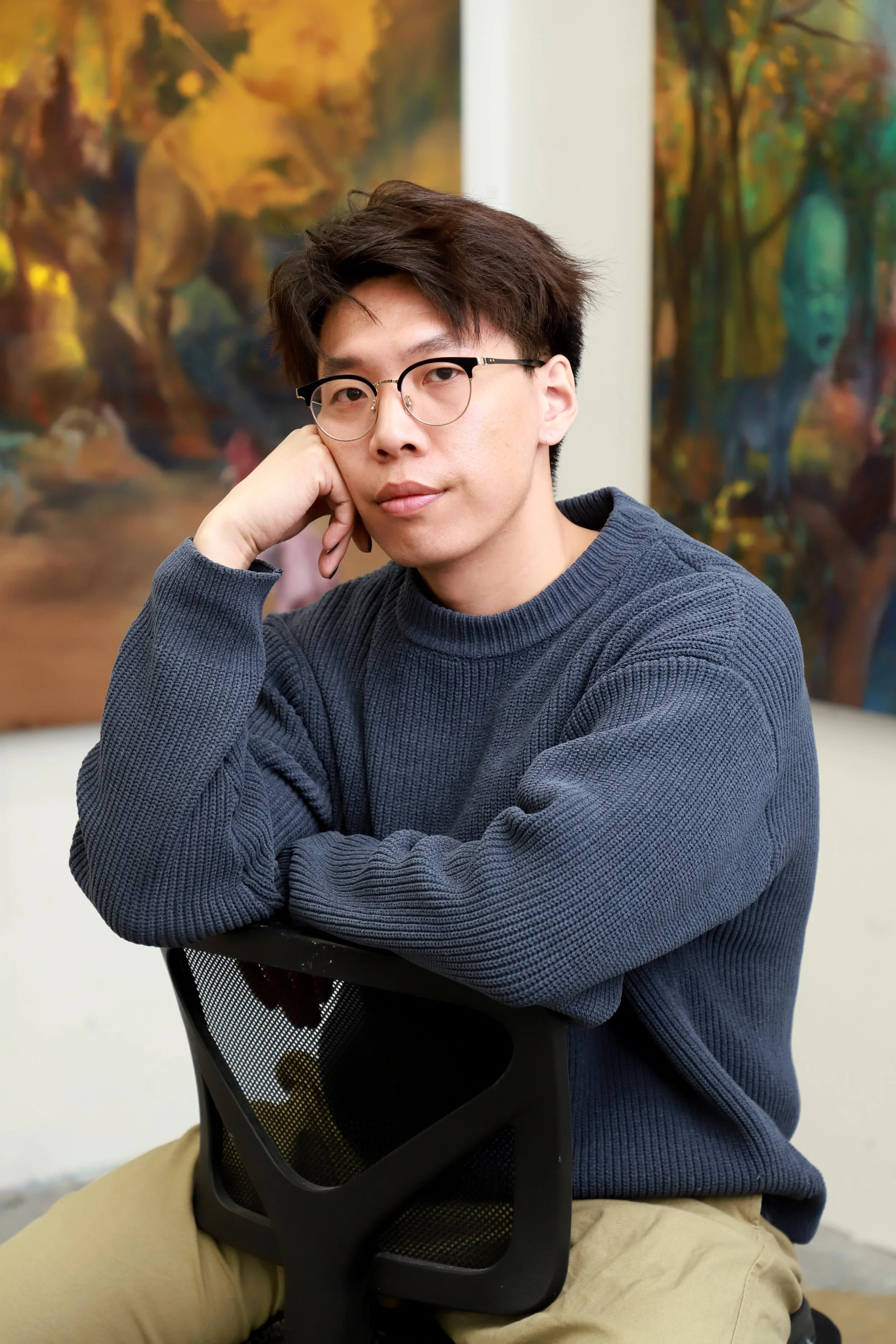
RUoyu Gong
Ruoyu Gong (b. 1999, Beijing, China) is a New York–based artist whose practice centers on oil painting while extending across bas-relief sculpture, monotype, collage, and found objects. In 2025, Gong earned his MFA in Painting at the New York Academy of Art, where he also received the Patron’s Scholar Award. He graduated with honors from the Rhode Island School of Design in 2023 and completed the Advanced Painting Seminar at the Central Academy of Fine Arts in 2021.
Gong’s work has been exhibited internationally, including Long Way Around (solo), Eli Klein Gallery, New York, NY (2026); Affordable Art Fair, Starrett-Lehigh Building, New York, NY (2026); Beneath the Punchline (solo), A Space Gallery, Brooklyn, NY (2025); Let Freedom Bring, Powerhouse Arts, Brooklyn, NY (2025); Tribeca Ball, New York Academy of Art, New York, NY (2024–25); Nascent, Minimalnyc Gallery, Brooklyn, NY (2025); Mirrors and Masks, Asian Art Contemporary, Online (2025); Evolving Identities, Sotheby’s Institute of Art, New York, NY (2024); and the International Contest of Contemporary Art – YICCA 23/24, Matalon Foundation, Milan, Italy (2024), where he won First Place.
His work has been featured in numerous publications, including Whitehot Maga- zine (2026), Harper’s Bazaar Art (BAZAAR ART) New Art column (2025), Robb Report Magazine (2025), Modern Renaissance Magazine (Issue #26), Al-Tiba9 Art Magazine (Issue #18), Divide Magazine (Issue #13), Art China, Art Review Magazine, and Artist Talk Magazine (Issue #36).
Gong’s recent awards include the Emerging Artist Award from The 5th Youth in the New Era — Contemporary Emerging Artists Nomination Exhibition (2025), First Place in Mirrors and Masks International Juried Exhibition (2025), the Patron’s Scholar Award (2024–25), and First Place in YICCA 23/24 (2023–24).
From Illustration to Painting
ArtEchive
You studied illustration at RISD before earning your MFA in Painting at the New York Academy of Art. How did you move from illustration into painting? Was this transition more about medium, narrative, or the way you wanted images to function?
Ruoyu GONG
It's interesting because my path wasn't really a transition from illustration to painting. When I was at RISD, I actually entered as a Painting major and only switched to Illustration during my sophomore year. Even after changing majors, I continued to work almost exclusively in oil painting and remained primarily interested in painting as a fine art practice rather than commercial illustration.
For me, the Illustration department offered something that I was looking for at the time: a strong emphasis on visual storytelling and technical problem-solving. I wanted to understand how to construct compelling images and communicate ideas visually, and that environment gave me a solid foundation.
Pursuing an MFA in Painting at the New York Academy of Art felt like a natural continuation rather than a change in direction. What shifted wasn't so much the medium as the focus of my practice. During my undergraduate years, I was mainly concerned with how to tell stories through images. In graduate school, I began combining that foundation with a much more personal artistic voice. My work became less about simply constructing narratives and more about exploring my own experiences, emotions, and questions through painting. That also led me to think more deeply about the possibilities of the medium itself, the role of narrative, and how I wanted my images to function beyond storytelling.
ArtEchive
Your practice centers on oil painting, but also extends into bas-relief sculpture, monotype, collage, and found objects. How do these different forms influence your painting practice?
Ruoyu GONG
My exploration of different materials really began during my senior year at RISD, when I started using monotype printmaking as a starting point for my oil paintings. At the time, I wanted to break away from a more linear and predictable way of constructing images. Monotype is fast, spontaneous, and full of chance, so it introduced a level of unpredictability that I wanted to bring into my painting process.
Back then, my practice was still entirely two-dimensional. During the second year of my MFA, however, I took a bas-relief sculpture course. By that point, I felt I had developed a certain muscle memory with oil painting, so I deliberately chose to work with a material I knew almost nothing about. Learning sculpture forced me to think differently about form, space, and the act of making.
For me, working across different media has never been about leaving painting behind. It's really about defamiliarizing myself from painting—stepping outside of my habitual ways of thinking so I can activate a different creative instinct. Then, when I return to the canvas, I can approach it with a renewed sense of curiosity and freshness instead of relying on habit.
In fact, over the past year I've returned to painting as my primary medium, and I can still feel the impact of those experiences. The ways of thinking I developed through printmaking, sculpture, collage, and other materials continue to shape how I approach painting today.
Animals, Characters, and Emotional Projection
ArtEchive
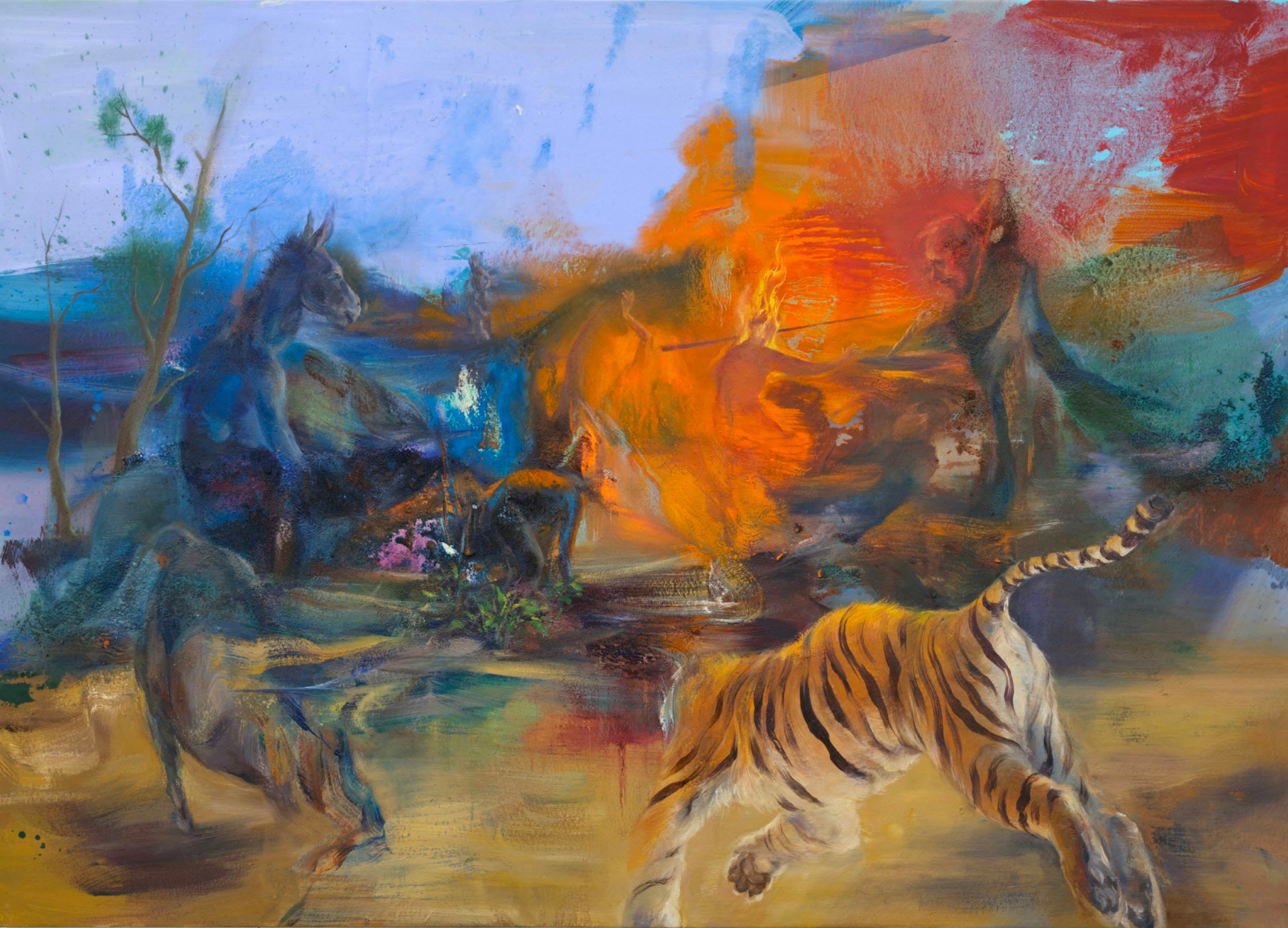
Animals appear frequently in your recent works, including tigers, peacocks, donkeys, cheetahs, birds, and roosters. What first drew you to animal imagery?
Ruoyu GONG
Animals became a recurring motif in my work gradually rather than intentionally. For a little over two years, I was primarily focused on the image of the donkey. That body of work was inspired by a traditional Chinese xiangsheng (comic dialogue), in which a donkey wears a bell while pulling a millstone. As long as the bell keeps ringing, the farmer knows the donkey is working. If the bell stops, the donkey is punished until it starts moving again. I was drawn to that image because it became a metaphor for labor, productivity, and the pressure to keep working, which resonated with my own experience as an artist.
Over time, however, I didn't want to limit myself to a single symbol or become known simply as "the artist who paints donkeys." As my work evolved, I became interested in a broader range of animals. Each one carries its own instincts, physical presence, and cultural associations, which gives me different ways of approaching ideas and emotions. Expanding beyond the donkey allowed my visual language to grow while still staying connected to the themes that have always interested me.
ArtEchive
In your paintings, animals often feel like characters, symbols, and emotional projections at the same time. How do you understand their role in your work?
Ruoyu GONG
I think animals allow me to approach the human condition a little more indirectly. When I paint the human figure, there's always a certain responsibility to describing a specific person, so my brushwork and my thinking can become more restrained. With animals, I feel much freer. They naturally exist somewhere between reality and metaphor.
I'm less interested in depicting animals as subjects in themselves than in using them as emotional or psychological stand-ins. Their movements, instincts, conflicts, and moments of vulnerability often mirror aspects of human behavior. Because they aren't tied to a specific individual, viewers can project themselves into them more easily.
In that sense, the animals in my paintings function simultaneously as characters, symbols, and emotional projections. They're not illustrations of particular stories. Instead, they create a space where human emotions—fear, desire, aggression, resilience, tenderness—can be experienced in a more universal and open-ended way.
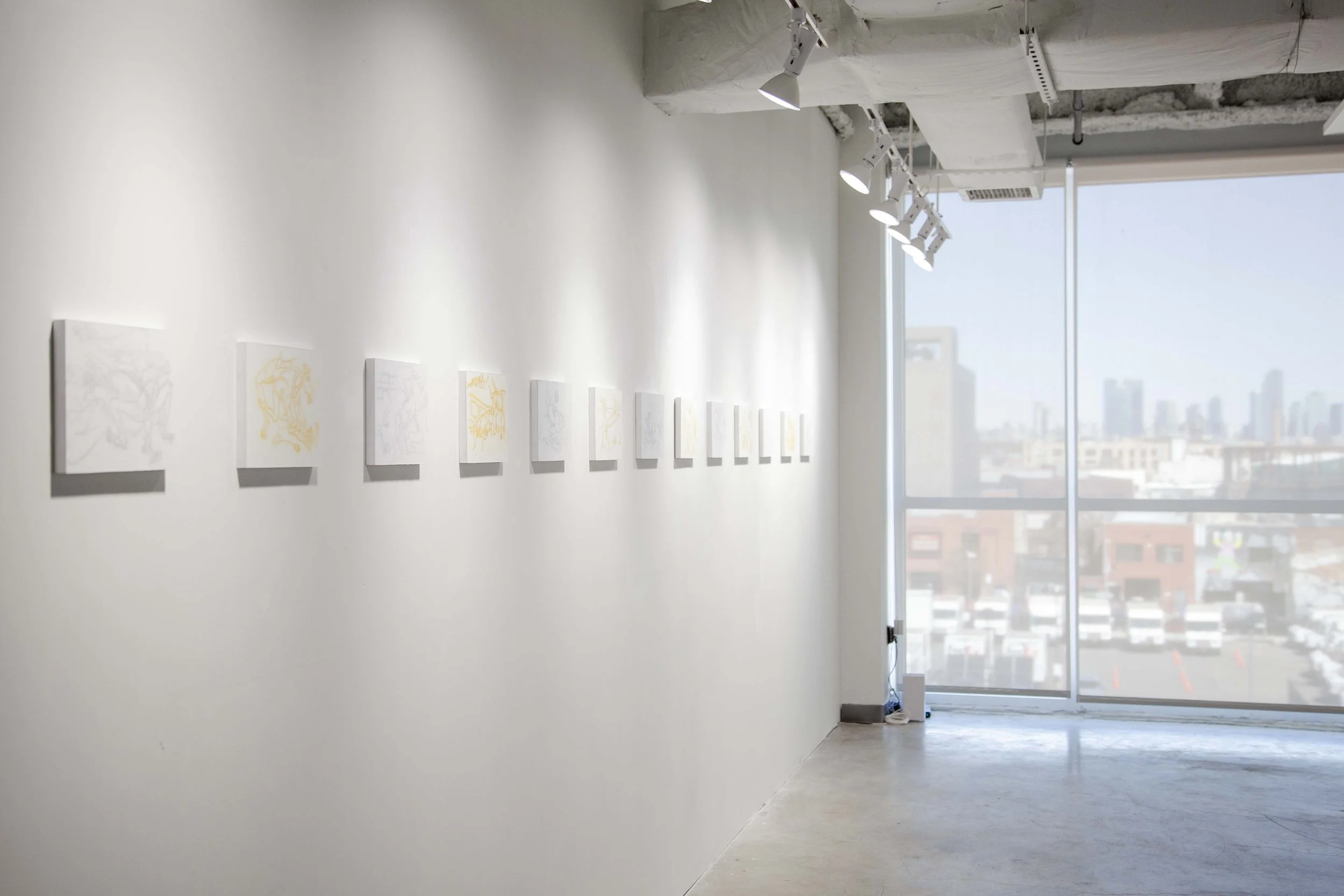
Installation view of Beneath the Punchline, courtesy of the artist and A Space Gallery.
Humor, Discomfort, and the Punchline
ArtEchive
Your 2025 solo exhibition was titled Beneath the Punchline. What does humor mean in your work? Is it a way to soften discomfort, or a way to reveal something deeper?
Ruoyu GONG
I think it's both. Humor can soften discomfort, but it can also reveal something that might otherwise be difficult to confront.
I've always been drawn to humor in art, especially the tradition of Chinese xiangsheng (comic dialogue). I listen to it while I'm working, so I think its rhythm and way of thinking have naturally found their way into my practice and even into the way I speak.
What interests me most, though, isn't humor in general—it's irony. Irony never states something directly. Instead, it creates a distance between what's being shown and what it actually means, inviting viewers to look beneath the surface. That's where I find it most powerful.
In my work, humor isn't there simply to make people laugh. It's a way of reconciling discomfort and creating an entry point into more complicated emotions. Sometimes laughter lowers our defenses, allowing us to recognize aspects of ourselves that we might otherwise avoid. In that sense, humor becomes a way of pointing toward a deeper reality rather than distracting us from it.
Material, Surface, and Image Formation
ArtEchive
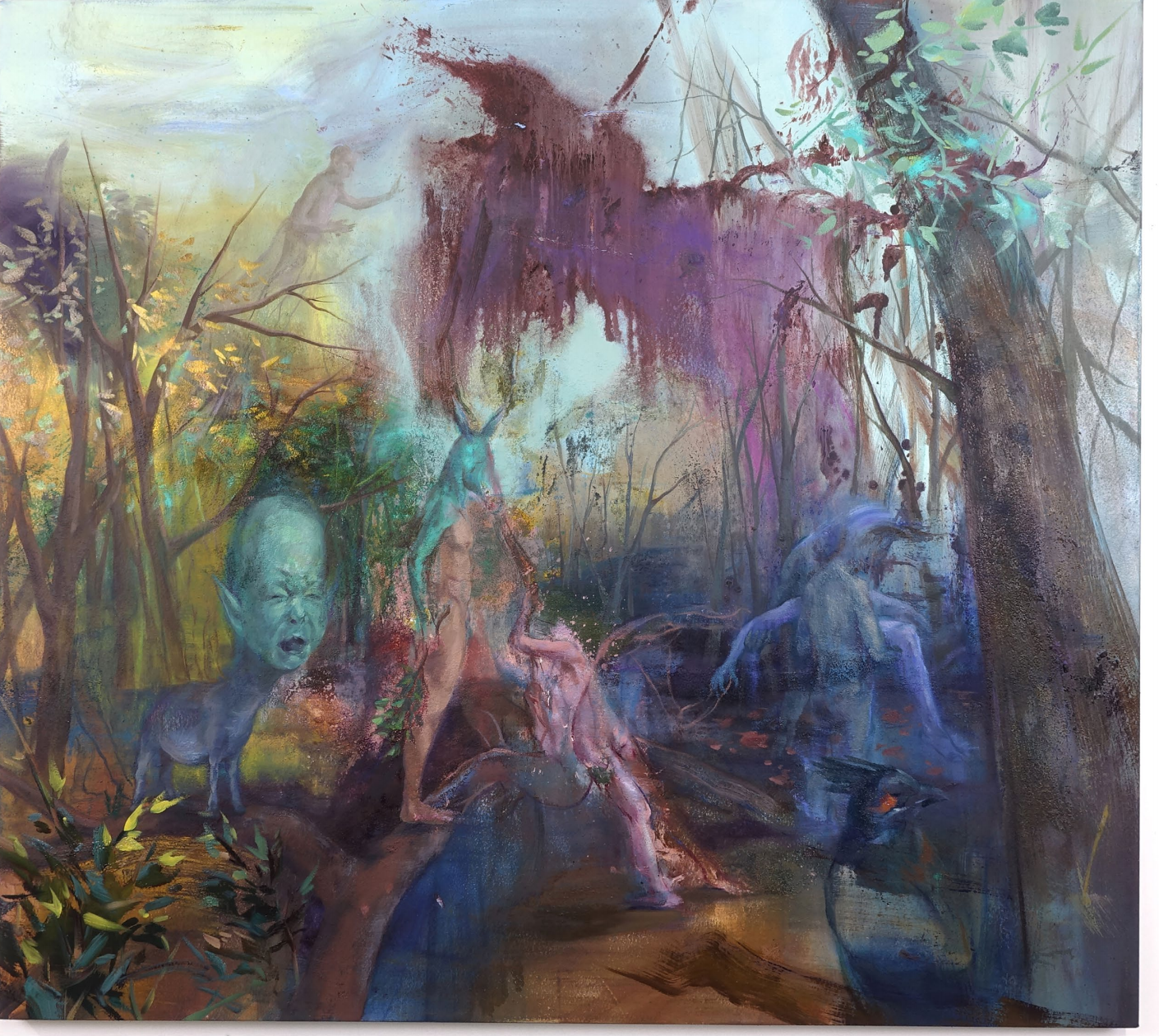
Many of your recent works use oil, coffee grounds, and oil pastel on canvas. What led you to introduce coffee grounds into the painting surface?
Ruoyu GONG
Introducing coffee grounds into my paintings actually came out of experimentation. After graduating, I started working in my own studio, where I had more space and more freedom to experiment with different materials and surfaces. I became interested in seeing what would happen if I mixed unexpected materials into oil paint.
I'm also a heavy coffee drinker, so one day I decided to recycle some used coffee grounds and mix them into the paint. At first, it was simply an experiment, but I quickly realized that I really liked the effect.
What interests me most isn't the symbolic meaning of coffee. It's the physical quality it brings to the painting. The coffee grounds create a rough, textured surface that introduces friction into the process. Instead of the brush moving smoothly across the canvas, I have to respond to the resistance of the material.
That resistance often changes the direction of the painting. Sometimes I begin with a very specific intention, but the uneven surface interrupts that plan. Parts of an image might disappear, become fragmented, or transform into something unexpected. Rather than fighting against those accidents, I try to work with them. In the end, the painting often becomes more open, more surprising, and compositionally richer than if I had simply executed my original idea.
ArtEchive
Your paintings often move between recognizable figures and abstract atmospheres. How do you decide how much of an image should remain visible, and how much should dissolve into color, texture, or gesture?
Ruoyu GONG
My paintings almost always begin in a very abstract and spontaneous way. At first, there's no intention to paint a specific figure or scene. I'm simply responding to color, gesture, texture, and the movement of paint. Gradually, recognizable forms begin to emerge from that abstraction, and that's usually where the painting starts to reveal its direction.
From that point on, the process becomes a constant negotiation between instinct and rationality. One part of me wants to preserve the raw energy and ambiguity of the abstract surface, while another part wants to develop recognizable forms and create a sense of structure or narrative. The painting moves back and forth between those two impulses throughout the entire process.
I usually know a painting is finished when it reaches a kind of equilibrium. There's enough information for the viewer to enter the image, but enough ambiguity for them to continue discovering things on their own. I'm always looking for a sense of theatricality, where something feels as though it's unfolding before you, but never becomes completely fixed or fully explained. That balance between revelation and concealment is what ultimately determines how much of the image remains visible and how much dissolves back into color, texture, and gesture.
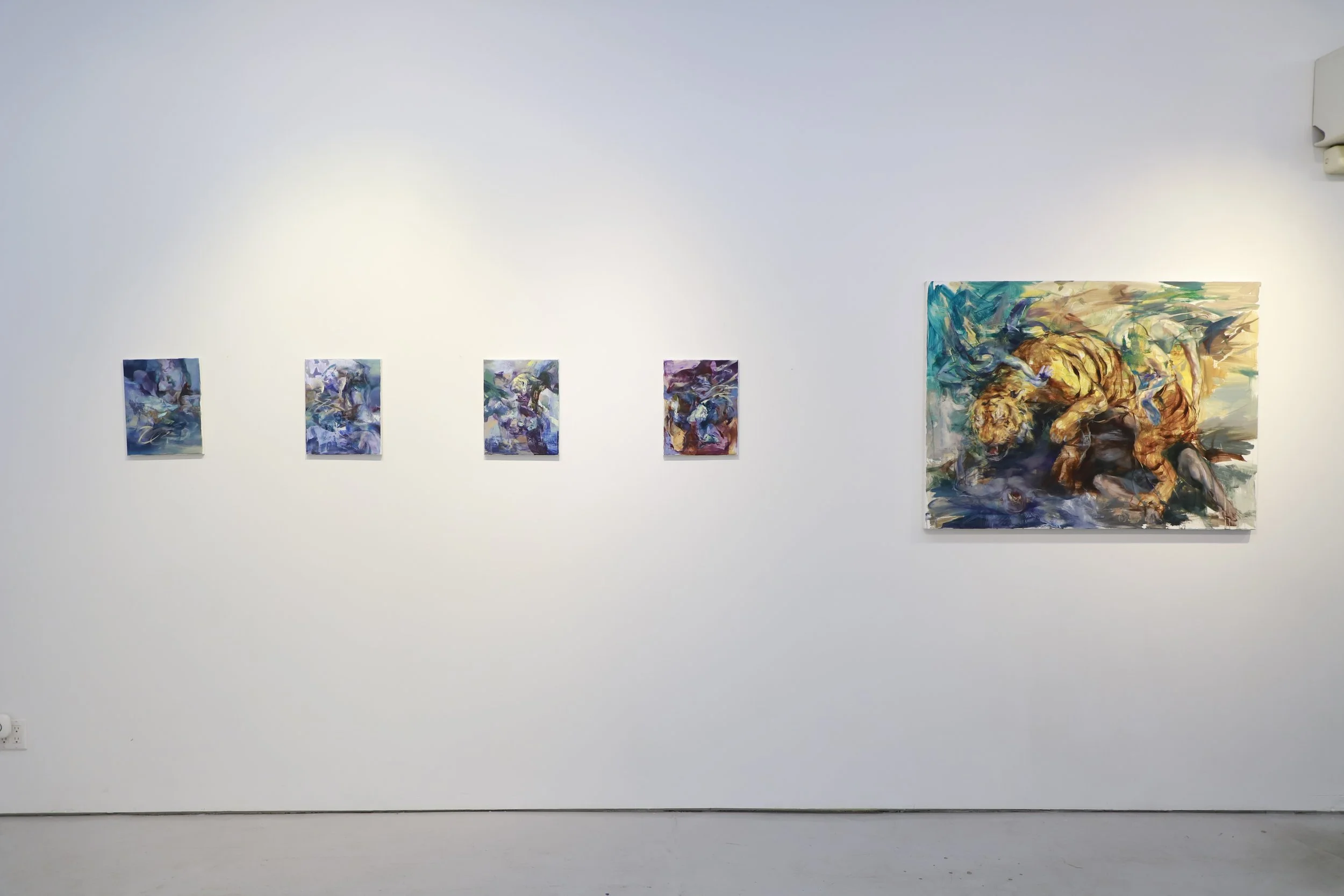
Detour, Memory, and Future Directions
ArtEchive
The title of your 2026 solo exhibition, Long Way Around, suggests detour, delay, and indirect arrival. How does this idea relate to your recent body of work?
Ruoyu GONG
Long Way Around was a pivotal exhibition for me because it brought together the different directions my practice had taken over the previous three years in New York. It included monotypes, bas-relief sculptures, and paintings, so it really documented a period of experimentation and exploration.
The title reflects the realization that all of those detours ultimately led me back to oil painting. In a sense, I returned to the medium I had always loved, but I came back with a completely different perspective. The journey through printmaking, sculpture, and other materials changed the way I think about painting, even though painting remains at the center of my practice today.
Looking back, I don't see those experiments as distractions from painting. They were necessary. Without stepping away from my familiar habits, I don't think I would have understood what matters most to me as a painter. Through those experiences, I discovered that materiality, spontaneity, and a willingness to embrace uncertainty are fundamental to the way I want to work.
So Long Way Around isn't really about taking a wrong turn. It's about recognizing that sometimes the indirect path is the one that teaches you the most. In the end, I arrived back where I started, but with a much clearer understanding of why I paint and how I want to paint.
ArtEchive
Looking ahead, what questions or directions do you want to continue exploring in your studio?
Ruoyu GONG
Looking ahead, the question I'm always asking myself is how to make the work more compelling—both visually and emotionally. I want the paintings to become richer as images while also communicating my ideas with greater clarity and depth. That's an ongoing challenge, and I think every new body of work is another attempt to get a little closer.
I'm also very interested in working on a much larger scale. Most of my recent work has been moving in that direction, and I'd eventually love to create monumental paintings or even murals. Working at that scale presents a completely different set of technical challenges. It requires a much deeper understanding of materials, structure, and how a painting unfolds across a large surface.
What excites me most is the possibility that scale can fundamentally change the viewer's experience. Larger paintings allow me to create more immersive spaces, incorporate more complex relationships between forms, and build a stronger sense of emotional and psychological presence. I hope to continue developing the themes I'm already exploring, but on a scale that allows them to become even more expansive and resonant.