
Lingering Prayers: In Conversation with I Chin Sung
Loss, Memory, and Spiritual Practice
Editor’s Note
This interview is based on a live conversation. The text has been lightly edited for clarity, while preserving the speaker’s original tone and meaning.
On May 31, 2026, ArtEchive held a conversation with artist I Chin Sung surrounding loss, prayer, memory, and the emotional processes embedded within painting and artistic practice.
The discussion explores how experiences of separation, longing, spiritual rituals, and personal healing gradually enter the artist’s work. Moving through topics such as grief, religion, handwritten texts, temple culture, and emotional transformation, the conversation reflects on how painting can function as a space for processing memories that resist closure and emotions that remain difficult to articulate directly.
Rather than treating art-making as a process of resolution, the interview approaches painting as a form of coexistence with uncertainty, absence, and emotional residue. Throughout the conversation, creative practice emerges not simply as a means of expression, but as a quiet spiritual exercise—one that allows memory, loss, and hope to remain present while slowly taking on new forms.
interviewee
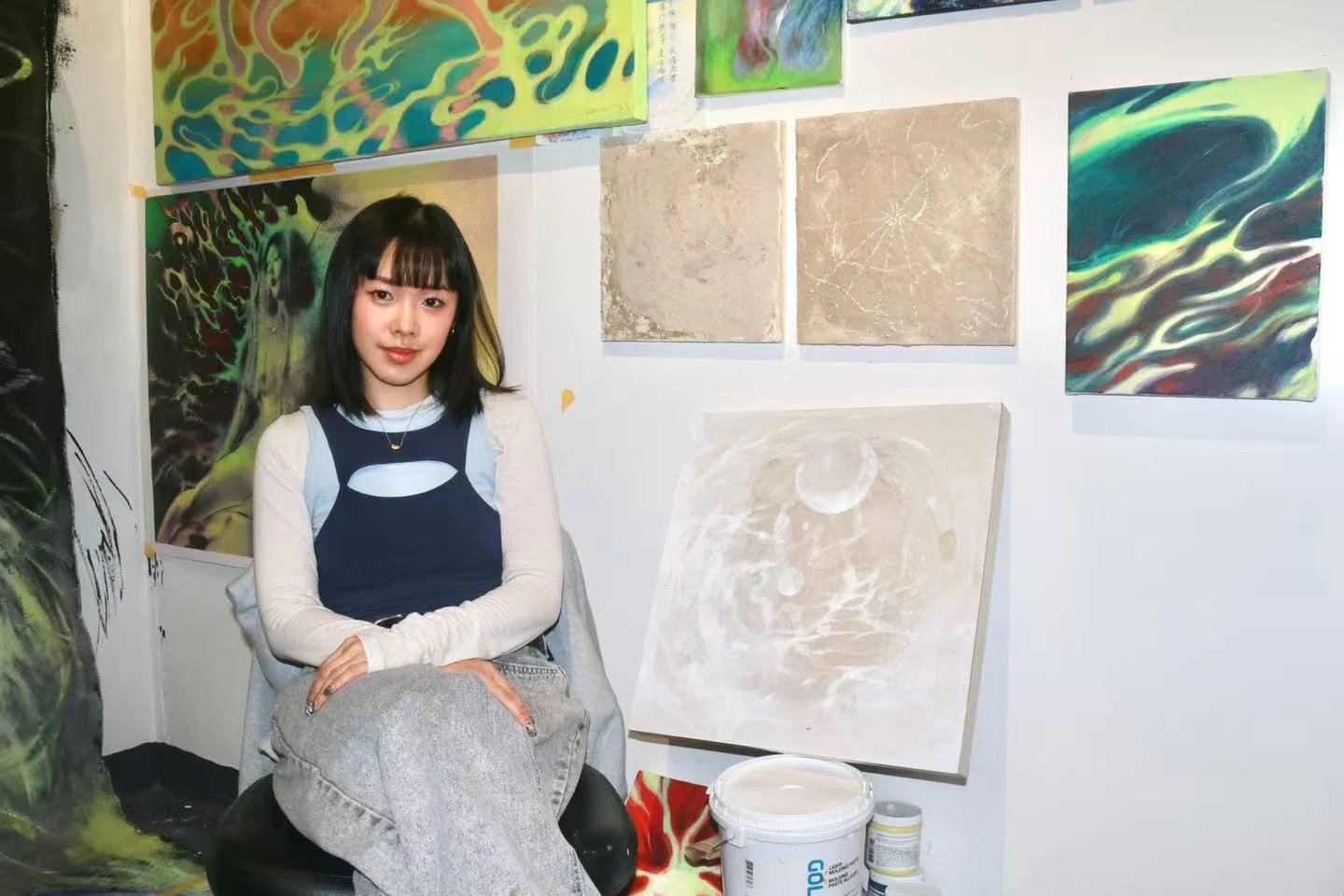
I Chin Sung is an artist, illustrator, and graphic designer born in Taipei, Taiwan, and currently residing in New York. Her work primarily consists of oil paintings, but she also explores various other creative media, including sculpture, installation, and video. Her creations are inspired by her life experiences in Taiwan, as well as the religious cultures of Buddhism and Taoism. Through her art, she aims to convey cultural themes while allowing the audience to experience a sense of healing.
I Chin earned a bachelor's degree in fashion design from Taipei Shih Chien University in 2020. Her fashion designs have been showcased on the runway at Songshan Cultural and Creative Park and exhibited in the Young Designers' Exhibition (YODEX) and The Arts of Fashion Foundation in San Francisco. While studying fashion design, she also taught painting at Meihouse Art Studio. After graduating, she took on graphic design projects. In 2021, she served as a graphic designer for the For1Dream International Cultural Corporation and Pronovias Taiwan.
In 2024, I Chin enrolled in the School of Visual Arts in New York, where she is currently pursuing a Master of Fine Arts degree and is expected to graduate in 2026.
I Chin SUNG
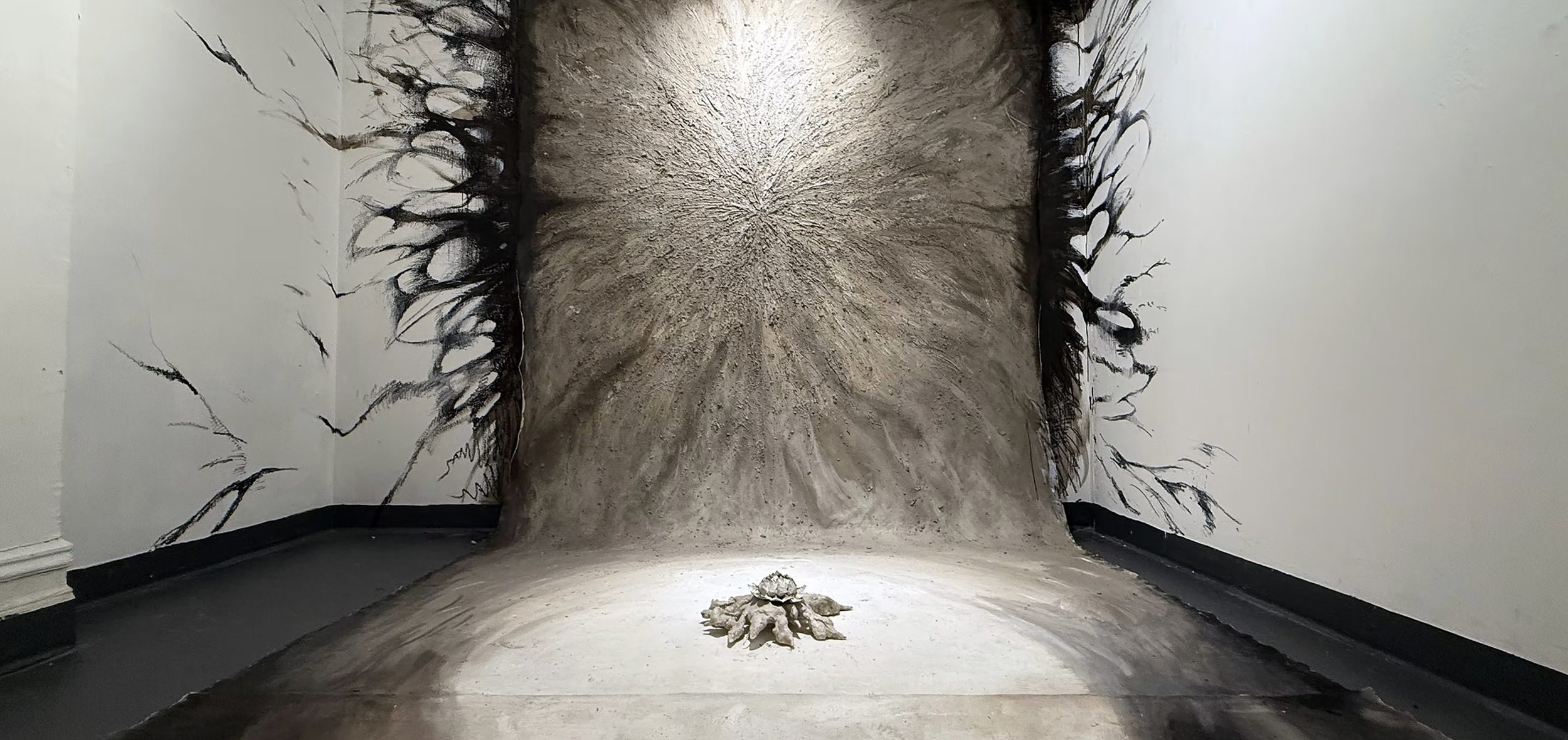
Memory, Loss, and What Remains
ArtEchive
I feel that your work is consistently engaged with the idea of loss, but not in a dramatic or overt way. Instead, it feels more like an emotion that has slowly settled over time—sometimes through the end of a relationship, sometimes through the distance created by time itself. I’m curious whether you see your practice as a way of preserving these memories, or as an attempt to say goodbye to them.
I Chin SUNG
For me, it is both.
The figures in my paintings are dedicated to people I can no longer meet in this lifetime. Some are family members who have passed away, while others emerge from past relationships that have ended but remain difficult to let go of.
Initially, my motivation for making these works came from a desire to understand why it can be so difficult to release attachment. I began using art as a way to document and examine those emotions. Perhaps I am simply someone who forms deep attachments—so even when I try to pour everything onto the surface of a painting, as if throwing all of those feelings like a bomb into the work, some part of them still remains.
Over time, however, the works have become something like a recording device. They preserve the voices, memories, and emotions that continue to resonate within me. In that sense, the process is not only about holding on, but also about saying goodbye to a previous version of myself.
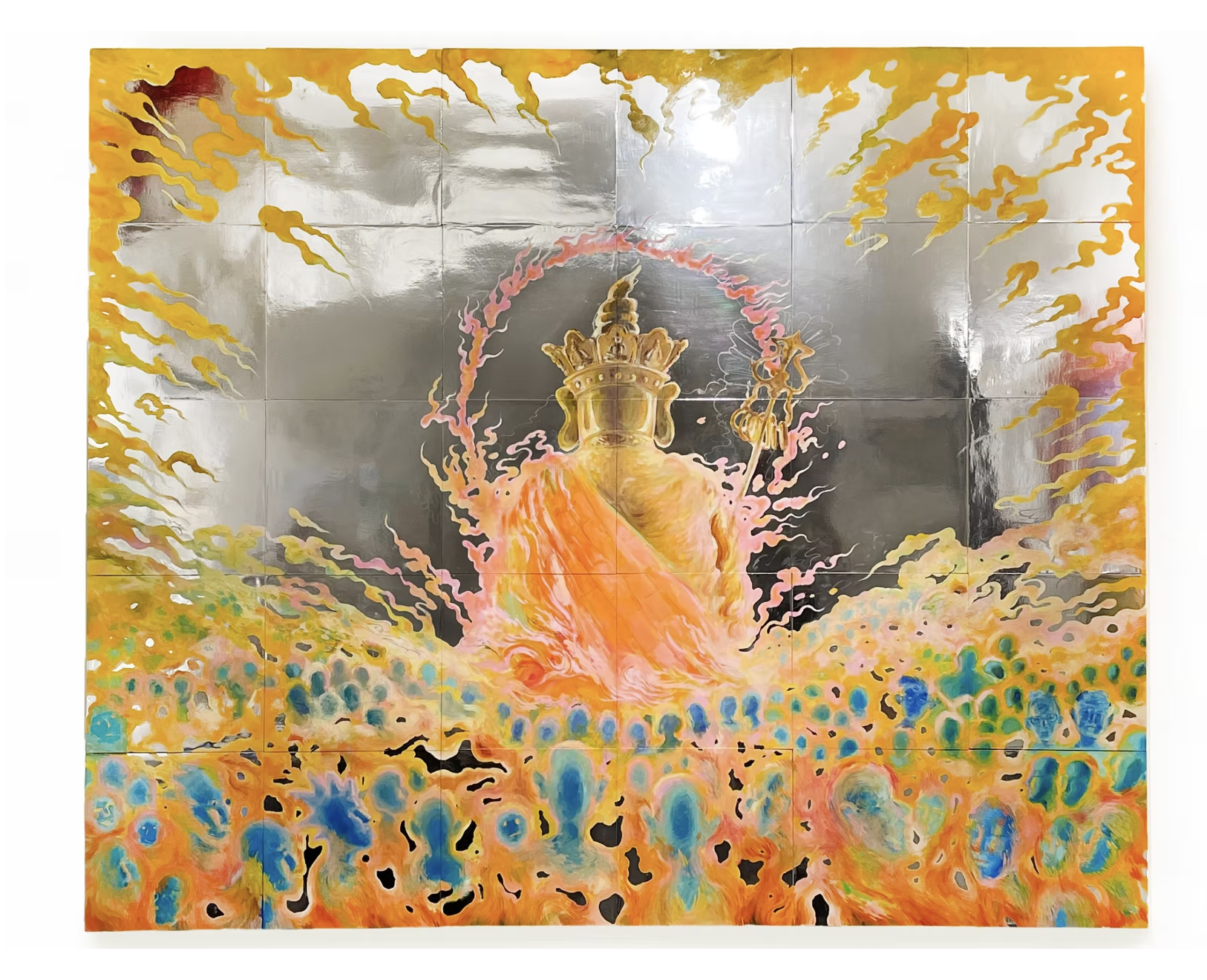
Prayer, Ritual, and Spiritual Experience
ArtEchive
Your work often incorporates elements such as prayers, incense ash, handwritten notes, and experiences related to temples and religious rituals. Yet I feel that what you are exploring is not simply religion itself, but a human desire to seek comfort, meaning, or a response during moments of vulnerability. I’m curious how you first developed a connection to these spiritual experiences, and what role they play in your life today.
I Chin SUNG
My connection to these spiritual experiences began with family memories.
When I was growing up, I often accompanied my family to funerals and Buddhist chanting ceremonies held for deceased relatives. I spent a great deal of time in temples because of this. For my father especially, honoring my grandparents after their deaths was extremely important. Beyond traditional occasions such as Tomb-Sweeping Day, we would also visit temples on their birthdays and death anniversaries to make offerings and pray.
To be honest, there was a period when I found these rituals repetitive and even frustrating. But as I grew older and experienced loss myself, I gradually began to understand why my father was so devoted to them.
Looking back now, I realize that these rituals were never only about religion. They were acts of remembrance, care, and continued connection. The memories of participating in them with my family have profoundly shaped both my understanding of grief and my artistic practice today.
ArtEchive
Many of your works make me think of the act of prayer—not because they directly depict religion, but because they seem to carry wishes, longing, or a sense of reaching toward someone who is no longer accessible. When you create, do you ever feel that you are speaking to someone? Is it your past self, someone who has left, or perhaps a presence that cannot be fully named?
I Chin SUNG
Yes. I often feel that, during the process of making work, I am unintentionally forming a kind of mental or emotional connection with my deceased family members. At the same time, there are also people I can no longer meet in this lifetime. In a way, the act of creating becomes a space where these relationships are still able to exist, not in a physical sense, but as a form of presence or dialogue that cannot be fully named.
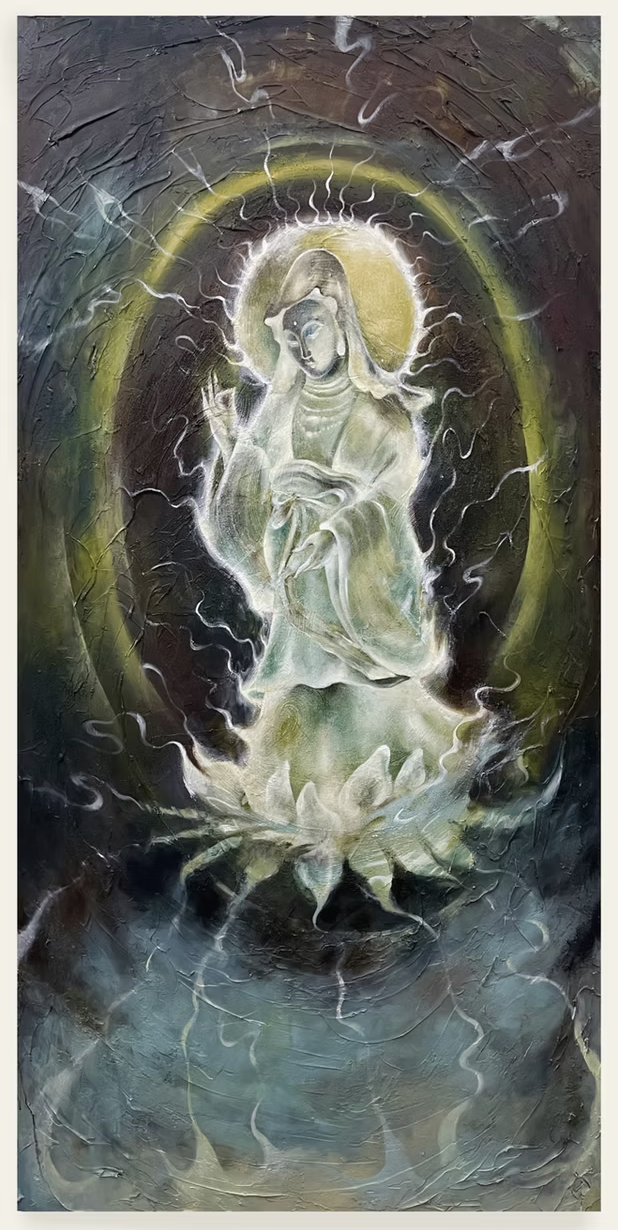
I Chin SUNG, Grandma's Word (Avalokitesvara), 2025, oil on canvas, glass bead gel, 24 x 48 in.
Painting as Healing, Painting as Practice
ArtEchive
I’ve seen you describe art-making as a healing process. At the same time, I wonder whether making art truly heals a wound, or whether some emotions never completely disappear and instead gradually become part of the work itself.
I Chin SUNG
I also used to think that making art would be healing in a straightforward way, but I’ve realized it’s actually quite painful most of the time.
I think it really depends on the subject matter I’m working with. For me, art-making does help me slow down, reflect, and enter a more meditative state, but it doesn’t make emotional wounds disappear. So rather than thinking of it as self-healing, I see the process more as a kind of mirror. Through making work, I continuously project and examine my current emotional state.
In that sense, the artwork becomes like a set of notes, a recording of how I was feeling at a specific moment, rather than something that resolves or erases those feelings.
ArtEchive
Looking back now, from experiencing loss, to returning to painting, to gradually building your artistic practice, do you feel that these works have ultimately changed your relationship to those memories? Or have they simply helped you learn how to live alongside them?
I Chin SUNG
Yes. I think this journey of making work has gradually taught me how to face my inner world more directly. It has also made me aware that everything in life is in a constant state of change and transformation. Rather than trying to fix or resolve emotions completely, I have come to understand the importance of learning to live alongside them. When I am less attached to gain and loss, or to external shifts, there is a moment where internal restlessness becomes quieter. To me, my practice is not only about expressing these experiences, but also about reflecting this ongoing shift in perception.