
How Roots Grow: Body, Queerness, and Spirituality in Unfolding Roots
Shuhan Zhang
I have always found the idea of “roots” slightly contradictory. When I was younger, roots seemed to promise certainty: where you come from, where you belong, where your family, culture, and identity begin. It was easy to imagine that, if we followed them far enough downward, we would eventually arrive at a stable and recognizable point of origin. Growing older has made that image more complicated. Once a person leaves a familiar city and begins living across different languages, cultures, and relationships, can there still be a complete origin to return to? Do the memories, bodily experiences, family stories, intuitions, and emotions that shape us remain in the past, or do they continue to grow through the body in the present? This is why the part of the title Unfolding Roots that stays with me most is “unfolding.” Here, roots possess a life of their own. They move, extend, encounter other things, and acquire new directions through change.
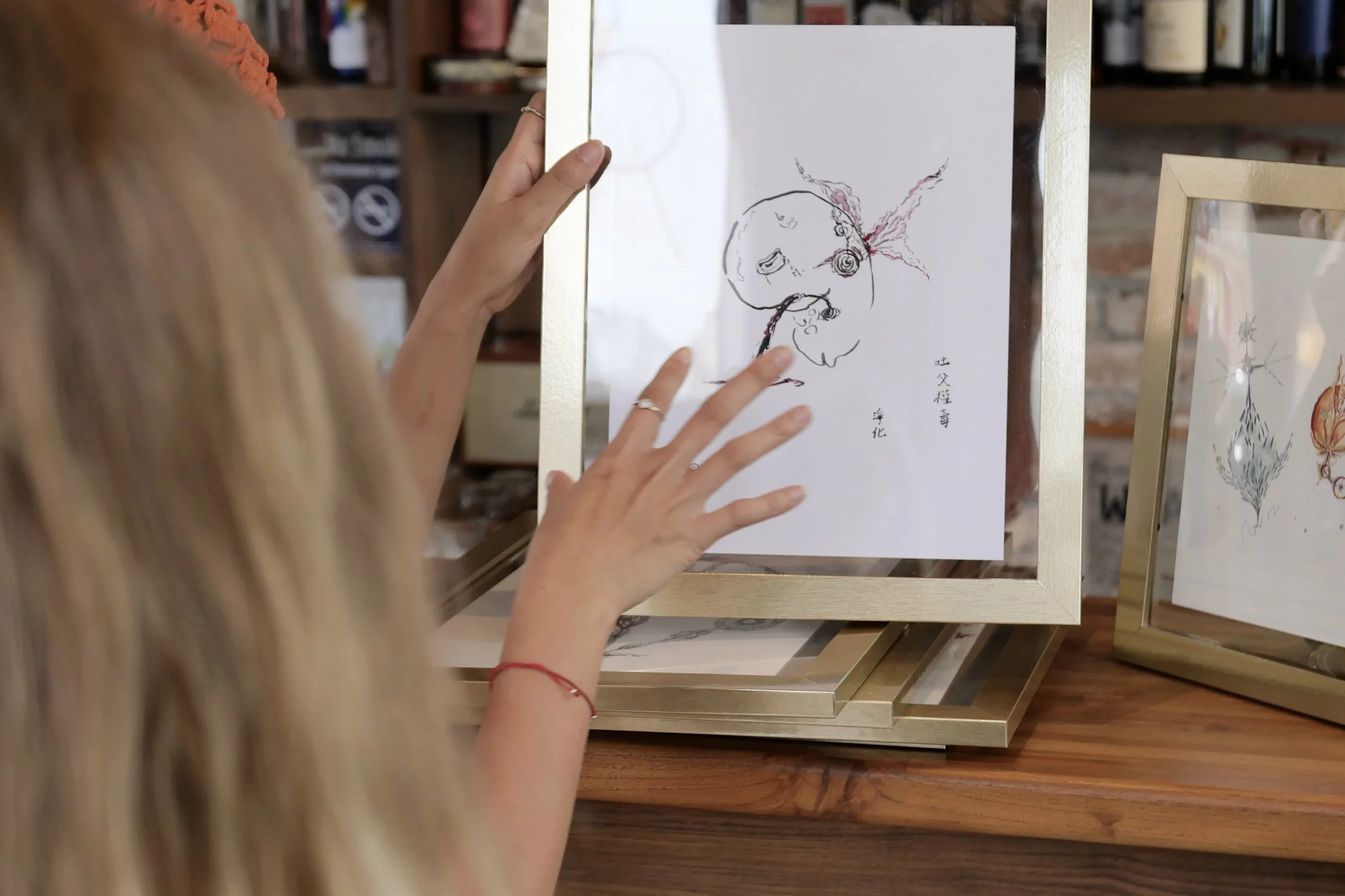
Curated by Xinying Wang and organized by Nicole Yang, Unfolding Roots took place at Mamali in New York’s West Village from August 29 to 30, 2026. As the inaugural pop-up project of Invitation, an independent platform for art and cultural experiences, the exhibition brought together artists, objects, and spaces across diverse cultural contexts, exploring the relationships between artistic practices, their surroundings, and the broader cultural narratives they inhabit. Through a dialogue between the works of Taiwanese artist Orange Li and Canadian-born, Brooklyn-based artist Sarah Davidson and, Unfolding Roots explores the idea of roots beyond fixed notions of origin or belonging. Roots connect nature, memory, cultural inheritance, identity, and place, while continually changing through movement, encounter, transformation, and perception.
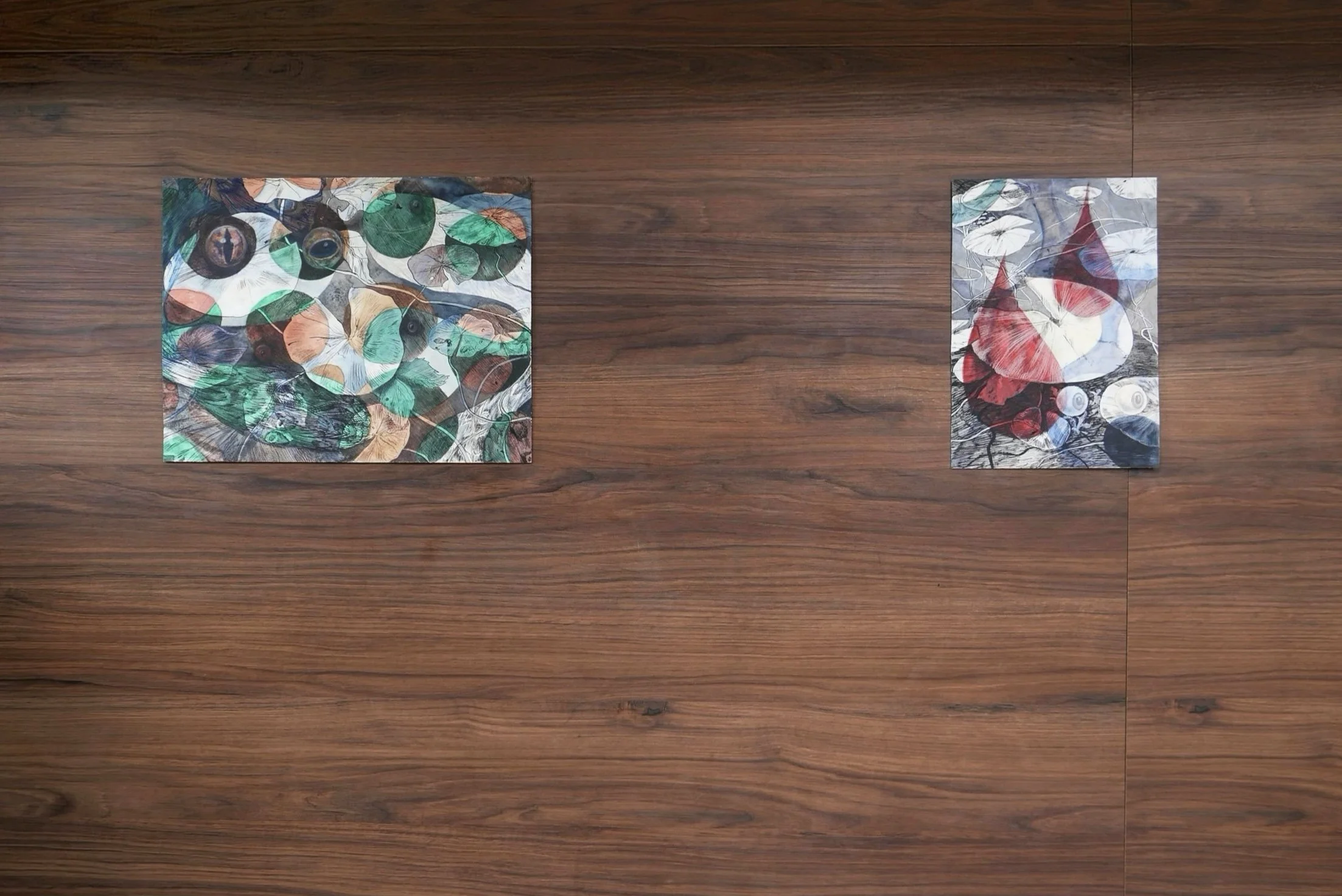
Installation view of Unfolding Roots. Courtesy of artist.
This loosening of fixed origins creates one of the most compelling connections between the practices of Orange Li and Sarah Davidson. Li’s work emerges from memory, dreams, and intuitive relationships between bodily and psychological states. Moving through nature, herstory, spirituality, and storytelling, her practice attends to experiences that are often hidden, overlooked, or marginalized. Within this context, femininity begins to function as a way of sensing and knowing the world. Western philosophical traditions have frequently organized knowledge through binaries such as reason and emotion, mind and body, culture and nature, subject and object. Women’s experiences have often been associated with the bodily, emotional, intuitive, and sensory sides of these divisions. Li’s attention to dreams, memory, the body, and spirituality restores epistemic weight to these forms of experience. Feeling, intuition, and dreaming can preserve knowledge and reach aspects of lived reality that rational language cannot fully contain.
This also makes me think about the relationship between memory and the body. We often feel an emotion physically before we understand it intellectually. Years after leaving a place, we may still carry the posture, habits, fears, or forms of intimacy learned there. Memory does not live entirely in consciousness; it settles into breath, movement, and sensation. If roots describe the relationships that form a person, then roots may also exist within the body. Land, family, and culture create one root system, while embodied sensations create another. Li’s work extends the meaning of roots beyond geography and genealogy, allowing personal history to remain active in the present.
In Sarah Davidson’s paintings, this fluidity of boundaries expands toward the relationship between human beings and the natural world. Davidson approaches nature through a queer ecological lens. A decade spent working as a wilderness guide informs their close observation of natural environments, while the paintings explore growth, transformation, change, and the shifting boundaries among nature, identity, perception, and the body. Queerness here carries implications that extend beyond a category of gender or sexuality. Philosophically, it offers a way to reconsider classifications that often appear self-evident: male and female, human and nature, subject and object, inside and outside. These boundaries have long shaped how we organize reality, while lived experience remains far more fluid than the categories designed to contain it.
Nature makes this fluidity visible. Plants spread outward; fungi form underground networks; animals migrate; cells continuously emerge and disappear; living organisms survive through dependence, exchange, and symbiosis. Nature resembles a shifting network of relations. Queer ecology consequently invites a reconsideration of the human position within that network. We are accustomed to looking at mountains, forests, plants, and animals and calling them “nature,” as though the observer occupies a clearly defined space outside of what is being observed. Yet the human body is always implicated: water, air, food, bacteria, growth, aging, and death continuously connect us to other forms of life. Human subjectivity begins from a condition of openness.
This is also where queerness and spirituality meet in an unexpected way. Spirituality can be understood as a shift in the perception of one’s place in the world: an awareness that the world does not revolve entirely around the self, and that the self itself is produced through countless relationships. Our language comes from others; memory remains connected to family and environment; the body depends on conditions provided by other forms of life; identity develops through growth, migration, desire, culture, and relationships. Seen in this way, spirituality makes the boundaries of the self more porous. Human and nature, past and present, self and other, body and environment begin to appear as mutually entangled conditions.
The feminine, the queer, and the spiritual in Unfolding Roots can therefore be understood as three intersecting paths. Orange Li enters these questions through the body, dreams, memory, and female experience, while Sarah Davidson turns to queer ecology to reconsider the relationship between bodies and nature. Their visual languages and approaches remain distinct, yet both arrive at a similar philosophical question: how does an identity come into being? When their works meet within the same space, “roots” gradually shifts from a language of origin toward a language of relation. The question “Where do I come from?” begins to open onto another: What am I connected to, and what am I growing alongside?
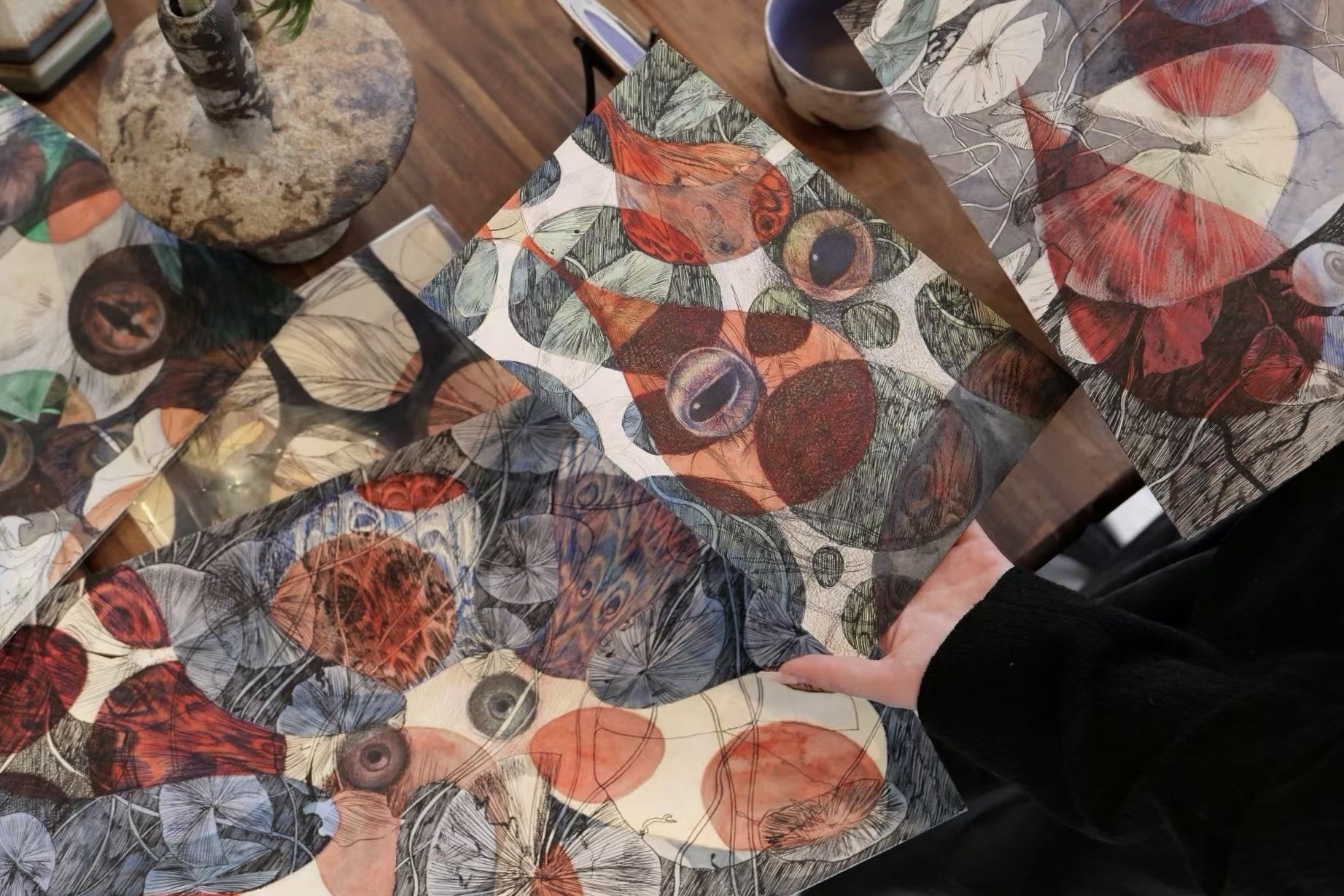
Installation view of Unfolding Roots. Courtesy of artist.
This relational understanding is also embedded in Mamali. The space moves between daytime and evening identities, while coffee, conversation, drinking, pausing, and passing through retain the rhythms of ordinary life. Art enters those rhythms instead of suspending them. Invitation’s curatorial approach seeks to create encounters with art that feel intimate and approachable, allowing relationships among artworks, objects, spaces, and people to emerge through everyday experience. The site consequently becomes part of the exhibition’s exploration of boundaries. Art moves beyond the conventional gallery, nature enters bodily experience, gender remains fluid, and identity continues to take shape.
For me, this is where Unfolding Roots becomes most resonant. Roots often evoke return, ancestry, and the search for a point that already exists. “Unfolding” introduces time into that image. Our roots continue to change as we live. We carry the sensations of places after leaving them; relationships leave traces in us; new cities, languages, cultures, and bodily experiences enter and alter what was already there. Roots can grow downward, sideways, and into one another. They connect, entangle, and produce new growth.
Perhaps the question we are searching for is larger than “Where do I come from?” What matters equally is how we understand the visible and invisible connections that bind us to our bodies, other people, nature, and the past while the world around us keeps changing. This is the image of roots that Unfolding Roots leaves with me: roots whose meaning does not end at origin, but continues to unfold as life moves forward.
Shuhan Zhang
Shuhan Zhang (b. 2002, Jiangsu, China) is a curator and writer. She received her M.A. in Visual Arts Administration from New York University and holds a B.A. from the Central Academy of Fine Arts. Her research focuses on digital art, cultural platforms, and the contemporary art market. She has curated exhibitions including After the Face, Lithic Coordinates, Losing Ghosts, A Lure, A Lament, and Spreading Growth. Her writing has been published in Tussle Magazine, IMPULSE Magazine, Art Spiel, and Whitehot Magazine, with a focus on exhibition criticism and contemporary art discourse.