
Growing from Mineral Color:
MEU GALLERY and the Contemporary Life of Rock Pigment
April Liu
Walking into MEU GALLERY from the busy corridors of Shenzhen UpperHills produces a subtle shift in pace. Mineral pigments are arranged in small vessels along the walls; crystals, thangka paintings, ceramics, and contemporary works appear throughout the space. Away from the neutrality of a conventional white cube, the gallery feels intimate and deliberately composed. Before encountering any individual artwork, one first encounters an atmosphere—a certain quietness that asks the body to slow down.
At the center of MEU GALLERY is an unusually specific material: rock color, or mineral pigment. While galleries often develop their identities around a generation, geography, or artistic movement, MEU GALLERY begins with material. Its programme grows outward from mineral pigment, connecting contemporary painting with thangka, craft, and objects of everyday life.
Mineral pigment carries a history long before it reaches the surface of a contemporary painting. Its colors can be traced through the Buddhist cave traditions of Dunhuang and other sites along the Silk Road, where minerals were ground into pigments and transformed into elaborate murals. There is something compelling in this physical process alone: stone, seemingly solid and immovable, is extracted, crushed, ground, and eventually turned into color.
This transformation also became the starting point for MEU GALLERY. Yitong founded the gallery after an encounter with traditional thangka and natural mineral pigments during a journey to Lhasa provided an early catalyst for its direction. Jasmine Ma later joined as a partner, bringing with her experience across Hong Kong’s collecting, auction, gallery, museum, and curatorial fields. Together, the two women have continued to shape the gallery from their distinct backgrounds and perspectives. From there emerged a simple but productive question: what can such an old material become today?
The connection between material and inner experience also shapes the gallery itself. Thangka and contemporary rock-color painting coexist throughout the space, allowing different histories and approaches to mineral pigment to encounter one another. The sense of spirituality within MEU GALLERY extends beyond religious imagery alone. It appears in the attention given to material, in the labor of grinding stone and building layers of color, and in the patience required to observe surfaces that change subtly with light.
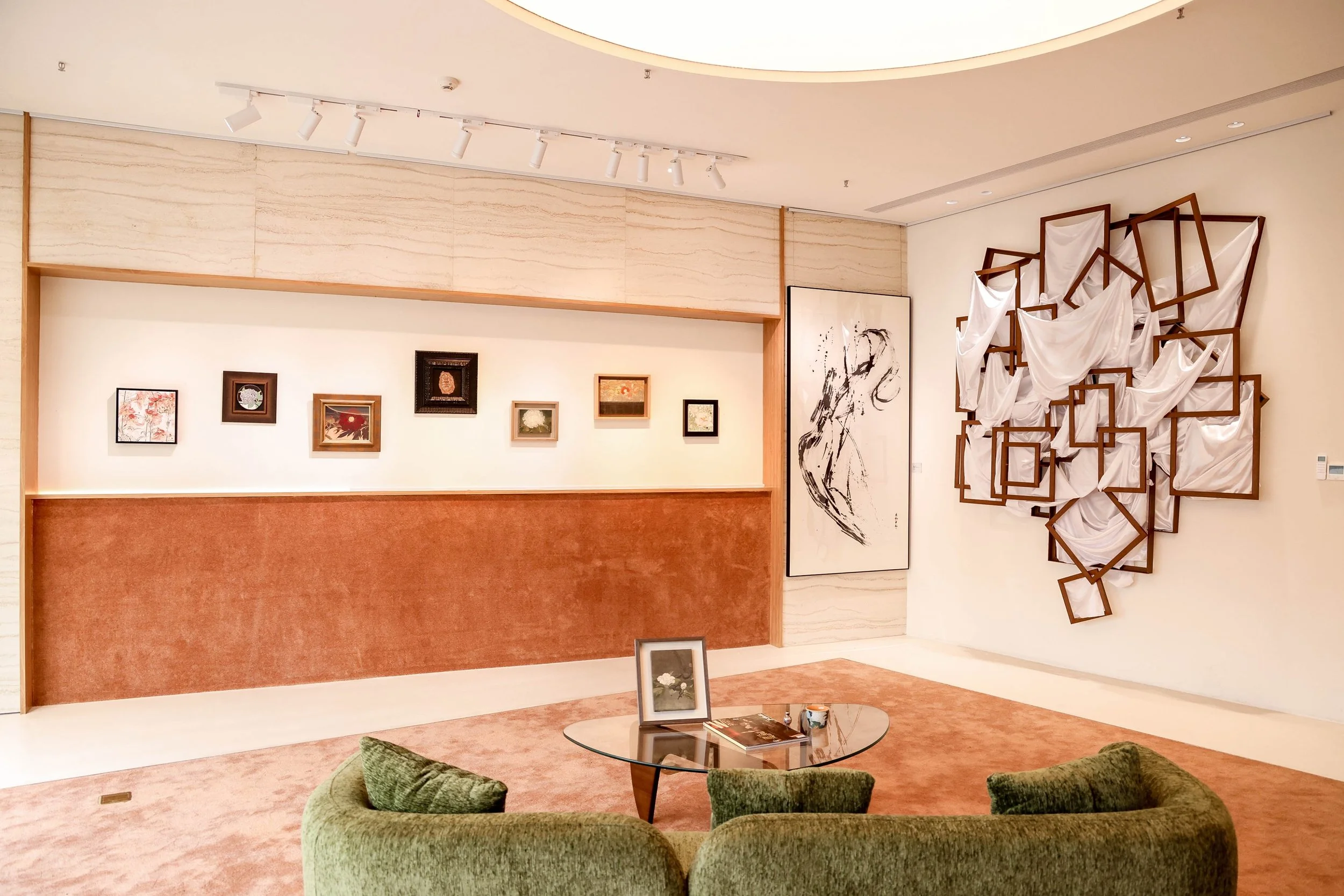
Installation view of MEU GALLERY. Courtesy of MEU GALLERY.
This dialogue continues through the gallery’s growing programme of contemporary artists, whose practices explore mineral pigment through different subjects, techniques, and visual languages. Together, their works move between abstraction and figuration, landscape and everyday experience, revealing the possibilities of this historical material within contemporary practice. From September to October 2026, MEU GALLERY will expand this conversation with a major rock-color exhibition on the fourth floor of UpperHills, bringing together a wider range of works and artistic approaches.
This is perhaps why the gallery’s location feels particularly significant. MEU GALLERY sits on the outer street of UpperHills, surrounded by retail, restaurants, hotels, and the constant circulation of Shenzhen. The contrast is immediate. Entering the gallery from a busy commercial environment, one encounters a space structured around slower forms of looking. At the same time, MEU GALLERY does not attempt to separate itself completely from the rhythms of its surroundings. Mineral pigment extends from paintings into ceramics and objects intended for daily use; workshops and collector salons bring people into closer contact with the material. Art becomes something that can be encountered through different degrees of familiarity, from seeing and touching materials to eventually living with a work.
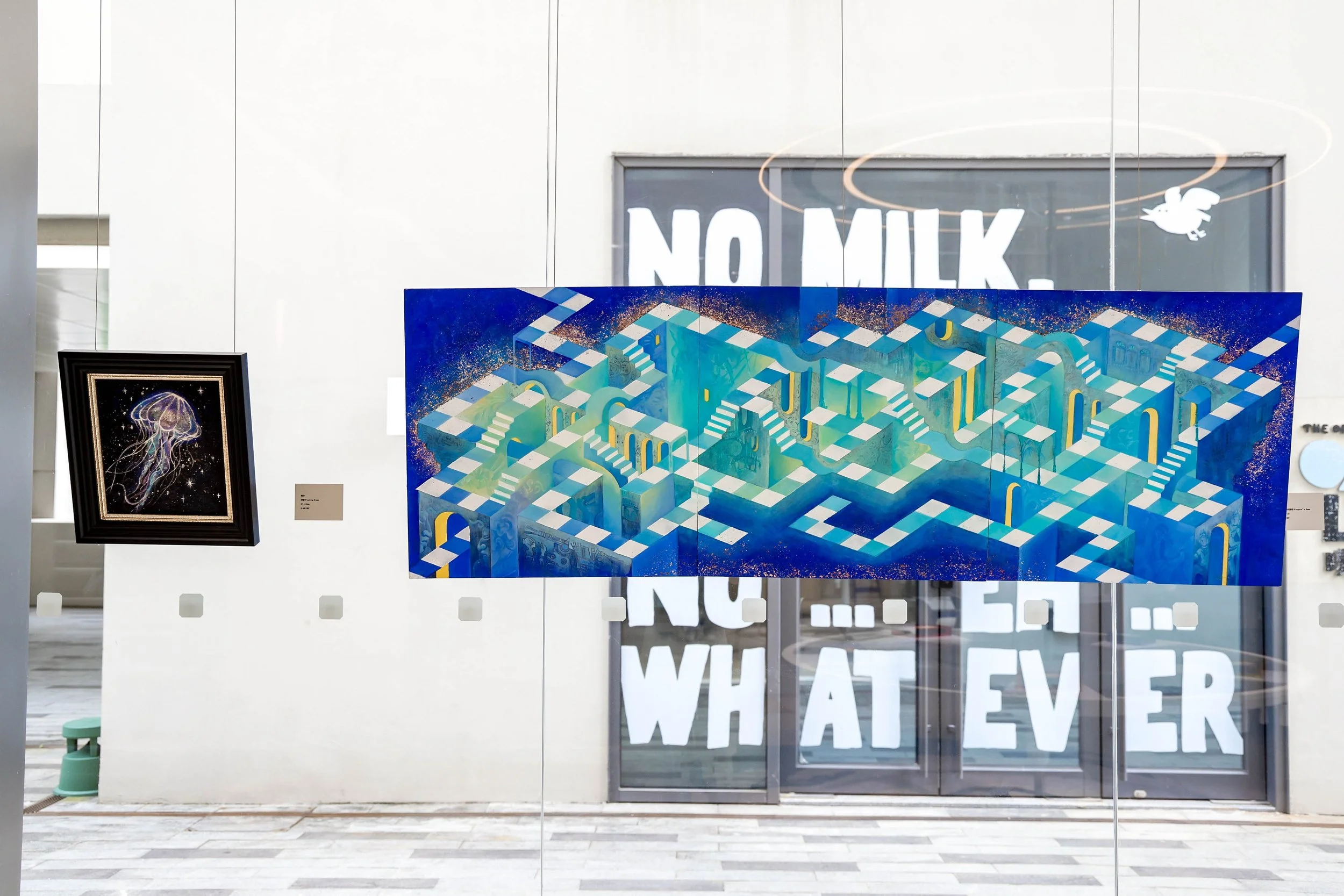
There is something particularly interesting about this model within the changing culture of art collecting in mainland China. Located outside a conventional gallery district and embedded within a commercial complex, MEU GALLERY allows encounters with art to happen alongside everyday urban life. Someone may enter without already identifying as a collector; curiosity can begin with a pigment, an object, a thangka, or simply the atmosphere of the space.
When I entered MEU GALLERY, this was what stayed with me most. Amid the movement and noise of the city, the gallery offered a temporary change in rhythm. Ancient pigments appeared through contemporary images; spiritual references met ordinary objects; stone became landscape, animal, color, and feeling.
MEU GALLERY begins with a remarkably specific commitment to mineral pigment. Yet from that specificity, something much broader begins to grow: a conversation between material and time, history and contemporary life, and the physical world and our inner landscapes.
Here, stone is still growing.
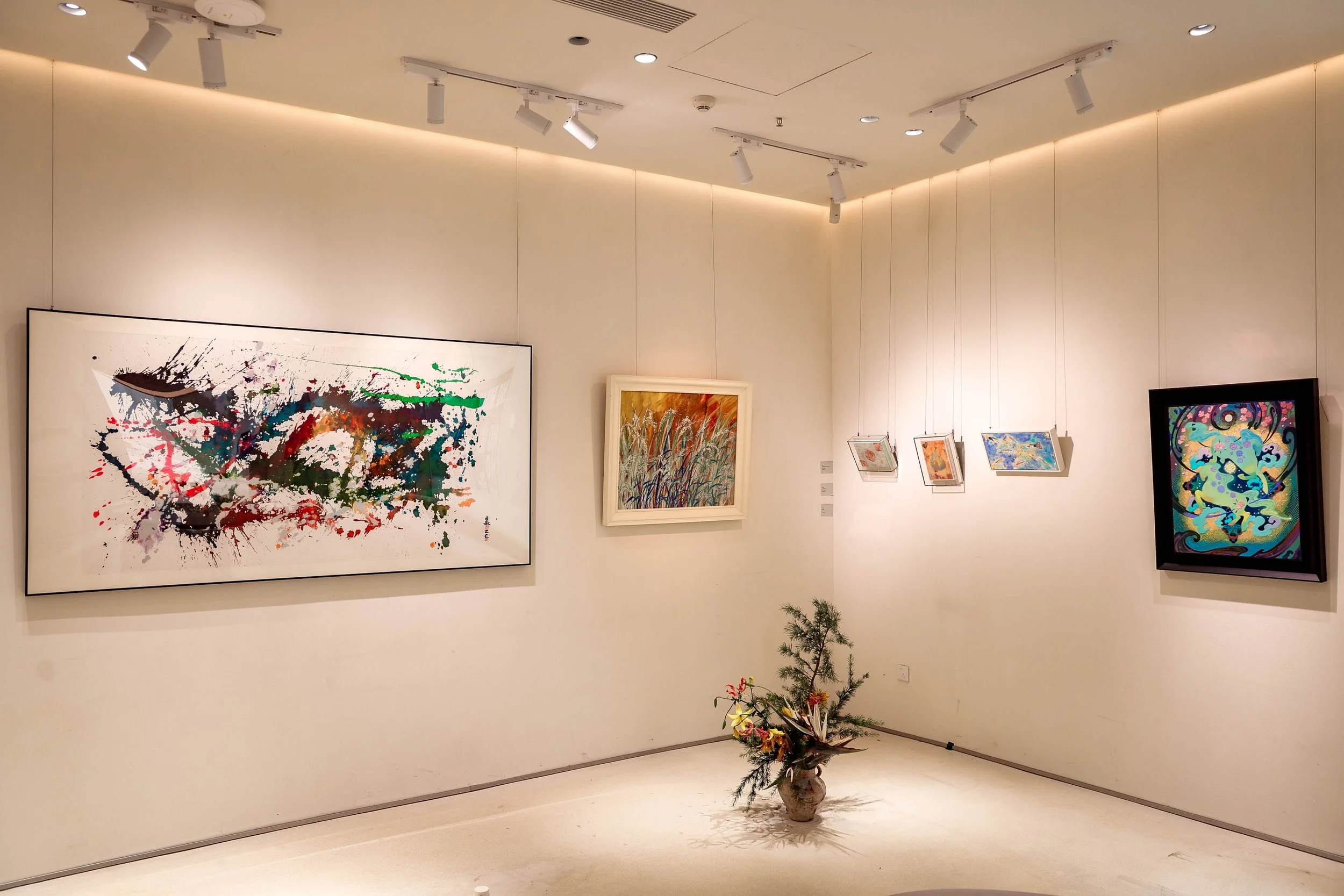
Jasmine Ma working onsite at the Gallery. Courtesy of Jasmine Ma.
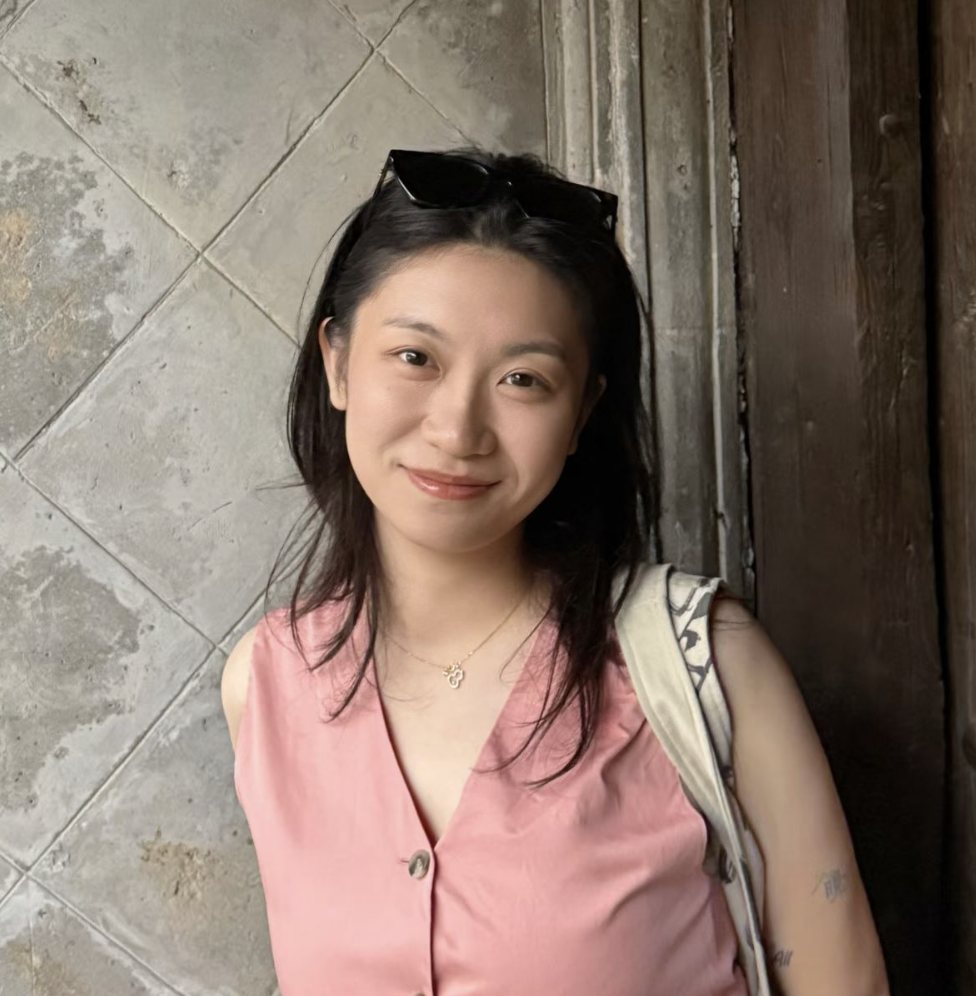
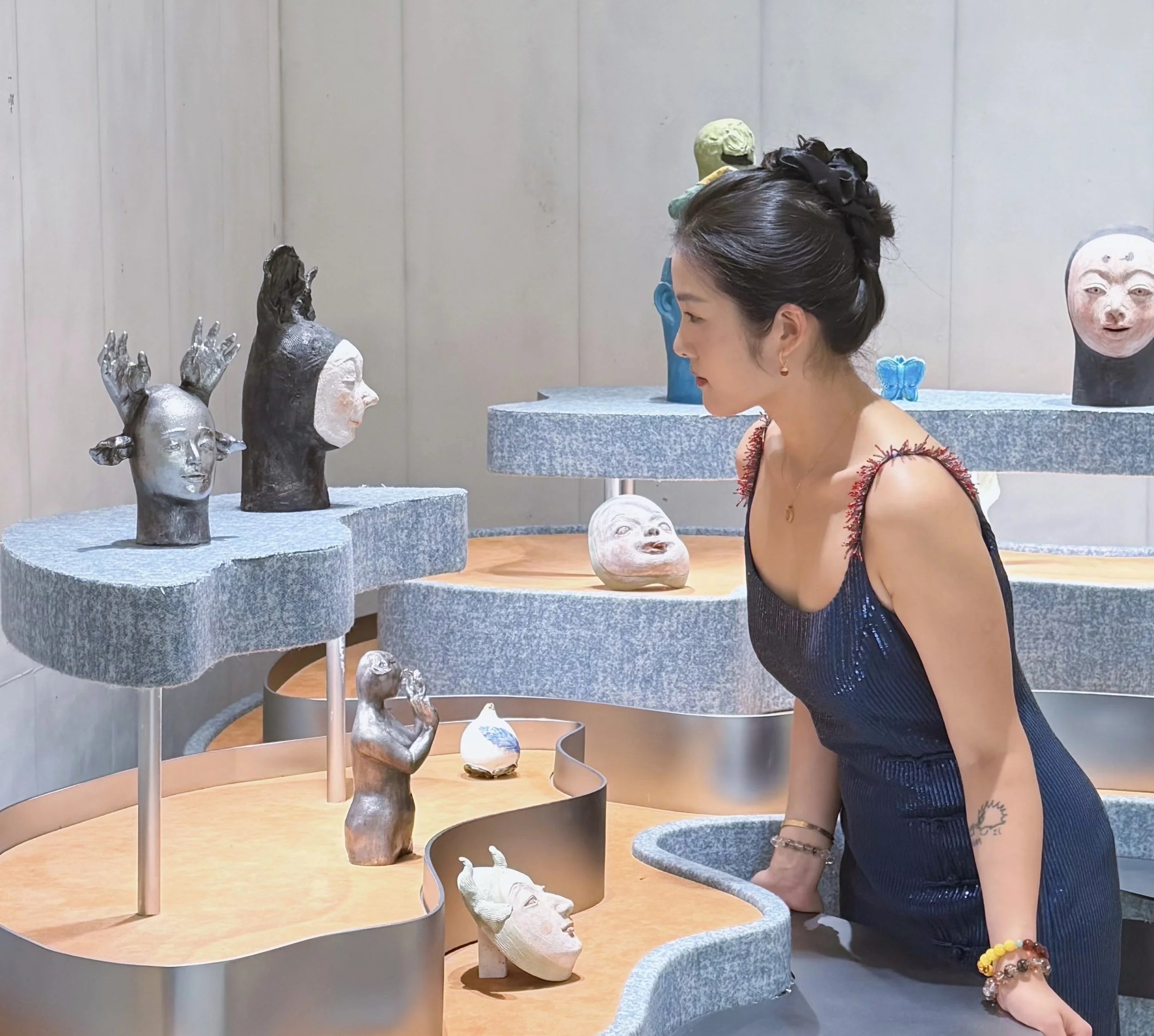
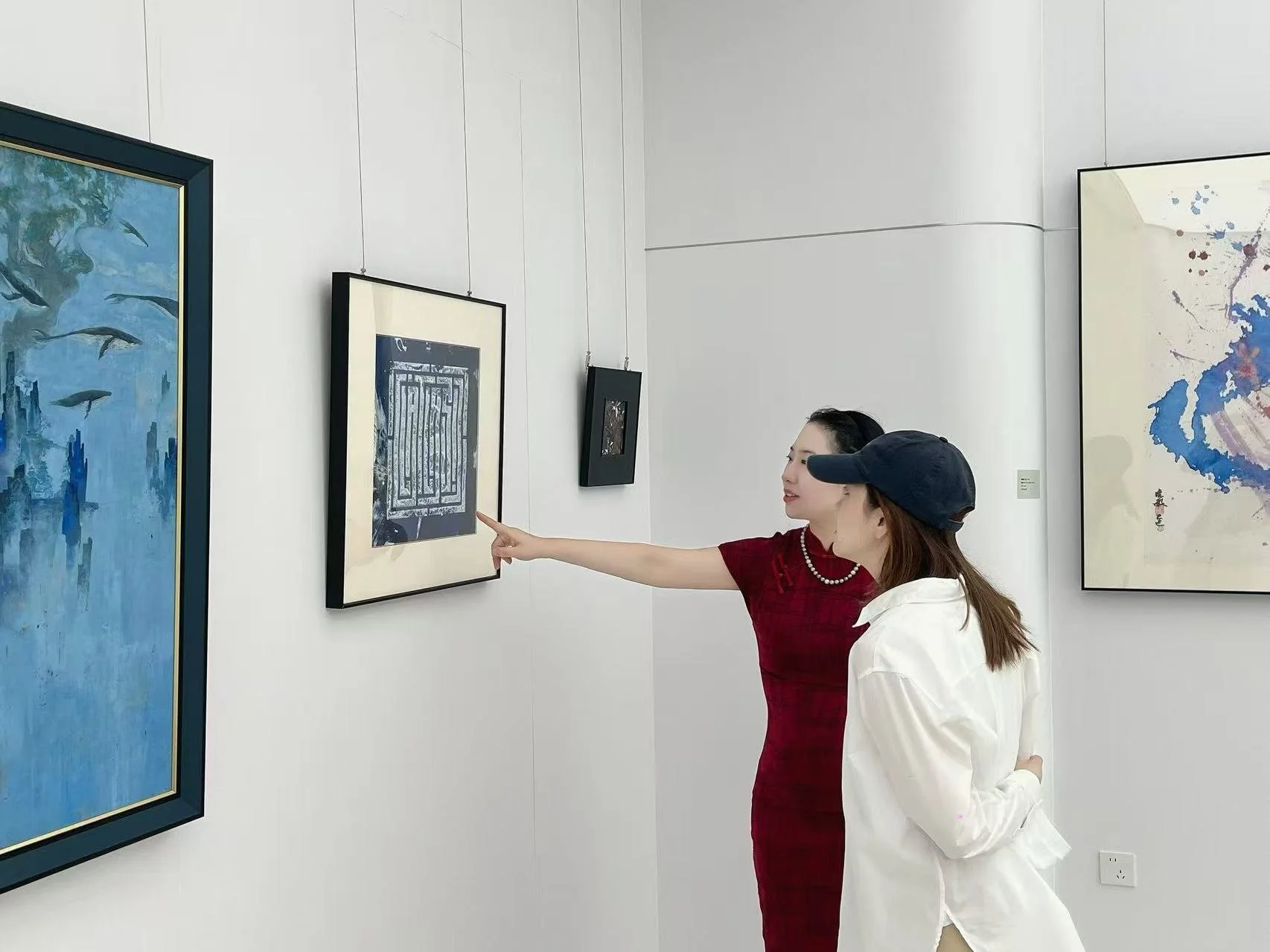
Yitong Jing working onsite at the Gallery. Courtesy of Yitong Jing.
ArtEchive:
MEU GALLERY began with your encounter with thangka and natural mineral pigments in Lhasa. What was it about these materials and traditions that stayed with you, and how did they come to shape the direction of the gallery?
Yitong, Founder of MEU GALLERY:
What stayed with me was the relationship between thangka and mineral pigment painting. One carries a strong spiritual and religious quality, while the other allows for a freer contemporary expression. To me, they reflect the idea of “non-duality” (不二): tradition and contemporary practice can exist within the same cultural lineage, while offering different kinds of beauty, experience, and reflection to different audiences.
Mineral pigments are also incredibly versatile. They have long been used in murals, traditional Chinese painting, ceramics, sculpture, and many other forms of artistic practice. The material leaves a great deal of room for experimentation and offers a natural way to connect traditional Chinese visual culture with contemporary expression. Through the gallery, I hope more people around the world can see how our cultural traditions continue to be carried forward, transformed, and renewed.
I also really enjoy spending time in the gallery looking at these works. To think that a mineral once buried deep underground can eventually become the image in front of us gives me a very tangible sense of the passage of time. In this way, the gallery has gradually become a small space where artworks and collectors can meet, and where different histories, materials, and ways of seeing can enter into dialogue.
ArtEchive:
With your experience across collecting, auctions, museums, galleries, and curatorial practice in Hong Kong, what drew you to MEU GALLERY, and what perspective did you hope to bring?
Jasmine Ma, Partner and Curator:
I still remember when Yitong asked if I wanted to build the gallery together. I had never imagined taking on such a big responsibility, and I was very grateful for her trust. I also really admire how she has stayed true to what she believed in from the beginning.
I have always loved the encounter between traditional and contemporary art. The first exhibition I did in Hong Kong was a contemporary sculpture and painting show in an antique gallery on Hollywood Road. My own collection is also very mixed, from antique ceramics to contemporary photography and street art. Putting them in the same space makes me feel that “time” is just a concept—it can be folded, broken, or even reversed. I find that feeling fascinating. I hope to bring this openness to MEU, to embrace more possibilities and break away from some of the usual rules and boundaries around art and aesthetics.
Having worked with different art institutions in Hong Kong, from public museums to auction houses and private museum, I have also started to think more about what different people need from art. Whether I am working with collectors, artists, partner brands, or visitors, I try to see things from their perspective. What I really hope to create at MEU GALLERY is an atmosphere where anyone can walk into the space and feel that they can join us in talking about art. That is something we are still working towards.
April Liu
April Liu is a curator, researcher, and arts administrator working across contemporary art, postcolonial theory, and institutional critique. She holds an MA in Global Arts and Cultures from Rhode Island School of Design and a BA in Cultural Management from The Chinese University of Hong Kong. She has worked at Christie’s, Pace Gallery, and major art institutions in China and the US. Her research focuses on how museums in East Asia negotiate identity, power, and postcolonial legacies. She lives and works between Providence and Hong Kong.