
Living With Distance
Shuhan Zhang
Living in New York, it is difficult to forget the presence of the body. On the subway, shoulders nearly touch. The street constantly asks bodies to move aside, speed up, or stop. Apartment walls carry other people’s footsteps, music, and conversations into one’s own room. People live in extreme proximity to one another, yet they are equally skilled at maintaining distance: avoiding prolonged eye contact, limiting their responses to strangers, and preserving some small sense of psychological privacy within the crowd. The more continuously the body is exposed to the presence of others, the more it seems necessary to learn how to temporarily close itself off.
At the beginning of the twentieth century, Georg Simmel identified a similar contradiction in The Metropolis and Mental Life. The modern city subjects the individual to an intense accumulation of stimuli, speed, and encounters with strangers. In order not to be overwhelmed by them, one gradually develops a restrained and detached form of psychological defense. What Simmel describes as metropolitan indifference does not necessarily mean that people have no relation to one another. It may instead emerge precisely from an excess of relations and stimuli: because it is impossible to respond continuously to every person, sound, and encounter, one has to learn what to filter out. Distance, then, becomes not only a spatial condition but also a way of living. New York is perhaps one of the clearest expressions of this experience. Its inhabitants constantly share train cars, streets, buildings, and air, while simultaneously learning how to prevent that proximity from fully entering the self.
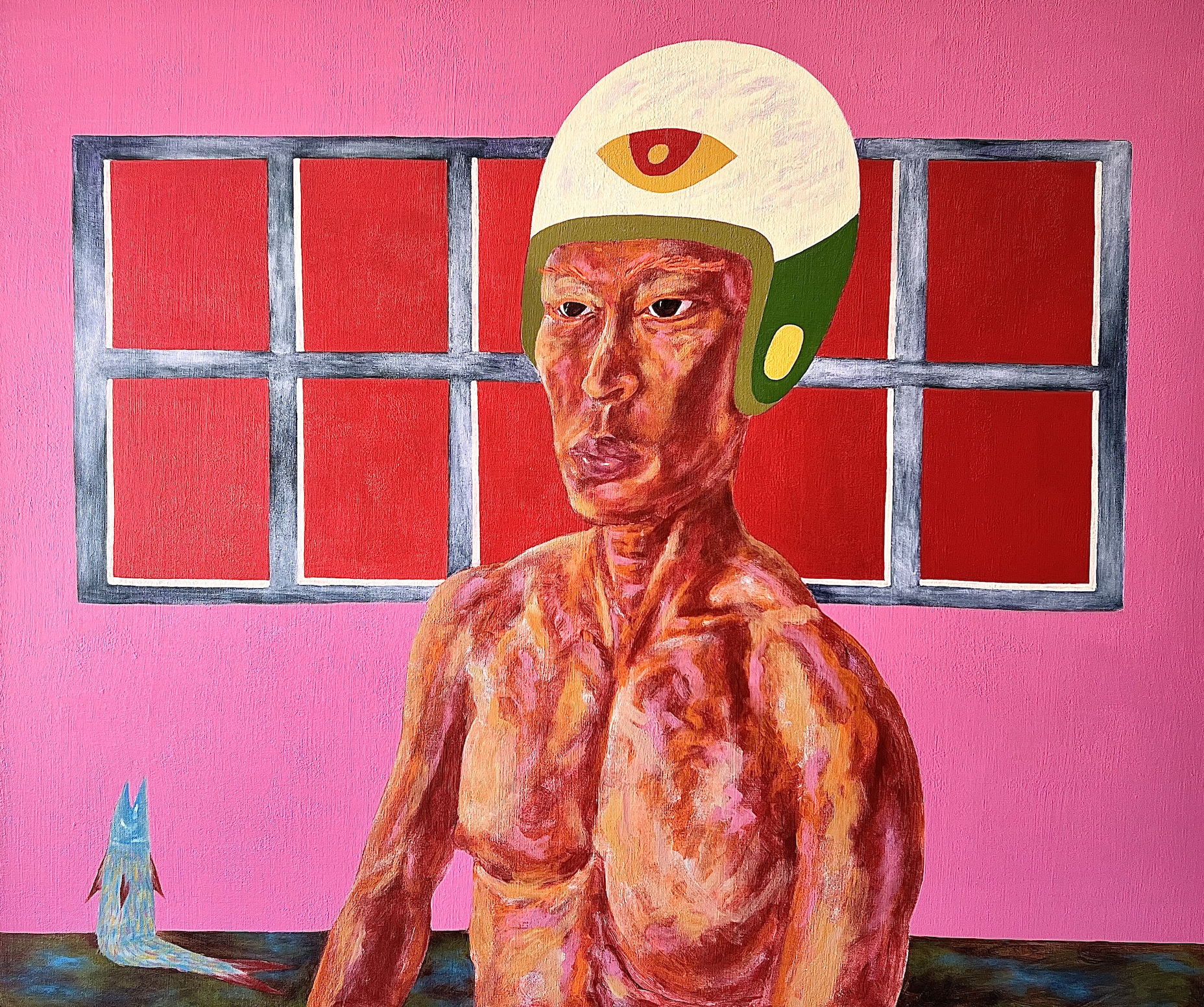
Yiming Tang, High Noon Madness, 2026. Courtesy of the artist.
It is within this urban context that CORPUS makes its questions about the body and its relation to others particularly tangible. Curated by Eliza Xinping Tan at Nguyen Wahed Gallery, the exhibition brings together works by Yiming Tang and Xinzi Luo alongside a quadraphonic soundscape directed by Ivy Jin and designed by Silvan Tang. It begins with the body’s most immediate boundary, the skin, without treating that boundary as a solid wall. Touch, pain, desire, memory, and the presence of others continually cross it. The body, in this sense, is not a clearly bounded entity that exists prior to relation, but something continually formed through contact. This understanding resonates with Jean-Luc Nancy’s concept of being-with. The self does not first become autonomous and complete and only afterward decide whether to enter into relation with others. Being with others is already a condition through which the subject comes into being. Relation is not something added to the self from the outside; it participates from the beginning in shaping what the self is. Yet being-with does not imply fusion, nor does it promise complete mutual understanding. On the contrary, we are always exposed to others while retaining parts of ourselves that remain inaccessible to them.
This is why incompletion becomes so important to CORPUS. The exhibition is not simply asking whether the body is vulnerable, but whether a fully complete and self-sufficient subject is possible at all. If a person is continually shaped through proximity, misunderstanding, attachment, loss, and memory, then the idea of a complete self may itself be a fiction. Bodily boundaries certainly protect us, but they are also continually rewritten by the outside world. In this sense, sound may be the exhibition’s most precise material. Rather than functioning as an atmospheric layer behind the visual works, sound is treated as a “second material” within the exhibition. Four independent channels continually reorganize spatial distance as sound appears from different directions, approaches, overlaps, and recedes. Breath, fabric, skin, paper, the resonance of wood and metal, and traces of water, wind, rain, and the urban environment form an approximately twenty-four-minute cycle.
What matters here is not simply the technical fact of the four-channel system, but the way sound alters the relationship between body and space. In New York, people become accustomed to actively filtering the world around them: looking down at a phone, putting on headphones, moving quickly through a crowd, deciding what deserves attention and what can be ignored. These habits are, in part, ways of managing the city’s excess of stimuli. The sound inside the gallery, however, does not submit entirely to this kind of control. It is not attached to any single artwork. Instead, it occupies the intervals between works and enters the spaces between viewers. A sound might emerge from behind, or from the direction of another person. Whether it belongs to an artwork, to the architecture, or simply shifts because of the listener’s position in the room is not always immediately clear. In these brief moments of uncertainty, the boundary of the body stops being merely an idea addressed by the exhibition and becomes something physically experienced through viewing and listening.
Yiming Tang’s paintings shift this question of boundaries toward the psychological distance that persists between people. His figures often appear to be already caught within some form of relationship, yet they never fully reach one another. Distorted bodies, unfinished gestures, fragments of communication, and nonlinear narratives make the paintings feel like moments abruptly extracted from much longer stories: something has already happened, something may still happen, but a complete explanation never arrives. In Stay Away From My Dinner, even the title carries a slightly absurd tone of defensiveness—an insistence that someone else keep away. It marks out a private boundary, but the need to declare that boundary exists precisely because another person is already present.
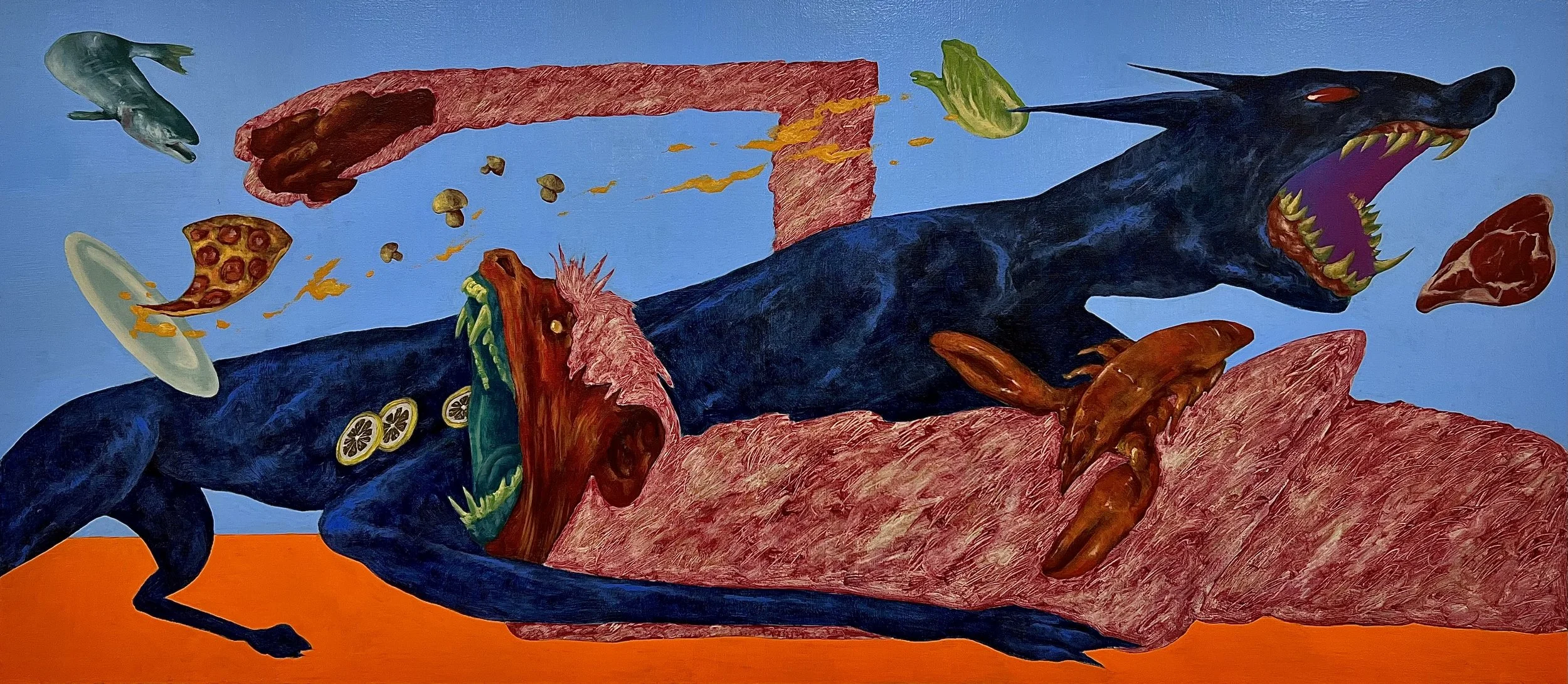
This movement between proximity and withdrawal has a subtle parallel in metropolitan social life. Strangers in New York are not without relations to one another; if anything, there are too many relations for most of them ever to become complete. A glance, a few exchanged words, or several seconds of bodily proximity may disappear almost immediately. The solitude in Tang’s work therefore does not feel like absolute isolation. It is closer to isolation within extreme connectivity: others are always there, but never entirely knowable. Sound intensifies this condition. It can establish contact without guaranteeing communication. Two voices or tones can coexist without merging; one sound can approach another and then disappear before any stable relation has formed. Relation is therefore never romanticized. It may also consist of misunderstanding, interruption, failed response, and distances that remain unresolved.
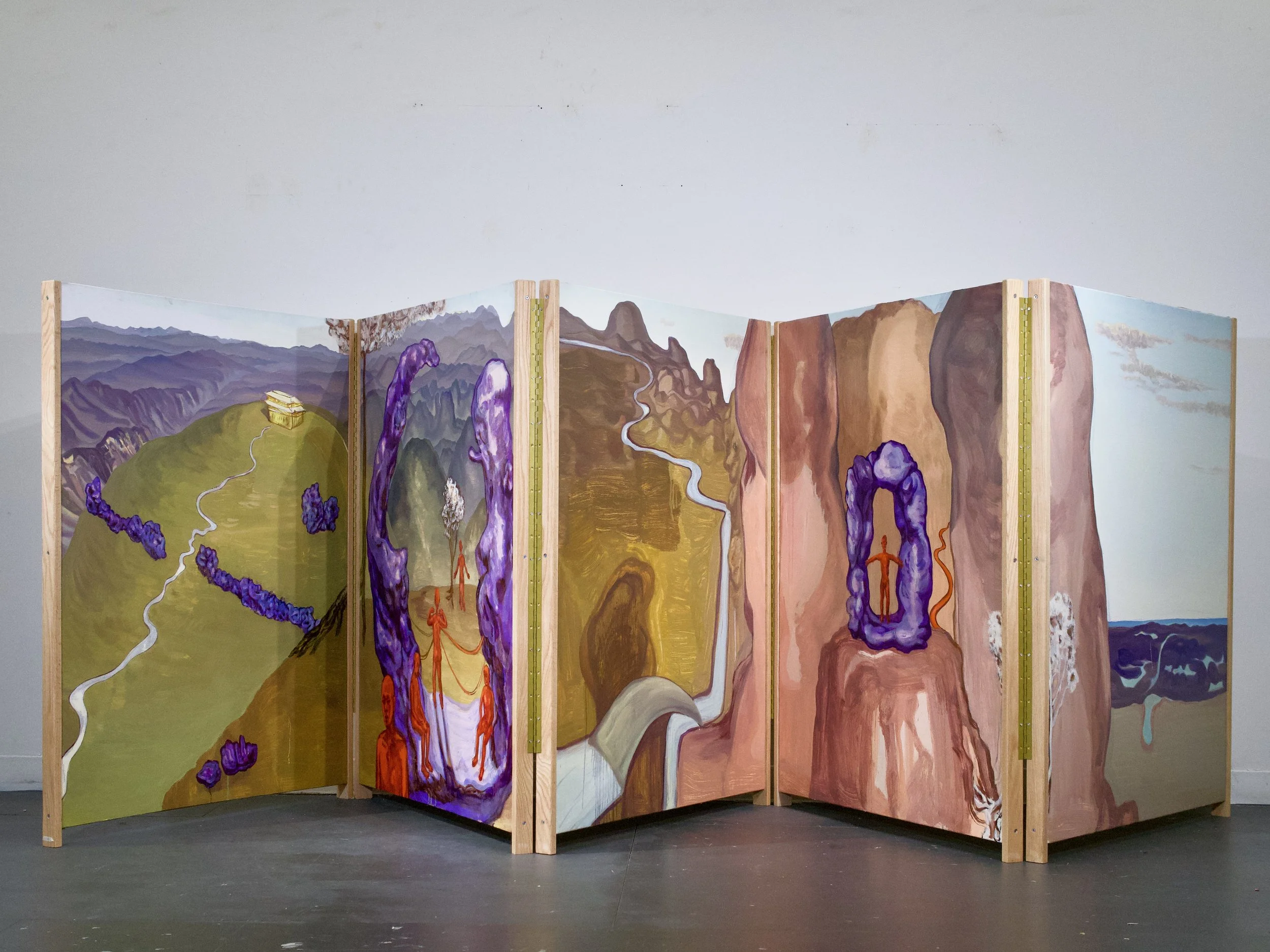
If Tang locates this distance between people, Xinzi Luo extends it into space. Roads, bridges, passages, stairways, houses, and shelter-like structures recur throughout her work, yet these spaces rarely lead toward a stable or clearly defined destination. They tend to stop just before arrival, holding space in a transitional state. This becomes especially apparent in the large-scale work A Walk Through Wudang, which combines oil paint, Chinese ink on silk, wood, wax, and piano hinges across a structure measuring 180 by 50 by 20 inches. In contrast to the more clearly delimited plane of conventional painting, its scale and material construction give viewing a stronger spatial dimension. The work begins to exceed the condition of an image contained within a frame and enters into a more direct relationship with the physical space occupied by the viewer.
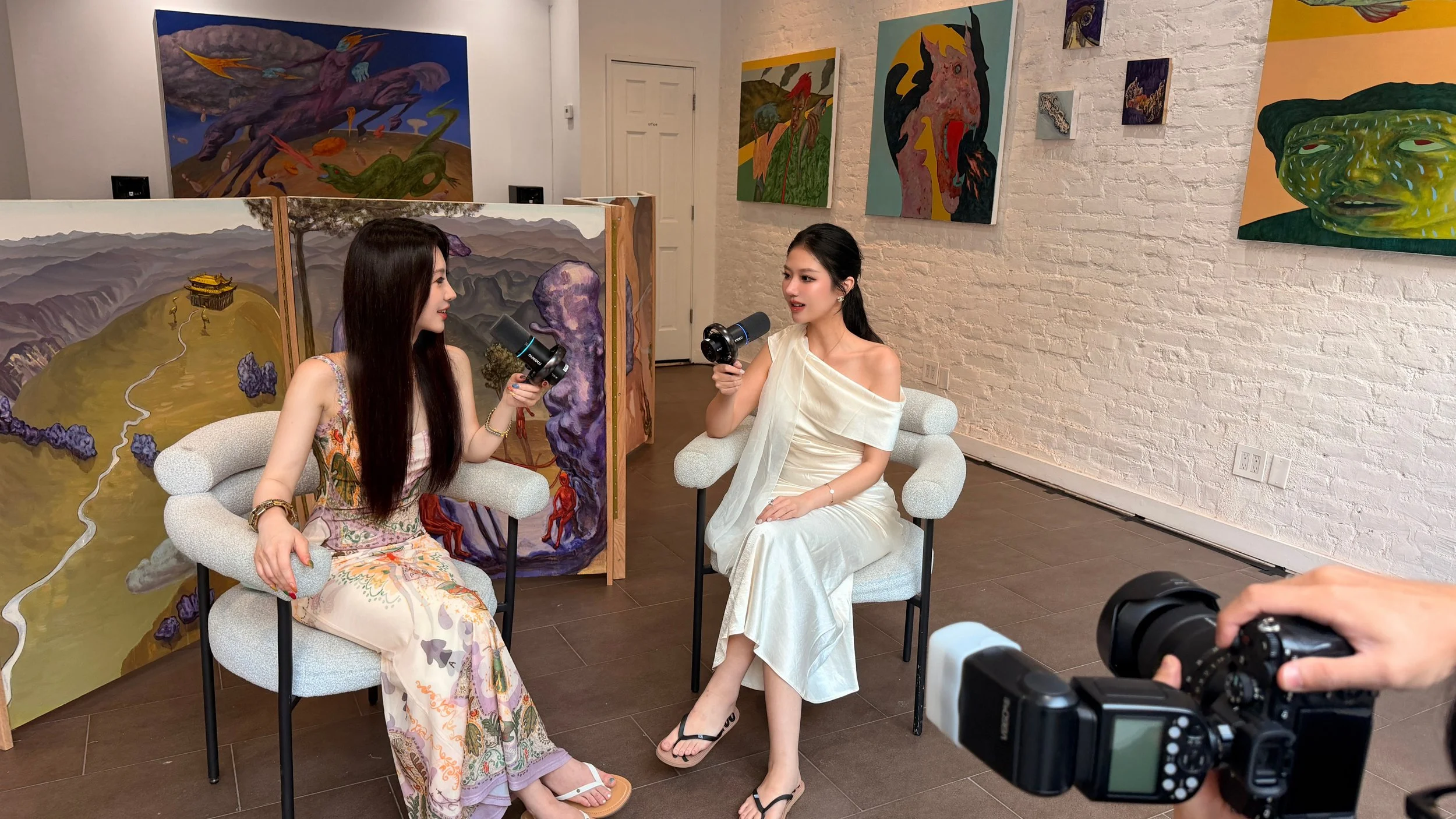
Curator Eliza Xinping Tan interviewing Soundscape Director Ivy Jin at Nguyen Wahed Gallery.
Luo’s paths, then, are not ultimately oriented toward arrival. They describe space as something continually in formation. Here, living together is not presented as an already constructed utopia, but as an unfinished possibility. How do we move closer while preserving difference? How can a space accommodate multiple bodies without requiring them to become the same? As the quadraphonic soundscape moves among these architectural and landscape-like forms, another layer of space seems to emerge beyond what vision can securely fix. Space is no longer organized only by walls, floors, or perspective within an image, but also by distances and relations that cannot be seen and yet can still be physically felt.
This is also what distinguishes CORPUS’s understanding of community from more familiar ideas of unity or belonging. Nancy’s thinking becomes useful precisely because he does not imagine community as a collection of individuals eventually merging into a complete whole. The exhibition similarly suggests that a community in which every difference has disappeared and every tension has been resolved might appear complete, but such completeness would also imply that transformation had come to an end. Incompletion, by contrast, keeps a structure open: differences can still be negotiated, and new relations can still emerge. Tang’s unresolved exchanges, Luo’s spaces that remain short of arrival, and the soundscape’s repeated movements of approach and withdrawal are therefore not simply three versions of the same idea. They locate incompletion across three different registers: psychological, spatial, and perceptual.
Seen from this perspective, incompletion begins to feel strangely familiar in New York. The city itself is composed of countless bodies that exist in proximity without ever fully merging. We share train cars, streets, stairways, walls, sound, and even air, while still retaining parts of ourselves that others cannot completely enter. Perhaps collective life is possible not because everyone ultimately understands one another, but because people are continually adjusting their distances: moving closer, stepping aside, responding, remaining silent. Simmel’s metropolitan defenses do not disappear, but CORPUS suggests another way of thinking about the boundary. A boundary need not function only as a barrier that keeps the outside world away; it can also become the very place where relation begins.
Perhaps this is where CORPUS offers its most compelling response to life in New York. Being-with does not require distance to disappear, nor does it demand that every boundary be broken. What allows relation to continue may instead be precisely what remains unresolved: an unfinished exchange, a path that has not yet reached its destination, a space that still permits another person to approach while allowing difference to remain. In a city that forces the body into encounters with countless others every day, the question may never have been how to become completely independent or self-contained, but how to acknowledge the ways we are continually changed by others while remaining open to the possibility of relation.

Shuhan Zhang
Shuhan Zhang (b. 2002, Jiangsu, China) is a curator and writer. She received her M.A. in Visual Arts Administration from New York University and holds a B.A. from the Central Academy of Fine Arts. Her research focuses on digital art, cultural platforms, and the contemporary art market. She has curated exhibitions including After the Face, Lithic Coordinates, Losing Ghosts, A Lure, A Lament, and Spreading Growth. Her writing has been published in Tussle Magazine, IMPULSE Magazine, Art Spiel, and Whitehot Magazine, with a focus on exhibition criticism and contemporary art discourse.