
When Life Begins to Feel Like a Scene
by Shuhan Zhang
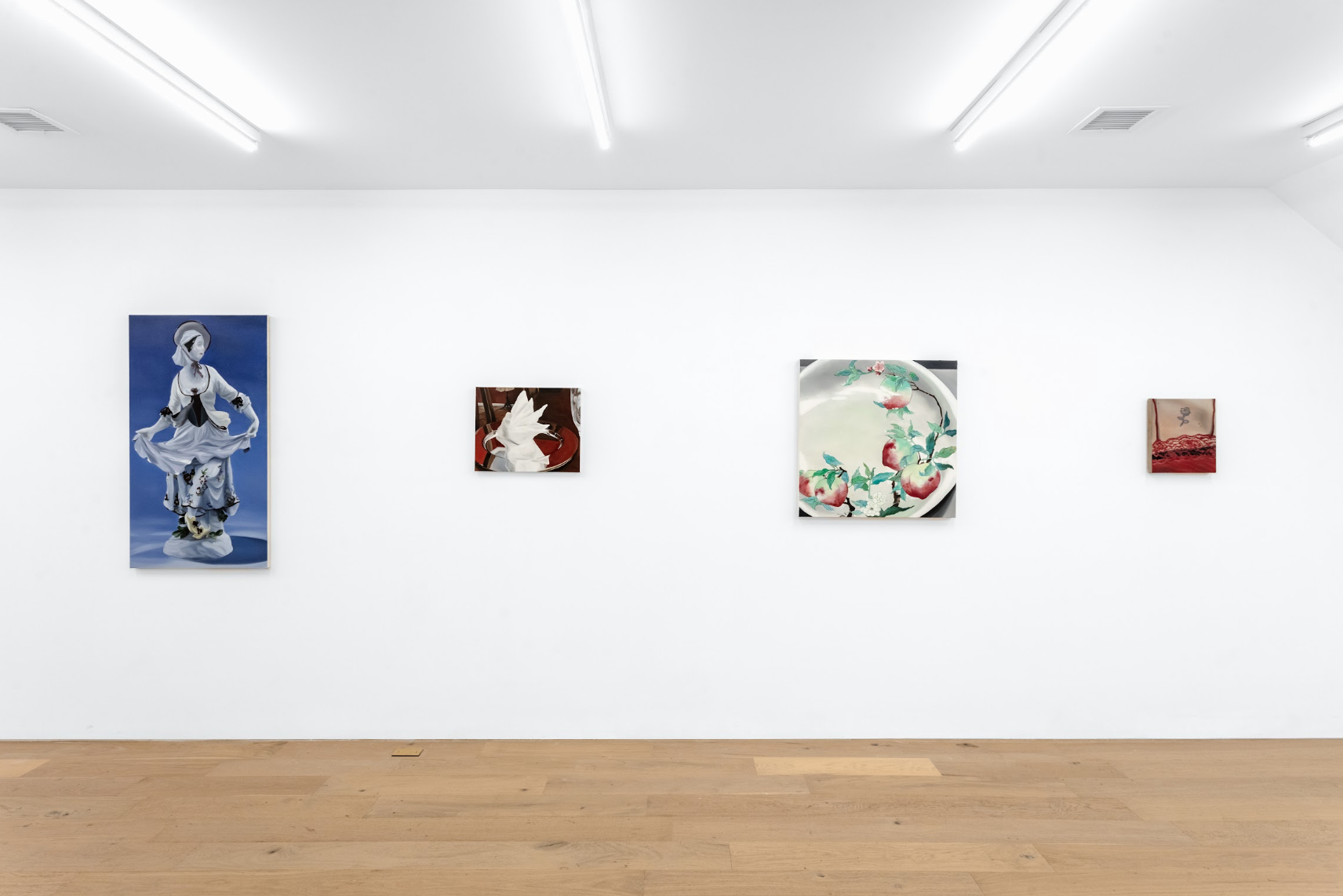
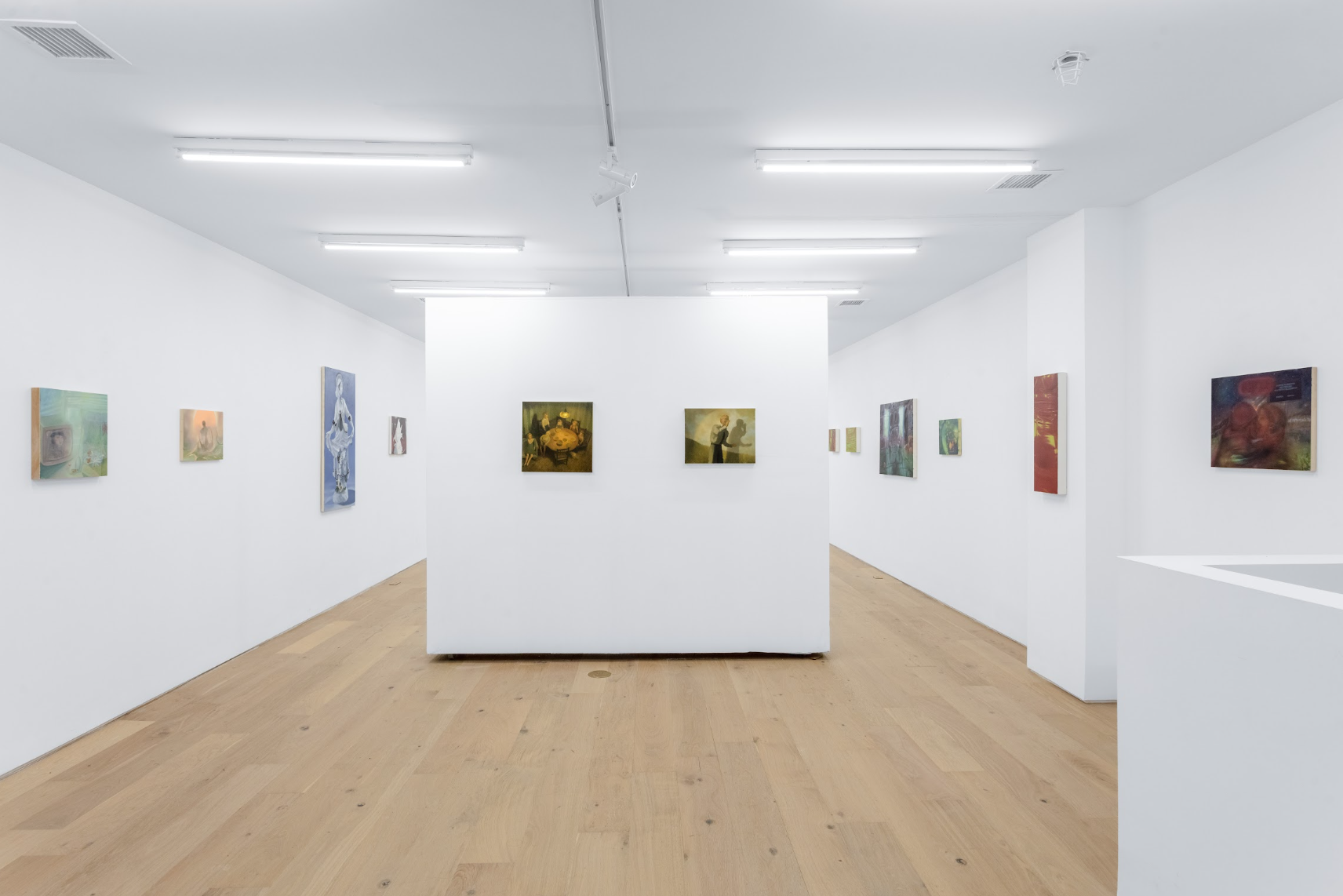
Installation view of Meanwhile, the Mise-en-Scène. Courtesy of the artist and the gallery.
We seem to be growing increasingly accustomed to watching life happen from the outside even as we are living it. When we enter a room, we instinctively look for where we should stand; when we put on a piece of clothing, we not only feel whether our body is comfortable in it, but also imagine how it looks from the outside; before a dinner has even ended, a certain moment has already been anticipated as a photograph. Looking no longer happens only after life has taken place; it enters experience earlier and earlier.
LATITUDE Gallery’s Meanwhile, the Mise-en-Scène, curated by Weifan Mo and Xumeng Zhang, brings together six artists, Eileen Feng, Pan Inkhoo, Athena Parella, Jordan Sears, Da Wang, and Wendy Wei. What the exhibition ultimately touches on is perhaps this very split. Drawing on the cinematic notion of mise-en-scène, its most compelling move is not to make painting feel more “cinematic,” but to turn looking itself into a question: as life increasingly comes to resemble a scene that can be watched, cropped, and arranged, can we still simply inhabit it without becoming spectators of ourselves at the same time?
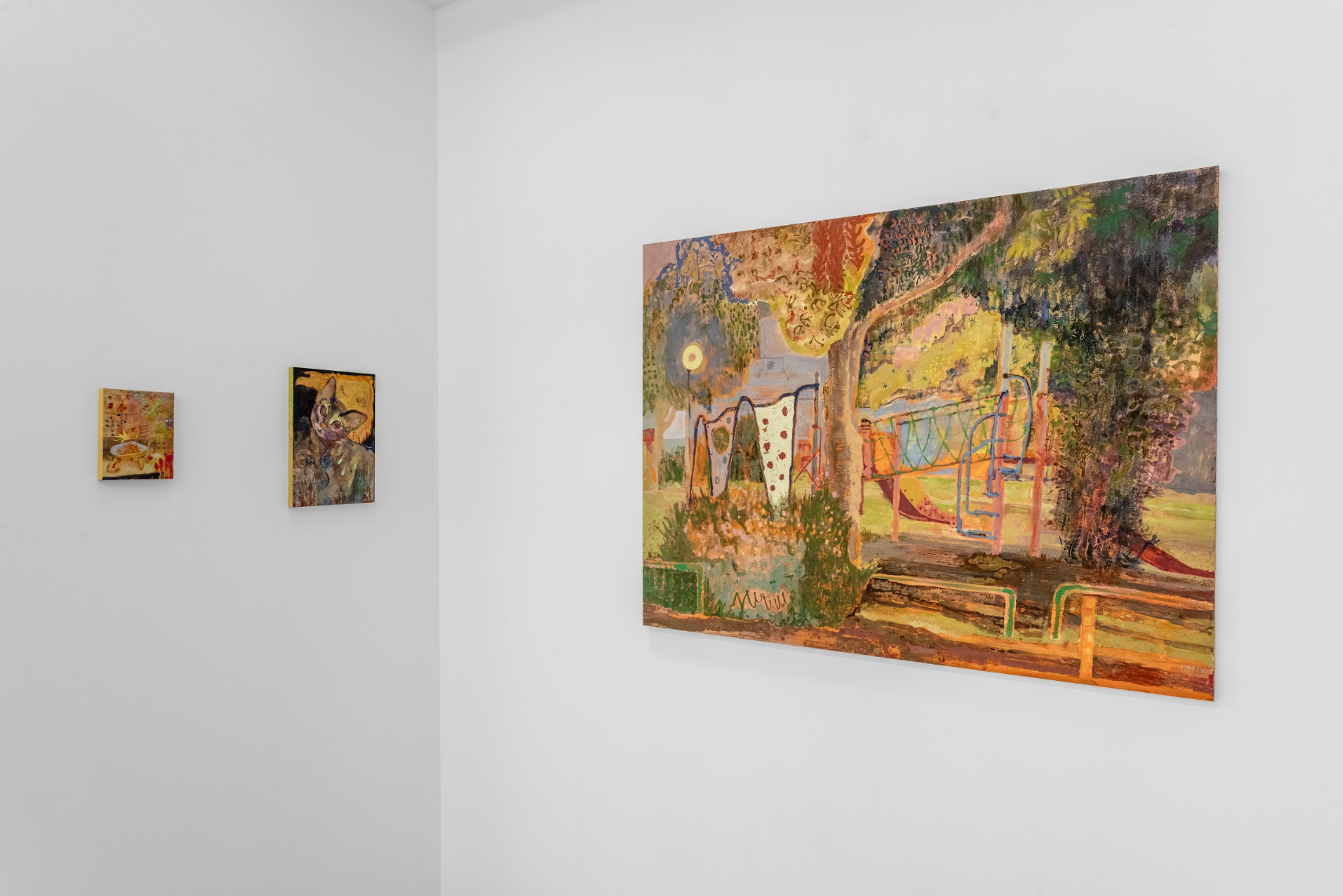
Installation view of Meanwhile, the Mise-en-Scène. Courtesy of the artist and the gallery.
The exhibition borrows the cinematic concept of mise-en-scène, the way figures, objects, space, and positions of viewing are organized within an image, yet it does not allow this “cinematic quality” to remain merely formal. The works of six artists are interwoven across the gallery’s two floors, with the experience of looking gradually contracting from streets, journeys, and open urban spaces toward interiors, objects, and more intimate psychological experiences; throughout this process, viewers are continually required to readjust their distance from the images. In this sense, “mise-en-scène” no longer refers simply to how a painter arranges a composition, but begins to point toward a more immediate question: before our bodies enter any space, has that space already prescribed how we should appear, how we should move, and how we should be seen?
This sense of being positioned by space first unfolds on the scale of the city in Da Wang’s work. Across roads, intersections, elevators, and figures in motion, the city is not simply a backdrop for events but a spatial mechanism that continually directs and repositions the body. In Crossing in the Rain, Stop!, and the Urban Password series, figures appear to be in motion, yet painting temporarily suspends that movement. This tension closely reflects the experience of urban life: as we move through the city, architecture, traffic, and the gaze of others continually make us aware of how we occupy space. In the city, we are both participants in our own actions and spectators watching ourselves act.
The staircases, curtains, dining tables, and doll-like figures in Athena Parella’s paintings continually hover between living spaces and stage sets; in some works, apparently natural scenes suddenly reveal traces of artificial construction through the presence of shadows and backdrops. What is truly unsettling is not that these spaces “look like stages,” but that they seem already aware of being watched. The figures do not appear to be performing anything in particular, yet the space itself enters a state of performance. We begin to wonder: is it the act of looking that turns life into a scene, or have we already learned to live according to the gaze of an imagined spectator?
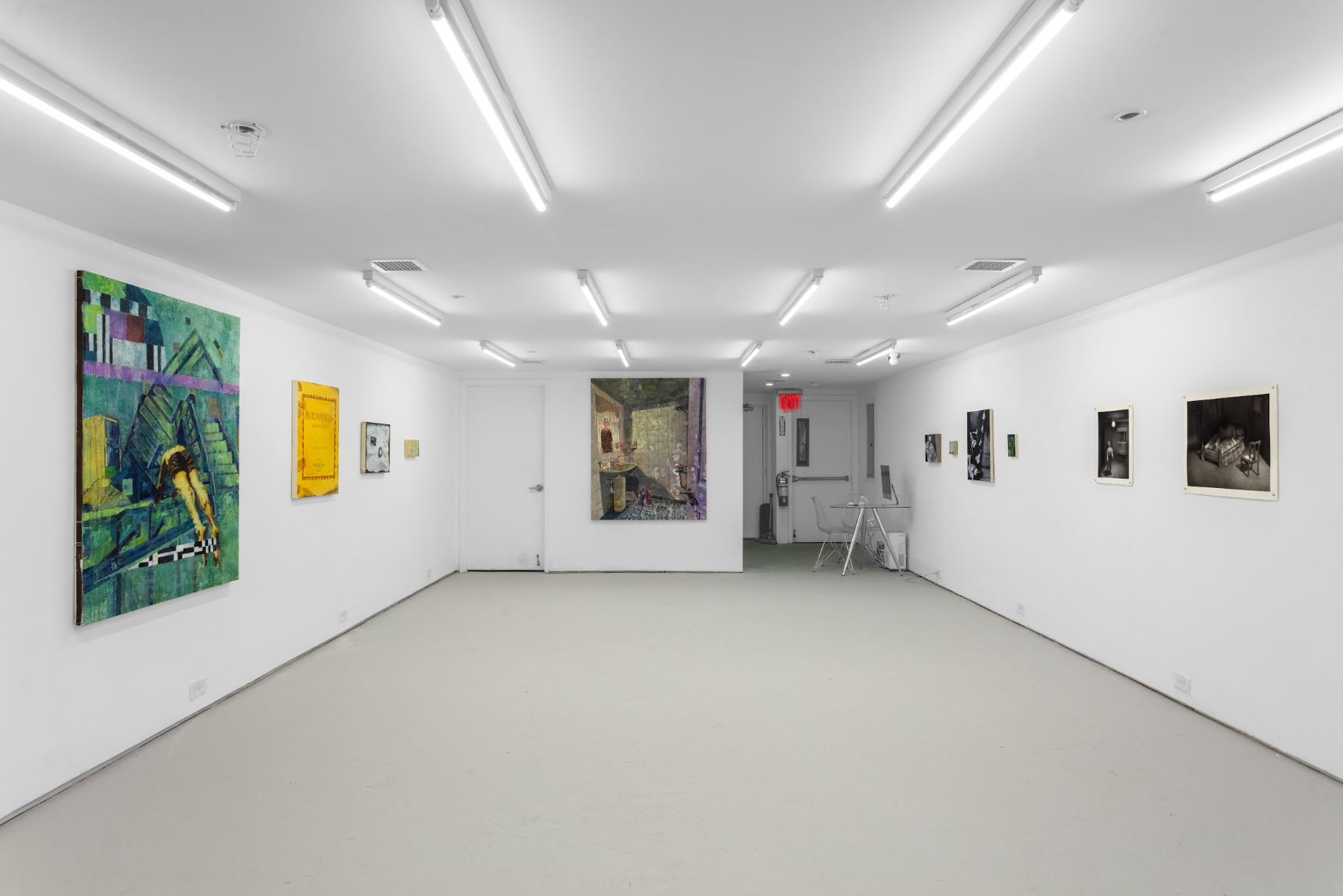
Installation view of Meanwhile, the Mise-en-Scène. Courtesy of the artist and the gallery.
Jordan Sears extracts fabric, folds, and cropped bodies from fashion and commercial photography, enlarging them through a visual language resembling the cinematic close-up; titles such as Banded, Cinched, Contained, and Suspended repeatedly point toward restraint, tightening, and suspension. Here, clothing does not merely cover the body; instead, it begins to shape how the body is supposed to appear. The seemingly natural poses, scales, and cropping conventions of advertising images have already entered the way the body understands itself: we live as bodies while simultaneously imagining those bodies as images that can be viewed and edited. Mise-en-scène, therefore, no longer remains within the frame. It has already begun to take place inside the body.
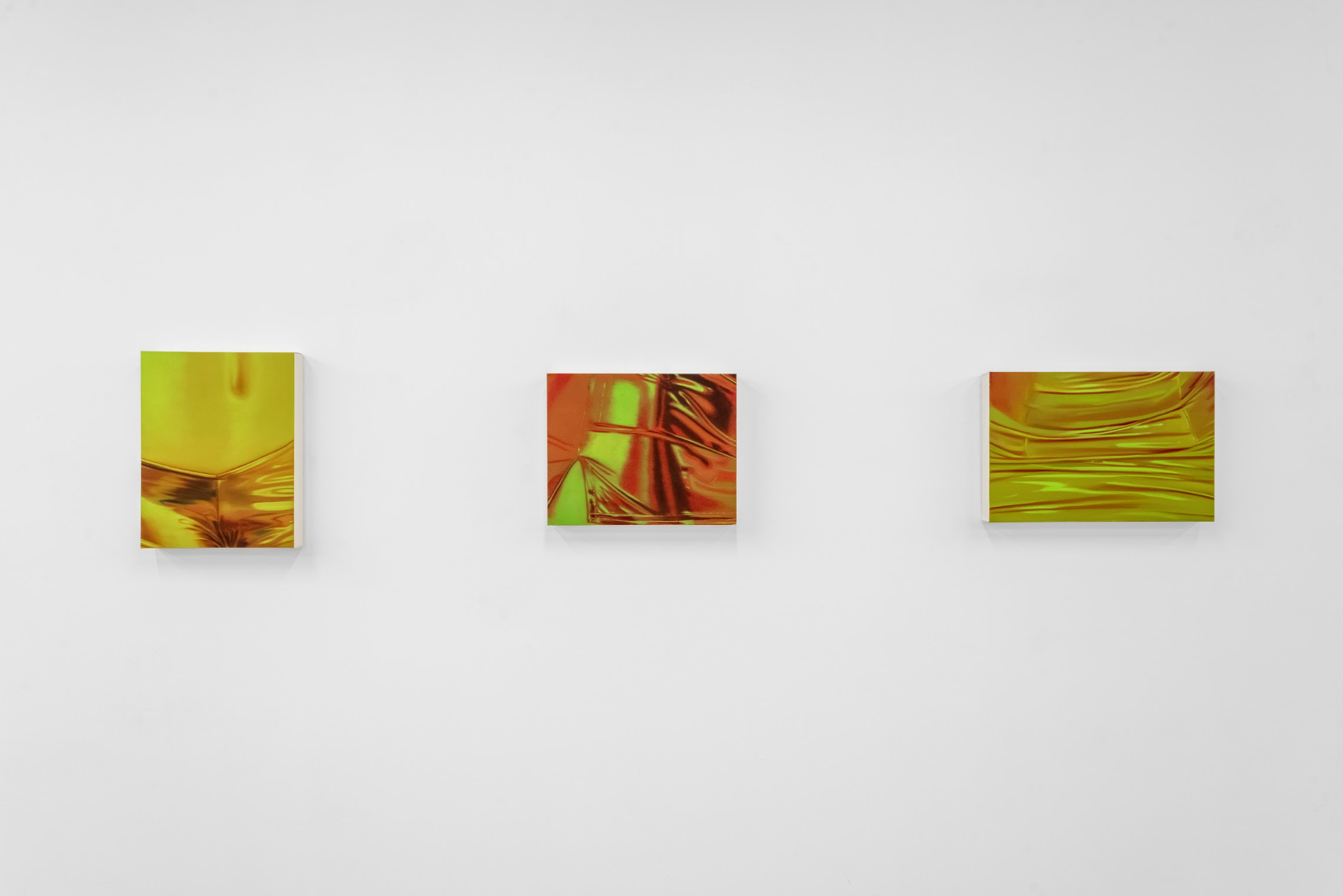
Installation view of Meanwhile, the Mise-en-Scène. Courtesy of the artist and the gallery.
With Weican Wang and Jiaqi Mao, this resistance becomes less material than temporal. Sea, sky, family imagery, and intimate relationships retain their familiarity, yet they can no longer be fully entered. This is both the tenderness and the cruelty of the photograph: it returns the past to view while simultaneously confirming that the past is no longer accessible. Mao’s attention to Lao Lao, the Chinese term for one’s maternal grandmother, is especially resonant in this regard. A familial name can summon an entire bodily memory: voice, gesture, domestic space, and details too minor or too intimate to describe precisely. Yet the image also places that intimacy on the other side of time. Memory keeps someone present while making the distance from that person newly perceptible.
Installation view of Meanwhile, the Mise-en-Scène. Courtesy of the artist and the gallery.
From this perspective, “Meanwhile” also acquires a more complex meaning than simply “something else is happening at the same time.” What may truly be happening simultaneously are experience and observation. We enter cities, rooms, families, and relationships while continually stepping back from them, imagining how these experiences might appear from the outside. The curatorial text treats the stillness of painting as a method: when narrative time is suspended, the otherwise imperceptible fissure between the body and a highly mediated environment can begin to surface. Film will eventually cut to the next shot, but painting forces us to remain, making us aware that while the figures in the image have been positioned in particular places, we ourselves, standing before the painting, have never occupied a neutral position either.
The most convincing aspect of Meanwhile, the Mise-en-Scène, then, is not how cinematic these paintings appear, but how the concept of cinema ultimately turns back upon and explains reality. Today’s mise-en-scène may have long since ceased to belong exclusively in front of the camera: urban spaces, commercial images, social media, and the gazes of others collectively train us in how to enter a scene—and how to imagine ourselves within it.
We are still living. But meanwhile, we are becoming increasingly accustomed to standing to the side, watching ourselves live.
Shuhan Zhang (b. 2002, Jiangsu, China) is a curator and writer. She is currently an M.A. candidate in Visual Arts Administration at New York University and holds a B.A. from the Central Academy of Fine Arts. Her research focuses on digital art, cultural platforms, and the contemporary art market. She has curated exhibitions including After Throwing, Formless, Imageless, The Bitterest Ice Cream, I’m a Cyborg, but That’s OK, Between the Breath of Objects, After the Face, Lithic Coordinates, Losing Ghosts, A Lure, A Lament, and Spreading Growth. Her writing has been published in Tussle Magazine, IMPULSE Magazine, Art Spiel, and Whitehot Magazine, with a focus on exhibition criticism and contemporary art discourse.