
The Body Remembers More Than We Do
by Shuhan Zhang
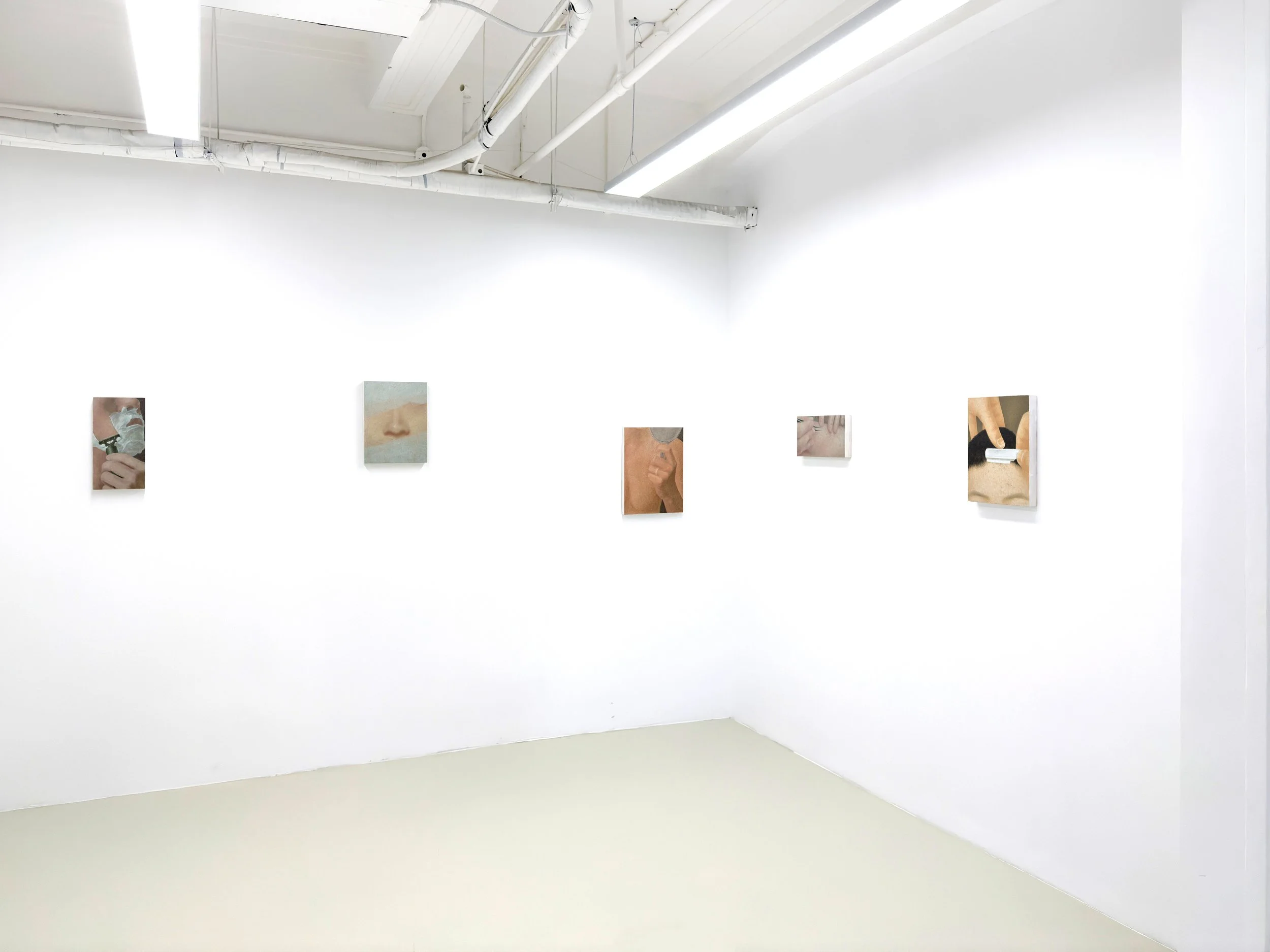
Installation view of Archived in Bodies. Courtesy of the artist and the Cub_ism_ Artspace.
Sometimes I think the body is a strange thing. We live with it every day, yet rarely notice its presence. It is only when something small happens that it suddenly comes forward from the background: a tan line left on the shoulder at the end of summer, a bruise noticed in the shower, a tiny patch of skin torn from dry lips, or the few millimetres of hair that have grown back after a haircut. These things rarely become memories we deliberately preserve, but they happened all the same. When I saw Lanxiong Zheng’s Archived in Bodies, what first came to mind were precisely these things that were never written down in a diary, yet once left their traces on the body.
The body rarely appears whole in the exhibition. Zheng fragments it into the abdomen, back, skin, hands, and other partial views from which identity is almost impossible to determine. The exhibition also focuses on bodily fragments and on the subtle relationships between the body, plants, and the surrounding environment. Rather than presenting the body as a complete and clearly defined image, it begins to feel more like a surface that continually receives time and experience. This way of looking is actually quite close to how we look at our own bodies in everyday life. We rarely stand in front of the mirror and examine ourselves as a whole. More often, we suddenly notice a particular detail: this part looks darker than before, there is a new mark here, or something once familiar has changed without us realising when.
One of the works I spent the longest time with was Tan Lines. The painting shows a patch of sun-darkened skin, crossed by pale lines where clothing once blocked the light, with a small star-shaped mark in the centre. There is almost no narrative to the image, yet it immediately made me think of looking in the mirror at the end of summer. It is only then that you realise how long you must have spent under the sun, that you really did go to the beach, that you really did walk so far. The trip has already ended. The photographs have been buried somewhere deep in your phone, and many of the details have already begun to fade, but your skin has not yet returned to how it was. It is still carrying that summer with it. I like this small gap in time. We tend to think that memory happens first in the mind, but sometimes the body remembers for longer. A tan line does not consciously record anything. It is simply what remains after the body has encountered sunlight. Yet precisely because it was never intentionally preserved, it somehow feels closer to a real “archive” than a photograph does. The word “archive” usually suggests documents, classification, numbering, and preservation. The archive of the body is much less orderly. Its records slowly appear without our noticing, and often disappear in much the same way.
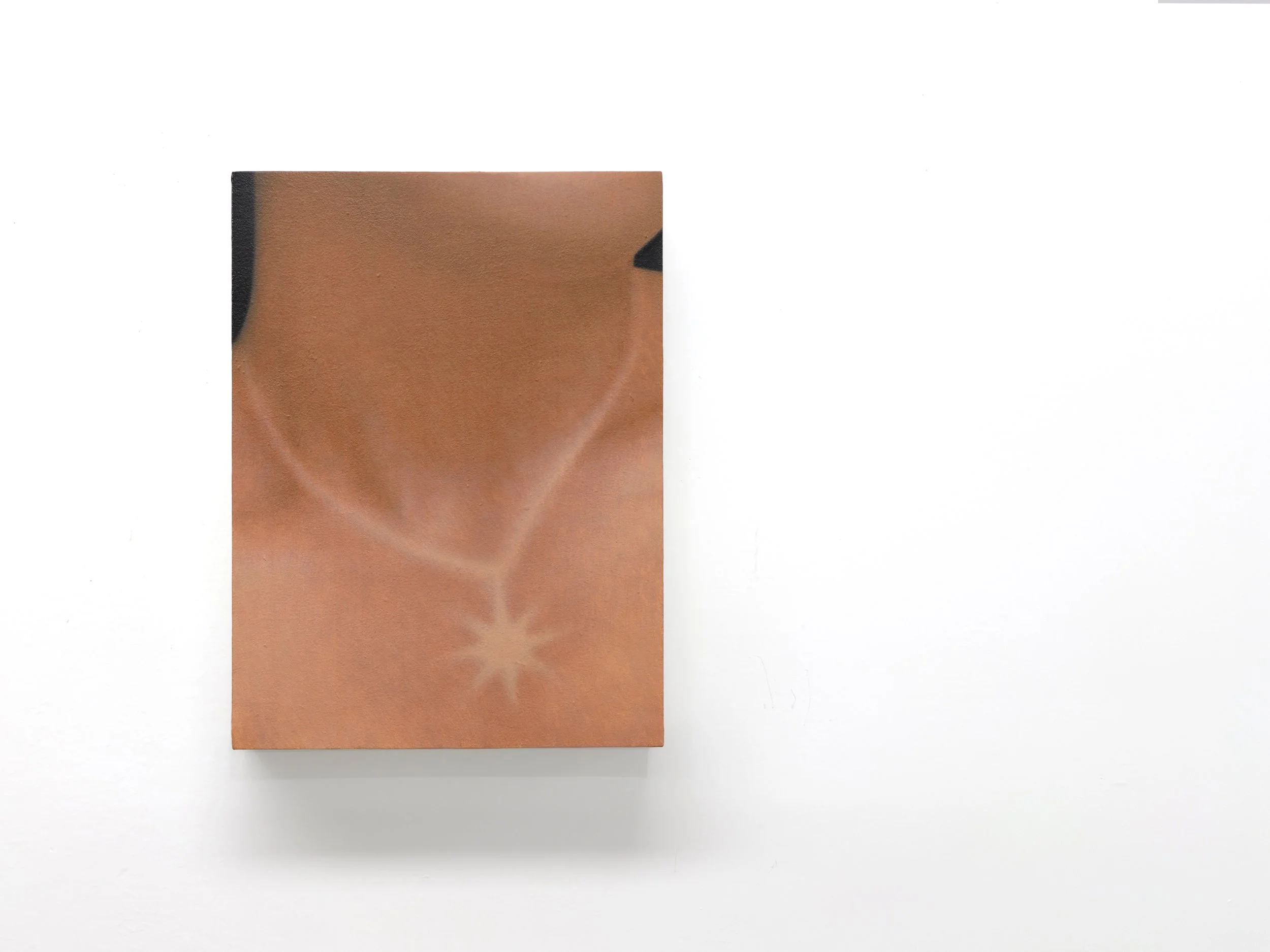
Zheng Lanxiong, Tan Lines, 2026. Courtesy of the artist and the Cub_ism_ Artspace.
But the body is not only a passive receiver of traces. When I came to Haircut, I began to notice a different relationship. The painting isolates the moment of hair being trimmed: fingers hold the hair in place while a tool presses close to the skin. Enlarged and separated from its ordinary context, the action becomes slightly unfamiliar. Cutting one’s hair is such an ordinary thing that we rarely think about it. Yet once the gesture is placed alone inside a painting, I suddenly became aware of how constantly we are altering our own bodies. We cut away hair that has grown too long, shave away what we do not want, trim our nails, treat our skin, hide some marks and create others. These actions happen so routinely that we rarely think of them as a process of “shaping” the body. Yet perhaps the body is constantly being rearranged through these repeated gestures. It never reaches a truly finished version of itself. What is cut today will grow again. What feels familiar today will change again after some time. In this sense, Archived in Bodies is not only about the body being recorded by time. We ourselves are also repeatedly entering this archive and revising it.
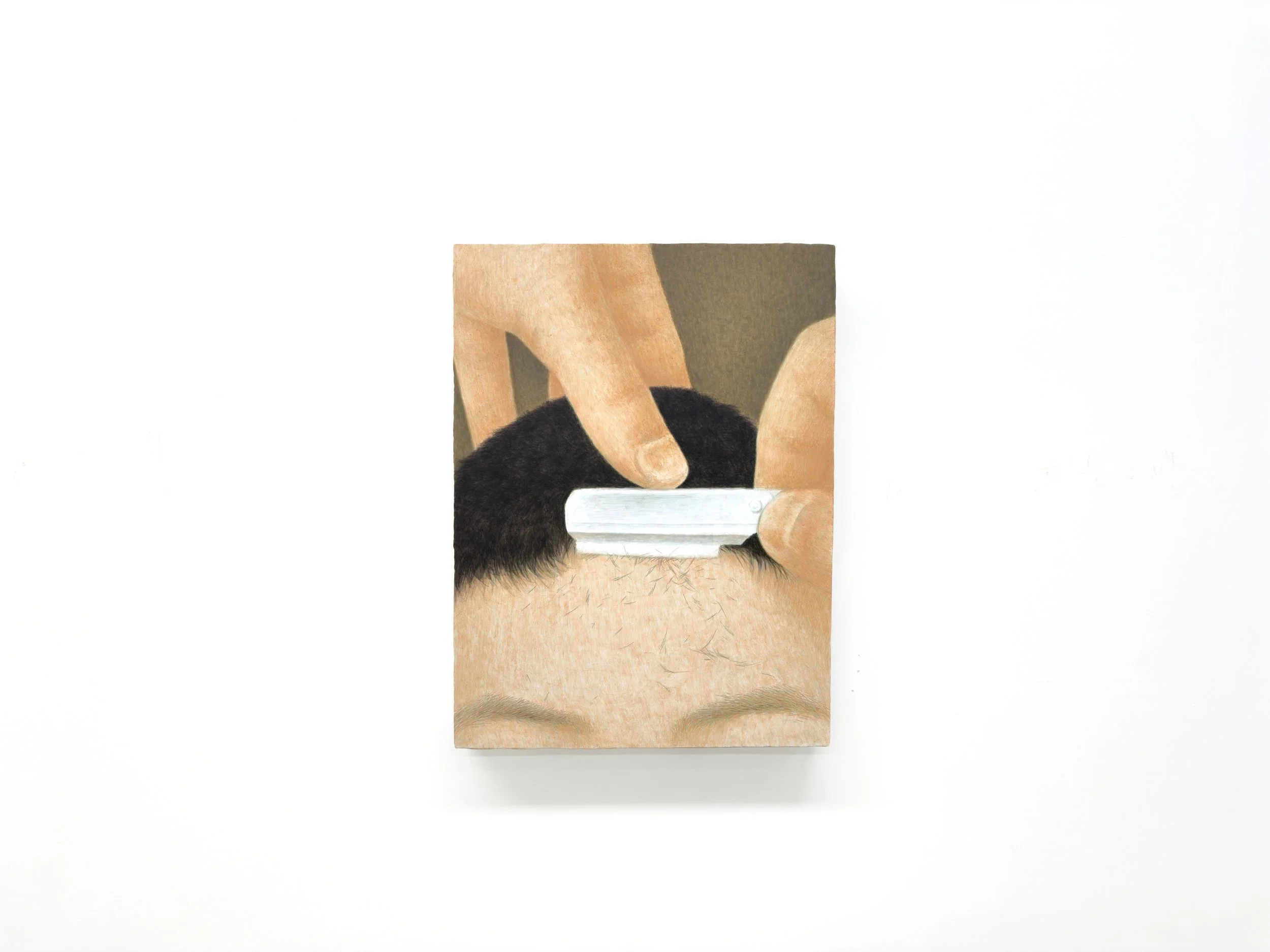
Zheng Lanxiong, Haircut, 2026. Courtesy of the artist and the Cub_ism_ Artspace.
Thistle pushed this thought a little further for me. In the painting, a bare body appears alongside a thorny plant. The plant does not simply sit in the background. It seems to press against the surface of the skin, while its branches, thorns, and shadows overlap with the body. My first reaction was almost physical: I found myself wondering whether the thorns were about to touch the skin. That very immediate response made me realise that the body in Zheng’s paintings is not a sealed or self-contained body. It is always in contact with the outside world. Sunlight changes the colour of the skin, plant shadows fall across it, blades move close to its surface, clothing leaves its boundaries behind. What we call “my” body is never entirely separate from its surroundings. Zheng’s practice has long grown out of personal experience, emotion, and memory, using a highly individual viewpoint to isolate fragments of everyday life. What I find compelling in Thistle is this instability of boundaries. The body seems protected and vulnerable at the same time, as if it might be pierced at any moment. We often think of the skin as the clearest boundary between the body and the world, yet almost every experience of the world must first pass through this boundary.
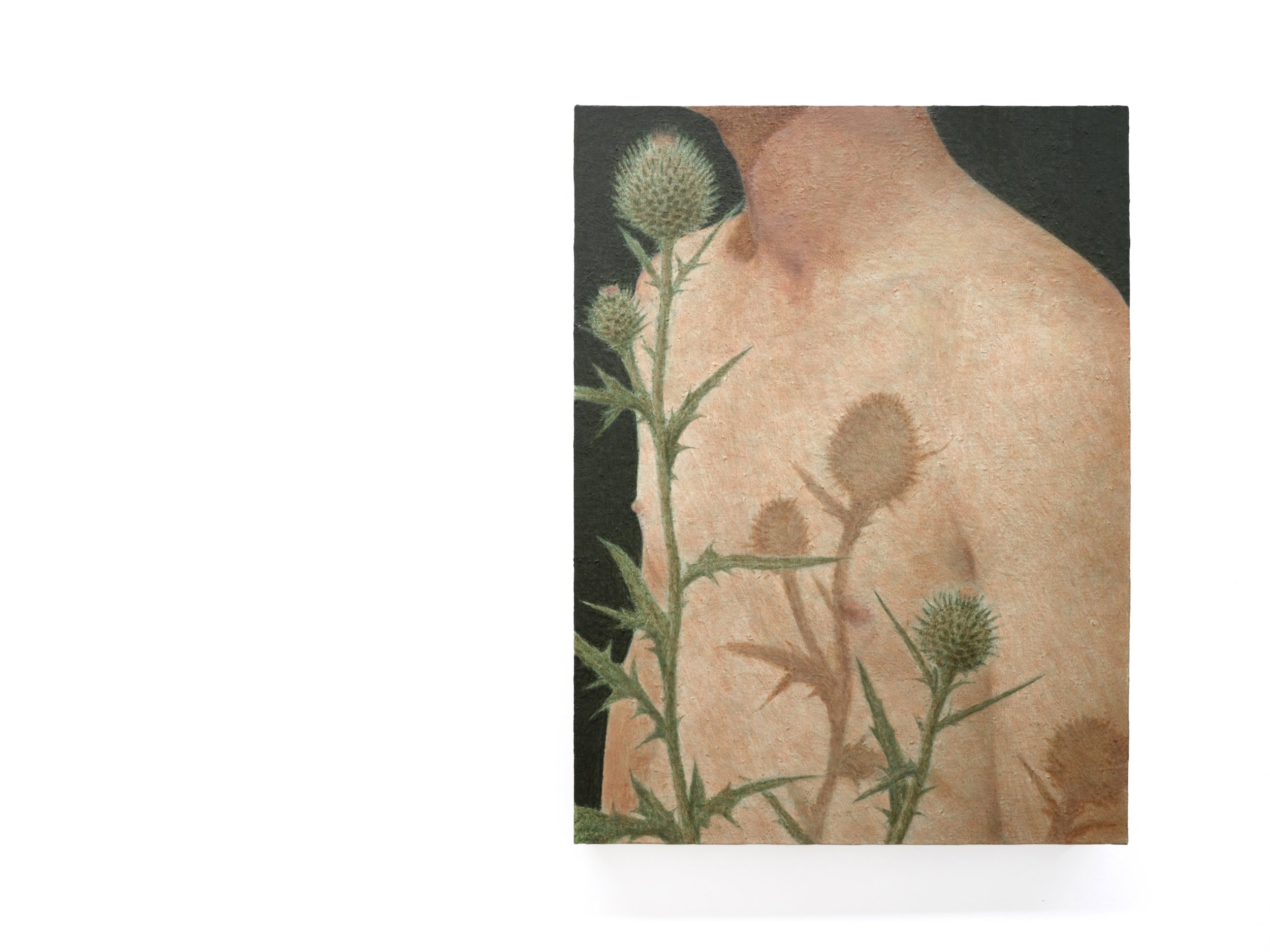
Zheng Lanxiong, Thistle, 2026. Courtesy of the artist and the Cub_ism_ Artspace.
The final work that made me stop was Mist. Here, a flesh-toned fragment of the body is placed against a cool, almost grey-blue background. The contours of the body and the traces on its surface seem to be slowly fading away. Tan lines lighten. Wounds heal. A scar that was once sharply visible may, years later, become only a faint discolouration. We do not preserve our experiences permanently inside the body. On the contrary, the body is also constantly covering over its own past. Zheng’s use of tempera contains a similar process: colour is repeatedly layered, covered, and adjusted, with each intervention leaving another trace of time within the painting. I like the resemblance between painting and the body here. The arrival of something new does not mean that what came before has completely disappeared. It may simply have been pushed further underneath, becoming harder to see.
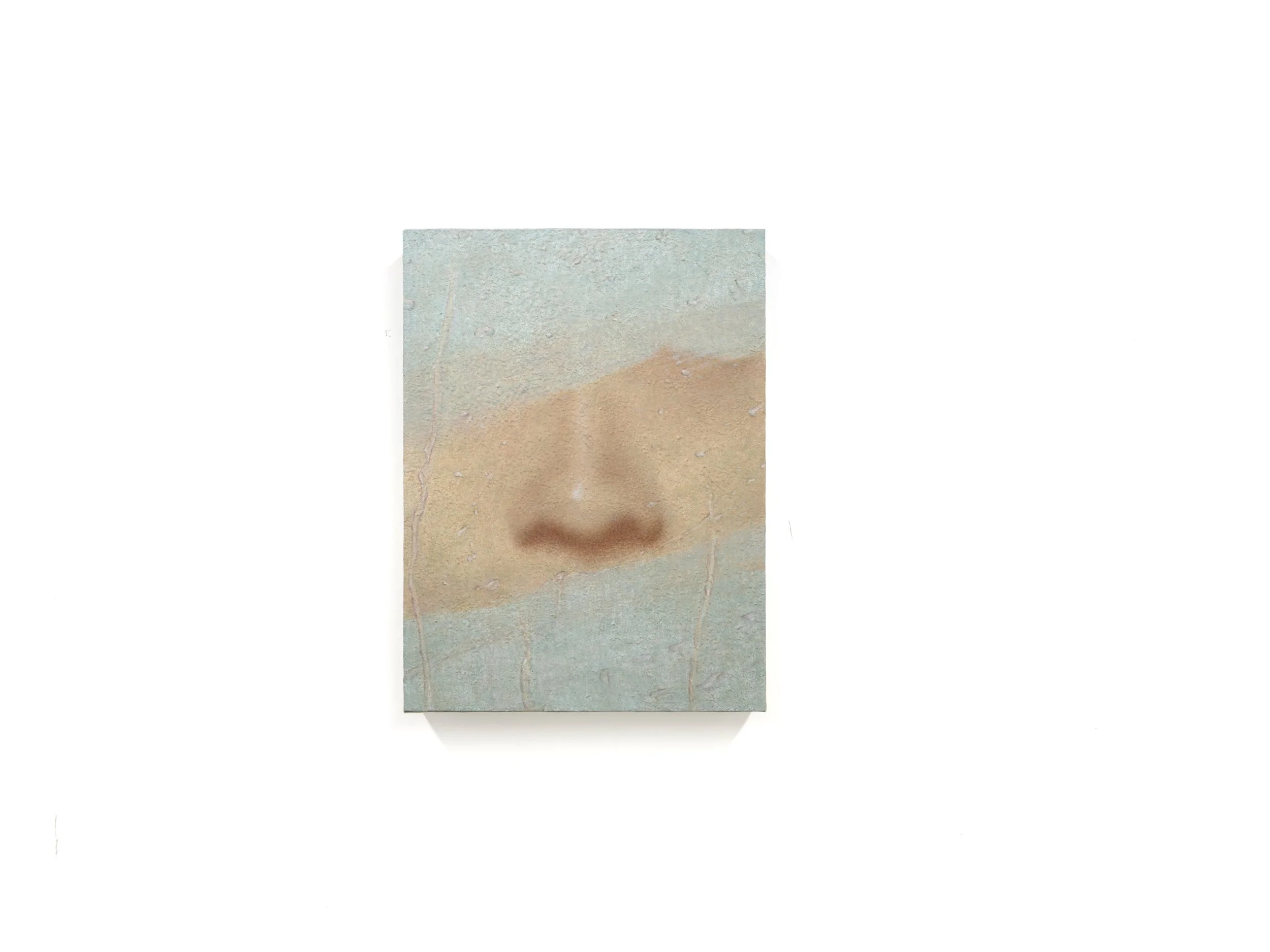
Zheng Lanxiong, Mist, 2026. Courtesy of the artist and the Cub_ism_ Artspace.
By the end of the exhibition, the word “archive” began to feel slightly contradictory to me. We usually preserve archives because we do not want something to disappear. But the body itself can never truly be preserved. It is always changing, always revising the records it has left behind. Some traces emerge, some fade, and some disappear before we even have time to notice them. This is what I like about Archived in Bodies. It did not suddenly give me some grand revelation about what the body means. Instead, it made me notice small things again: tan lines, hair, skin, and the subtle changes that remain after the body comes into contact with the world. After leaving the exhibition, I even found myself instinctively looking down at my own hands, thinking about wounds that were once so visible and are now almost impossible to find.
There are things I no longer remember. But my body once did. Perhaps the “archive” of the body was never meant to preserve a fixed version of who we are. Perhaps it simply records the ways in which we have passed through time.
Archived in Bodies is a solo exhibition by Lanxiong Zheng, curated by Calvin Wang, on view at Cub_ism_ Artspace in Shanghai from August 29 through October 17, 2026.
Shuhan Zhang (b. 2002, Jiangsu, China) is a curator and writer. She is currently an M.A. candidate in Visual Arts Administration at New York University and holds a B.A. from the Central Academy of Fine Arts. Her research focuses on digital art, cultural platforms, and the contemporary art market. She has curated exhibitions including After Throwing, Formless, Imageless, The Bitterest Ice Cream, I’m a Cyborg, but That’s OK, Between the Breath of Objects, After the Face, Lithic Coordinates, Losing Ghosts, A Lure, A Lament, and Spreading Growth. Her writing has been published in Tussle Magazine, IMPULSE Magazine, Art Spiel, and Whitehot Magazine, with a focus on exhibition criticism and contemporary art discourse.