
When Form Dissolves, the Image Recedes
by Bella Wei
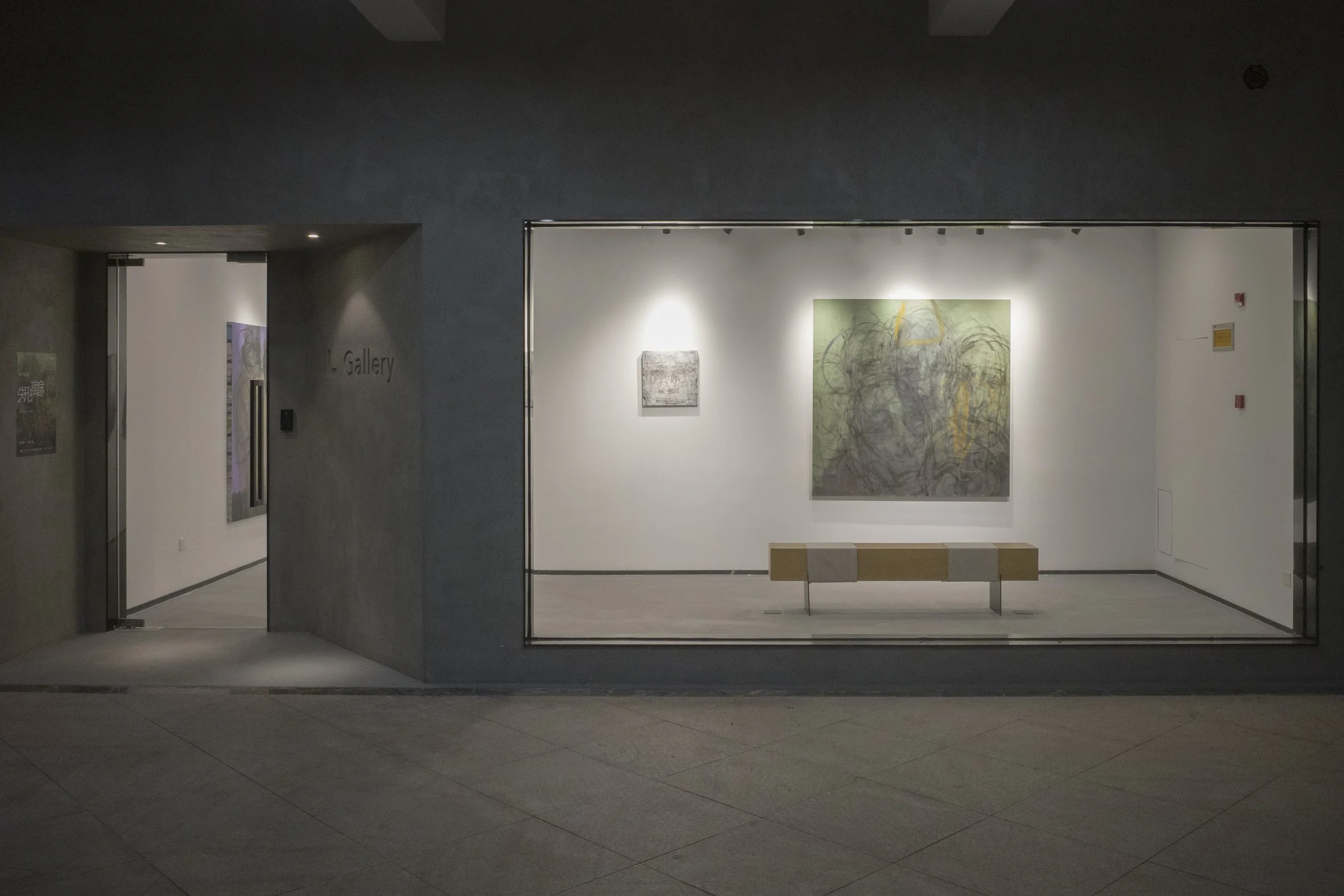
Installation view of Formless, Imageless. Courtesy of the artist and L Gallery.
Before entering L Gallery, visitors can already glimpse two works hanging on the interior wall through the gallery’s street-facing window. Reflections of the plaza and the viewers’ blurred silhouettes spread across the glass, partially obscuring the paintings beyond.
Formless, Imageless is a solo exhibition by artist Zhang Hongyu, curated by Shuhan Zhang, on view at L Gallery in Hangzhou from August 3 to 19, 2026. Through a series of paintings that move between portraiture and abstraction, the exhibition examines how forms dissolve through repeated acts of layering, obscuring, and erasure, and how looking persists when recognition begins to break down.
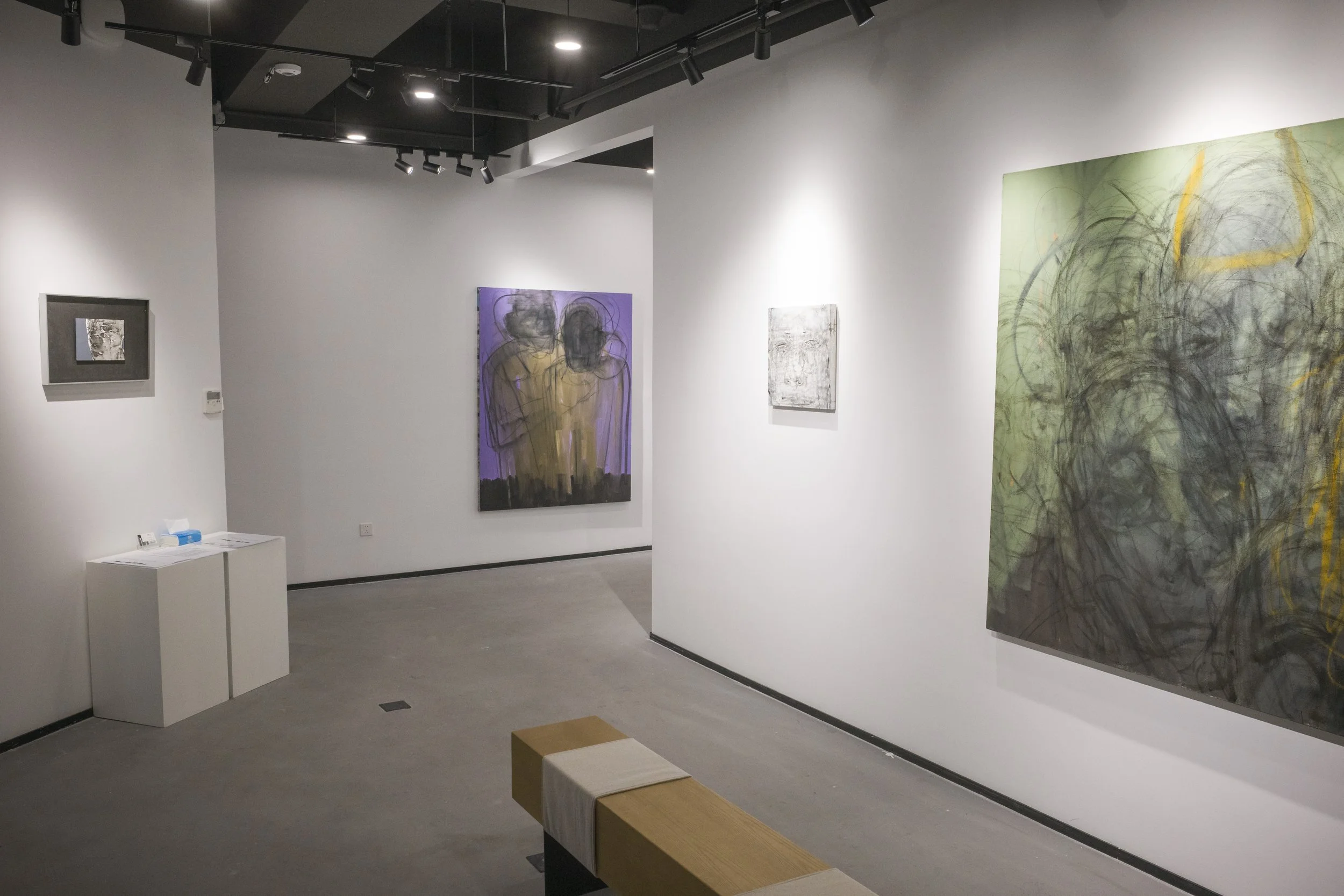
Installation view of Formless, Imageless. Courtesy of the artist and L Gallery.
In Arrogance and Abyss, three skull-like outlines cluster at the centre of the canvas against a heavy greenish-grey ground. An intricate network of lines nearly absorbs their facial features. The figures resemble three overlapping profiles of the same person, or three bodies pressed so closely together that their contours bleed into one another. Both readings remain possible, and the painting leaves the tension unresolved. Nearby, Uncrowning Tears extends this ambiguity. Its lines carry a similar density, yet feel noticeably heavier, as though an emotion were sinking without ever reaching the bottom.
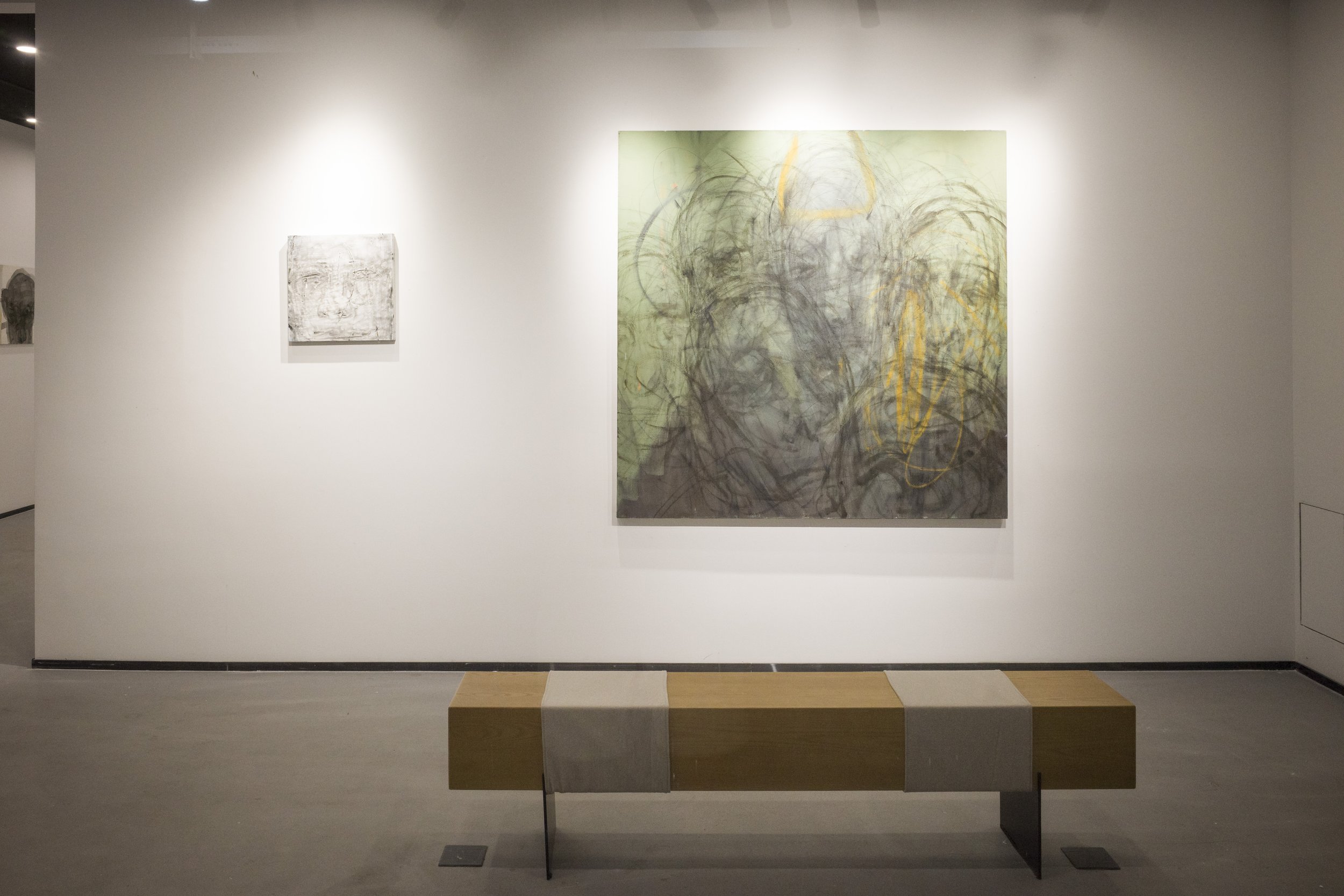
Installation view of Formless, Imageless. Courtesy of the artist and L Gallery.
The dissolution of form and the recession of the image recur throughout the exhibition. Across accumulated layers of brushwork, forms loosen, erode, and consume one another, depriving the act of looking of a stable basis for recognition. As expressions, identities, and narratives recede, the image gradually withdraws from what can be clearly identified or narrated. The works ultimately pose a question to the viewer: when a painting no longer offers a definite interpretation, are we still willing to remain before it and allow our memories, emotions, and experiences to shape what we see?
The exhibition text draws on Gilles Deleuze’s idea that clarity can be undone through clarity itself. In Francis Bacon: The Logic of Sensation, Deleuze considers how Bacon’s distorted and erased faces loosen the face from conventional representation and bring it closer to the material reality of flesh and suffering. This framework offers a productive way to approach Zhang Hongyu’s paintings. Clarity first takes shape through precise and accumulated marks, then gradually collapses under the pressure of the same gestures that produced it.
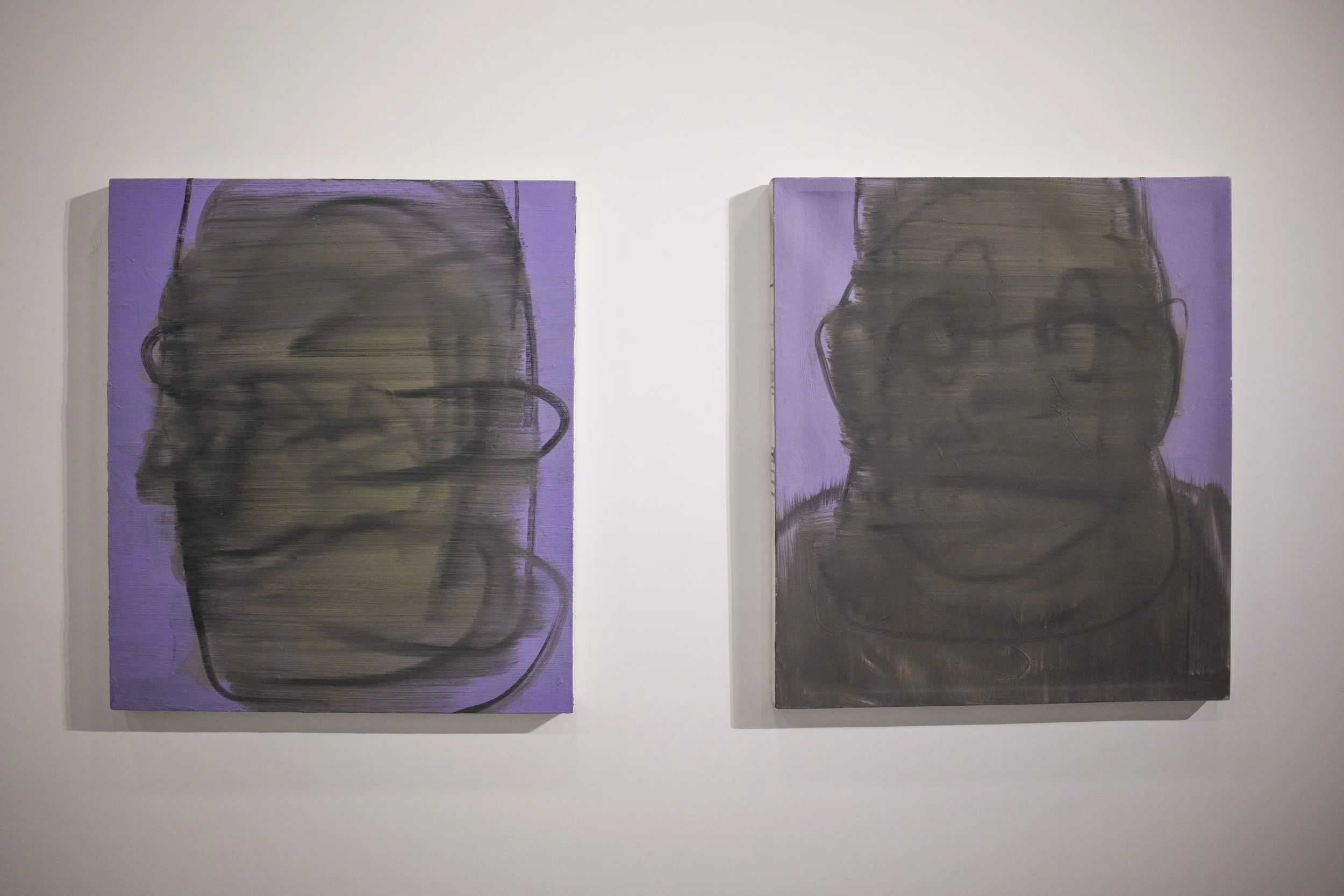
Installation view of Formless, Imageless. Courtesy of the artist and L Gallery.
Some works push the dissolution of form to an extreme. Lines accumulate in concentric rings; each stroke remains distinct and materially present, yet their density eventually causes them to consume one another. Downward drips of paint make the faces appear to melt and peel away from the canvas. Zhang Hongyu describes this technique as a process of subtraction involving dissolution, obscuring, and withdrawal. For the artist, certainty takes shape through an unfolding process instead of a fixed moment. The paintings enact this logic: as the lines dissolve the original image, they also open up new possibilities. What remains on the canvas is often less than what first appeared.
Another group of works moves away from figuration more quietly. They retain the basic structure of portraiture—the volume of a head, the profile of a face, and faint traces of facial features. The identity and personal history of the depicted figure gradually recede, giving way to an elusive state of mind. As viewers spend more time with the paintings, their capacity to identify a particular sitter weakens, while their emotional charge becomes increasingly palpable. What remains resembles an emotional residue left behind after the figure has faded.
Perhaps the few minutes spent before the gallery window already foreshadow the entire viewing experience. Seen through the reflective glass, forms become indistinct, yet the viewer continues to search for something recognisable within them. The dissolution of form and the recession of the image offer no finished narrative, leaving a cluster of unresolved sensations. After leaving the gallery, those blurred outlines continue to linger in memory, much like the parts of ourselves that resist articulation: silent, yet undeniably real.
The exhibition is curated by Shuhan Zhang, with Xiaoxiao Yu serving as executive curator. Formless, Imageless is on view at L Gallery in Hangzhou from August 3 through August 19, 2026.
About the author:
Bella Wei is a curator and writer based in Shanghai, currently pursuing studies in art theory at the Central Academy of Fine Arts. As a core member of the art organization ARTION, she has curated exhibitions in cities including Paris, Shanghai, and Hangzhou. Her writing and practice focus on the public nature of contemporary art exhibitions, spatial narratives, and emotional expression.