
When Does a Home Begin?
by Luman Jiang
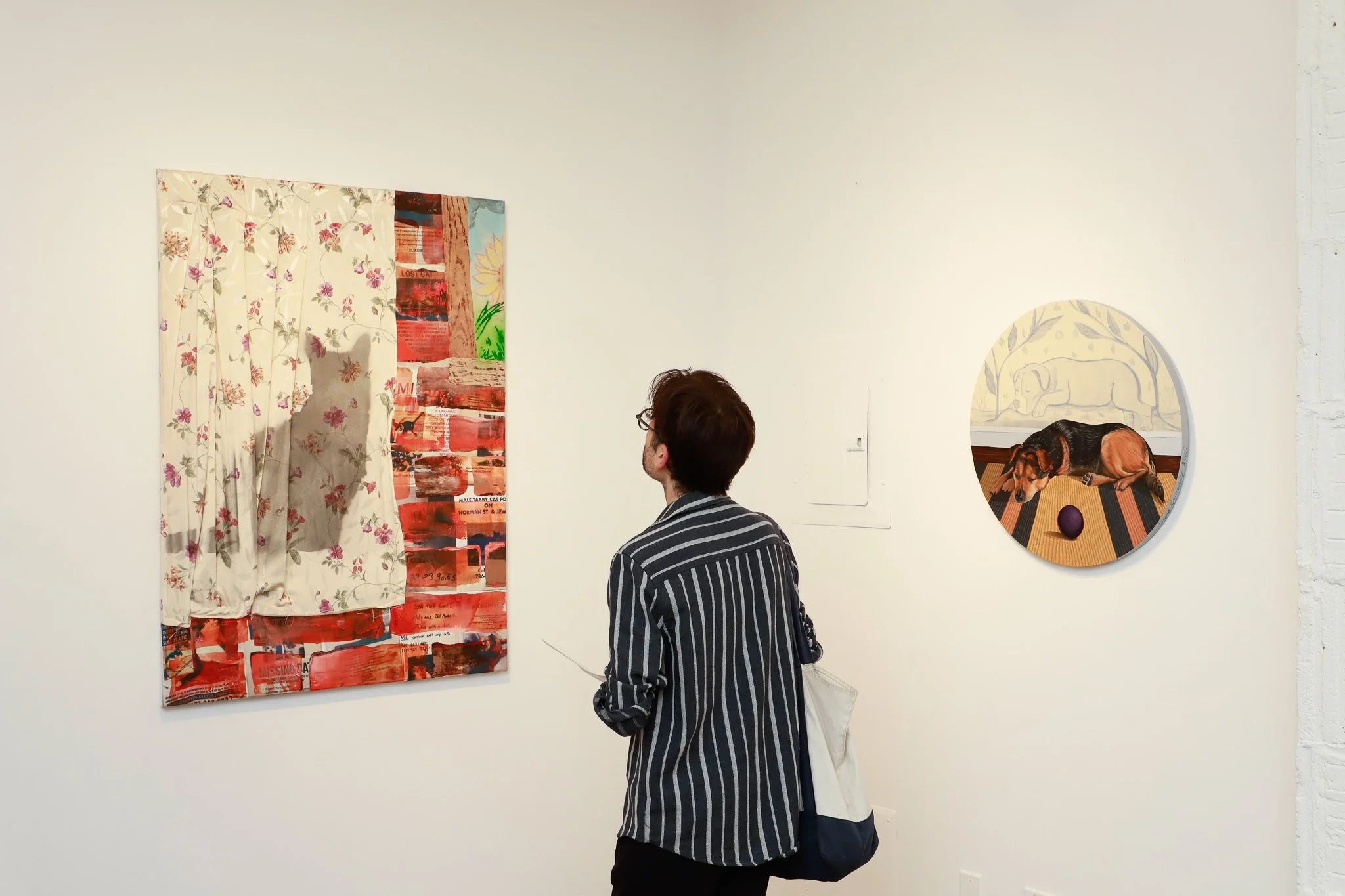
Installation view of A Home Together, FLOHAUS Gallery, New York, 2026. Photo courtesy of FLOHAUS Gallery.
A cat looks up from an open cardboard box. The box still bears traces of its original use for packaging and transport. It can be moved or discarded and offers only the most limited form of shelter. Yet when the cat meets the gaze of someone standing outside the box, this ordinary container begins to acquire another meaning: a life that might otherwise have gone unnoticed brings someone to a stop.
What turns an act of seeing into an encounter? That initial pause may not yet be love, nor is it simply pity. It is closer to the feeling that one can no longer remain uninvolved. The animal no longer recedes into the urban background but emerges as a particular life calling for a response. Yet stopping can only open a relationship. It is not enough to make a home.
Held at FLOHAUS Gallery in New York from August 27 through September 6, 2026, the group exhibition A Home Together begins with just such an encounter. Curated by Jinyi Freya Xu and presented in recognition of International Homeless Animals Day, the exhibition brings together 27 artists whose works engage with companionship, rescue, care, coexistence, and belonging. “Encounters” focuses on meetings between humans and animals and on the beginnings of emotional attachment, while “Home Together,” through small-scale works and a salon-style presentation, turns toward the intimate spaces shaped by art, animals, and everyday life.

Luigi Mallozzi, And i will call you.. cornetto!, 2026. Oil on canvas with removable cardboard box, 40 × 30 cm. Image courtesy of the artist and FLOHAUS Gallery.
Does removing a life from danger mean that it has found a home? If a cardboard box, an animal shelter, or an indoor space can temporarily protect a body, what transforms shelter into belonging?
Luigi Mallozzi’s And i will call you.. cornetto! captures precisely this unfinished moment. The work is rooted in Mallozzi’s experience of finding his black cat in a similar box. In the painting, the cat takes its name, “Cornetto,” from the words and images printed on the box. Naming turns a chance encounter into a shared history that can be narrated, transforming an anonymous stray into an individual who can be recognized and remembered. As the cat looks upward, viewing ceases to be a one-way act. The animal also looks back, and the person outside the box begins to understand that a response may be required.
The cardboard box is not merely depicted. As a removable element, it enters the physical structure of the work itself. It is both discarded packaging and a temporary refuge. The box may conceal the body without ensuring its safety, preserving a life for the moment while leaving its future unresolved. What changes is not the physical form of the box but a person’s relationship to the life inside it. When looking becomes pausing, and pausing becomes responsibility, an ordinary container can become the starting point for a shared life.
For curator Jinyi Freya Xu, the distance between a box and a home is also personal. She found a kitten only a few hours old in a cardboard box, brought her home that same evening, and named her Jiojio. The box offered shelter for the moment; bringing Jiojio home began the much longer work of caring for her.
Political theorist Joan Tronto’s ethics of care offers one way of understanding this transition. In Moral Boundaries (1993), Tronto treats care not simply as goodwill or emotion but as an ongoing practice: noticing another life’s needs, assuming responsibility, carrying out the material work of care, and remaining attentive to how that care is received. From this perspective, being moved is not yet the same as caring, just as shelter is not yet the same as home. Nor can care be defined unilaterally by the one who provides it. It requires attention to how another life accepts, refuses, or responds to care, and a willingness to adjust the relationship accordingly.
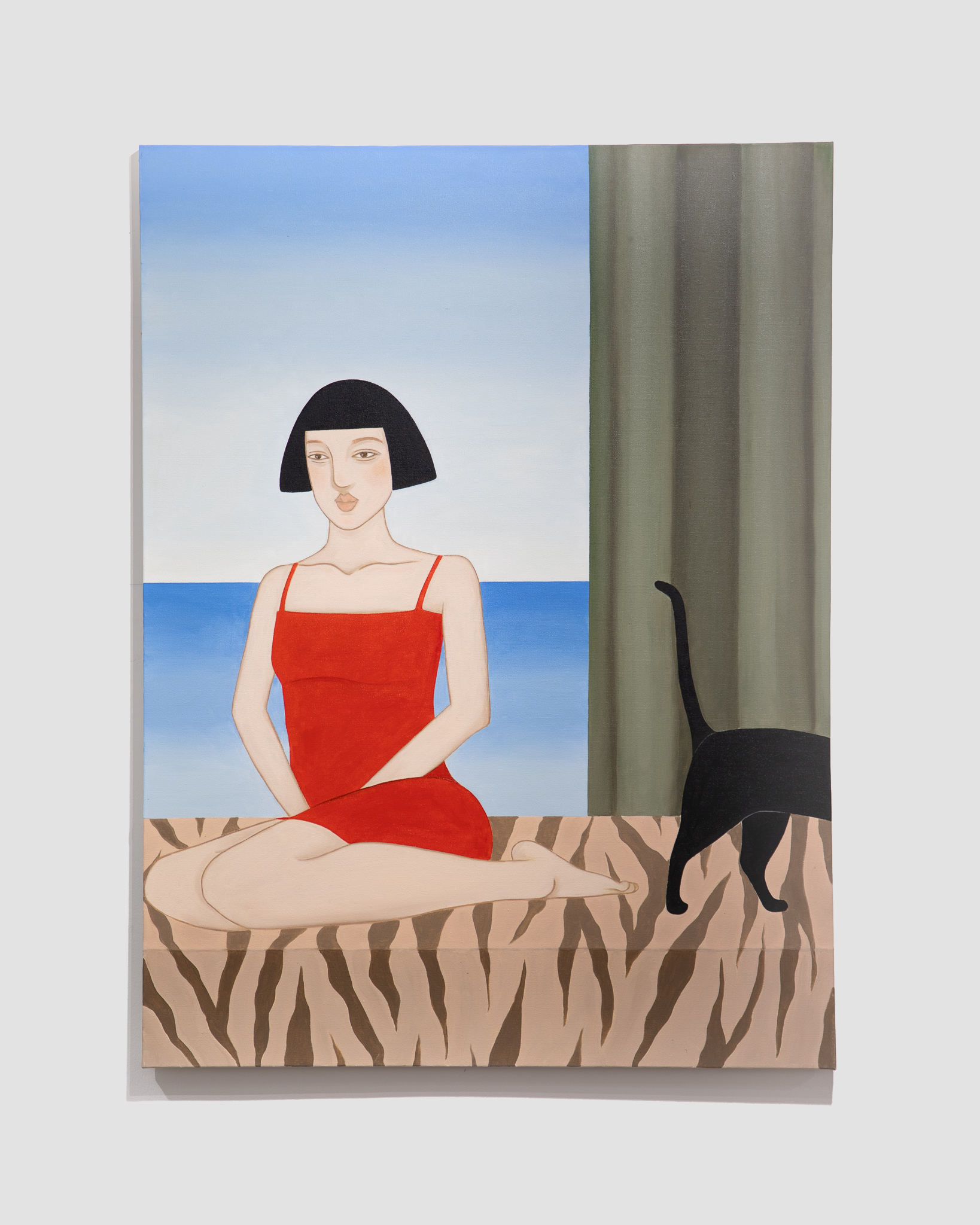
Chandra Fang, Untitled, 2025. Oil on canvas, 30 × 40 in. Image courtesy of the artist and FLOHAUS Gallery.
Chandra Fang’s Untitled brings this question into a quiet, everyday scene. The artist’s friend sits on a patterned sofa, while an adopted black cat appears mid-stride at the right edge of the painting. They face different directions and do not touch. The cat is neither held nor made the focus of the composition; it simply moves through the room. Their distance reads less as separation than as ease. Read alongside Tronto, the scene suggests that care can also mean leaving room for another life to approach, withdraw, or remain nearby on its own terms.
In David Enriquez’s We’ll Play Again Someday, home persists through bodily habit. The work depicts the artist’s two dogs, Picasso and Frida. Picasso passed through three families before Enriquez’s family became his fourth and final home. After Picasso’s death, Frida began sleeping in the place where he had often rested. That familiar spot remains part of the household’s daily life, now occupied by Frida.
Care, however, does not make a home permanent. In Sammy Bennett’s Shadow of Alo, the safety of one cat is placed beside the disappearance of many others. Bennett incorporated a curtain from his home into the work, spray-painting Alo’s shadow directly onto it and layering it with lost-cat and lost-dog posters collected over several years. The curtain once hung in the domestic space Bennett shared with Alo, while the painted shadow testifies to the cat’s presence without presenting his body. These animals, too, once had names, habits, and homes; now their photographs and descriptions ask others to help find them. By placing these notices on a curtain from his own home, Bennett brings the uncertainty surrounding their disappearance into a familiar domestic setting. Home offers protection, but the shared life it shelters remains vulnerable to separation and loss.
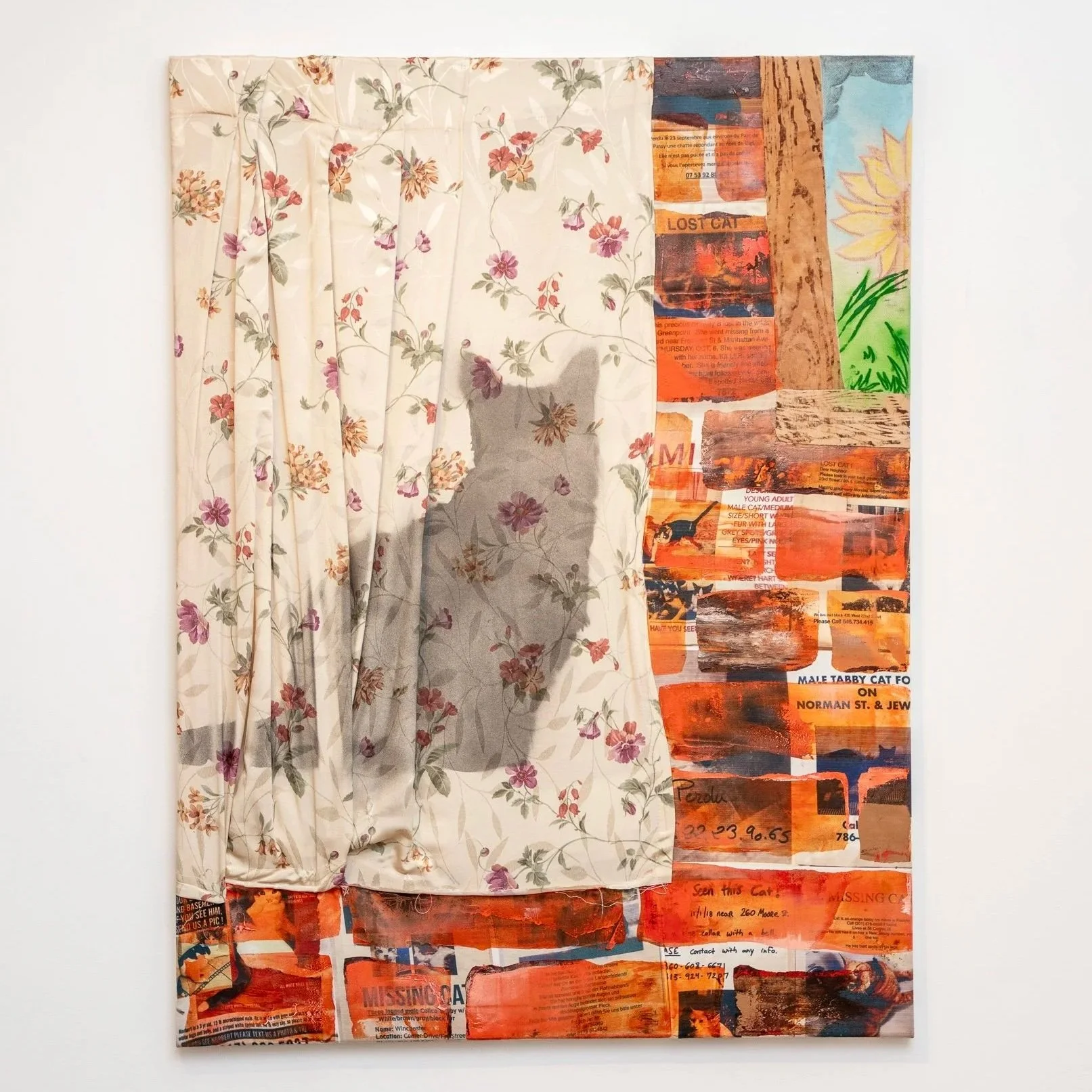
Sammy Bennett, Shadow of Alo, 2021. Acrylic, screen-print, dye-sublimation, and curtain on canvas, 46 × 38 in. Image courtesy of the artist and FLOHAUS Gallery.
The salon-style presentation of “Home Together” carries these individual experiences into a shared space. Paintings, photographs, ceramics, illustrations, and small objects begin to resemble the traces of life that gradually accumulate within a home. By bringing different lives, stories, and memories into proximity, the exhibition allows home to emerge through many small, overlapping relationships.
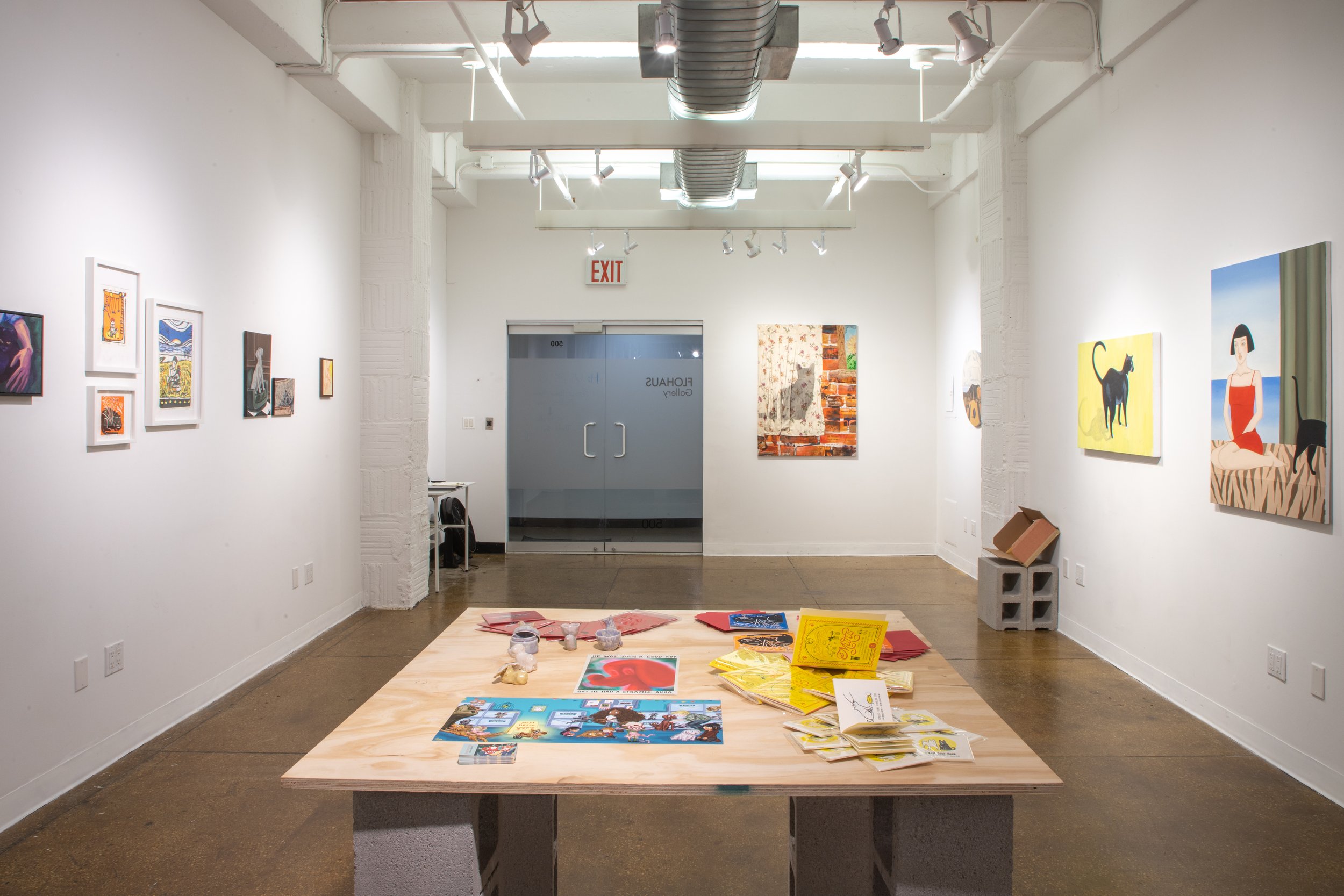
Installation view of A Home Together, FLOHAUS Gallery, New York, 2026. Photo courtesy of FLOHAUS Gallery.
From Mallozzi’s cardboard box and Bennett’s curtain to the images and objects gathered throughout the salon, A Home Together does not present home as a solid or complete architecture. Home instead takes up temporary residence in gazes, names, resting places, bodily habits, and preserved objects. Home may begin when someone stops, but it is not completed in that moment. That first pause matters, but what follows—feeding, waiting, adjusting, and remembering—slowly gives home its shape. Here, “Together” names an unfinished practice: noticing another life, making room for its habits, and keeping a place for it even after separation or loss.
A Home Together was a group exhibition curated by Jinyi Freya Xu and presented at FLOHAUS Gallery in New York from August 27 through September 6, 2026.

Luman Jiang (b. 2002, Chongqing, China) is a writer and curator whose practice moves between Chinese- and English-language art worlds. Her criticism, published in Whitehot Magazine and Tussle Magazine, examines exhibitions through questions of cross-cultural translation and mediation. She holds an M.A. in Visual Arts Administration from New York University.