
The Slack Chain
Written by Luman Jiang
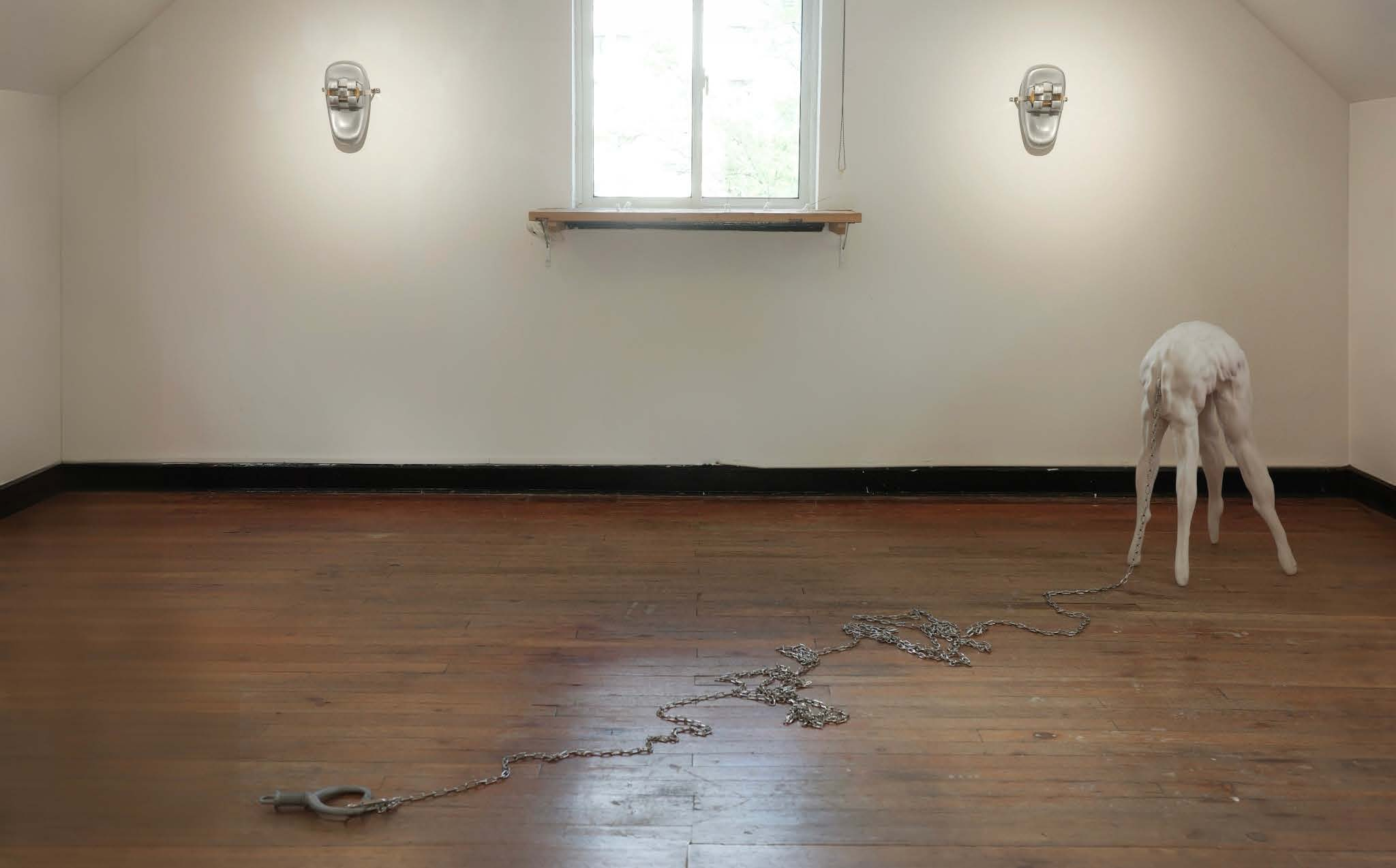
Installation view of Eva Chenyao He’s Procrustean, COLLECTA, Shanghai, 2026. Image courtesy of the artist and COLLECTA.
On the wooden floor, a chain lies in loose coils. At one end is a flesh-colored form: four long, slender limbs give its silhouette a vaguely animal quality, while its upper portion resembles a human torso. Its surface gathers into downward folds. The other end of the chain is attached to a gray ring, open on one side. The ring lies on the floor across the room and does not encircle the form. Between them, the chain crosses an interval of bare floor, making the distance between them part of the work. Only by tracing the chain with the eye do these three elements come together as a single work: nasal septum.
The ring is a slightly enlarged version of a bull’s nose ring, and the title names its point of contact with the body. The artist explains that the open ring represents what remains after its wearer tears through its own nasal septum to escape. The slack chain thus registers an aftermath: escape has come at a bodily cost.
nasal septum appears in Procrustean, Eva Chenyao He’s solo project at COLLECTA in Shanghai. The English title derives from the myth of Procrustes, who cut or stretched bodies to make them fit his bed. The Chinese title, 削足适履, means “cutting the foot to fit the shoe.” Both preserve the measure at the body’s expense. The project statement extends this logic to internalized standards, asking how individuals come to alter themselves to fit predetermined shapes. Adjustment need not await an external command; it can become something a person undertakes.
Disability studies scholar Rosemarie Garland-Thomson develops “misfit” as a concept for understanding the incongruity produced when a particular body encounters a particular environment. Fit emerges from that relationship and can change with its conditions. Invoking this concept does not equate the exhibition’s abstract forms with disabled bodies. It offers a way to ask how these works make a body appear to fit or fail to fit—and to whom they assign the burden of adjustment.
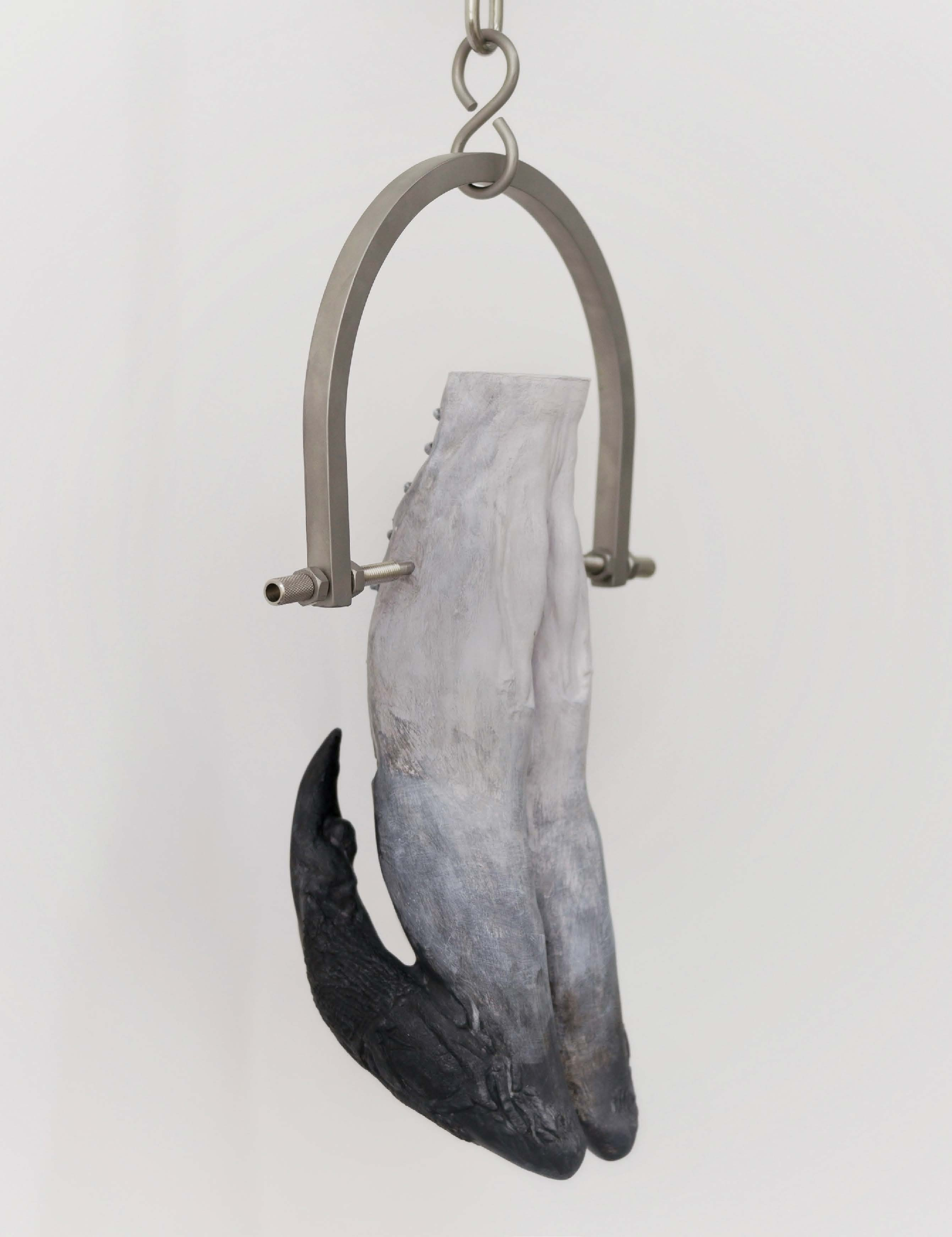
Eva Chenyao He, it took over my gravity, 2026. 3D-printed photopolymer resin and cranial retractor, 12 × 25 × 150 cm. Image courtesy of the artist and COLLECTA.
In it took over my gravity, a form that is gray-white above and nearly black below hangs before a window. A taut chain suspends an arched cranial retractor. Two threaded rods extend inward from opposite sides of the arch and pierce the form’s upper portion; the form’s lower end divides into two lobes. The cranial retractor both suspends and penetrates the form, whose weight bears down on the two points of contact.
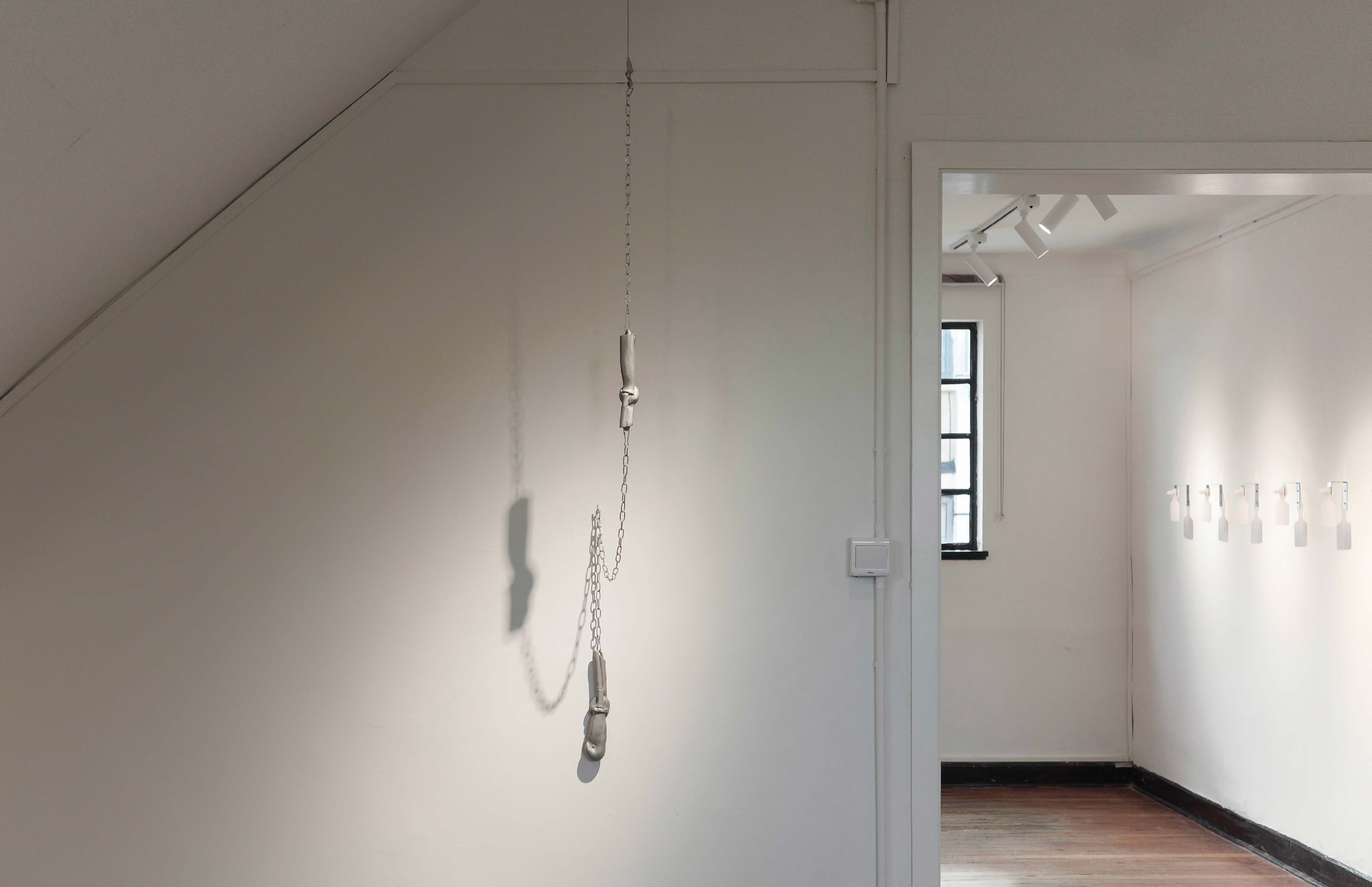
Eva Chenyao He, arm in arm, 2026. Stainless steel and chain, 30 × 30 × 150 cm. Image courtesy of the artist and COLLECTA.
The chain bearing this weight is taut, but not every chain in the exhibition takes the same form. In arm in arm, a chain links two stainless-steel, arm-like components and hangs between them in a loose curve. Unlike the chain resting on the floor in nasal septum, this one is suspended within the assembly, maintaining the connection between the two components as it curves downward. Stainless steel supplies both the bodily contours and the connecting structure. The arm-like shapes suggest companionship, while their connections organize that gesture as a mechanical assembly. Body and device become materially continuous.
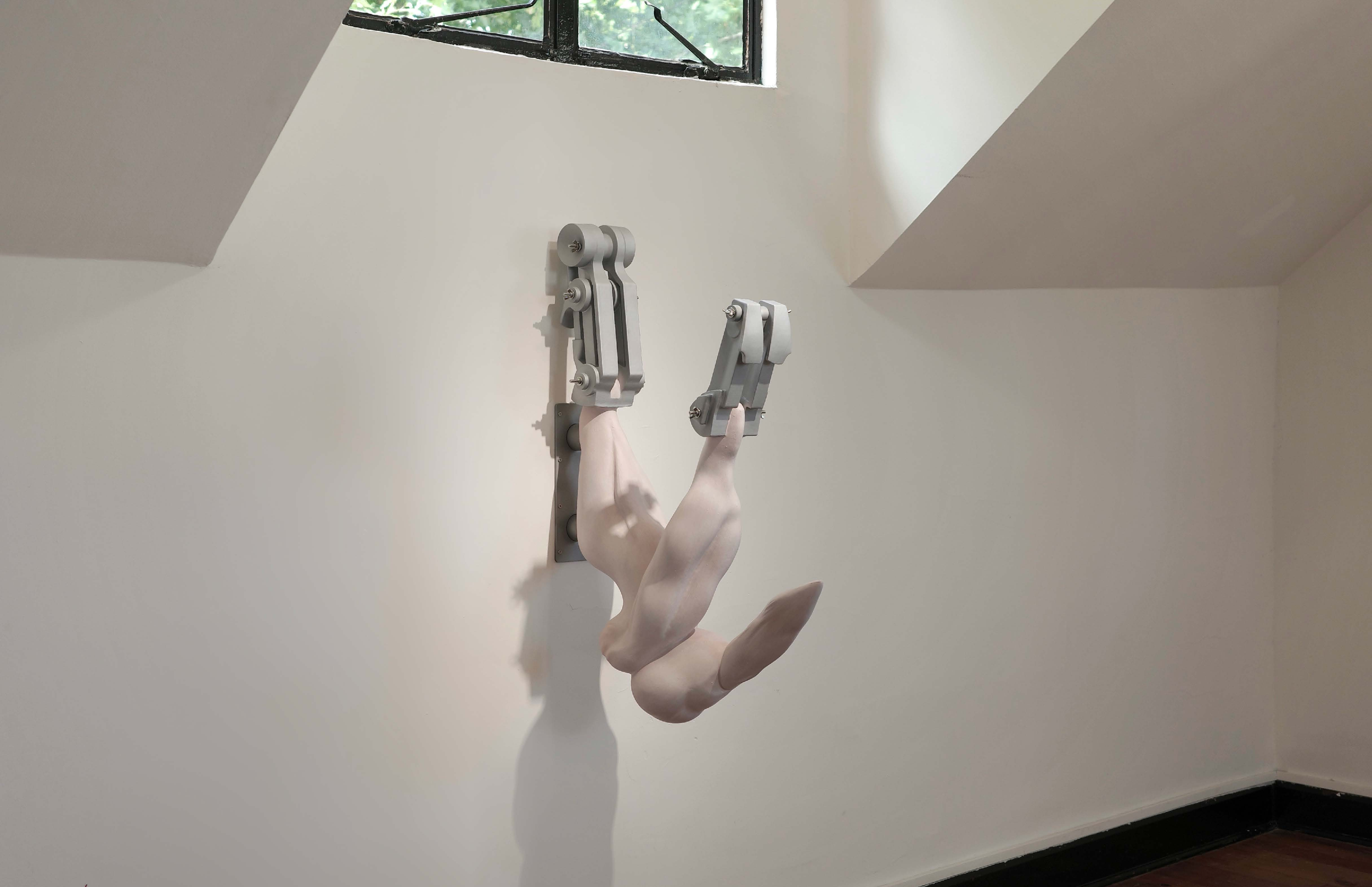
Eva Chenyao He, 3 in 1, 2026. 3D-printed photopolymer resin and stainless-steel hardware, 68 × 22 × 90 cm. Image courtesy of the artist and COLLECTA.
With 3 in 1, “fit” shifts toward assembly and use. Bent flesh-colored sections meet gray articulated structures with visible metal bolts and pivots. The accompanying text compares the arrangement to a Swiss Army knife: the body becomes a component that can be folded, stored, and deployed on demand. Color and shape assign bodily and mechanical roles to the two sets of elements, compressing a complex process of adaptation into a clear formal contrast. The work presents the completed adaptation: a body already bent. Read alongside the project’s account of internalized standards, this finished state is the premise of the work.
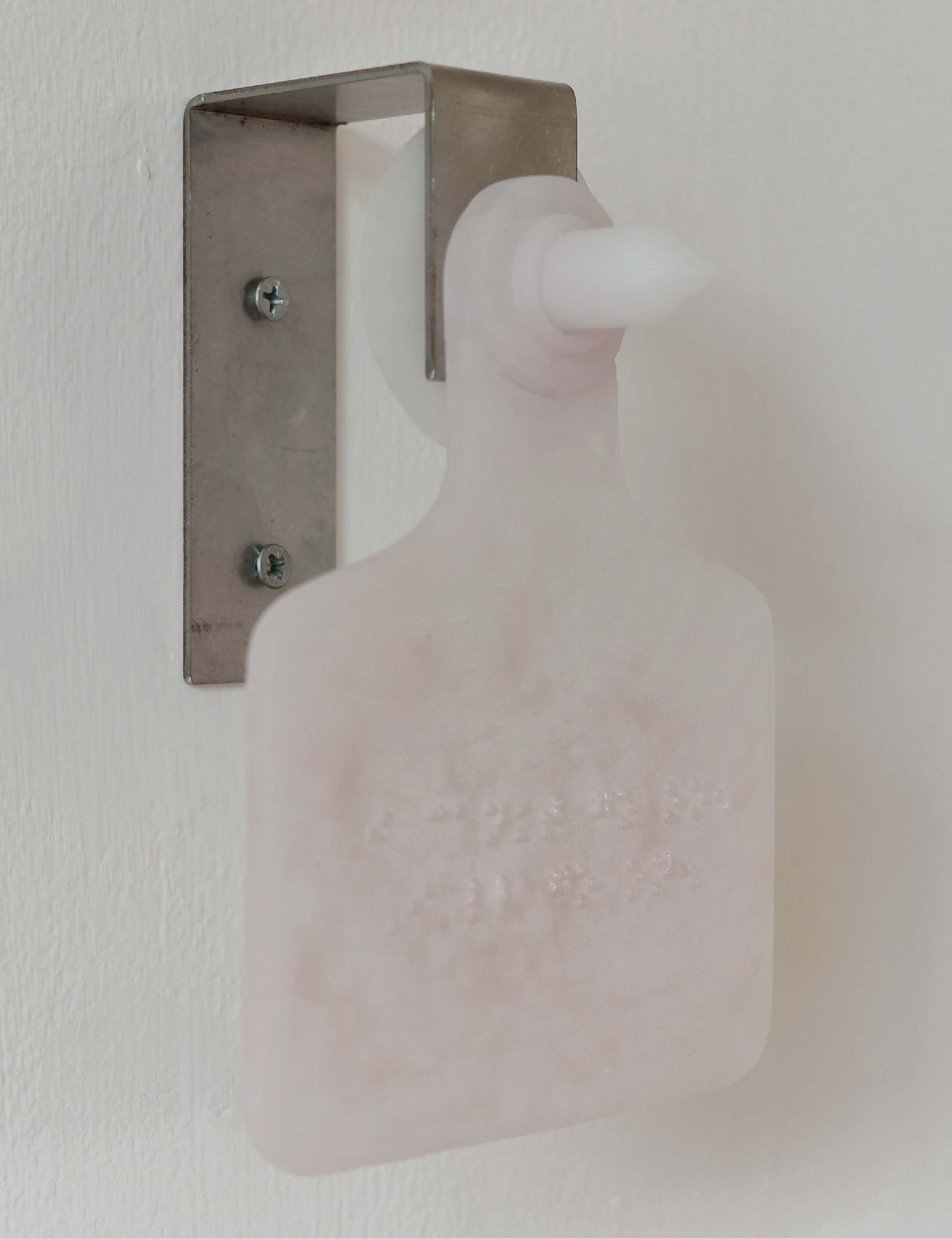
Eva Chenyao He, ear tag (series), 2026. Pâte de verre, 12 × 15 × 1.4 cm each. Image courtesy of the artist and COLLECTA.
ear tag (series) shifts the question from bodily shape to the conditions of legibility. Six works in pâte de verre retain the standardized outline of a livestock ear tag, replacing industrial serial numbers with texts in English Braille. Five feature texts by Rilke, Dickinson, Kafka, Beckett, and Celan; the remaining work presents the artist’s own line, “We have nothing but laughter.” Her words enter the same format and arrangement as the others. Braille is a tactile writing system designed to place language within reach of the hand; here, fragile glass and wall-mounted presentation make tactile access precarious. Viewers may recognize the code without necessarily being able to read its content. This raises a question about the display itself: does it expose a barrier to access, or risk reproducing one? The tag introduces a separate constraint. Six distinct texts occupy a format designed to identify livestock by number, indifferent to what each text says. Standardization becomes visible through the repeated outline, without requiring a contrast between flesh-colored forms and steel devices. The standard does not erase difference; it fixes the shape difference must take in order to be registered at all.
In the attic, the misfit between body and environment takes spatial form. As Peihua Yu notes in the exhibition foreword, visitors bend and crouch beneath the low, sloping ceiling, their postures echoing those of the works. The wooden floor and old window temper the clinical associations of the devices, placing them within a room marked by ordinary habitation. For a visitor who must stoop to continue, the space makes the allocation of adjustment concrete: the body changes its posture while the architecture remains in place. Stooping does not itself establish coercion. It does, however, make perceptible an act of bodily adjustment that a more accommodating space would not require.
This experience also sharpens a question about looking: once the exhibition’s logic has been recognized, what remains to be judged? In 3 in 1, the Swiss Army knife analogy directs attention toward the correspondence between folded bodily forms and functional parts. Under its guidance, looking can become an exercise in confirming the metaphor of a body adapted for use. The limitation lies in how neatly the explanation fits the arrangement, rather than in the decision to show adaptation already completed. Elsewhere, however, the theme is only a starting point. The viewer must still determine how a connection functions, what differences remain within a standardized format, and who is able to access what is displayed.
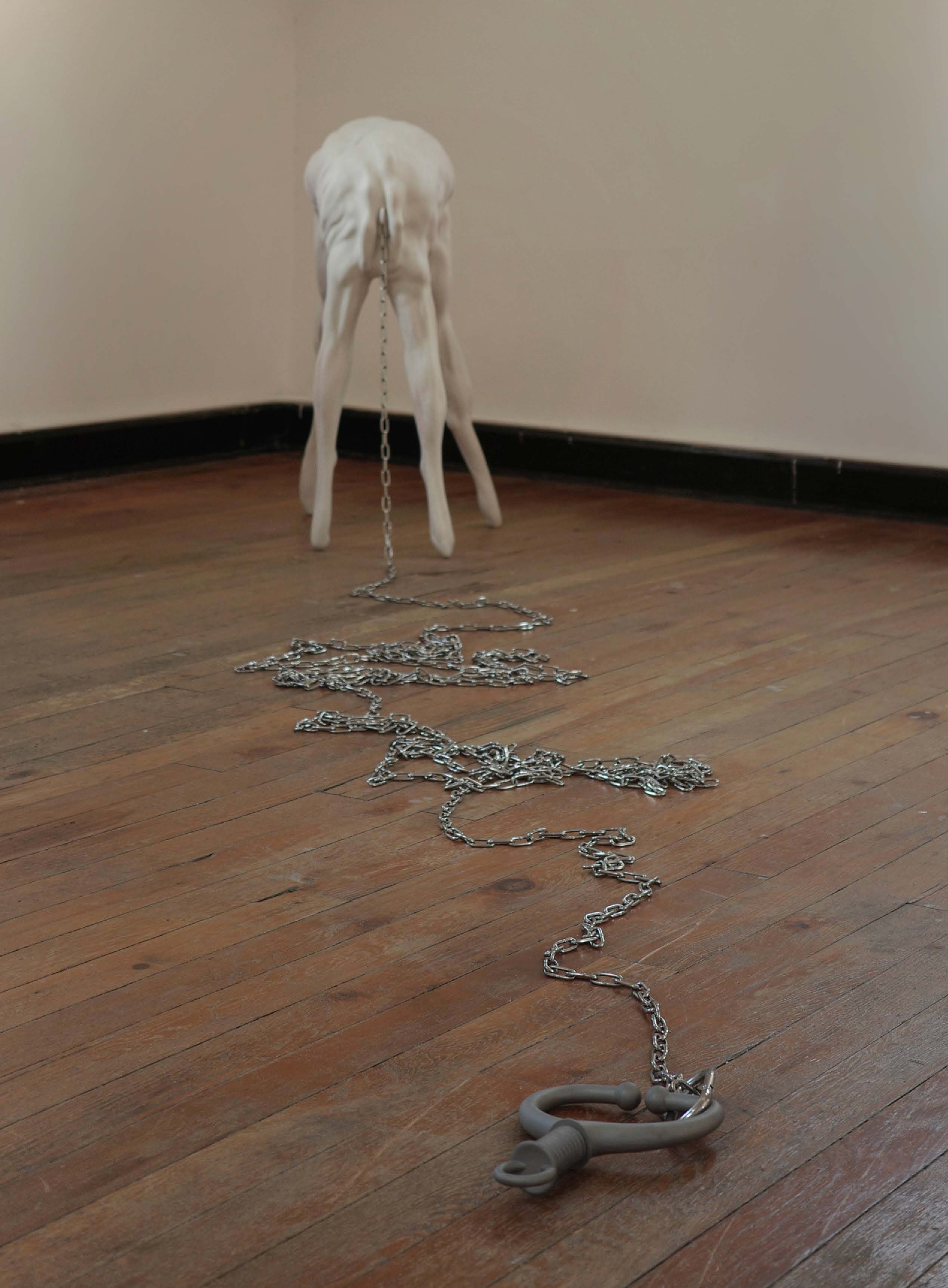
Eva Chenyao He, nasal septum, 2026. 3D-printed photopolymer resin and stainless steel, variable dimensions (body: 45 × 62 × 90 cm; ring: 17 × 4 × 25 cm). Image courtesy of the artist and COLLECTA.
Return to nasal septum. The ring lies open on the floor, and the chain rests in loose coils, still connected to the flesh-colored form. That form, conceived as both victim and system, complicates any clean separation between the body and the mechanisms of control. The installation holds together the trace of escape and the structure left behind: the ring is empty, but the apparatus remains. On Procrustes’ bed, the body pays for conformity. The open nose ring extends the question to refusal: why must the body pay both for conforming to a system and for breaking away from it?
Eva Chenyao He, Procrustean, August 28–September 13, 2026, COLLECTA Shanghai, 4/F, West Building, 77 Tai’an Road, Changning District, Shanghai.

Luman Jiang (b. 2002, Chongqing, China) is a writer and curator whose practice moves between Chinese- and English-language art worlds. Her criticism, published in Whitehot Magazine and Tussle Magazine, examines exhibitions through questions of cross-cultural translation and mediation. She holds an M.A. in Visual Arts Administration from New York University.