
What the Cloth Holds: On Soft Friction
by Luman Jiang
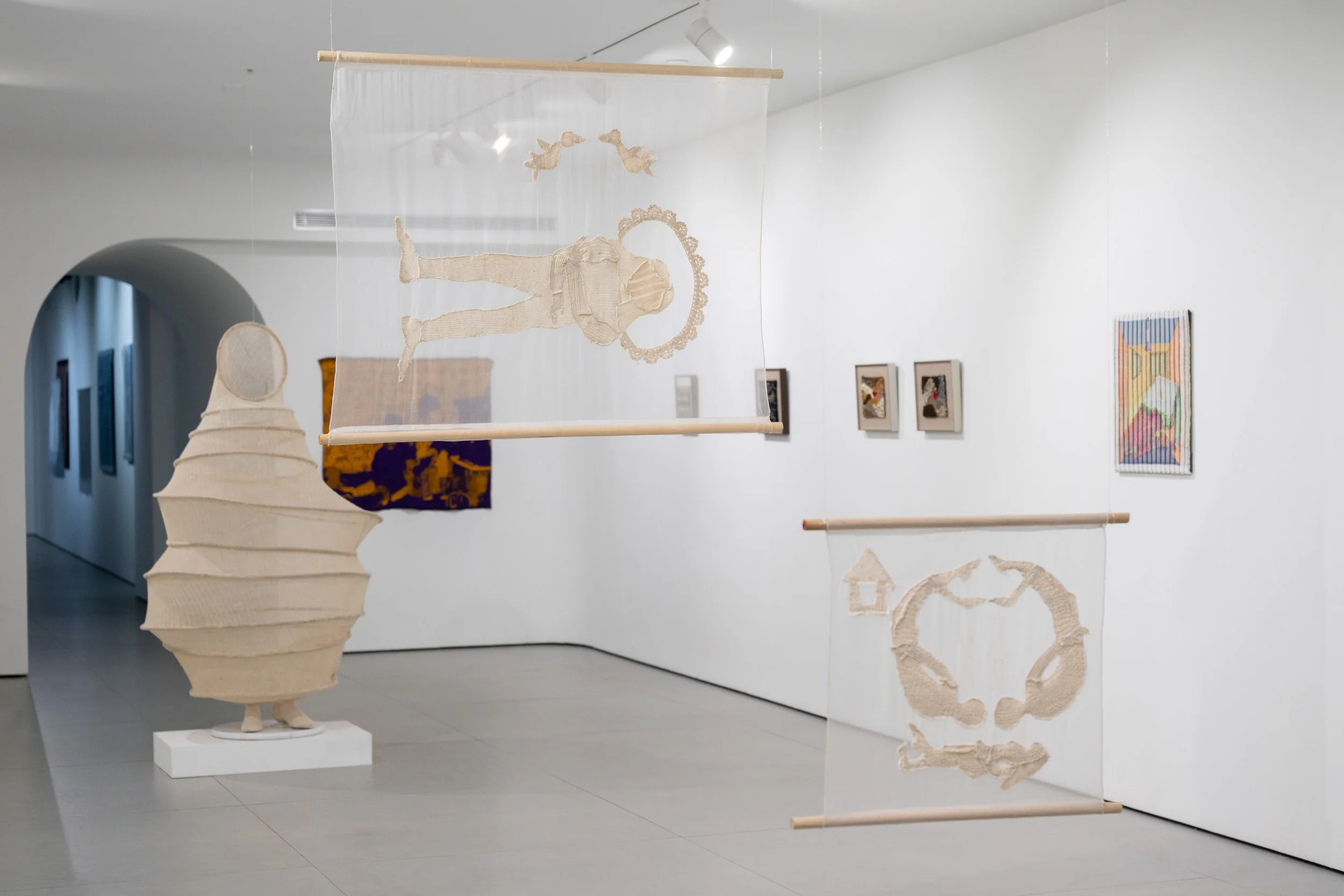
Installation view of Soft Friction at THE BLANC. Courtesy of THE BLANC and the artists.
When Ada Lovelace looked at the Jacquard loom, the punched-card machine that could weave any pattern a person could imagine, she drew an odd conclusion: a machine that can weave anything can also compute anything. Cloth, in her reading, was already a kind of code, a surface you write instructions into. Soft Friction, the group exhibition curated by Leo Yuan at THE BLANC, takes that old intuition at its word. Its seven artists all use textile to do one thing: to make a soft surface hold something that would otherwise stay invisible. What differs is the time each act of translation requires. Speed here is not pace but translation time: how long it takes to turn labor, memory, or feeling into thread, and whose time that is. Read across the room, the show runs like a single gesture slowed down and sped up, from the hand trained over a lifetime to the script that takes a second. The friction the title promises is not a clash of subjects. It is the distance between those speeds, made visible in thread.
It begins at the slow end. Shradha Kochhar hand-spins khadi and kala cotton, then knits the yarn into forms set against sheer mesh, scaling a domestic kind of feminized labor up to a size you have to look up at. Nothing here is quick, and nothing is meant to be read quickly; the work asks for something like the time its making took. Sarah Khadraoui pushes the same patience toward memory, weaving her own biography into hand and jacquard cloth, a childhood doodle, the silhouette of her mother's Moroccan wedding dress, so that a remembered image arrives not as picture but as structure you could run a finger along. In both, the cloth is an archive of the hand, and the hand is slow on purpose.
A little further along, the encoding turns from the maker's own history outward, to the spaces and feelings between people. Tinglan Huang treats the woven interior as a proxy for relationships: in one piece a teal panel spills from the wall's corner and pools toward the floor, hung from a single small family photograph pinned above it, a tremor of white stitching crossing its surface, like a room that has slumped under its own weight. Jacqueline Qiu compresses reference until almost nothing is left of it. Her four small chenille-and-wool panels, framed and clustered like specimens, press the energy of a feast or the stillness of dusk into a repeating geometric pulse, until what is recorded is no longer a scene but its rhythm. The thing being made invisible to visible is getting harder to name, and the cloth keeps holding it anyway.
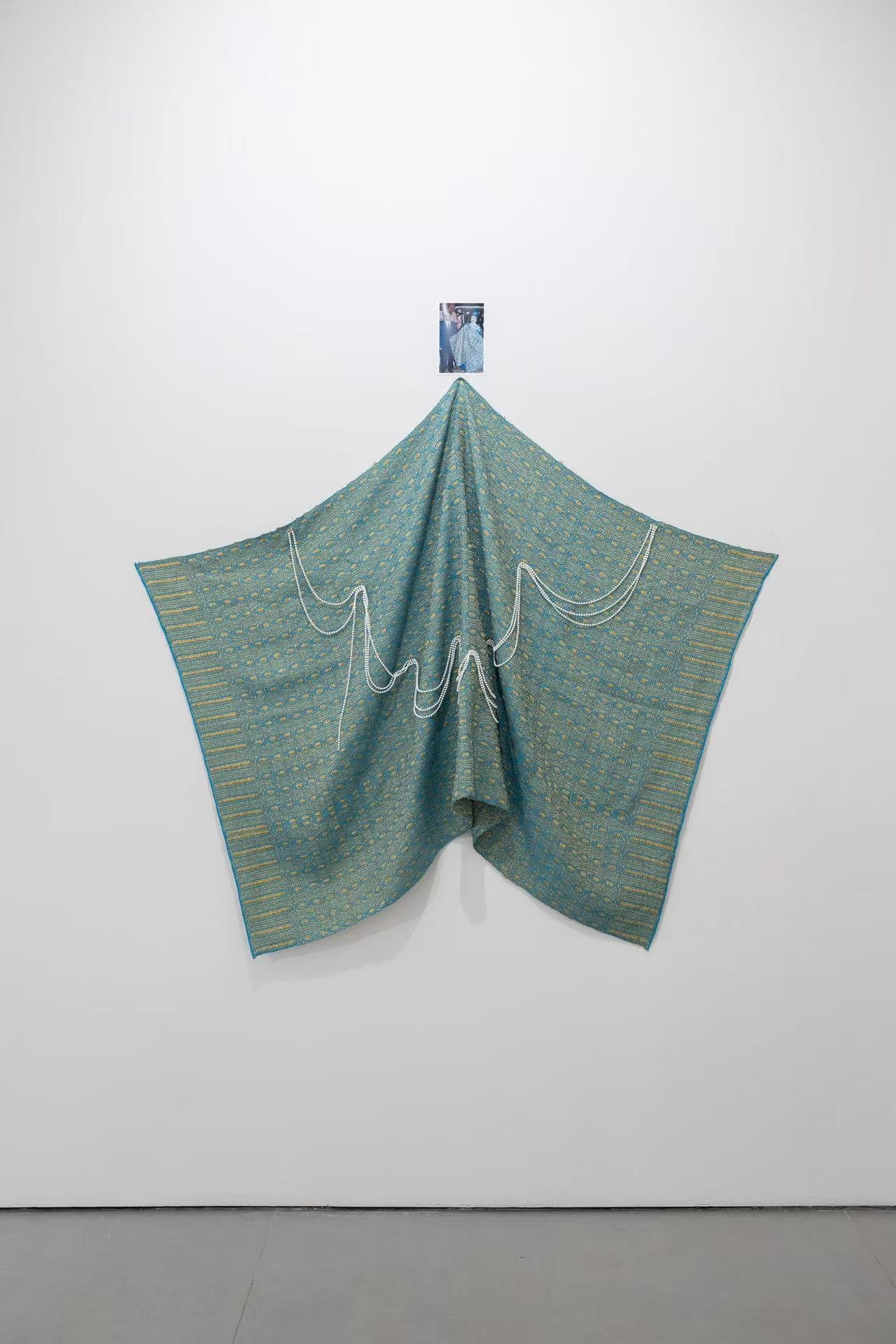
Installation view of Soft Friction at THE BLANC. Courtesy of THE BLANC and the artists.
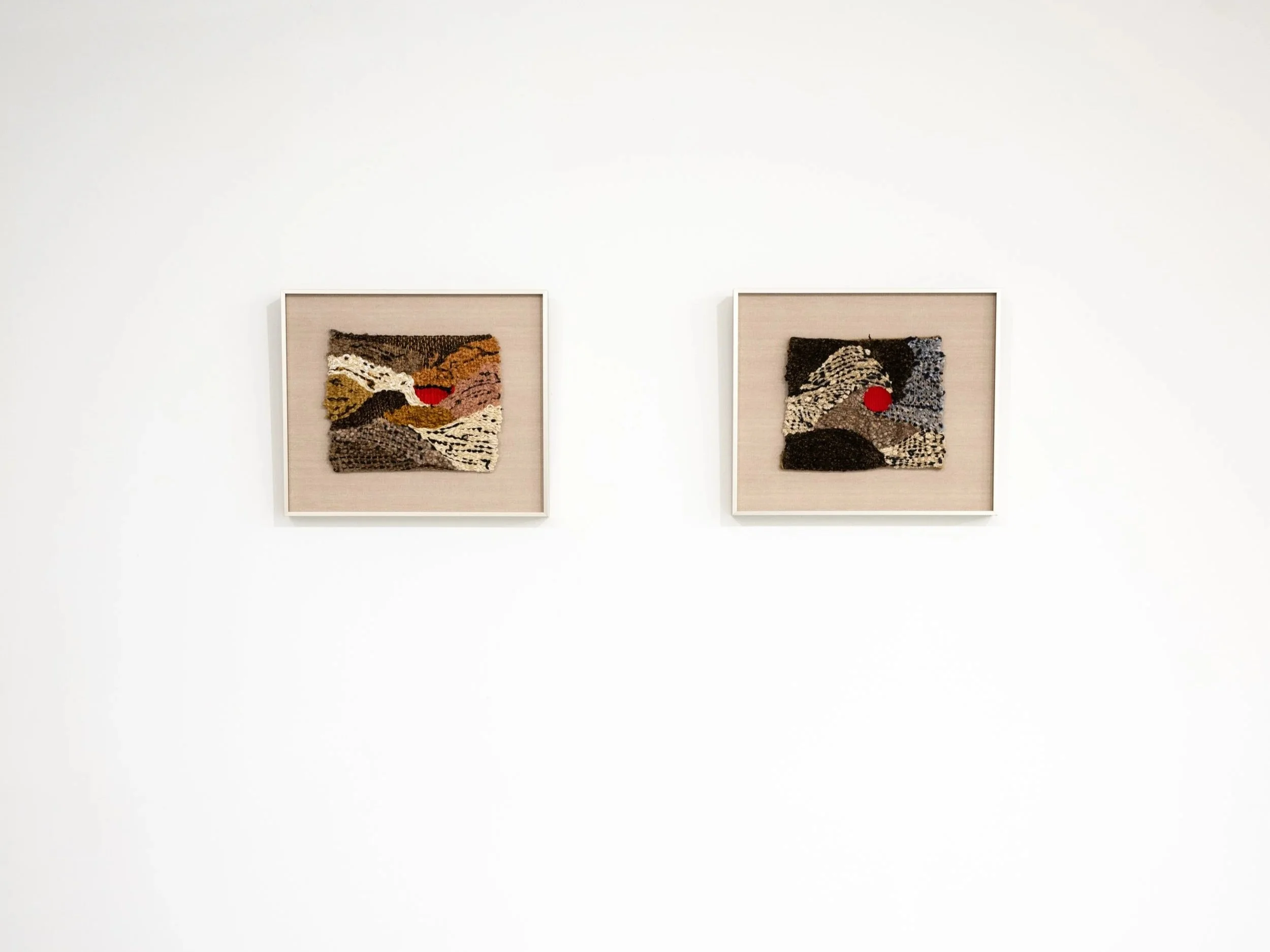
Installation view of Soft Friction at THE BLANC. Courtesy of THE BLANC and the artists.
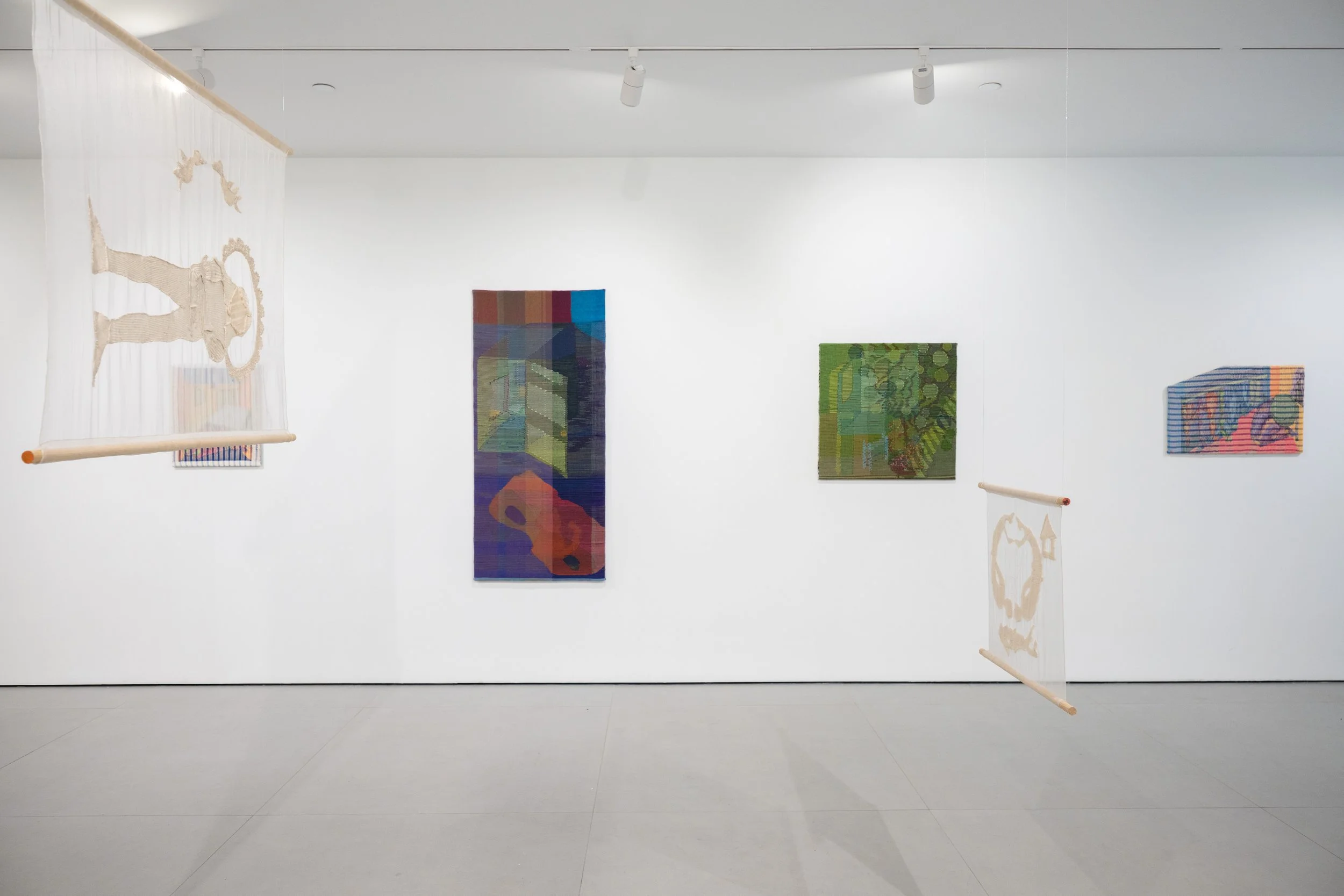
Installation view of Soft Friction at THE BLANC. Courtesy of THE BLANC and the artists.
At the fast end, the hand steps back and lets a system share the work. Craftwork, the practice of Nicole Yi Messier and Victoria Manganiello, anchors the show with Ancient Futures, sixteen woven panels threaded with fiber optics that an AI sentiment script turns into light as visitors offer up their stories. The wall text promises joy as red, frustration as blue, but what hangs in the room is stranger and more continuous: the cloth glows acid yellow-green, then sinks to a cold underwater blue, optic fibers spilling from its frayed lower edge like roots and ending in lit points that pool on the floor. It reads less like a screen than like a half-living thing wired to feeling, and it is candid about what it cannot quite do, finding as much in the technology's ambiguity as in its accuracy, an honesty about the losses of automated translation that much AI-inflected art tends to skip. The same surface that took Kochhar months now rewrites itself in seconds, on a stranger's passing mood. Further along still, Lindsay Degen's label DEGEN sends the cloth back out into circulation, encoded for a body that will wear and change it.
This is where the title earns itself. Lined up, their works are one gesture stretched to its limit: Kochhar's khadi takes the time a body takes, Craftwork's script takes a second, and the whole exhibition is the space between. The medium is soft enough to absorb every method across that span, and the friction is simply what stays visible of the distance each one had to cross. The show is at its sharpest here, when it lets that distance stay uneven, when it resists folding hand-spinning, algorithm, labor, and feeling into a single flattering language of softness, as if a stranger's sixty-second story and a grandmother's months of spinning were the same kind of giving.
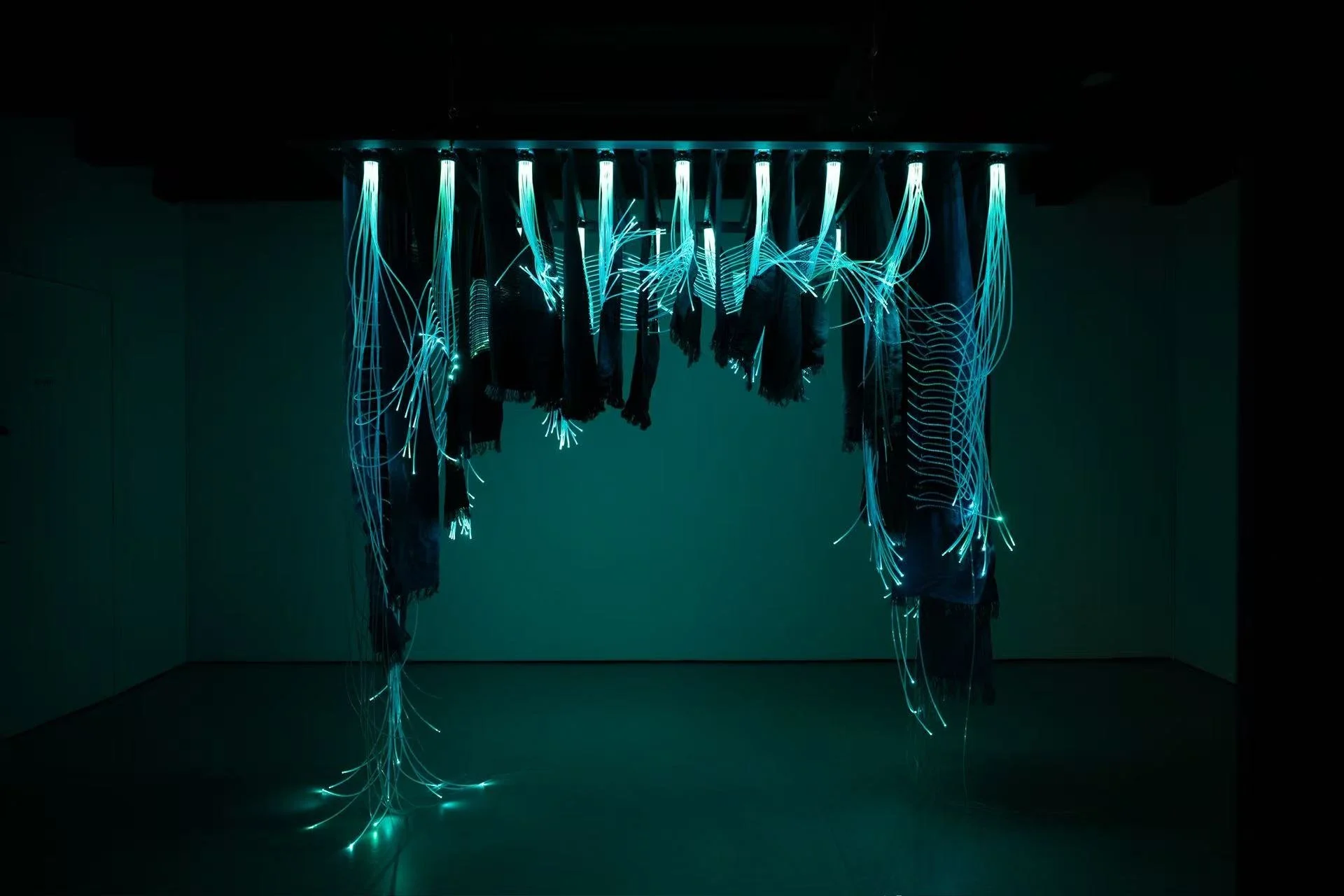
Installation view of Soft Friction at THE BLANC. Courtesy of THE BLANC and the artists.
It would be easy to read Soft Friction as a survey of contemporary textile practice, and on its own terms it is one. But it is doing something quieter: taking a single impulse, to entrust the invisible to cloth, and letting you watch it move, unevenly, from the hand to the machine without pretending the gap is small. What holds is the substrate itself, a surface older than writing or computation, still taking in whatever we encode into it, whether spun over months or generated in an instant. Softness here is not the opposite of friction. It is what makes friction legible, the give in the cloth that registers how far, and how fast, a meaning traveled before it came to rest in the weave.
Soft Friction at THE BLANC in New York, on view through May 15 - Jun 27, 2026.
About the author:

Luman Jiang (b. 2002, Chongqing, China) is a writer and curator whose practice moves between Chinese- and English-language art worlds. Her criticism, published in Whitehot Magazine and Tussle, examines exhibitions through questions of cross-cultural translation and mediation. She holds an M.A. in Visual Arts Administration from New York University.