
The Emergent Visions of Kiki Kim
by Chunbum Park
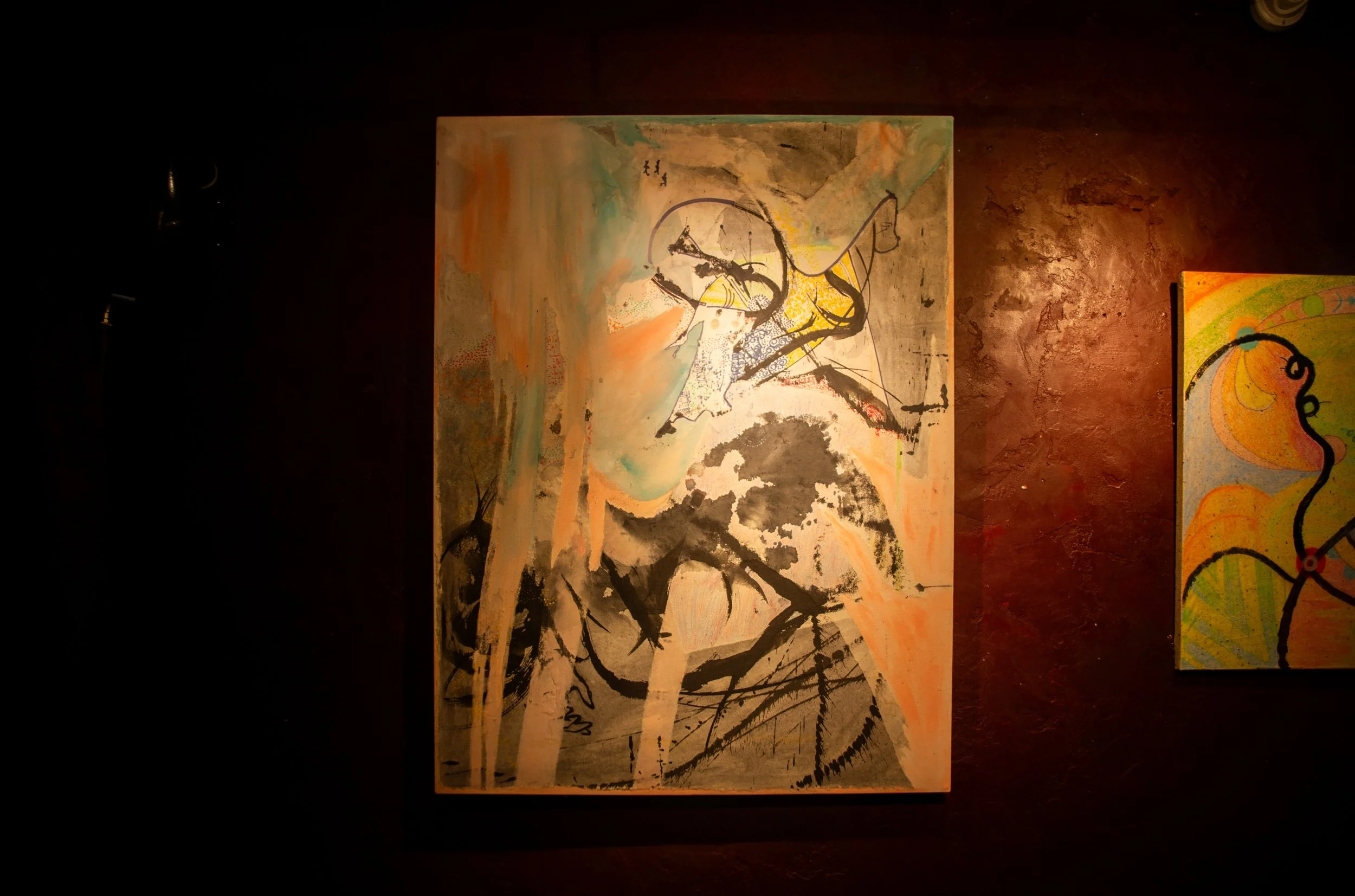
Kiki Kim, Still Hanging Around, 2026. Courtesy of the artist and The Boiler Room NYC.
At Kiki Kim’s solo exhibition at The Boiler Room NYC, the artist exhibits a dozen paintings and drawings that explore the convergence of visual territories or styles of symbolic, pictographic, and surrealistic significance. The works occupy a particular niche between the cartoonization of natural, abstract, and symbolic forms within a mode of calligraphy that is energetically transformed by her feminine persona and psyche.
Surrealist and abstract artists of Spanish and French origin, like Joan Miro and Jean Arp, come to mind when describing Kiki Kim’s works stylistically, even as many people may disagree with such a direct comparison. It must be conceded that Kim is still in the process of developing her vision and style as an emerging artist, and the exhibition becomes a platform and a moment in which the artist can review and assess her own works for a future direction.
Kim’s idealistic tendencies and positive energy are her main strengths as an artist, yet they also contribute to a set of decisions on the canvas that may appear arbitrary and not fully rigorous. The artist’s intention must be respected, but not all intentions are equally authentic or carry equal visual weight or meaning.
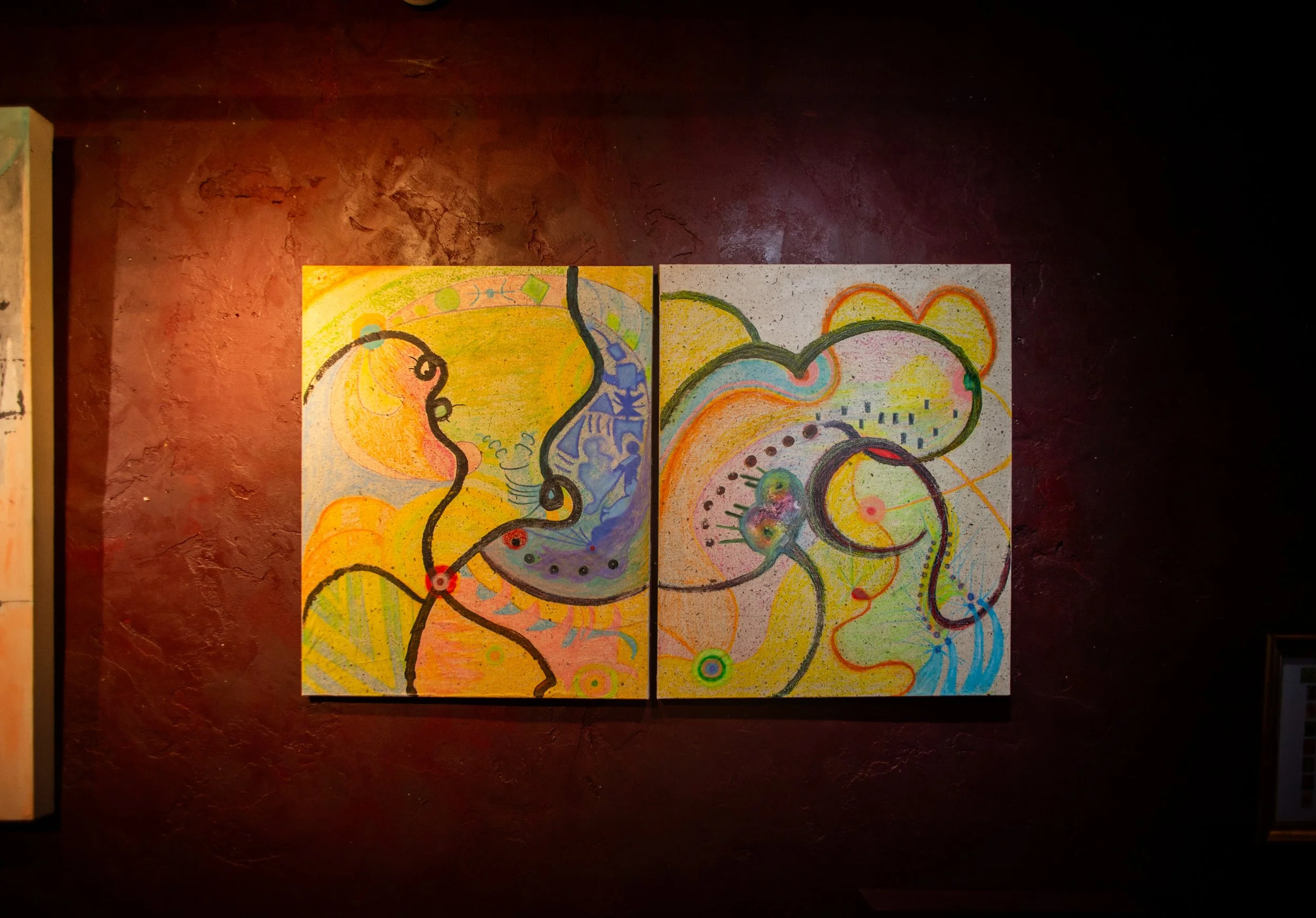
Kiki Kim, I Swallowed the Cold, but No One Believes, 2026. Courtesy of the artist and The Boiler Room NYC.
“I Swallowed the Cold, but No One Believes” is one such work in which Kim’s strengths and weaknesses as an artist are clearly visible. Overall, the work expresses a radiating harmony that instills warmth in the viewer, but it is not Kim’s most successful work.
Purely from a visual standpoint, the panel on the right side is more successful than the left panel because it has a dynamic use of form and color, and they are simultaneously balanced. The neutral grey negative spaces surround the warm-colored feminine and natural forms, contributing to a sense of balance. This layered sense of balance is achieved through this in-between space bridging the more chromatic areas that vibrate in the opposite directions of warm and cool colors. Dark outlines that undulate in a curvilinear fashion provide strong contrast and articulation of forms and simultaneously give the image a calligraphically-inspired visual quality.
The panel on the left, however, has areas that lack in intentionality and visual depth. The most interesting part is the blue segment to the right that features symbols of stars and geometric shapes, and from a visual standpoint this shape must be expanded to a larger area to further transform and complete the image. There is too much empty or breathing space in the left panel, which carries the qualia of inactivity and boredom, without contributing anything of significance that ameliorates the composition or the color balance.
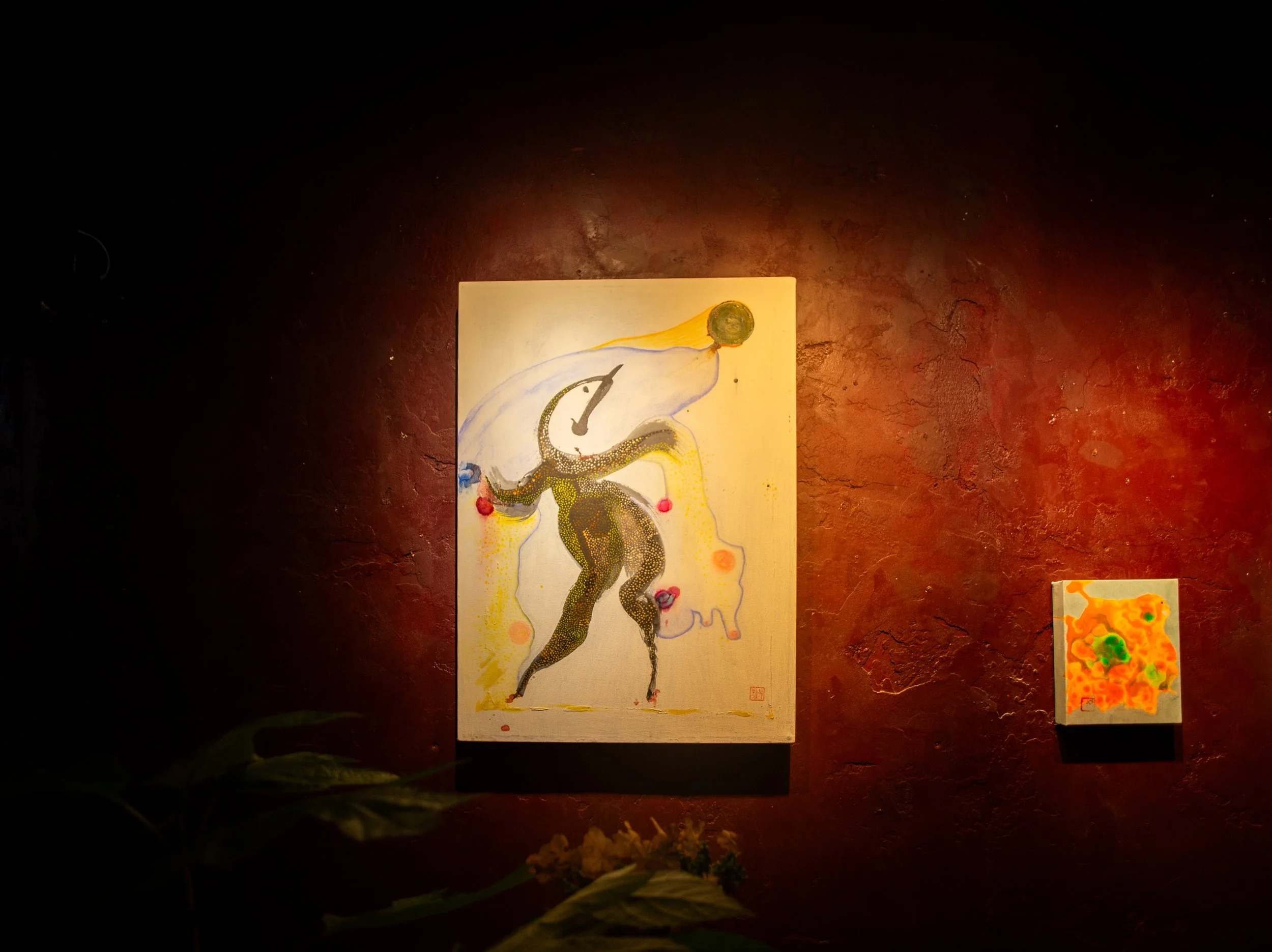
Kiki Kim, Dance with Me, 2026. Courtesy of the artist and The Boiler Room NYC.
Kim’s most successful work is “Still Hanging Around,” which she began many years ago when she first arrived in America and recently completed. It is multi-layered and process-based, in which the artist repeated the steps of painting, gluing, and ripping to cause an inter-cascading interlaid composition of movements and forms. In it, we find the caricature of a cartoon character with a bouncy and energetic persona, representing the pure good within the artist’s vocabulary and ontological mapping of the good and the greedy in relation to the self and the world. The good, generous, and loving character with a Pikachu-like face and morphed bodily shape occupies a space which is turbulently formed and stabilized via erasure and construction, and destruction and recollection. The cartoonishly represented protagonist may be jumping above the top of a crescent of a great wave or rising fumes of a volcanic eruption. A hand is hinted below to the left, which suggests that the forms adjacent to it to the right side of the viewer represent a dress or a hanbok of a possibly Korean woman, who is falling down onto the ground.
The work may point to the horrors of the Japanese occupation of Korea in the early 20th century and the contradiction between this historical fact and the current facade of the Japanese modern identity based in the ultra-emasculated, hypersexualized and westernized image within anime and the kawaii culture. The Japanese modern political and national identity is mainly based in erasure and whitewashing, as well as alignment with the west on literal and metaphorical terms, just as the painting involved all those aspects. A Korean born in the 1970s or 1980s, who encountered the peak of Japanese technological, economic, and cultural boom in the 1980s and the 1990s, must have surely been shaken by the seductiveness of the colonizer. The colonizer (the Japanese), who is the representation of evil for the colonized (Koreans), had all the good things, like Pikachu, like Sony Walkman, the Shinkansen bullet train, and the world’s second largest economy. The situation was the same for the newly liberated people of the countries in Africa, South America, and South Asia, who met the rapid reconstruction of and re-domination by the European colonizers (with the help of the US) with a strong sense of suspicion and confusion.
We may not know fully what meaning or readings the painting alludes to, but it is her most successful work in terms of visual depth and pictorial intentionality. Here every decision counts, nothing is arbitrary, and everything points towards the articulation of an authentic vision to be found within the artist’s psyche. This work will be “still hanging around” a hundred or two hundred years later because it will have withstood the test of time, and it is Kiki Kim’s most successful work to date.
The artist must persevere on and not give up, despite the criticism offered here. She made a powerful painting that successfully combines the lessons of eastern and western painting. Now the challenge remains, in which Kiki Kim must repeat the successful outcomes again and again until she is able to maintain a repertoire of re-producing works that can withstand the test of time. She must let go of her idealistic tendencies that disarm her vision and critical capacity; she must embrace a critical position to select her decisions on the canvas and to better curate and differentiate her stronger offsprings from her weaker outcomes.
Kiki Kim’s solo exhibition Dream Bleeds: Between Internal Architects of Spirit, on view at The Boiler Room in New York from August 13 through August 25, 2026.
About the author:

Chunbum Park or “Chun” (Korean alphabet: 박준범, Chinese characters: 朴準範) is a painter, photographer, curator, and writer based in Cliffside Park, NJ. Born in 1991 in Seoul, South Korea, Park immigrated to the United States in 2000, and they received a BFA in Fine Arts from the School of Visual Arts in 2020 and an MFA in Fine Arts Studio from the Rochester Institute of Technology in 2022. Born a male, Park likes to cross dress and depicts themselves as a woman in their paintings. They are the inventor of the ArtBid art auction card game and run the Roundcube Collective and the Brooklyn to Gangnam visual and literary print magazine. Park writes exhibition reviews for Two Coats of Paint, Art Spiel, Dart Magazine, and dArt International Magazine.