
Close Enough to Touch, Close Enough to Miss
by Christine Chen
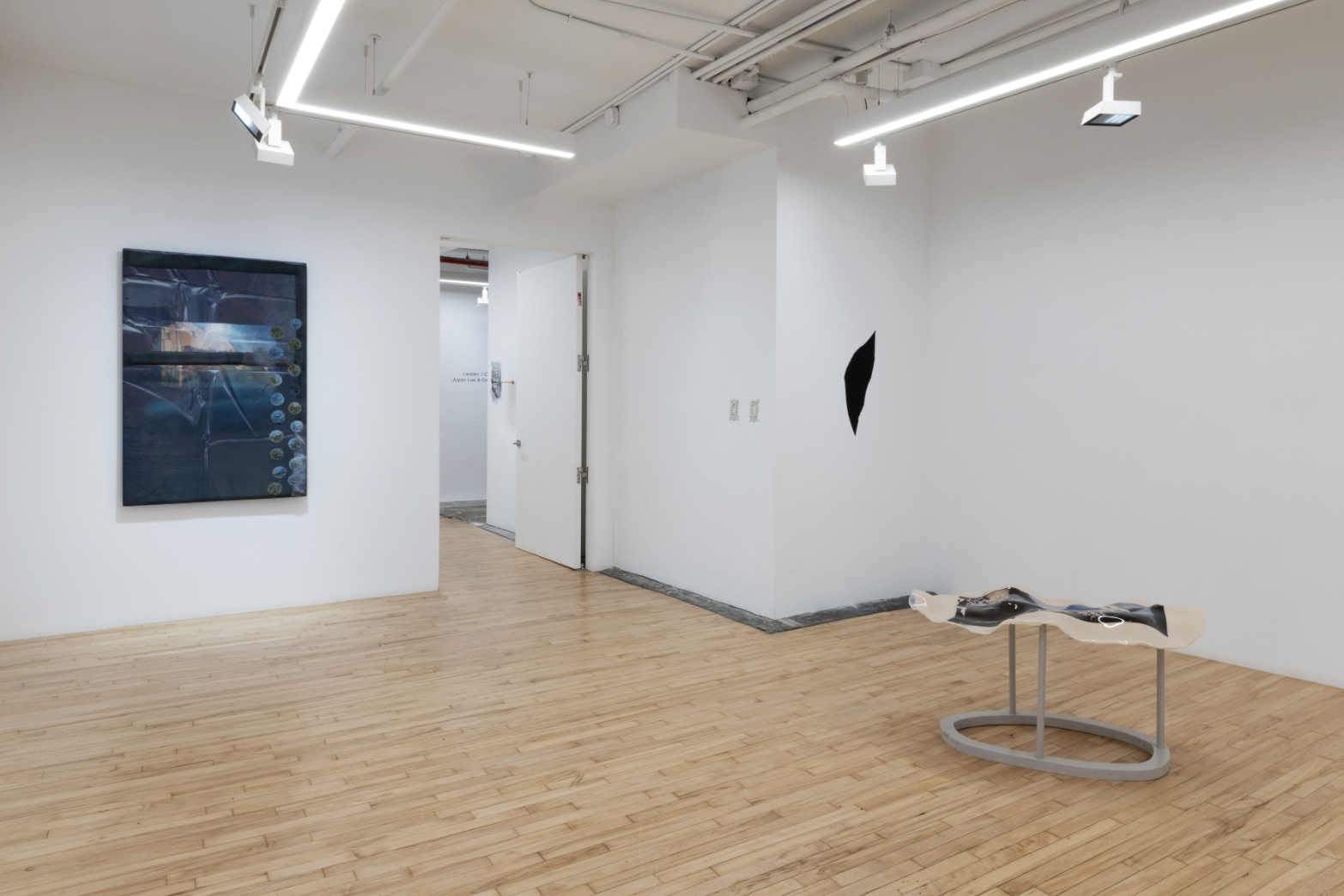
Installation view, Ladder/Chain, July 17 - August 14, 2026, HESSE FLATOW, New York. Courtesy of the artist and HESSE FLATOW, New York. Photo: Jenny Gorman.
An image, now, is something you scroll, swipe, click, walk past. Did your brain even register it? Ladder/Chain, Juyon Lee and Emma Safir’s two-person exhibition at HESSE FLATOW, simply asks you to stay with one a little longer.
Descending the stairs, the first thing you encounter is light. In Juyon Lee’s Bodiless Travels V, a length of neon traverses warped glass broken into three parts before slipping beyond its edges. Embedded within the glass is an image of her grandfather’s body, shrouded in paper lotus petals at a funeral Lee could not attend. Nearby, its glow catches Emma Safir’s pewter casts, installed low on the wall where you might otherwise look for an electrical outlet.
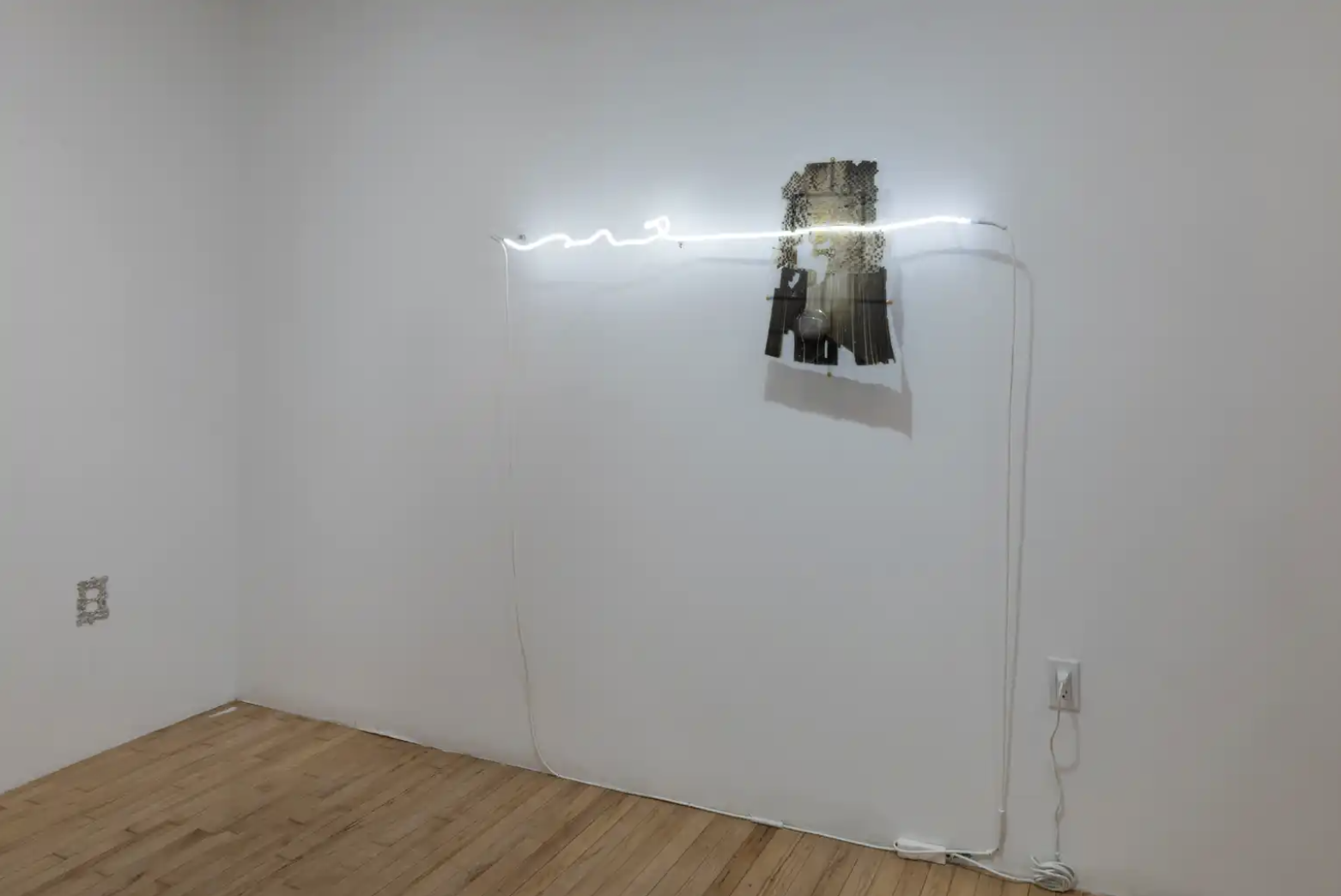
Installation view, Ladder/Chain, July 17 - August 14, 2026, HESSE FLATOW, New York. Courtesy of the artist and HESSE FLATOW, New York. Photo: Jenny Gorman.
Inside the main gallery, another of Safir's pewter casts hangs where a light switch could be. Her green upholstered panel, Boboli Gardens, hangs behind Lee’s low glass work, Parabolic Traces – Burnmark Video Call I, whose proportions recall a coffee table. For a moment, you feel as if you are standing in a living room. A switch, an outlet, a wall hanging, something like furniture. Then it turns strange. Safir's sockets conduct nothing; Lee's table-like form holds nothing. What lingers is the afterimage of a domestic space.
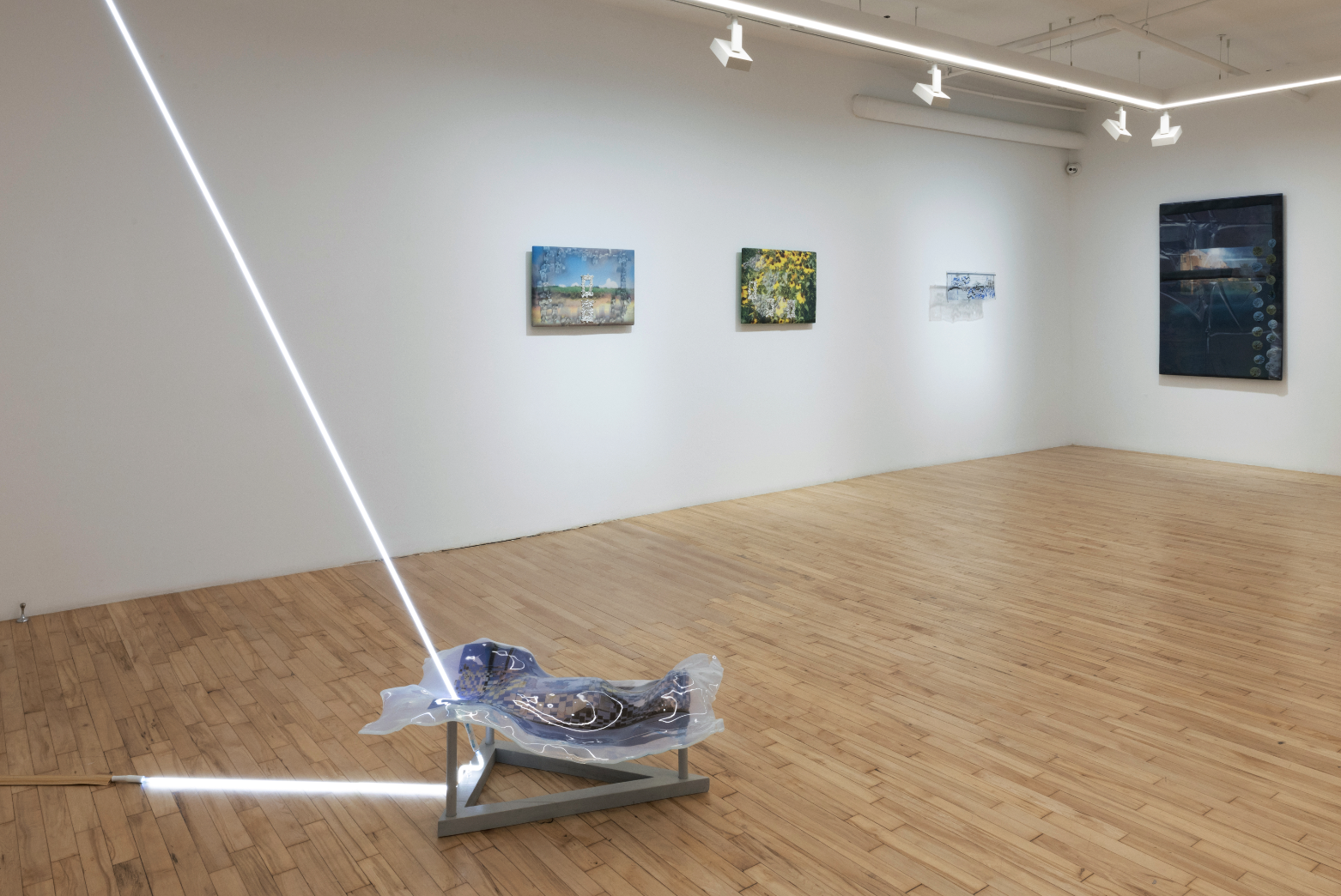
Installation view, Ladder/Chain, July 17 - August 14, 2026, HESSE FLATOW, New York. Courtesy of the artist and HESSE FLATOW, New York. Photo: Jenny Gorman.
For an exhibition named after visible and invisible mending stitches, very little in Ladder/Chain actually returns to what it was. Lee leaves the fracture open. Safir reproduces familiar domestic fixtures while removing their function. The exhibition is more convincing because neither artist mistakes repair for restoration.
Both artists begin with photographs that move between digital and physical forms. Lee describes images stored on a phone or in iCloud as simply "floating around." She splices and hand-weaves photographs from her archive before transferring the resulting image onto glass and firing it in the kiln. Safir’s images travel differently: through scans, rubbings, digital collage, upholstery, stitching, and other surface interventions. In both practices, the photograph becomes less a finished image than something continually handled.
For Lee, that handling began with physical absence. After her grandfather died, she could not attend his funeral and remained connected to her family in Korea through photographs, texts, and video calls. She has described working materially with photographs as something that “slows down the way I process the image.” Yet the irony of Lee’s process is that giving these photographs greater physical presence does not make them easier to reach. Weaving breaks the image apart; heat softens the glass and blurs what has already been fragmented.
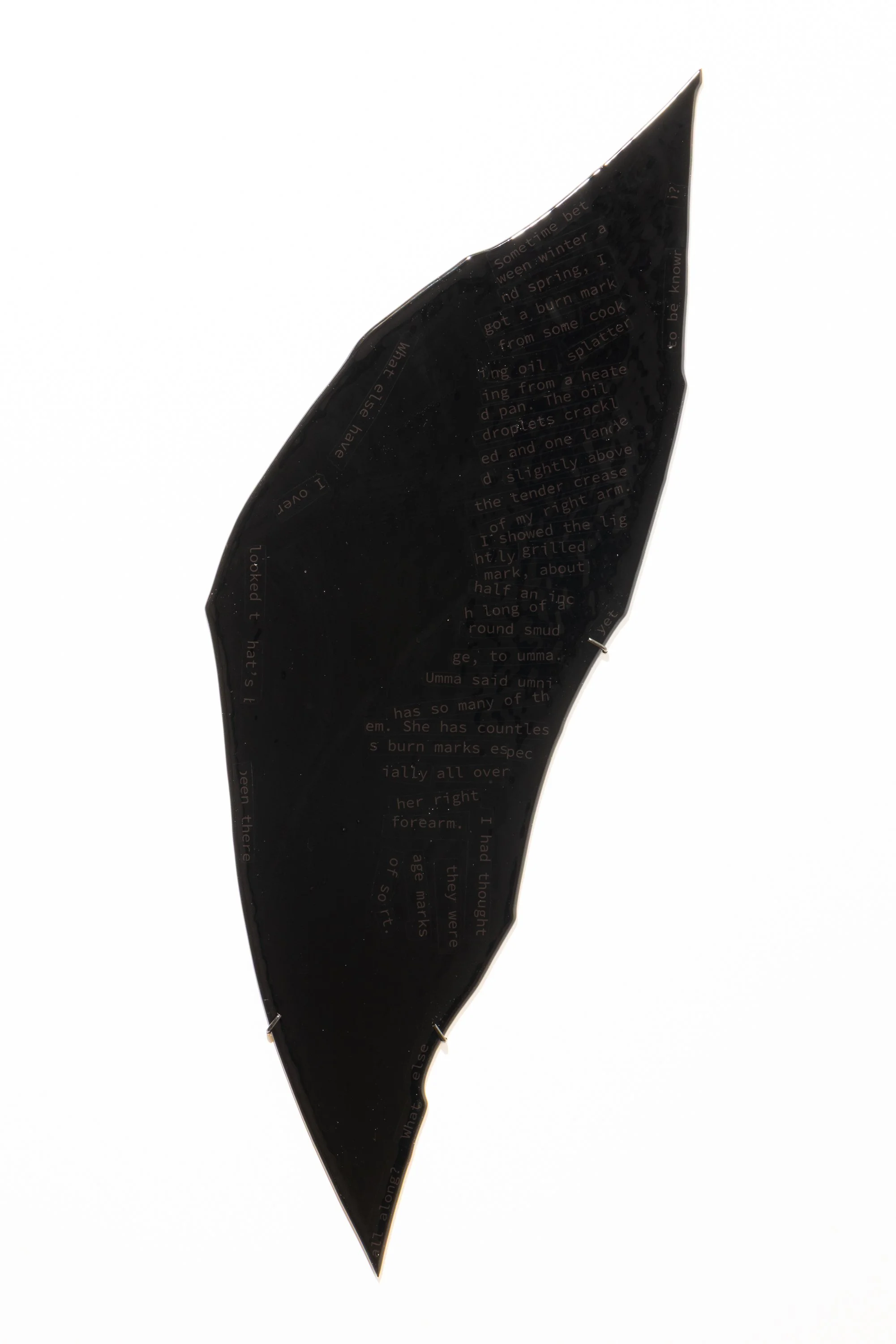
Juyon Lee, what else yet to be known, 2026. Decals of artist’s writing fused in glass, Glass: 27 ¼ x 10 ¼ x 1/8 inches (69 x 26 x 3.1 cm). Courtesy of the artist and HESSE FLATOW, New York. Photo: Jenny Gorman.
One of the quieter works makes that contradiction especially clear. From across the room, what else yet to be known appears as little more than a dark shard of glass. Move closer and text begins to surface. Lee recounts mistaking marks on her grandmother’s skin for signs of age before learning they were burns accumulated over decades of cooking. When she later asked to see them over FaceTime, the image was too blurry, prompting her to ask for higher-resolution photographs. More resolution still did not amount to complete access. The work makes the viewer repeat that failure of attention. You stand there not seeing, until you see.
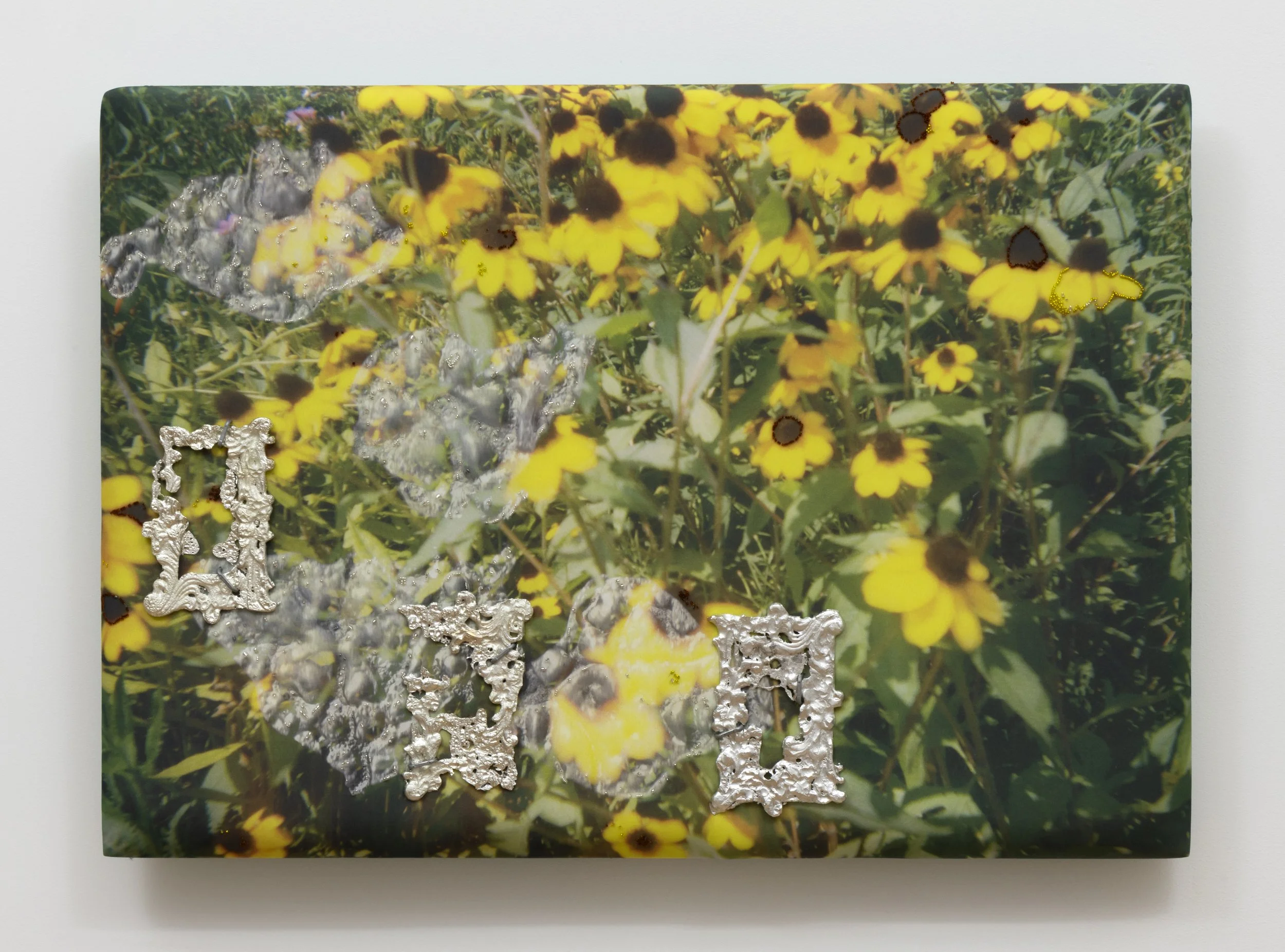
Emma Safir, Black Eyed Susans, 2026. Digitally printed silk, pewter, mirrored glass beads, reflective thread, neoprene, flashe paint, 20 x 28 x 1 ½ inches (50 x 71 x 3cm). Courtesy of the artist and HESSE FLATOW, New York. Photo: Jenny Gorman.
Safir begins from a different problem. Her works sit close to the body. Soft and upholstered, they invite a physical familiarity that their surfaces then complicate. She wants, as she puts it, to “slow down the read,” redirecting the eye toward what might otherwise go unnoticed, while her obsessive handwork pushes against what she calls the “invisibility of digital labor.” Across the panels, photographs are rarely left untouched. Pewter casts, beads, gathered fabric, and thread accumulate across their surfaces, what Safir describes as “accessorising” the works. These additions obscure, frame, and redirect the image, keeping the eye moving between photograph and object. Their tactility approaches what Laura U. Marks calls “haptic visuality,” a mode of looking in which vision begins to behave like touch. (1) Yet the intimacy remains incomplete: the works invite the hand while the gallery prohibits it. Safir herself describes these forms as "seductive, plush objects" that entice and stay impenetrable. Reflective thread further complicates these surfaces. Safir describes it as feeling “like air” or a spiderweb, almost immaterial in appearance even as it physically holds the work together. A camera flash brings the thread forward; under ordinary light, it recedes again. What you see depends, quite literally, on the conditions of looking.
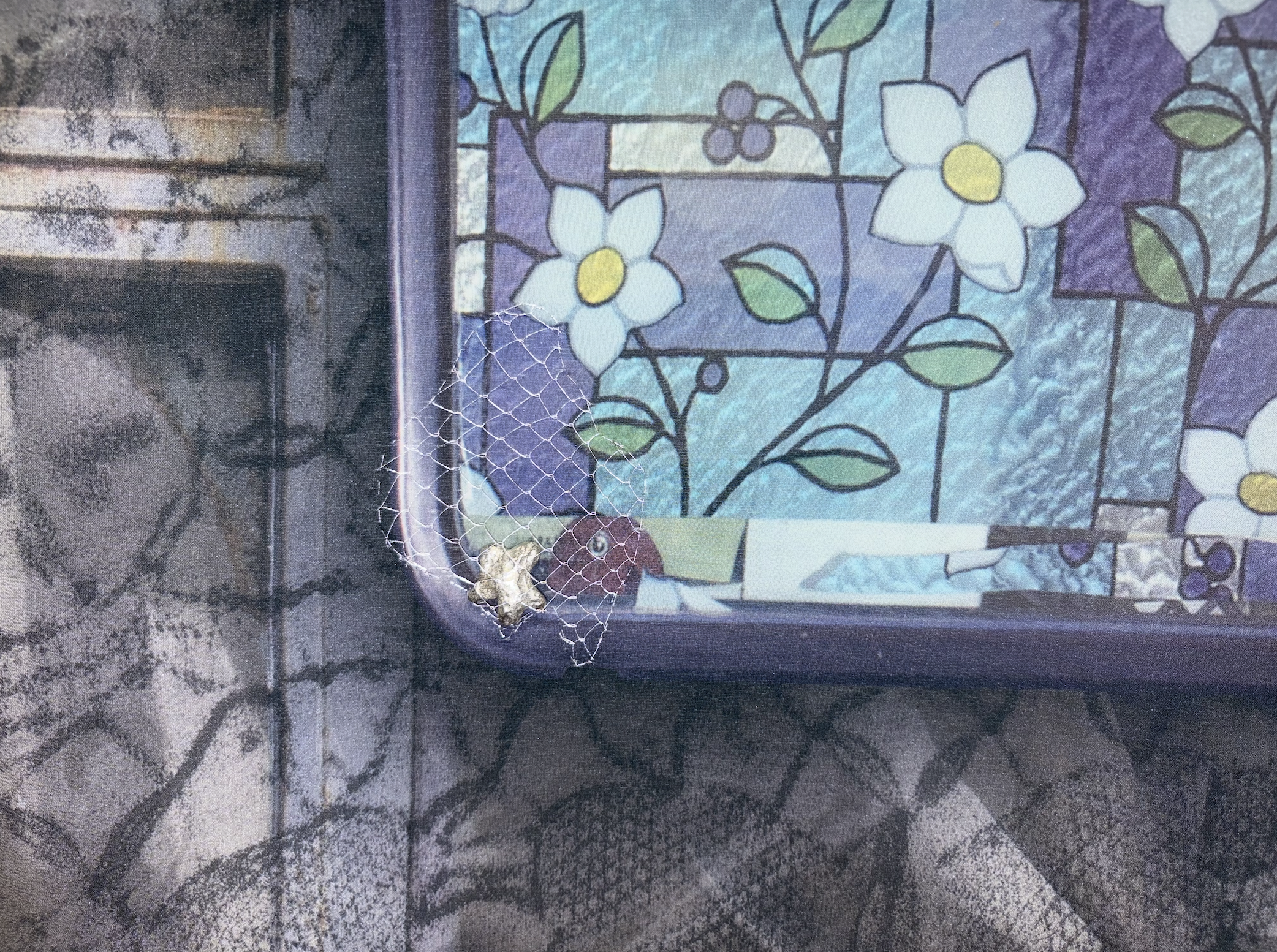
Emma Safir, BLUE MOON (SISI), (detail with flash), 2024. Digitally printed silk, upholstery foam, mdf, appliqué, house paint, needlelace, reflective thread, pewter, flashe paint, 48 x 28 x 1 ½ inches (121 x 71 x 3cm). Courtesy of the artist and HESSE FLATOW, New York. Photo by the author.
This is where Lee and Safir meet most convincingly. Lee gives material form to images shaped by physical absence, while Safir places objects close to the body only to complicate access to them. Lee can see someone an ocean away and still be unable to touch them; Safir places something within arm’s reach yet it remains inaccessible.
Which returns you to the opening question. Did your brain register the images? By now, the answer should be yes. You have moved, waited, looked again. What you missed at first begins to surface, and still the images never quite hand themselves over. Ladder/Chain is strongest in that unresolved space, not where distance is mended, but where you are made to feel it.
1 Laura U. Marks, The Skin of the Film: Intercultural Cinema, Embodiment, and the Senses (Duke University Press, 2000), 162.
Ladder / Chain is a two-person exhibition featuring Juyon Lee and Emma Safir, on view at HESSE FLATOW in New York from July 17 through August 14, 2026.
About the author:

Christine Chen is an Australian-born, New York-based curator, art historian and writer whose work centers on diasporic aesthetics, transnational narratives, and the visual histories of communities excluded from written archives. Her curatorial practice embraces community-rooted and cross-cultural approaches that challenge systems of erasure, attending to questions of migration, memory, and racial identity, and to the ways lens-based art and material culture can recuperate what dominant archives suppress.
She is the 2026 Season III and IV NARS Foundation Curatorial Fellow and currently serves as Curatorial Research and Gallery Associate at Thomas Nickles Project. Separately, she is project managing a forthcoming monograph on the New-York artist Morton Kaish.
Previously, Christine has held positions at the Wallach Art Gallery and Lehmann Maupin Gallery. She holds an MA from Columbia University and a combined BA/LLB from the University of New South Wales.