
Survival and Transformation in Here on and after
by Analeia
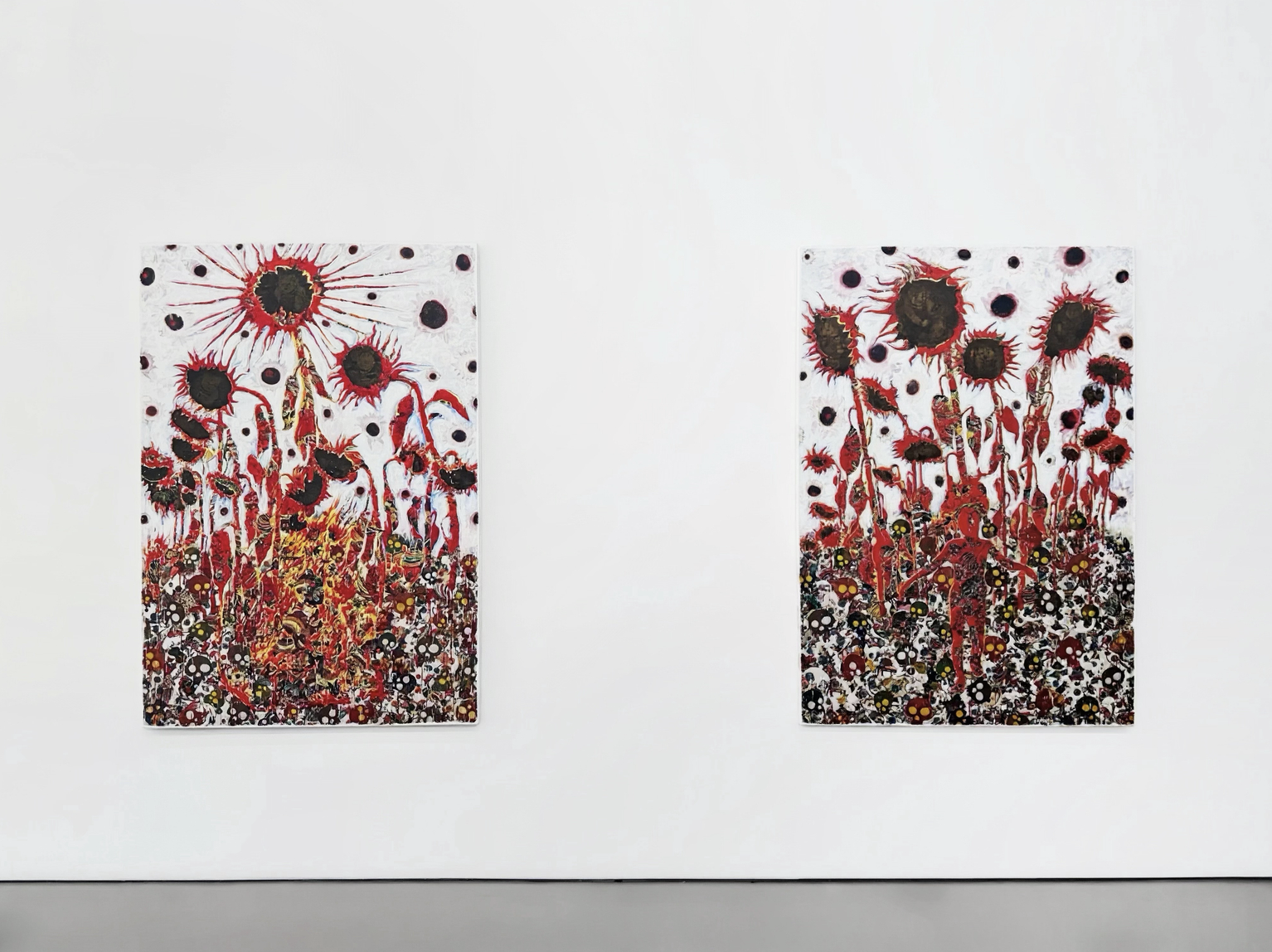
Installation view of Here on and after, Eli Klein Gallery, New York, 2026. Courtesy of the artist and Eli Klein Gallery.
Walking into Hanoi-based artist Bùi Thanh Tâm’s solo exhibition Here on and after at Eli Klein Gallery, viewers are immediately confronted with a dense field of recurring visual forms. Most prominent among them is the sunflower, an image that appears throughout nearly every painting. At first glance, the flower seems readily legible: a familiar emblem of resilience, growth, and hope, particularly within the broader thematic framework the artist explores, shaped by the afterlives of colonialism, war, and intergenerational trauma. Yet such a reading only partially accounts for its presence. What becomes increasingly striking over the course of the exhibition is not what the sunflower symbolizes, but the persistence of its return. Alongside recurring references to traditional Vietnamese woodblock prints—including Đông Hồ, Hàng Trống, and Kim Hoàng—the sunflower reappears across radically different pictorial environments. It is enlarged, fragmented, recolored, and transformed, yet never fully disappears. These visual forms function less as inherited symbols than as living images that continue to mutate across time.
Echoing Aby Warburg’s concept of Nachleben, or understood as the survival (the continuity, afterlife, and metamorphosis) of images and motifs, this persistence of the flower, or images derived from woodblock prints, does not simply belong to the particular temporal moments that first produced them. They survive through processes of repetition, displacement, and transformation, carrying fragments of earlier cultural memories into new historical contexts, as Tâm brings them into Eli Klein Gallery. The sunflower, a motif that inevitably recalls earlier artistic creations—from Van Gogh’s iconic works that reveal the burning emotion he invested in the act of creation to Anselm Kiefer’s meditations on memory and history—does not function as a quotation or a stable symbol. Instead, it becomes a mutable visual form repeatedly reactivated across different pictorial environments. The flower persists while continually changing.
Across Tâm’s canvases, the sunflower takes on shifting scales and identities. In Hello. God is here I and II (2026), it appears enormous, suspended like a sun in the sky. In The Value of Freedom II and III (2026), it rises above the human figure and skull, somewhere between monument and tombstone. In Utopia II and III (2026), it stretches upward like a solitary tower, nearly exceeding the limits of the canvas. Its most striking transformation occurs in Searching for the Sunflower I and II (2026), where the very center of the flower’s core becomes a pupil-like void, drawing the viewer inward as its petals begin to resemble eyelashes.
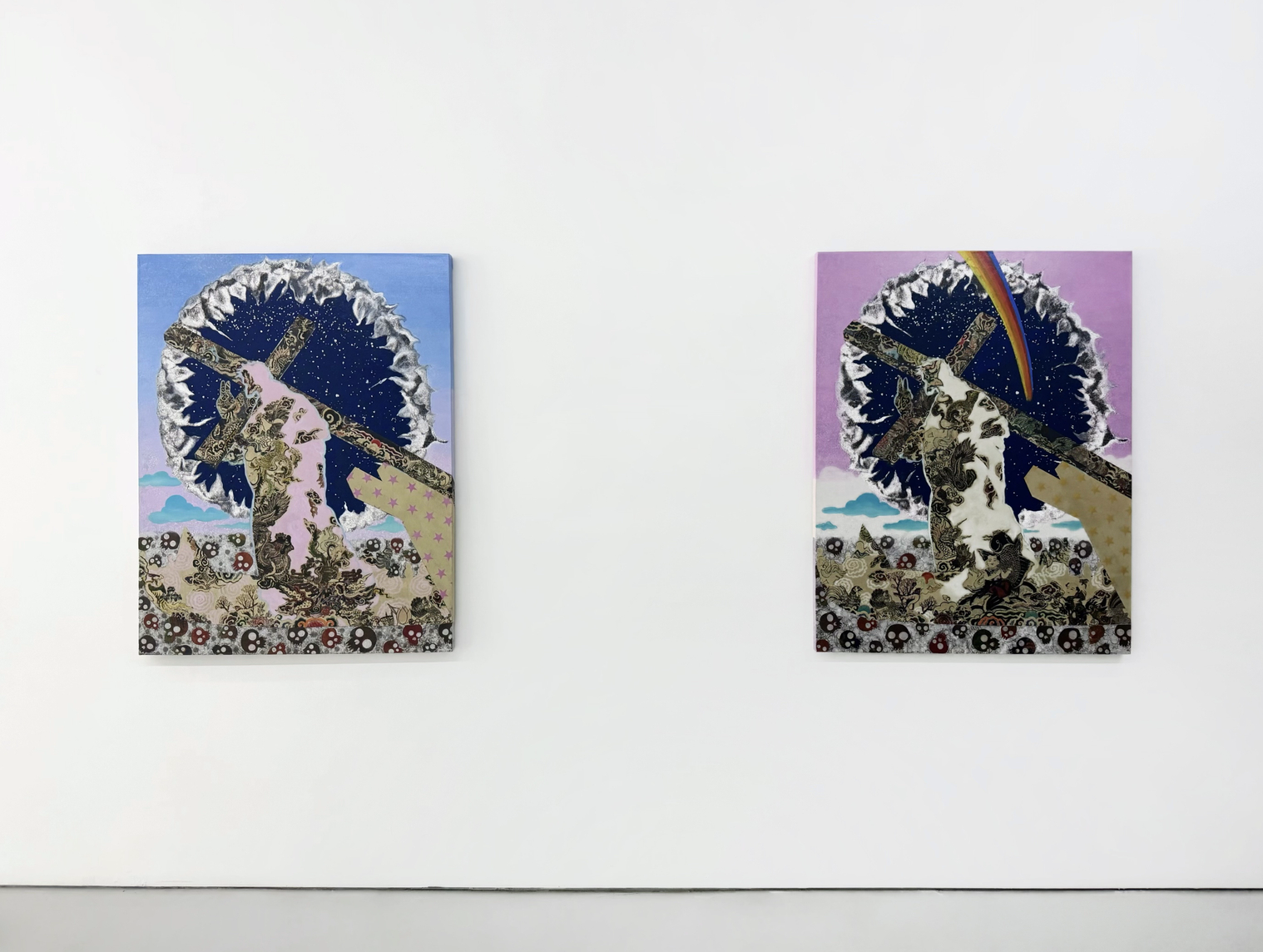
Installation view of Here on and after, Eli Klein Gallery, New York, 2026. Courtesy of the artist and Eli Klein Gallery.
A similar dynamic governs Tâm’s engagement with traditional Vietnamese folk woodblock imagery. Motifs infiltrate the sunflower’s seed heads, emerge from its petals, and appear behind or within its monumental forms. Through layering, collage, recoloring, and repetition, these images undergo continual metamorphosis. What returns is never the original image itself, but its afterlife: a transformed visual memory that survives precisely through change. Neither wholly traditional nor fully contemporary, these forms occupy the unstable temporal space where past and present remain entangled. Through his mastery of traditional techniques, Tâm brings together the visual heritage of his origin with the iconic flower motif of Western modern art, repeatedly transplanting, transforming, and renewing these images, granting them new life within different historical and pictorial contexts.
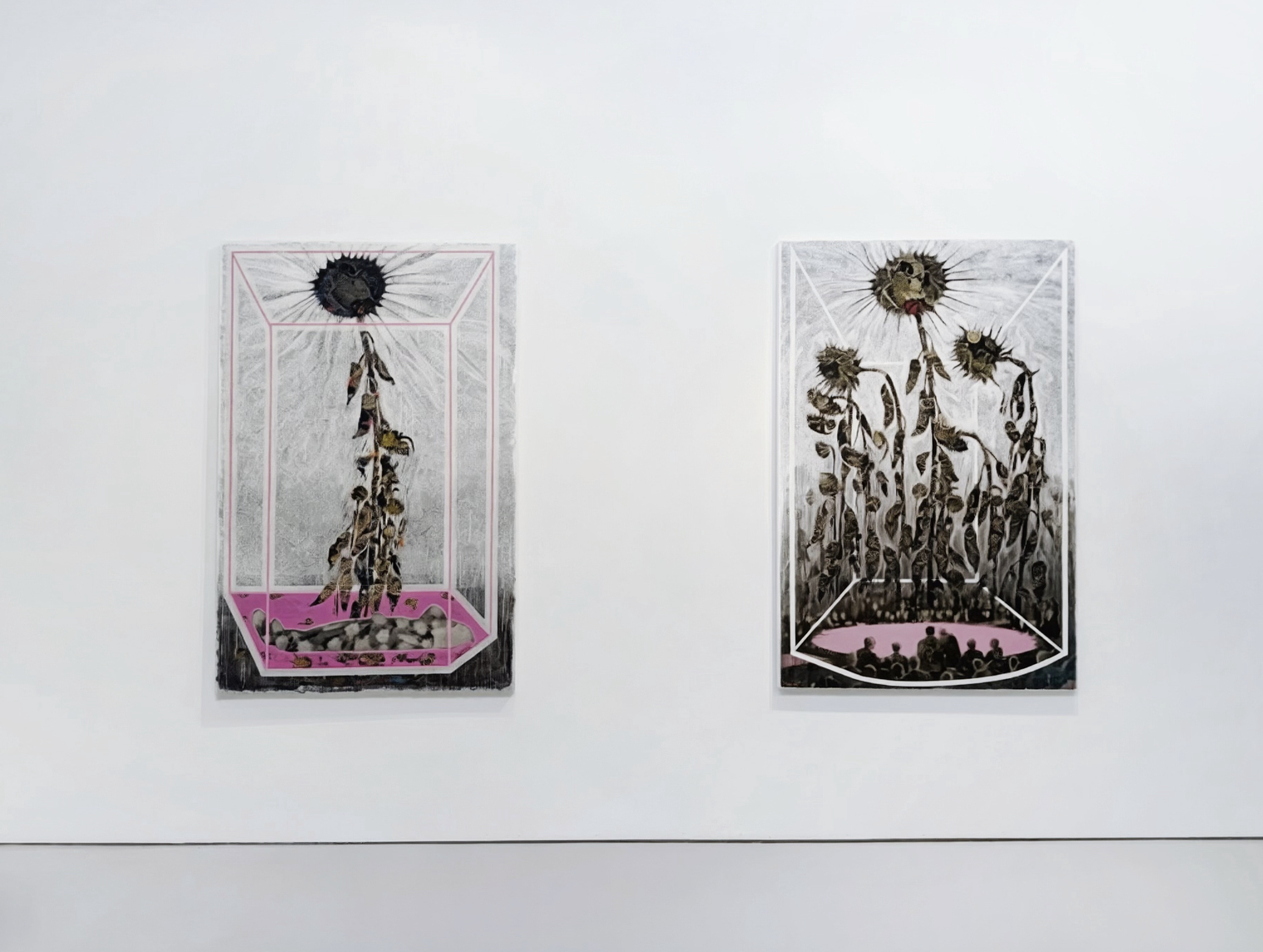
Installation view of Here on and after, Eli Klein Gallery, New York, 2026. Courtesy of the artist and Eli Klein Gallery.
The exhibition title Here on and after ultimately describes a condition of survival. “After” refers not only to the historical aftermath of colonialism, war, and modernization, but also can be understood as the afterlife of images themselves. Yet the inclusion of “here” is equally significant. Tâm does not simply recover these surviving forms; he stages their return within the present tense of the gallery. This experience begins the moment one enters the gallery, where the immense black “eyes” of Searching for the Sunflower I and Searching for the Sunflower II (2026), positioned at the far end of the space, quietly organize the viewer’s movement and gaze throughout the exhibition.
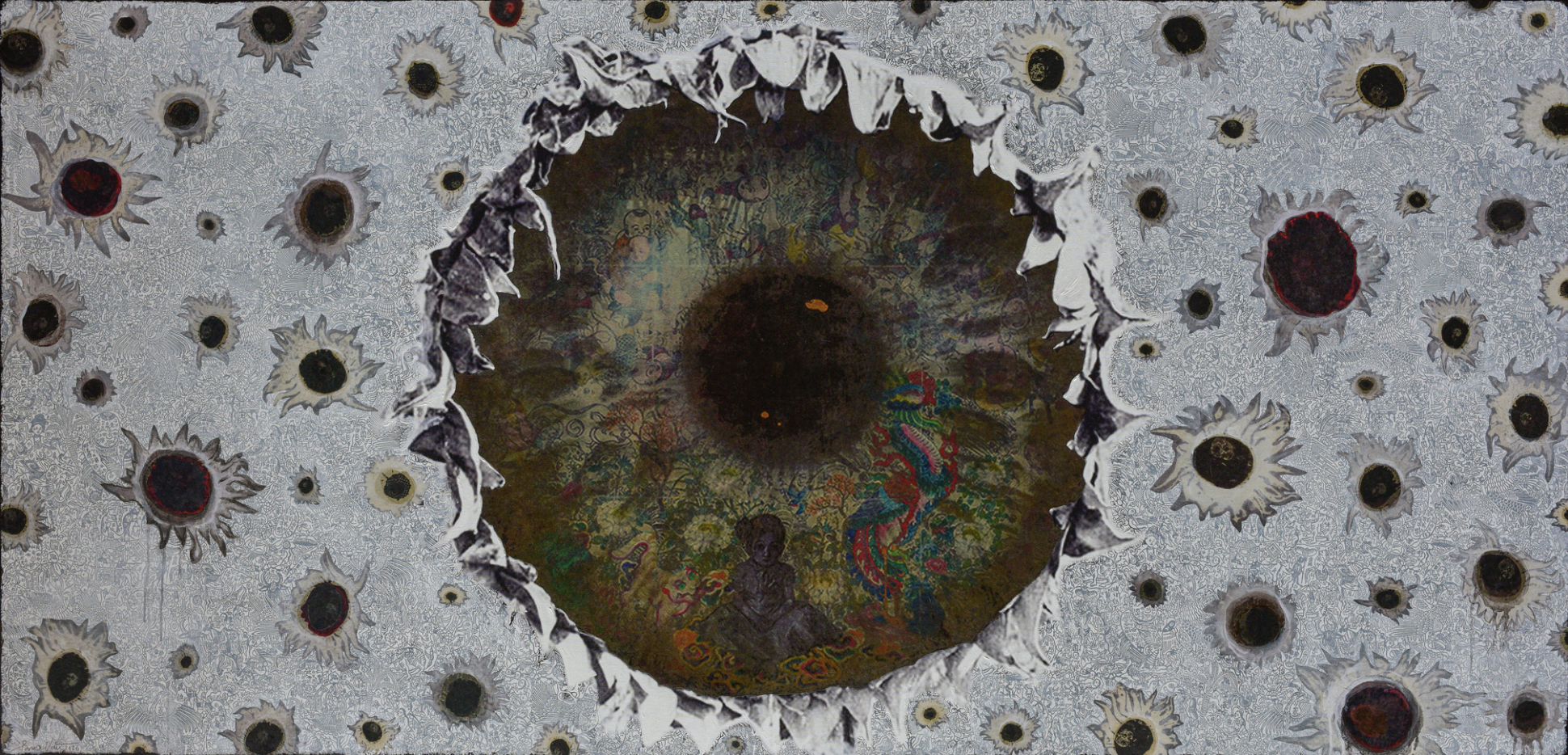
Bui Thanh Tam, Searching for the Sunflower II, 2026. Courtesy of the artist and Eli Klein Gallery.
The dark centers of the sunflowers are depicted in eye-like forms, appearing to return the viewer’s gaze and quietly register every movement through the gallery. The viewer is no longer merely looking at the sunflower; they become part of the visual field that the sunflower observes. Yet what these eyes reflect is not what they “see” in the present, but the accumulated traces of images that exist within the flower itself: fragments of traditional woodblock prints, inherited visual memories, and cultural forms carried from the past. Alongside them, the figure of a child also gazes directly toward the viewer, introducing another temporal layer into the encounter. Within this moment, the gaze does not belong to a single subject or a single time; instead, past images and present perception occupy the same visual space. In the gallery, on the canvas, time collapses.
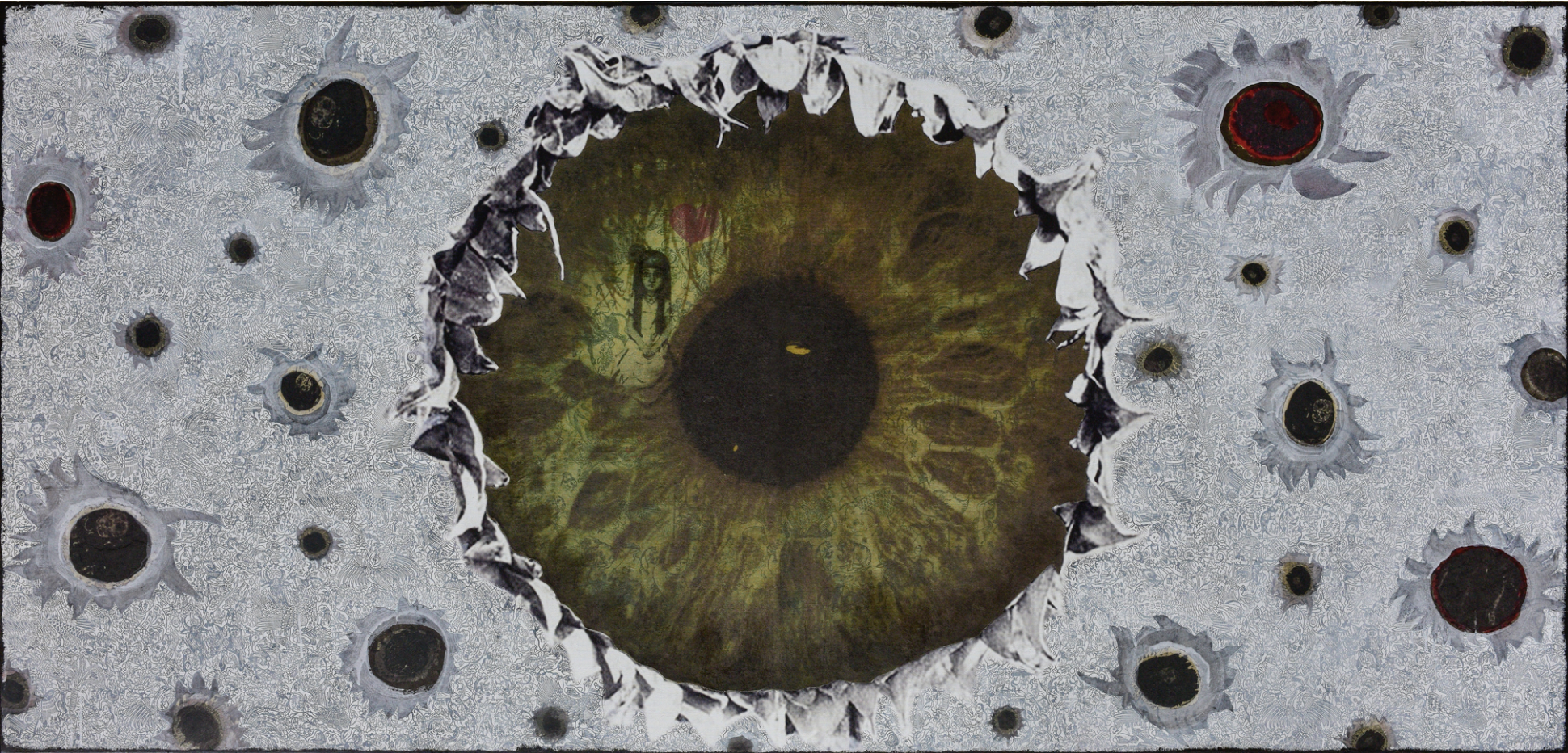
Bui Thanh Tam, Searching for the Sunflower I, 2026. Courtesy of the artist and Eli Klein Gallery.
What endures in Tâm’s paintings is not the permanence of any single image, but the possibility of its continual reappearance. The sunflower looks back not because it possesses a fixed meaning, but because it remains open to new histories, new viewers, and new moments of recognition. In this encounter, the afterlife of images becomes something we do not simply witness, but momentarily inhabit.
Bùi Thanh Tâm: Here on and after at Eli Klein Gallery in New York, on view from May 16 to July 18, 2026.
About the author:
Helen Lam (Analeia) is a writer and content creator based between Hong Kong and New York. She holds a B.A. in Art History from Barnard College of Columbia University.