
Is Art Becoming a New “Hard Asset”?
Written by Shuhan Zhang
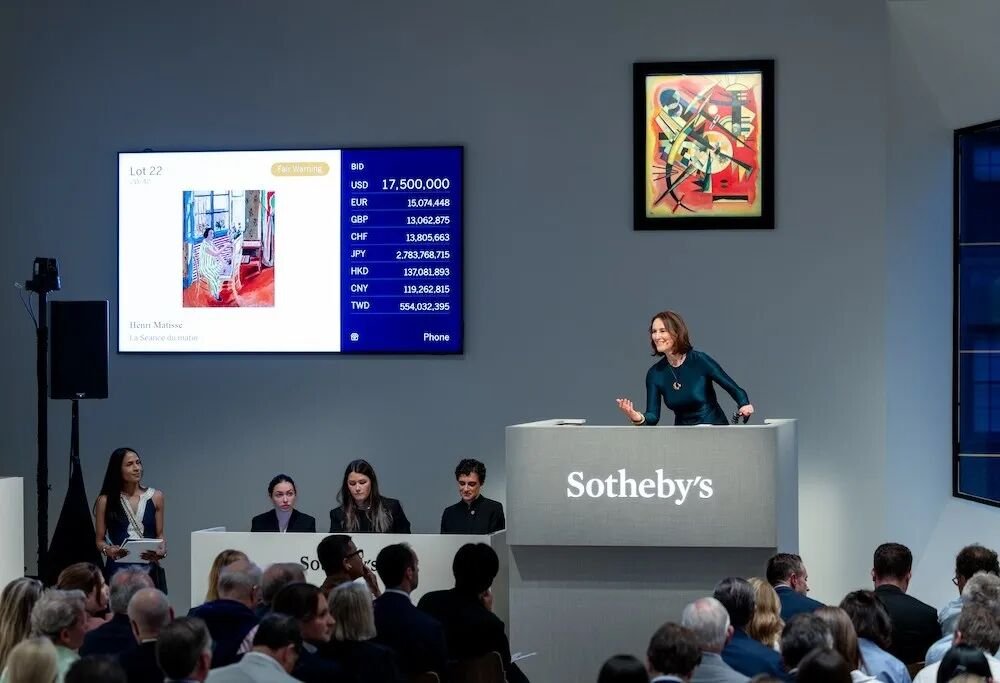
Installation view of Sotheby’s New York Modern Evening Auction.
For a long time, discussions surrounding wealth preservation and appreciation were largely centered around traditional financial instruments such as real estate, stocks, and gold. Especially in a global environment shaped by prolonged monetary easing, rising inflation, and increasing market volatility, anxiety surrounding currency depreciation has become increasingly visible among asset-holding classes. At the same time, however, another significant shift has gradually emerged: more and more high-net-worth individuals are turning their attention toward art investment and the broader process of art assetization.
This shift does not simply mean “buying a painting to hang at home.” Rather, artworks are increasingly being incorporated into wealth management and asset allocation systems. For many affluent collectors and investors, art is no longer viewed merely as a form of aesthetic consumption, but as a long-term store of value. In certain ways, it has even begun to function as a form of culturally embedded “hard asset.”
Currency itself does not possess permanent stability. As global liquidity continues to expand, the purchasing power of cash savings is constantly eroded. Real estate was once widely considered one of the most stable tools against inflation, yet in recent years global property markets have begun to experience cyclical instability, declining liquidity, and rising holding costs. Meanwhile, although stock markets offer the possibility of high returns, they are equally accompanied by substantial risk and uncertainty. Within this context, investors are increasingly rethinking what “long-term value storage” actually means.
The global financial system is currently undergoing a structural “great turning point.” Fluctuations in dollar credibility, debates surrounding Federal Reserve independence, the rise of multi-currency settlement systems, and geopolitical restructuring are all reshaping the logic of traditional assets. Within this broader environment, artworks are increasingly being treated as alternative assets capable of combining cultural value, scarcity, and financial functionality.
One of the defining characteristics of art lies in its irreproducibility and cultural scarcity. Whether considering Picasso, Basquiat, Andy Warhol, Zao Wou-Ki, Yayoi Kusama, or Yoshitomo Nara, their works cannot be infinitely reproduced in the same way as financial instruments. The value of art is not entirely rooted in functionality, but instead emerges through cultural consensus, historical positioning, institutional validation, and social recognition. As a result, blue-chip artworks often do not fluctuate in direct alignment with short-term economic cycles. Rather, as global capital increasingly searches for long-term stores of value, art has gradually become recognized as a unique asset category.
For example, following the 2008 global financial crisis, the market prices of many blue-chip artists continued to rise. In 2017, Japanese collector Yusaku Maezawa purchased Jean-Michel Basquiat’s Untitled for over $110 million, a sale that not only broke records but also reinforced global confidence in top-tier art assets. At the same time, major auction houses have increasingly become symbolic spaces for the circulation of ultra-high-net-worth capital. Evening sales at Sotheby’s and Christie’s now often resemble financial spectacles as much as cultural events.
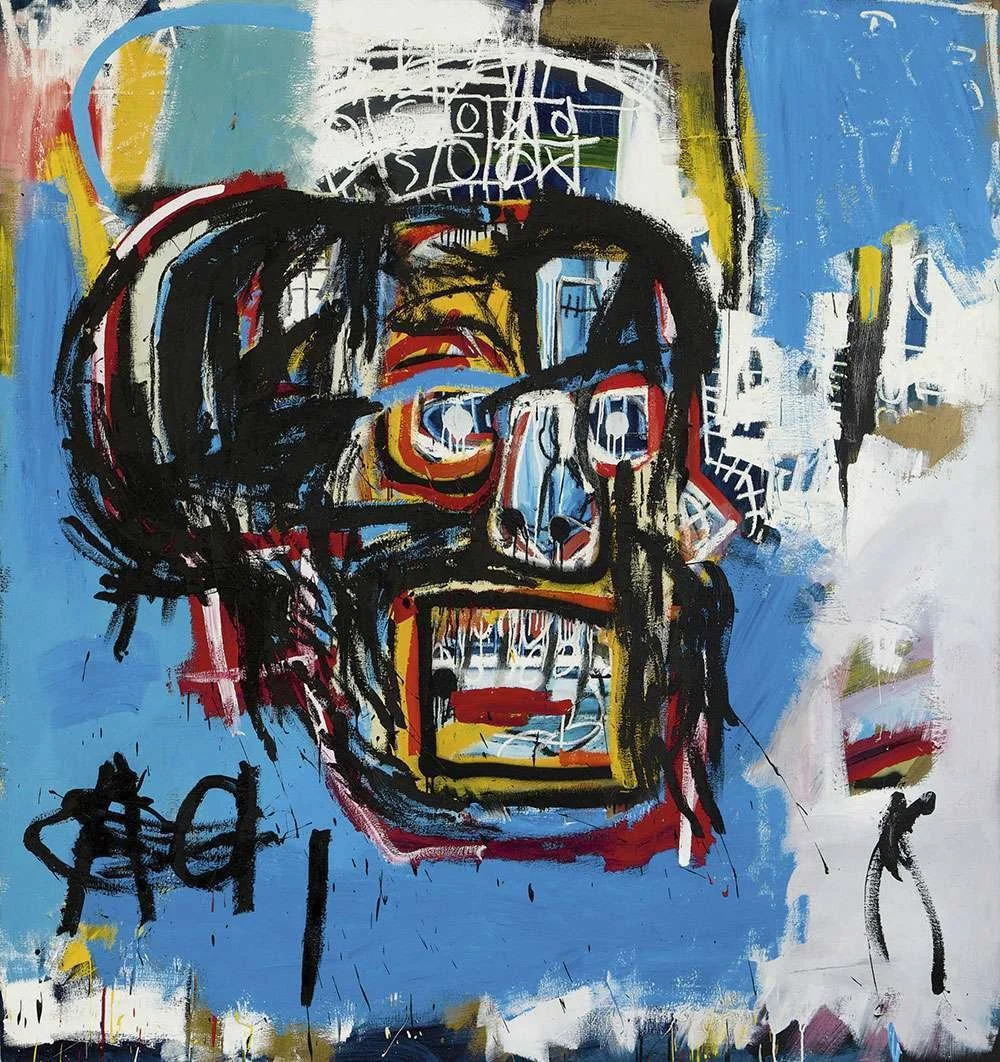
Jean-Michel Basquiat, Untitled, 1982. Sold for $110.5 million during Sotheby’s Contemporary Art Evening Sale in New York in 2017, marking one of the most significant moments in the financialization of the contemporary art market. The work was acquired by Japanese entrepreneur and collector Yusaku Maezawa.
As traditional financial assets become increasingly volatile, high-net-worth individuals and institutional investors are paying greater attention to diversification and risk-hedging strategies. The logic surrounding art ownership is therefore shifting as well: artworks are no longer treated merely as speculative objects for short-term appreciation, but are increasingly being incorporated into long-term wealth planning, family trusts, and intergenerational asset structures.
More importantly, the art system itself is becoming increasingly financialized. In the past, art collecting was primarily associated with private passion and cultural interest. Today, however, artworks are increasingly entering the structures of funds, trusts, family offices, and private banking systems. Many international financial institutions have established dedicated Art Finance departments. UBS, for instance, has long published the Global Art Market Report in collaboration with Art Basel, while institutions such as Deutsche Bank and Citibank have also participated in art wealth management services, including art-backed loans, collection valuation, tax planning, and inheritance strategies.
Simultaneously, museums and foundations continue to reinforce art’s status as a form of cultural capital. The Guggenheim, for example, has long exceeded the role of a conventional museum. From New York to Bilbao and Abu Dhabi, the Guggenheim model has become a mechanism of global cultural capital distribution. Art not only produces cultural influence, but also drives urban redevelopment, tourism economies, international branding, and capital flows. In many cases, the value of an artwork no longer derives solely from the object itself, but from the institutional systems, exhibition histories, collecting networks, and circulation structures surrounding it. The logic of the art market increasingly resembles the construction of consensus value within financial markets.
At the same time, developments in digital technologies and financial instruments are further accelerating the assetization of art. NFTs, blockchain provenance systems, fractional ownership models, art trust funds, art-backed financing, and AI-driven valuation systems all suggest that art is entering an increasingly financialized and globalized era. Many art finance institutions are beginning to experiment with “Art Asset Credit Scoring” systems that evaluate artworks through factors such as auction performance, exhibition history, institutional support, liquidity, and market stability.
In many ways, the art market is no longer simply a market for buying and selling artworks. It is gradually becoming a far more complex structure where cultural capital, financial systems, technology, and global liquidity intersect.
Of course, the art market still carries high barriers to entry, strong information asymmetry, and significant volatility. It is by no means a completely safe market. Unlike stocks, artworks do not circulate within fully standardized systems. Their value still depends heavily on institutional credibility, collecting networks, market psychology, and cultural recognition. Yet it is precisely this cultural and symbolic dimension that distinguishes art from conventional financial assets.
For the truly wealthy, wealth management has never been solely about generating profit, but about constructing long-term, intergenerational asset structures capable of resisting systemic risk. Artworks happen to possess several characteristics simultaneously: scarcity, global mobility, cultural capital, symbolic prestige, and long-term value retention. Art therefore functions not only as an asset, but also as an extension of social identity.
Perhaps the most important question in the future will no longer simply be: “How much is art worth?” but rather: “In a constantly shifting financial world, could culture itself become a new form of asset logic?”
About the Writer: Shuhan Zhang (b. 2002, Jiangsu, China) is a curator and writer. She received her M.A. in Visual Arts Administration from New York University and holds a B.A. from the Central Academy of Fine Arts. Her research focuses on digital art, cultural platforms, and the contemporary art market. She has curated exhibitions including After the Face, Lithic Coordinates, Losing Ghosts, A Lure, A Lament, and Spreading Growth. Her writing has been published in Tussle Magazine, IMPULSE Magazine, Art Spiel, and Whitehot Magazine, with a focus on exhibition criticism and contemporary art discourse.