
The Bitterest Ice Cream: Objects as Sediment
by Luman Jiang
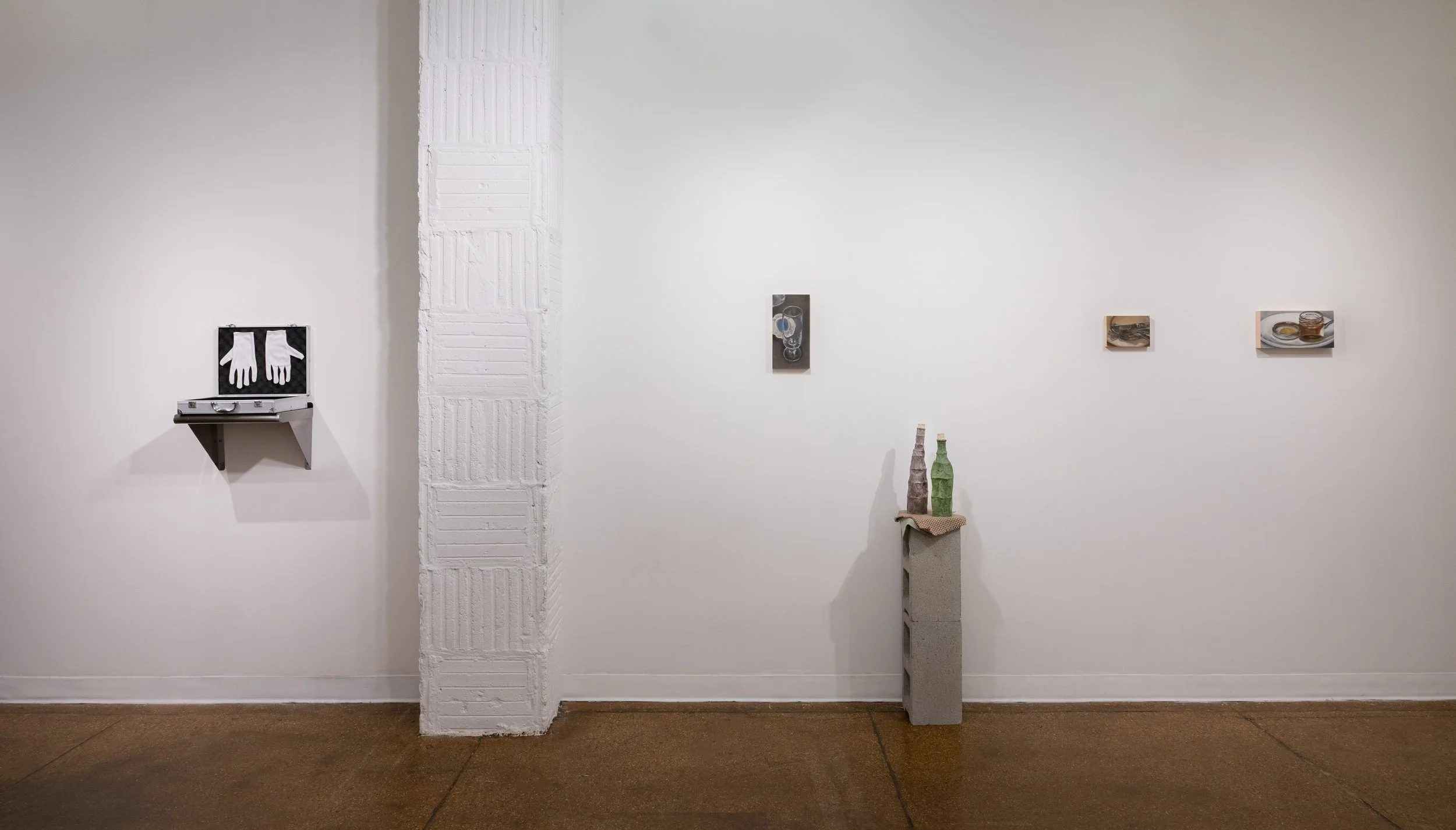
Installation view of The Bitterest Ice Cream. In courtesy of the artists.
Ice cream is the exhibition's most fitting and most ironic figure. The sweetness it promises lasts only a few seconds on the tongue before it melts and disappears, impossible to preserve and impossible to return to. What is "bitterest" is a different kind of taste, one that stays. Bitterness lingers in the mouth long enough to seep into memory; it outlasts sweetness. Through this opposition of flavors, the exhibition poses a question about objects and feeling: how does emotion remain in matter, and once it does, what has the object become?
In her foreword, curator Shuhan Zhang writes that objects are rarely inert, that they absorb, reflect, and mediate human experience and become vessels for feeling. This is the exhibition's premise, though the metaphor of the vessel might be pushed one step further. A vessel implies that feeling pre-exists the object and is poured into it, as if the object were a neutral container waiting to be filled. What the two artists show runs in the opposite order: the object is worked over first, and feeling grows out of that handling, layer by layer.
Sara Ahmed, in The Cultural Politics of Emotion, argues that emotion belongs neither to the subject nor to the object but accumulates its intensity by circulating, by "sticking" to the surfaces of certain objects and bodies through repeated contact. An object holds no feeling in itself, yet an object that feeling has passed through again and again comes to look as though it carries feeling. This logic of sticking supplies exactly the temporal dimension the vessel metaphor leaves out: an object comes to hold emotion because it has been passed over, looked at, and handled repeatedly, and it is in that repeated contact that feeling sediments onto it.
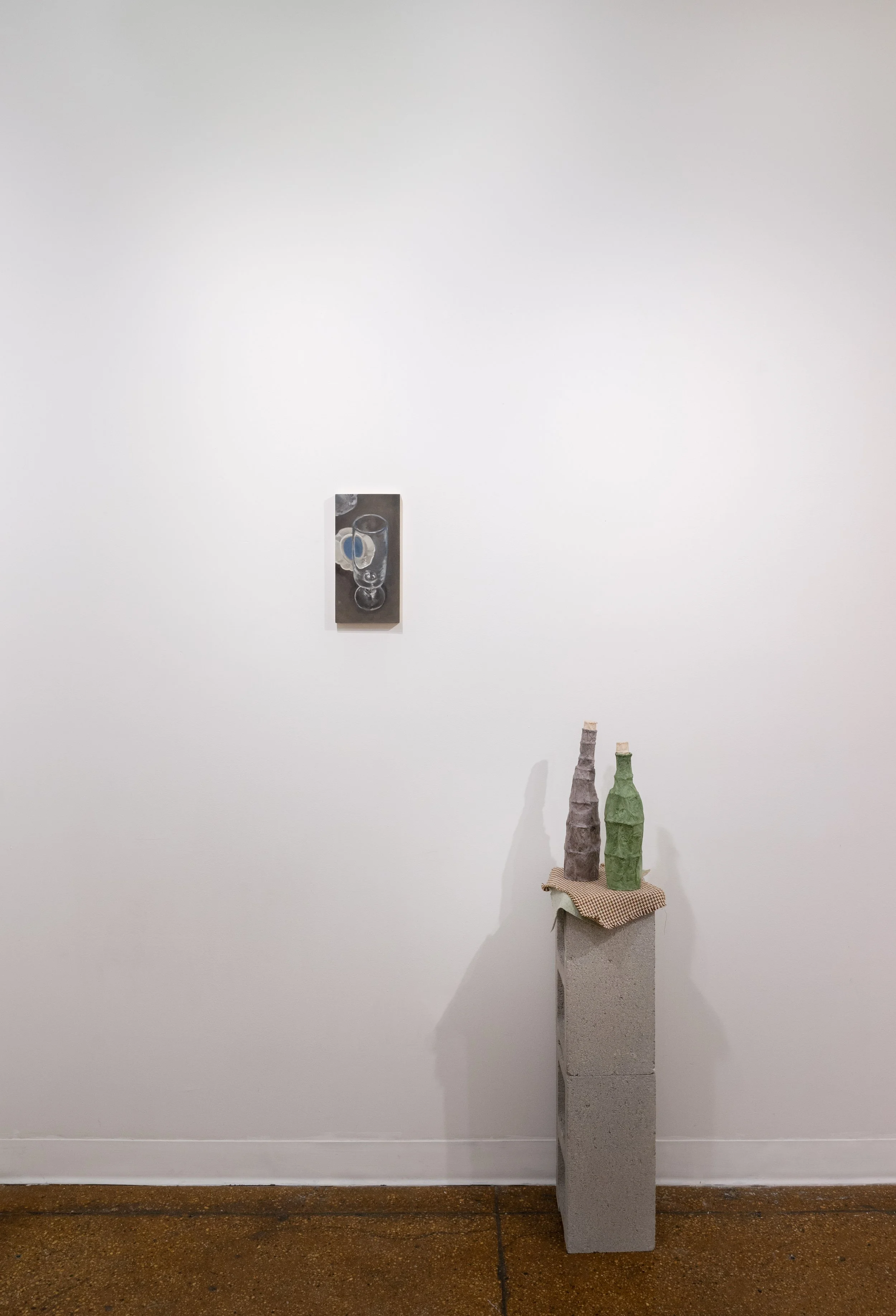
Installation view of The Bitterest Ice Cream. In courtesy of the artists.
Shengjie Jiang paints objects that cannot be kept. A sliced apple, a half-eaten cake, emptied tableware; she chooses things already going bad, already on their way out, a sweetness about to expire. But the fugitive is not only what rots. In Elephant and in the two paintings titled The Wind in the Willows, the transient enters as something that passes through rather than something that spoils: an animal crossing a garden, a literary echo hovering near the image, there for a moment and already leaving. Whether decaying or merely passing, her subjects share the same brief tenure. Many of her formats are small, often between 5 by 7 and 12 by 6 inches, as if a fleeting moment had been stopped by force and fitted into a frame that permits no excess gesture. The Grasshopper and Pot series return to the same set of domestic objects, jars, utensils, the creases of cloth, though the light and arrangement shift slightly each time. Painted over and over, looked at over and over, the object thickens with feeling in the repetition. It does not become something else. It simply ages in the course of being remembered, slowly and irreversibly; each act of looking wears it down a little, and for that reason makes it a little heavier.
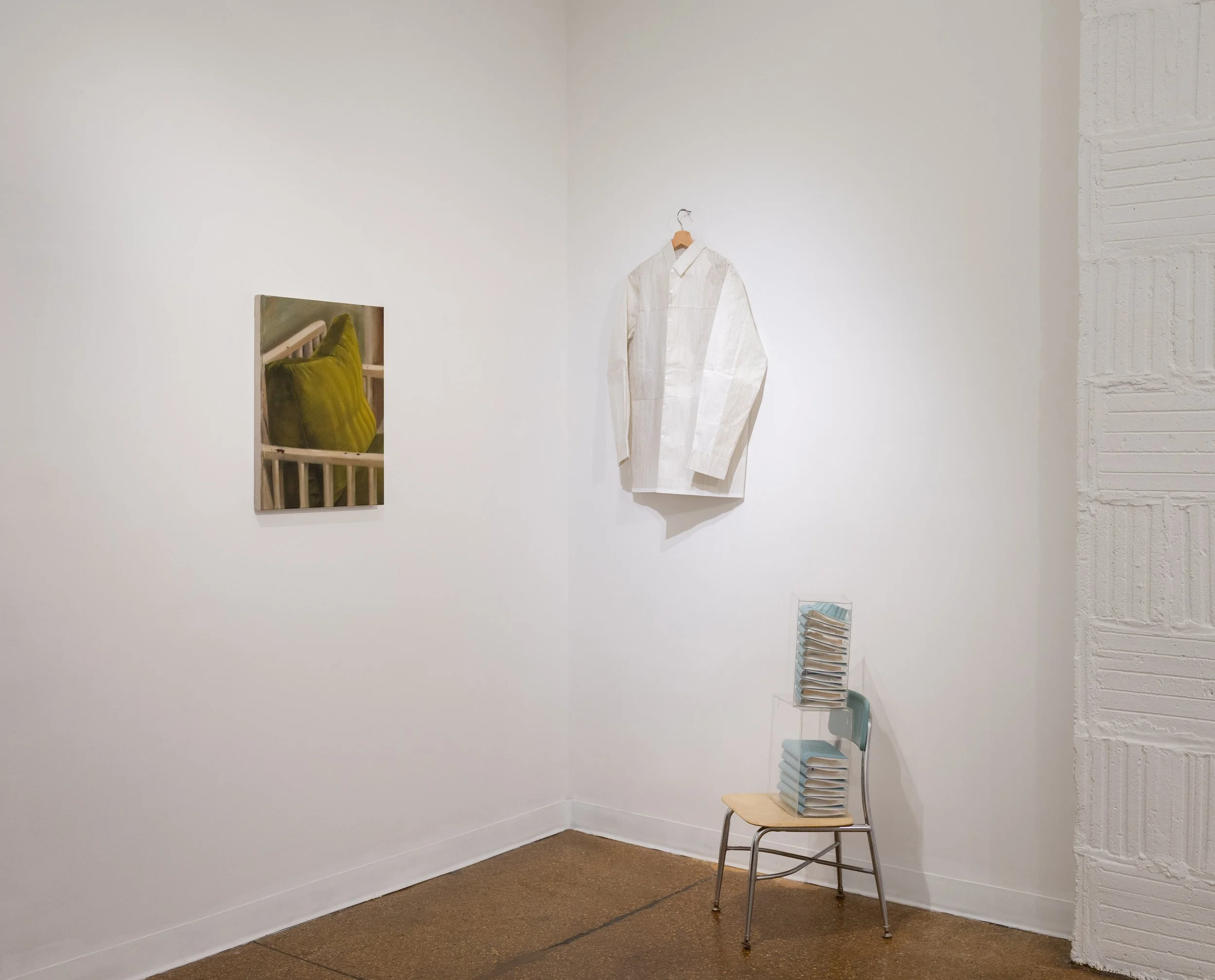
Installation view of The Bitterest Ice Cream. In courtesy of the artists.
Alex Wen works with materials made to sediment. Paper, cloth, the bound pages of a book, things whose very mode of existence depends on being handled again and again: folded, stacked, sewn, turned. A garment printed by letterpress and suspended in the gallery is no longer a garment meant to be worn; a book bound dos-à-dos, two books sharing a single spine back to back so that finishing one requires flipping the whole thing over to begin the other, is no longer a book meant to be read. What happens here is the shift Bill Brown describes from object to thing: in ordinary use an object is transparent, we look through it in order to use it, and only when it falls out of its functional context does it reassert itself as a thing and look back at us. Where the Horizon Folds is precisely such a work; its binding is itself a structure about two memories that coexist yet remain invisible to each other, since you cannot open both faces at once. As these everyday objects slip loose from their practical use, feeling becomes visible in the same instant.
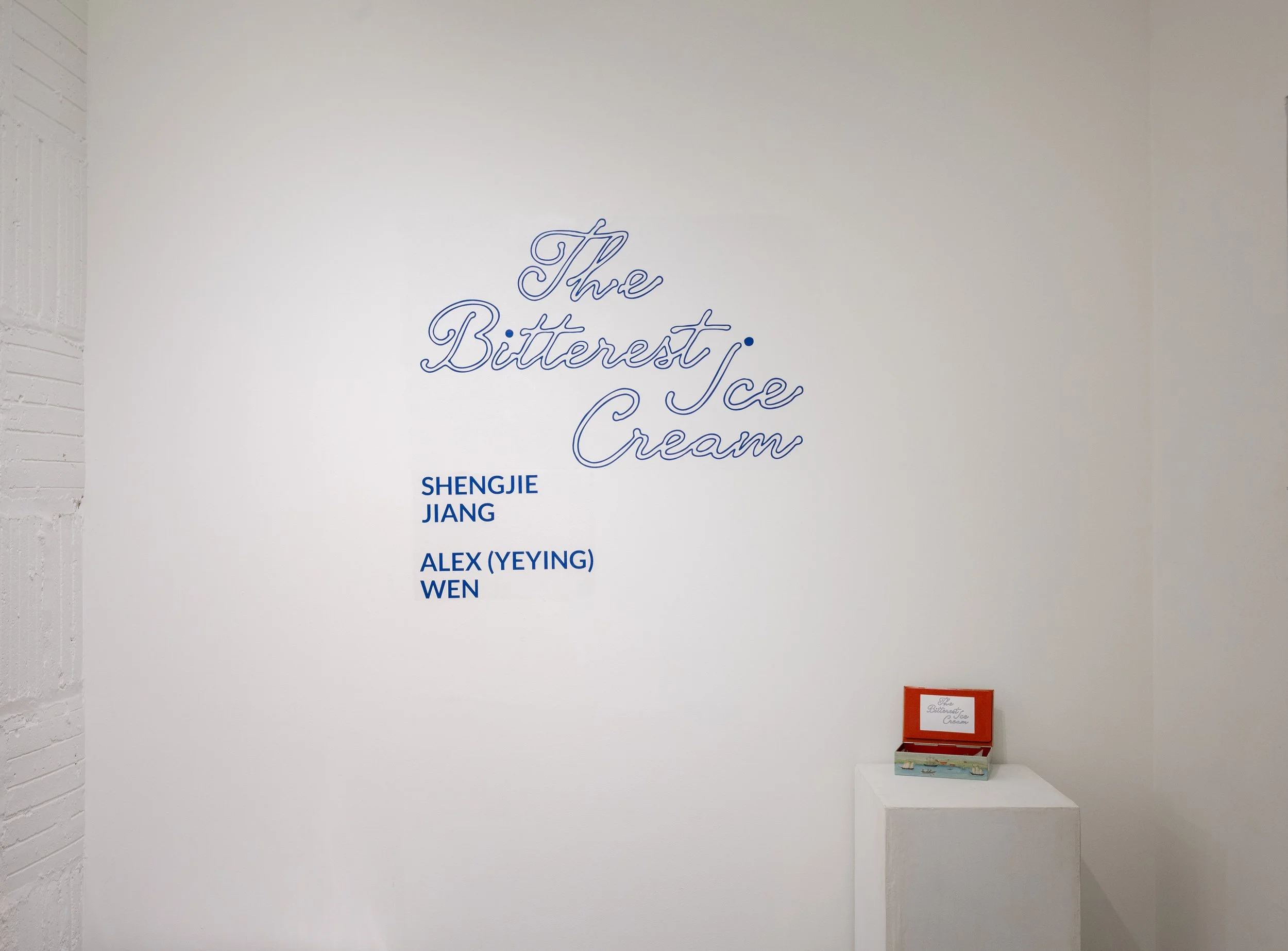
Installation view of The Bitterest Ice Cream. In courtesy of the artists.
If Jiang's objects wear down in the course of being remembered, Wen's thicken in the course of being handled. The first is subtraction: sweetness dissipating, the painting a holding-on to what disperses. The second is addition: paper and book growing denser with each fold and transfer. Yet both rest on the same underlying logic. The shape of the object stays fixed while its density changes. A tomato is still a tomato, a book still a book; they do not deform, they are only pressed, by accumulated looking and touching and turning, into layer upon layer of weight that has nothing to do with their original function.
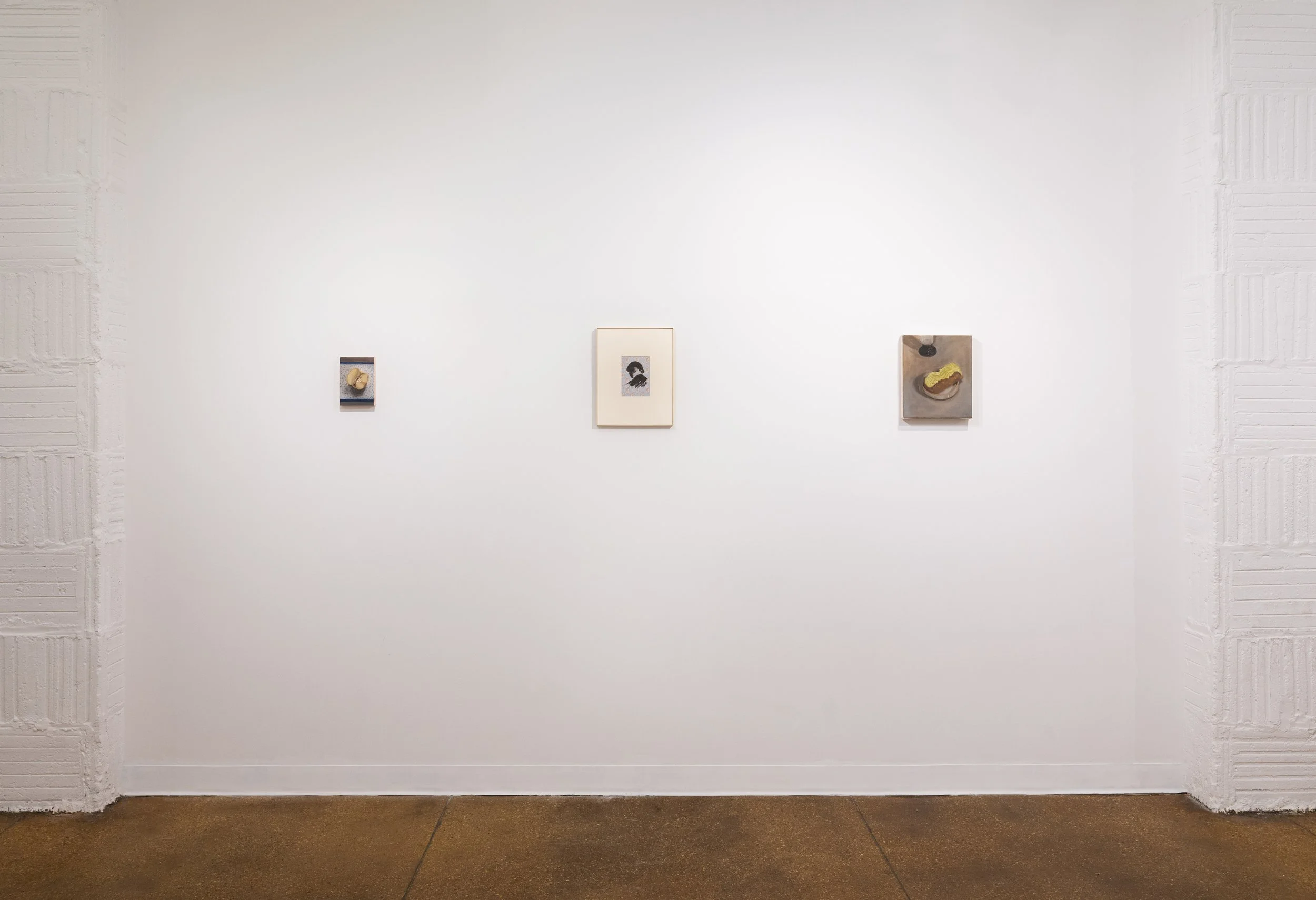
Installation view of The Bitterest Ice Cream. In courtesy of the artists.
This is perhaps what "bitterest" means in the title. Bitterness is bitterest because it is durable enough to be left behind. Sweetness is sensory, immediate, incapable of settling; bitterness is relational and slow, sedimenting only through repeated handling until it presses down, compacts, and becomes part of the very density of the material. What this exhibition finally shows is not that an object preserves feeling, but that feeling, passing through the same object again and again, slowly makes it singular. The object comes to be claimed, not owned: claimed by repeated contact, by the hand that works it and the eye that keeps returning, until it can no longer be encountered as if for the first time.
The Bitterest Ice Cream at FLOHAUS Gallery in New York, on view from July 3 to July 10, 2026.
About the author:
Luman Jiang (b. 2002, Chongqing, China) is a writer and curator whose practice moves between Chinese- and English-language art worlds. Her criticism, published in Whitehot Magazine and Tussle Magazine, examines exhibitions through questions of cross-cultural translation and mediation. She holds an M.A. in Visual Arts Administration from New York University.