
Ecology of Desire: Toward an Aesthetic of Recursive Intelligence
By Weifan Mo
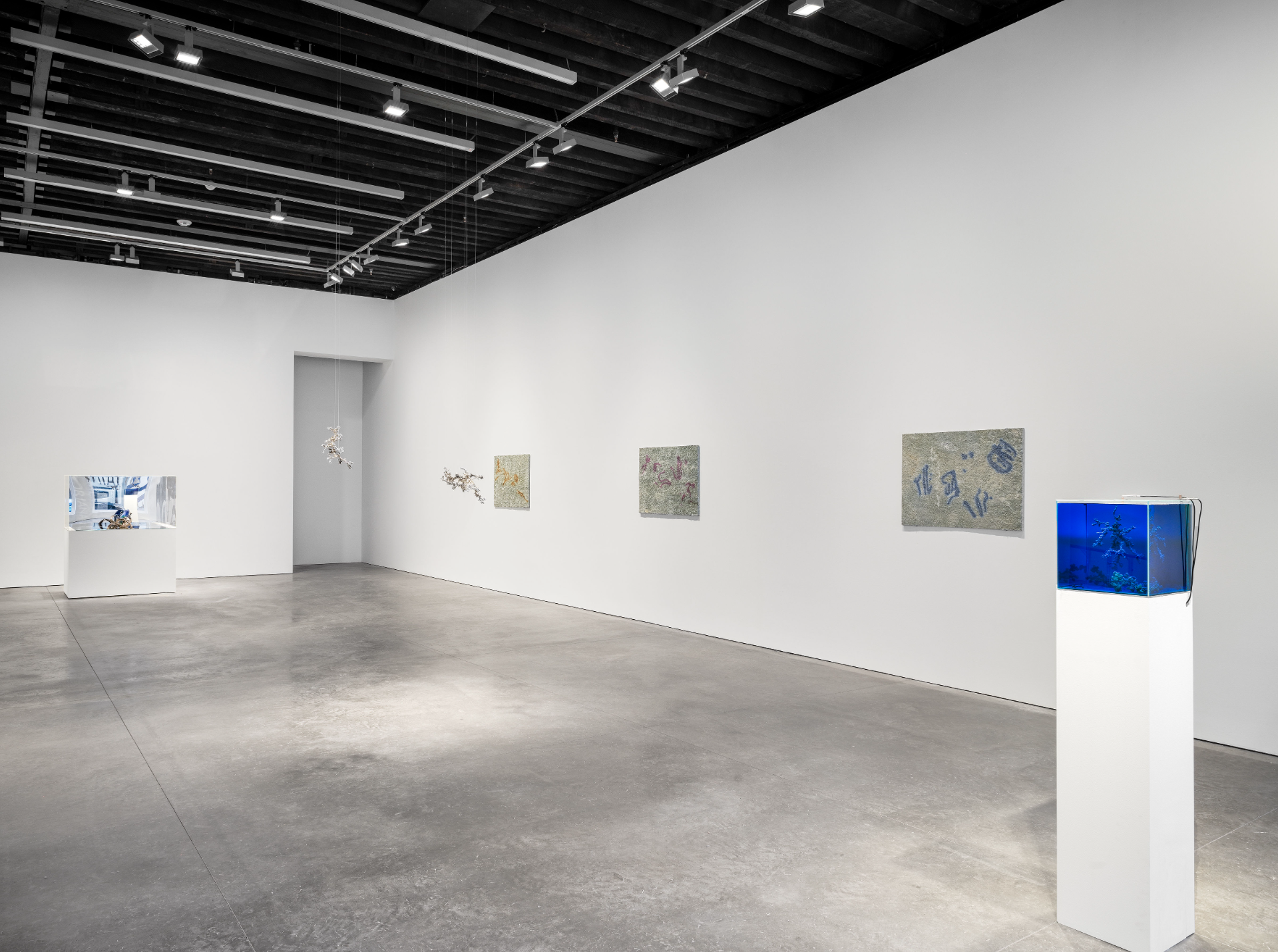
Installation view of Recursion, courtesy of artist and Marian Goodman Gallery New York
Through the luminous currents of video installations, in the sapphire glow of an aquarium, upon still metals and stones, forms unfurl with a hypnotic tension, throbbing like the heartbeat of some secret, ineffable life. It is alive, and yet it pulses with a radiance that surpasses any regular capture of that conception, rendering a dark, luminous enigma. A tenuous, diaphanous beauty circulates within the fissures of mechanical logic—the affect of a collective sensuousness.
In her solo exhibition, Recursion, at Marian Goodman Gallery, New York, Agnieszka Kurant resists collapsing into a reductive vision of recursion as a facile, unbounded infinity of tragedy in response to the epochal dilemmas posed by a (post-)synthetic regime of production. Instead, she turns to materiality as the occasion and condition to press out an aesthetic silhouette of recursion from its ever-fluctuating flow. Her gestural leap of aestheticization slips past the merely descriptive or representational registration of the factual. Out of copper crystals, glass, mineral pigments, stones, aquariums, and pulverized objects, these materialized imprints cohere into a generative force that reconfigures intellection as an interlaced ecology. Kurant’s art thus stages an exploratory intervention in visions of cybernetics through the quest for beauty, in which the very perception of beauty seems to subtly orchestrates a delicate equilibrium of this ecology of intellection.
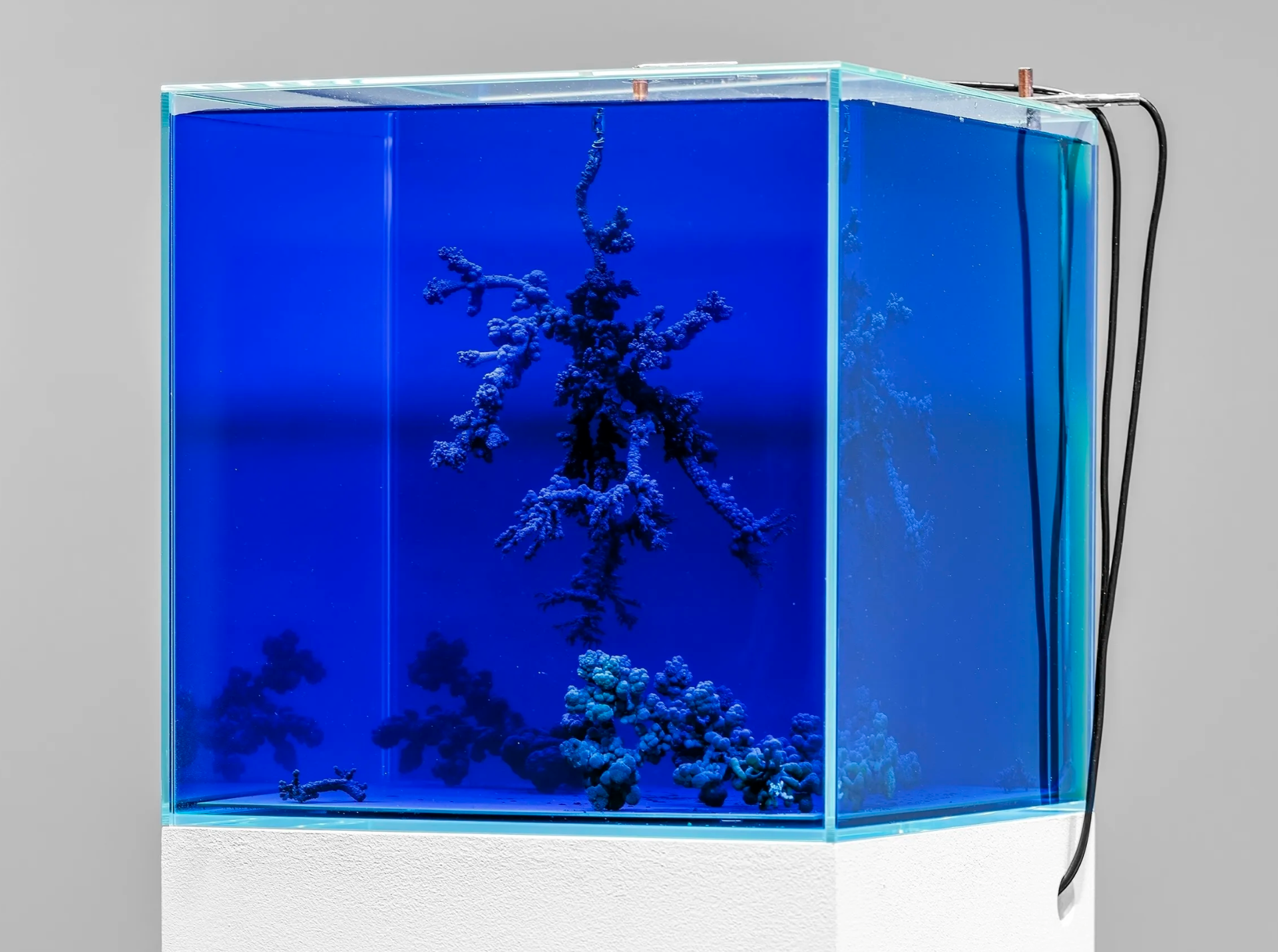
Installation view of Recursion, courtesy of artist and Marian Goodman Gallery New York
Kurant nudges thought into the unthought. Yet in Uncomputables (2026) and Unthoughtforms (2026), she does not romanticize the “unthought” into a utopian, more-than-human mystery. It is, rather, a living technical production: a crystallization of ideas suspended in the liminal interstice between human cognition and systemic feedback. Or more precisely, a threshold binding the AI-harvested simulacra and our authentic, sensuous responses to them, a reality at once mediated and immediate.
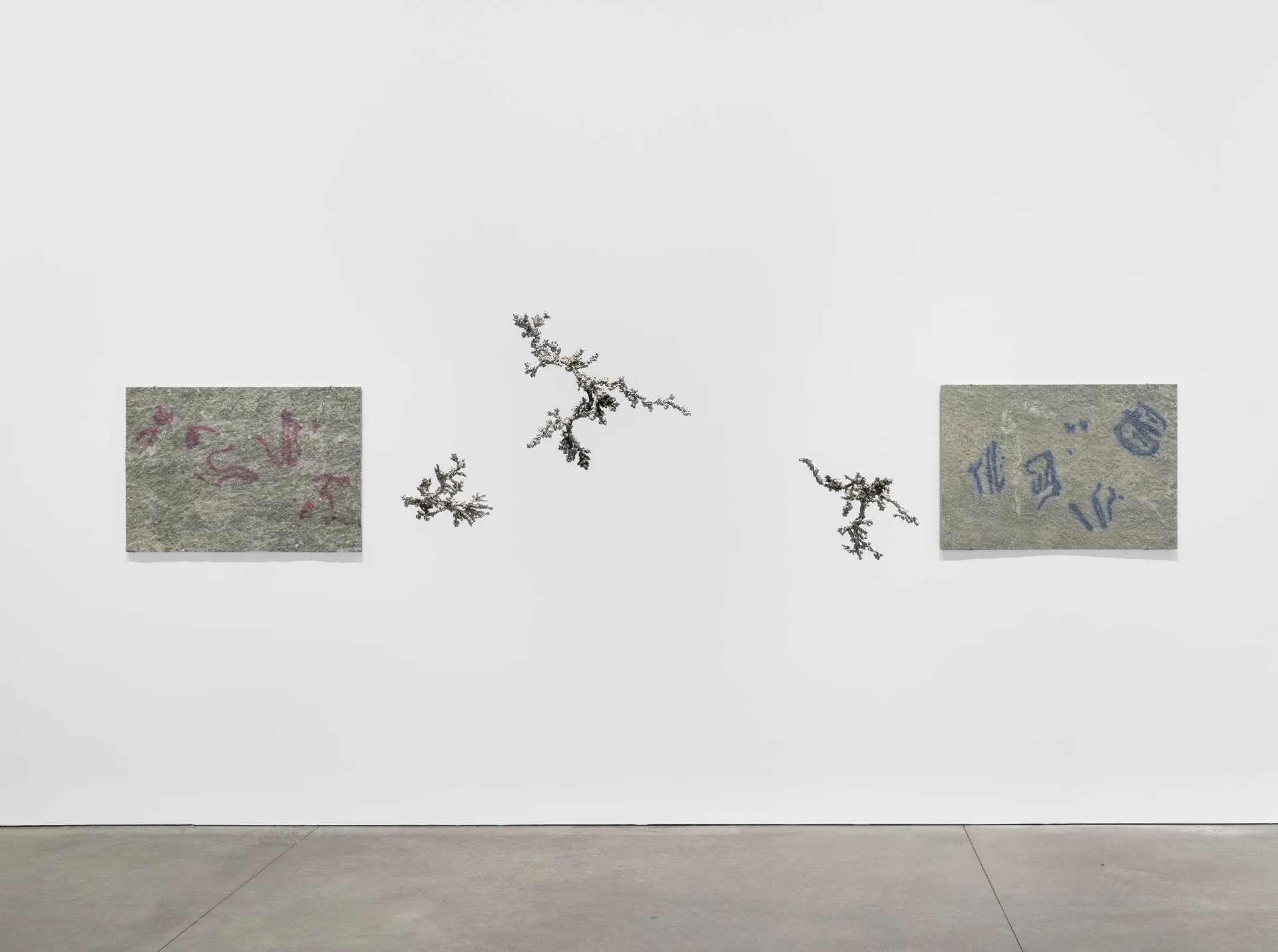
Installation view of Recursion, courtesy of artist and Marian Goodman Gallery New York
The same juxtaposition resonates through Kurant’s vision of human language and the arc of evolutionary history. In Adjacent Possible (2021) and Phantomatics (2026), Kurant flirts with the stochastic fabric of human experience, within which the evolutionary trajectories of human culture and language are drawn along by a numinous collective intelligence. In fact, this intelligence hauntingly and profoundly resembles generative AI, radiating an uncanny, almost disquieting aesthetics that eludes linear causality. A noise. The computer’s re-computations into alternative languages and adjacent ancient relics are converted into a perceptible, visceral state: noise. It is the noise of our speech—the misaligned grammars and idiosyncratic coinages that persist as the constant background of our living. Thus, the pre-linguistic and the linguistic move in the same oscillating rhythm, with recursion not only endlessly self-referential within the computational system but also continuously leaking into human material reality and history.
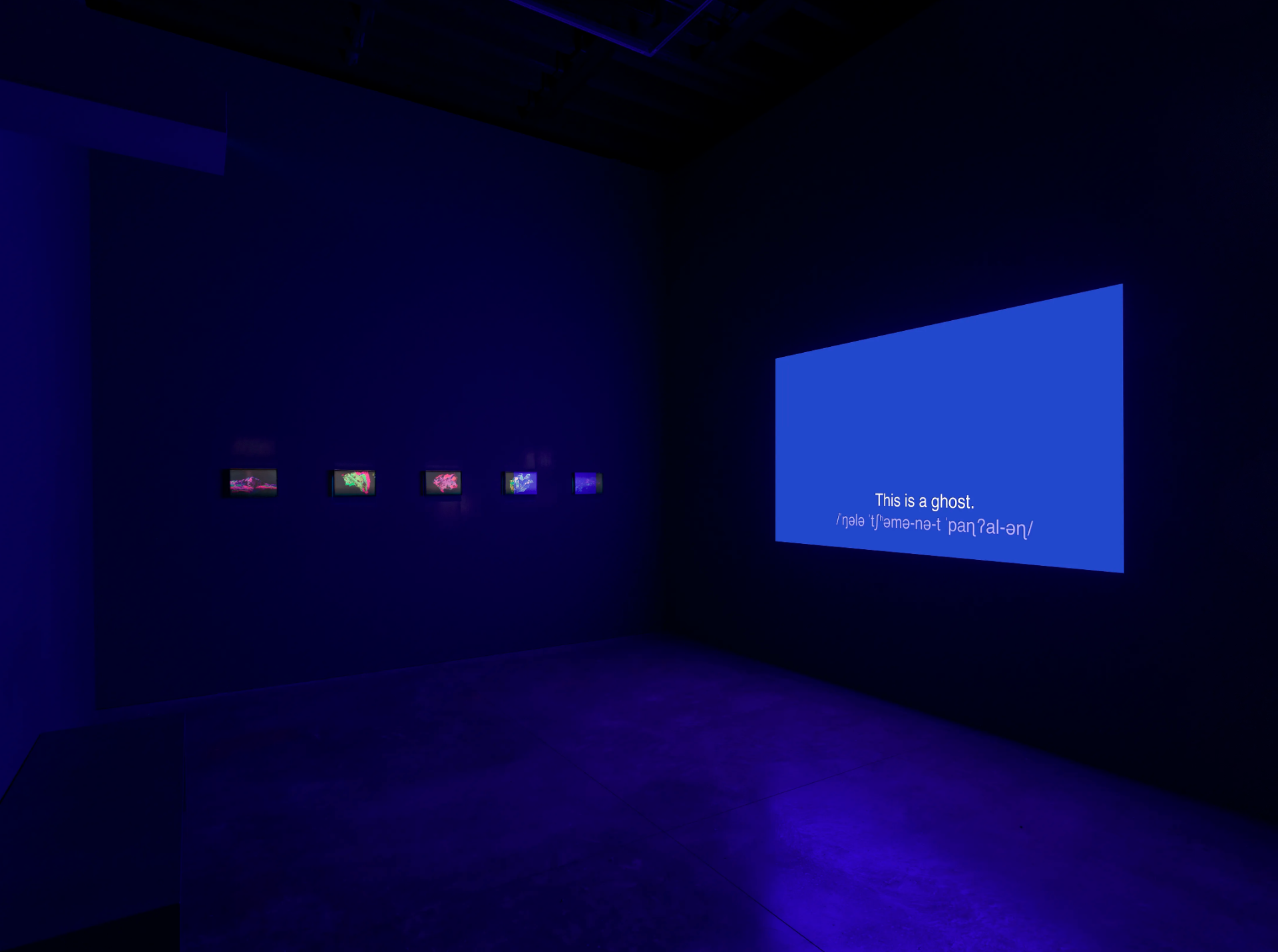
Installation view of Recursion, courtesy of artist and Marian Goodman Gallery New York
In the conclusion of her essay on “the metabolic logic of AI slop,” Kate Crawford raises a mesmerizing question: should we embrace slop, or seek desire for something wholly other? Kurant’s gesture seems to retrace the hidden currents of desire that flow beneath the slop, in order to figure out whether we’ve already been desiring otherwise. Enacted in Sentimentite (2022) and other works, it is desire itself, not the projection onto its objects, that fuels its own recursive production. Rather than just lingering on the metaphysical perils of slop, Sentimentite inhabits the contours of desire in their tangible, mineral traces. Within these veined imprints, the human-AI entanglement circulates as a quietly persistent ecology, suggesting that in countless unnoticed intervals, we may already have slipped beyond the recursive logic that seemed to contain us.
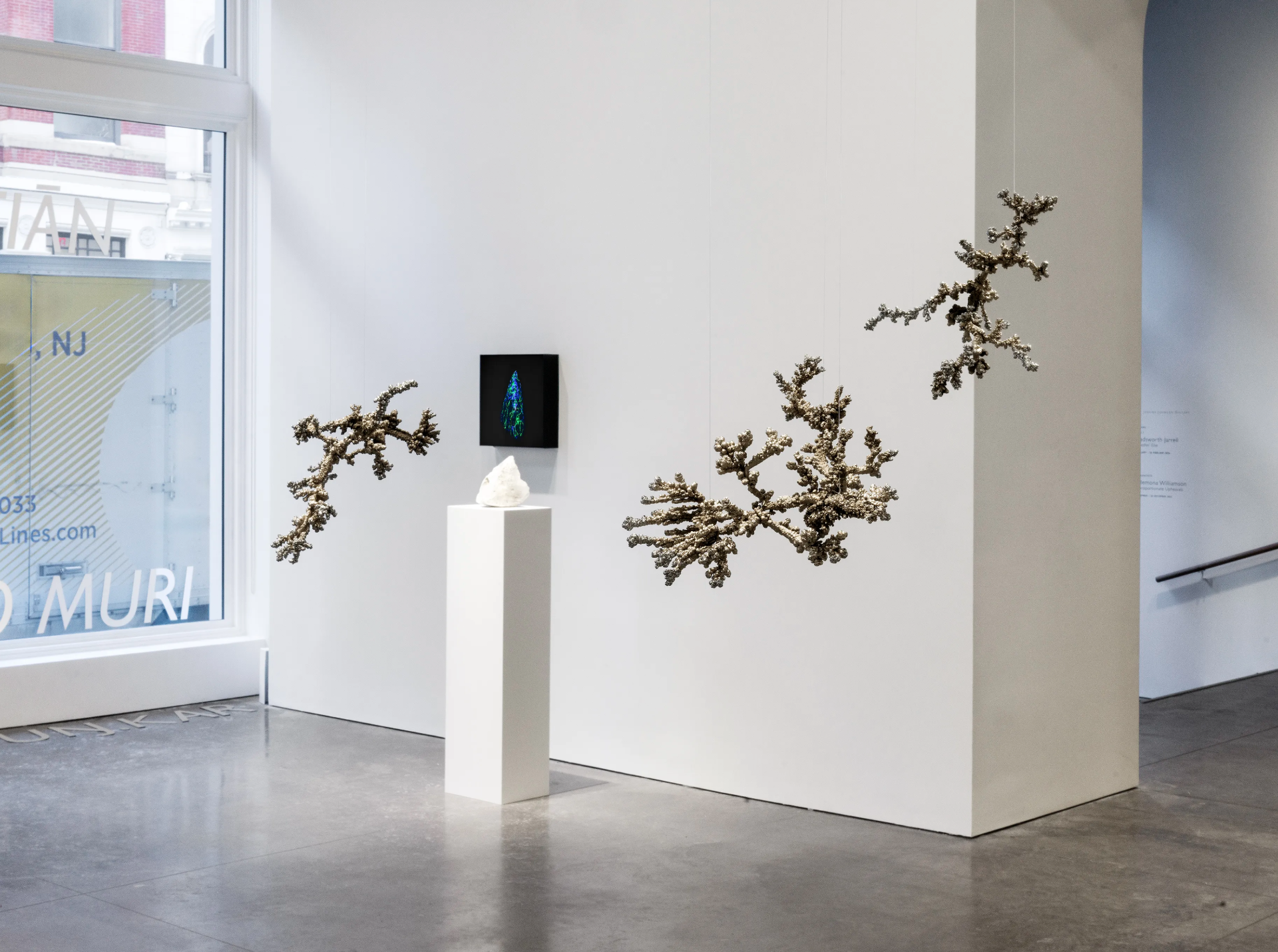
Installation view of Recursion, courtesy of artist and Marian Goodman Gallery New York
Agnieszka Kurant: Recursion at Marian Goodman Gallery, on view through 6 February - 21 March 2026
About the author:
Weifan Mo (Michelle) (b.2001) is a writer, creator, and curator, with scholarly interests that encompass aesthetics, phenomenology, affect studies, Ancient Greek philosophy & drama, and Chinese diasporic literature & films. She received an MA in Philosophy from the New School for Social Research and a BA in Philosophy from Duke Kunshan University. Her academic and creative initiatives revolve around interdisciplinary artistic practices that channel our intellectual life into everyday experience. She employs the project of aesthetics study as a filter to encapsulate the affective dynamics surrounding individuals within modern and postmodern contexts. Her curatorial projects have been exhibited in Gallery 456 | Chinese American Arts Council, THE BLANC, and Latitude Gallery.