
After the Sweetness
by Morny Li
When a piece of candy rests in the mouth, sweetness arrives before shape. The tongue remembers its coating, its artificial flavor, the sensation of something slowly dissolving, until a hard fragment suddenly meets the teeth. Only then do we realize that sweetness does not necessarily mean softness.
This Candy Has Teeth begins with this small sensory misalignment. Bringing together works by Shengjie Jiang, Weican Wang, Jiaqi Mao, Yukun (Chloe) Ba, and Cindy Zhaoyue Chen, the exhibition moves through objects, images, and bodily memories associated with childhood. Yet what it ultimately addresses is not a familiar narrative of lost innocence. For candy to have teeth does not mean that its sweetness was false. The sweetness remains; it simply can no longer be swallowed without resistance.
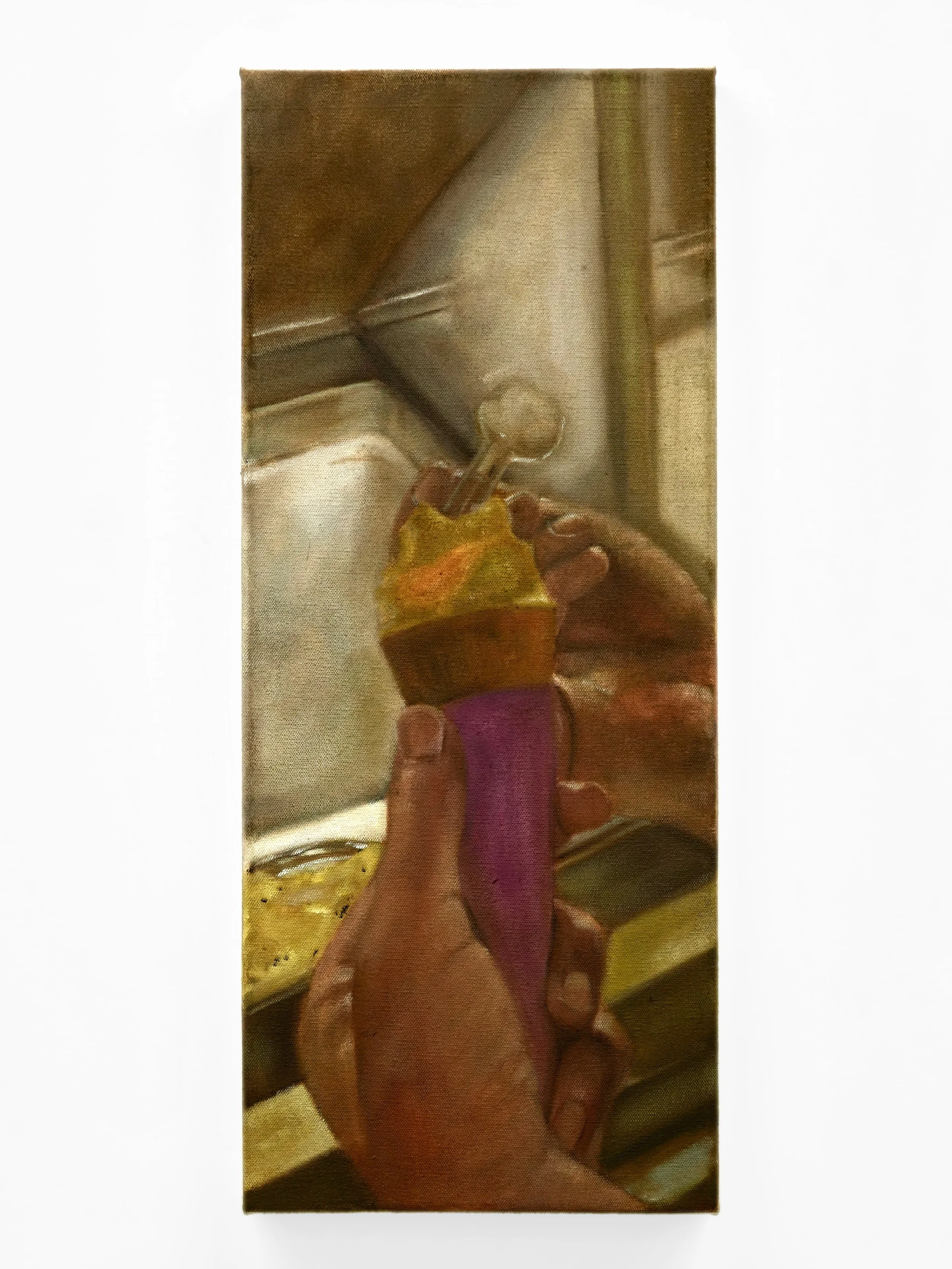
Shengjie Jiang, Elephant, 2024. Courtesy of the artist.
This distinction offers a useful way into the exhibition. Childhood is often softened by memory into a collection of familiar things: animals, toys, family members, seaside landscapes, games, and small objects once held in the hand. But softness is never entirely self-sufficient. A stuffed animal depends on seams to hold its body together. Paper requires folds, pressure, or support to maintain a form. The security of domestic life relies on routines, spaces, and the labor of other people. Softness is always sustained by some kind of structure. As children, however, we are rarely aware of what holds it in place.
The works of Shengjie Jiang and Cindy Zhaoyue Chen preserve an immediate sense of intimacy. Animal forms, bright colors, and toy-like proportions draw on a visual vocabulary that feels almost bodily in its familiarity. These images do not initially ask to be interpreted; they seem already lodged somewhere in memory. We recognize their affect before we search for their meaning. Yet that familiarity quickly begins to slip. In Jiang’s paintings, recurring figures do not become more stable through repetition. Instead, they shift slightly each time they return, much as remembered images do. Chen produces a different kind of hesitation through ceramics: bodies that appear fuzzy, playful, or made to be held are in fact hard, weighted, and breakable.
Cuteness, then, becomes less a visual quality than a misalignment between seeing and touching. The eye assumes it already knows the object; the body receives another answer when it comes closer.
Ba’s work pushes this tension further into the internal logic of materials. Paper, magnets, edges, and systems of support make visible the structures that allow apparently delicate forms to remain intact. Here, hardness does not oppose softness. It enables it. This is one of the exhibition’s most productive propositions: childhood tenderness is not an illusion that adulthood later exposes as false. Tenderness and structure were always intertwined. Growing older simply makes the supporting framework easier to perceive.
With Weican Wang and Jiaqi Mao, this resistance becomes less material than temporal. Sea, sky, family imagery, and intimate relationships retain their familiarity, yet they can no longer be fully entered. This is both the tenderness and the cruelty of the photograph: it returns the past to view while simultaneously confirming that the past is no longer accessible. Mao’s attention to Lao Lao, the Chinese term for one’s maternal grandmother, is especially resonant in this regard. A familial name can summon an entire bodily memory: voice, gesture, domestic space, and details too minor or too intimate to describe precisely. Yet the image also places that intimacy on the other side of time. Memory keeps someone present while making the distance from that person newly perceptible.
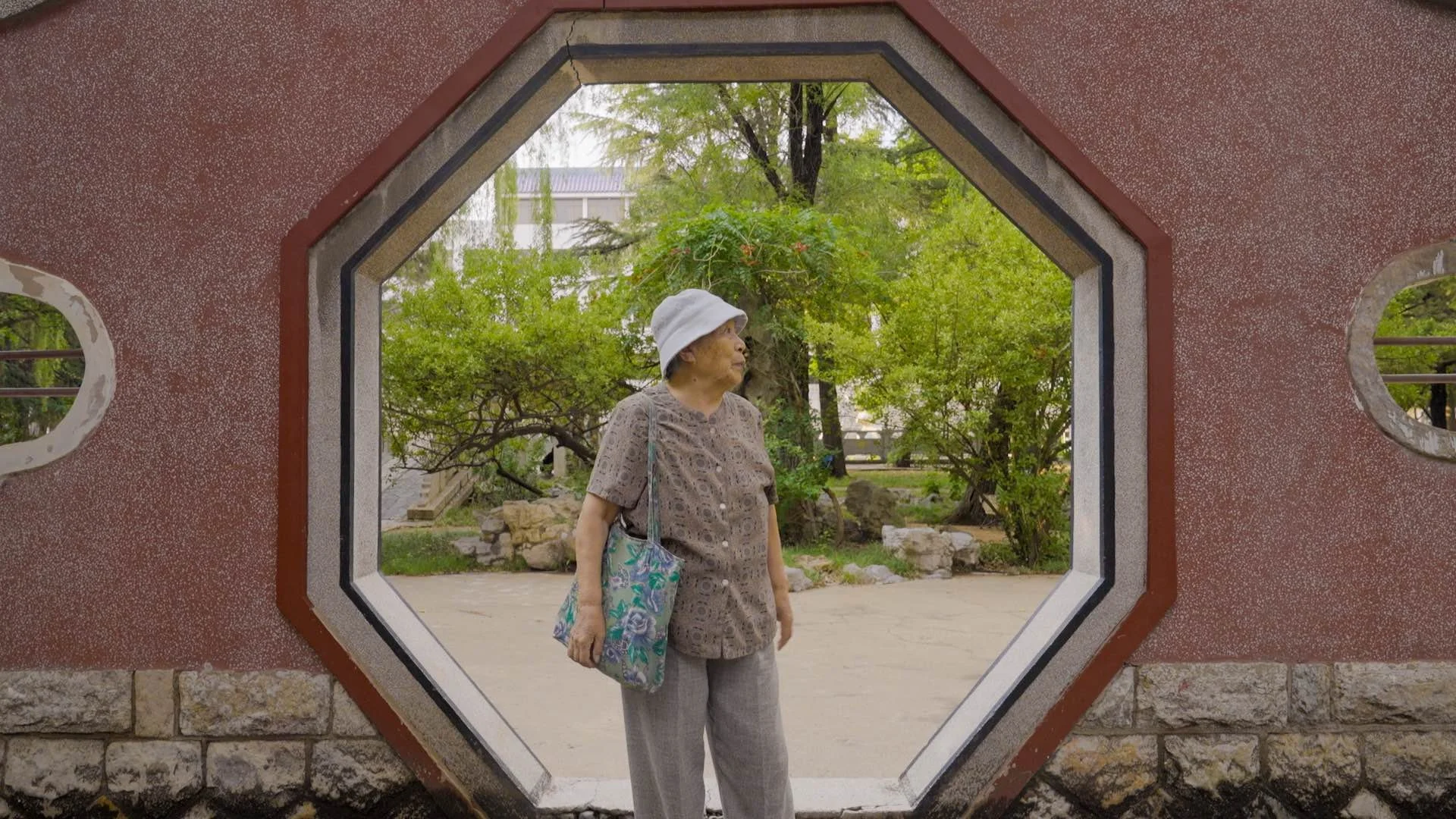
Jiaqi Mao, Lao Lao, 2026. Video still. Courtesy of the artist.
Distance does not cancel intimacy. It gives intimacy weight.
What recurs throughout This Candy Has Teeth, then, is not a simple reversal between sweetness and pain, but a subtler shift in perception. When things that once required no explanation return to an adult body, they begin to reveal their edges. Objects have material limits. Intimacy has conditions. Memory has distance. The exhibition does not suggest that childhood was secretly less beautiful than we believed; rather, it asks what happens when we finally become capable of sensing the structures that once held that beauty in place.
This is why the metaphor of teeth feels so precise. The teeth are not a dark truth hidden beneath the sugar coating. They are closer to the small resistance that matter retains within intimacy, a reminder that even the most familiar object can never be fully possessed by memory.
What is most compelling about This Candy Has Teeth is that it does not ask us to give up our attachment to childhood. Sweetness is not denied, nor is softness exposed as naïve. Across the works of Jiang, Wang, Mao, Ba, and Chen, things that once appeared weightless are simply allowed to regain their weight. What lingers is not the object itself, but the sensation left after contact.
Some childhood memories work like that. They have not disappeared, and they have not turned bitter. Years later, when we bite into them again, we simply feel the teeth.
The exhibition is curated by Shuhan Zhang. This Candy Has Teeth is on view at 526 West 26th Street, Suite 414, New York, from August 25 through September 1, 2026.
About the author:
Morny Li is a writer, curator, and co-founder of CHINCHINART. She holds a BA in Art from Temple University in the United States and an MA in Arts and Cultural Management from King’s College London. Her practice spans exhibitions and public programs, with a particular focus on the localized contexts of contemporary art and the experience of diverse publics. Her academic research engages with material culture, the ontology of the remainder, and the “afterlife” of objects, extending to questions of material circulation, the politics of clothing, and cultural power in postcolonial contexts. She has worked with a range of art institutions, gaining extensive professional experience, while continuing to explore questions surrounding art ecosystems and cultural communication.