
Losing Ghost: When Memory Refuses to Disappear
Yihan Yan
In Losing Ghosts, a group exhibition curated by Luman Jiang, Xinying Wang, Shuhan Zhang, and Yvonne Yitian Xu and organized by CHINCHINART and A&B Lab, the ghost emerges as an experiential structure for thinking through time and memory. Beginning with the semantic ambiguity of the Chinese term Youling (幽灵), the exhibition treats the ghost as a state suspended between presence and disappearance: certain experiences have receded from the present, yet continue to shape it in residual form. The ghost thus becomes a way of understanding memory, time, and perception.
This framework resonates with Jacques Derrida’s notion of “Spectrality” in Specters of Marx. Derrida suggests that ghosts point to pasts that continue to reverberate within the present. History does not simply come to an end; it returns in the form of delay, echo, and trace. From this perspective, the ghost names a temporal condition in which the boundary between past and present remains unsettled.
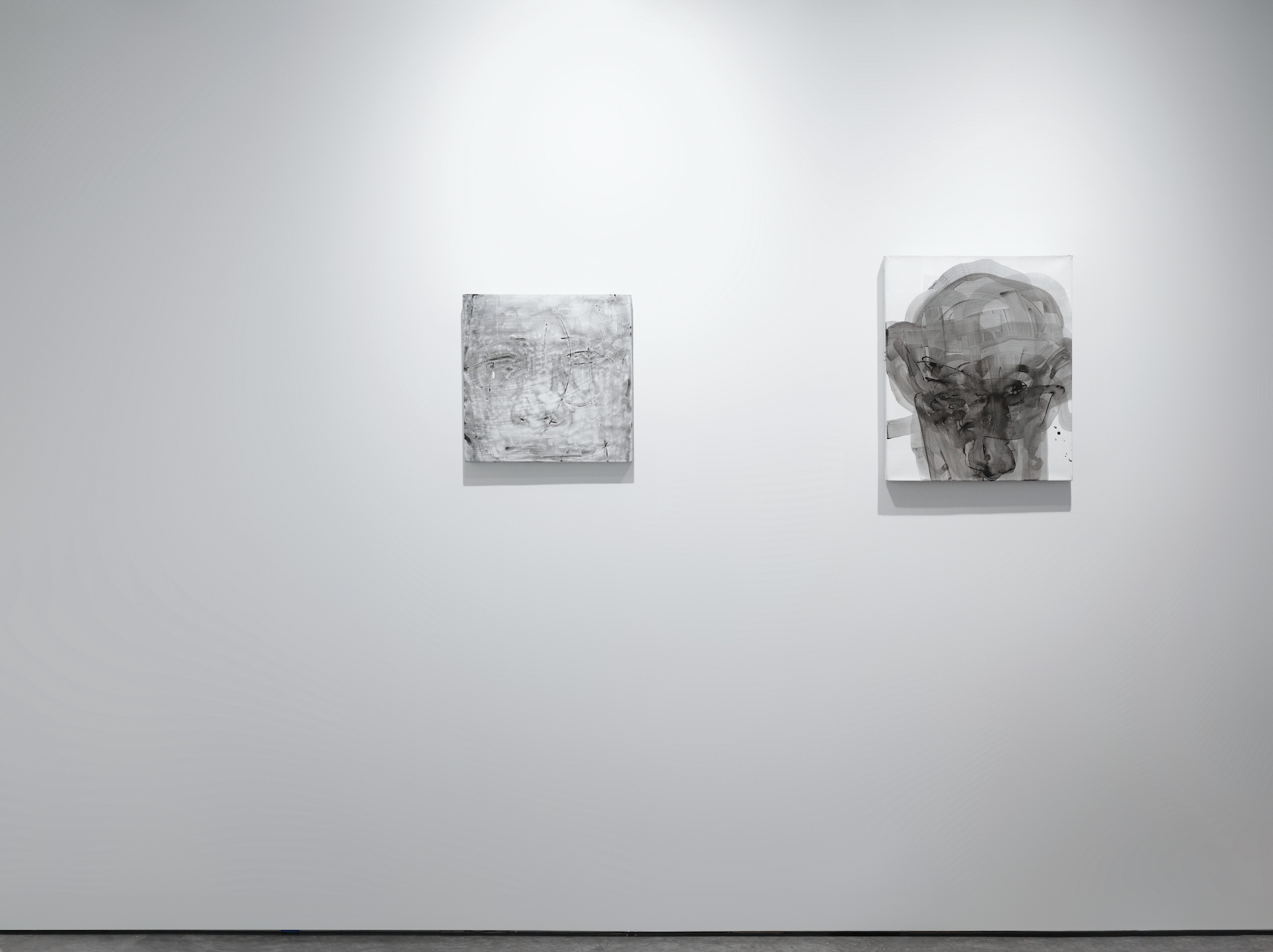
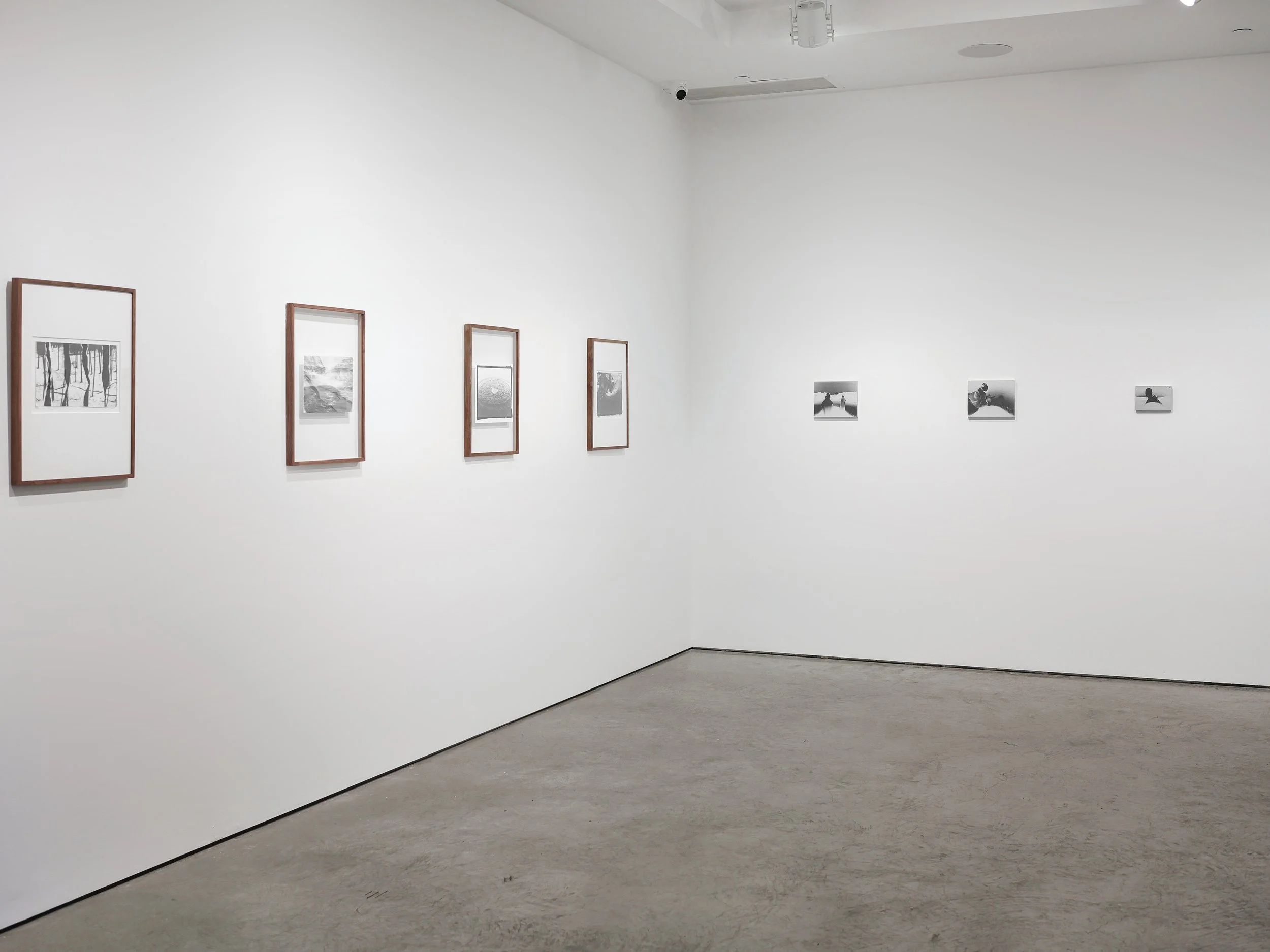
The exhibition unfolds gradually through video and painting, producing a layered experience of looking. Works echo one another across the gallery, and as viewers move through the space, new relations continuously emerge between images. Recurrent blurred scenes, arrested moments, and situations that resist full explanation shift the act of viewing toward reflection on memory and time. Moving among these images, the viewer encounters not only distinct visual narratives but also the lingering traces of memory that continue to surface within them.
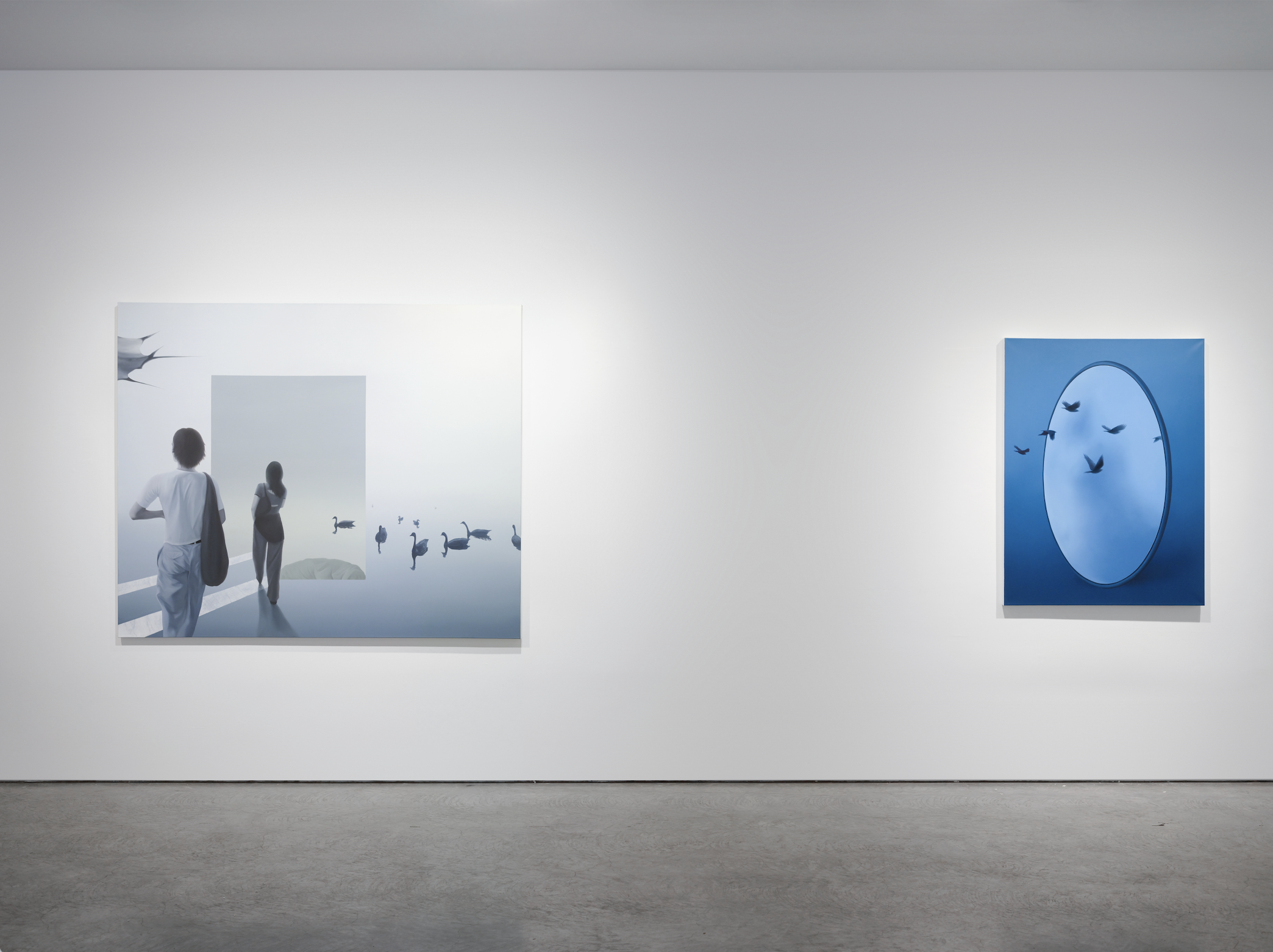
Installation view of Losing Ghosts. Courtesy of CHINCHINART.
At the center of the gallery lies a work composed of grains of rice. Arranged into extended linear forms, the rice suggests both pictographic signs and the biomorphic figures of a child’s casual drawing. As an everyday material, rice lends the work a palpable fragility; each grain is clearly visible, yet always vulnerable to displacement or dispersal. It is precisely this instability that keeps the image in a provisional state. Standing before the work, I became increasingly aware of the temporality carried by the material itself. The pattern cannot be permanently fixed; it appears instead as a fleeting trace, akin to memory, which is composed of small fragments and remains open to continual rearrangement.
In Sona Lee’s work, a different temporal experience of memory comes into view. Her painted spaces are quiet and loosely held together, with figures and surroundings remaining in an open relation to one another, so that the scenes seem drawn from everyday life while retaining a dreamlike indeterminacy. Looking at these works, I gradually felt that the image was still in the process of taking shape, never fully settling into place. Certain details appeared acutely familiar, while the overall situation remained difficult to define. This slight uncertainty gives the paintings a mnemonic quality; memory often preserves particular fragments with clarity while failing to restore the whole situation from which they emerged. Through this visual experience, suspended between reality and imagination, Lee’s work reveals something fundamental about the structure of memory itself. Memory is not a complete reconstruction of the past, but a perceptual process formed through the repeated regrouping of dispersed fragments.
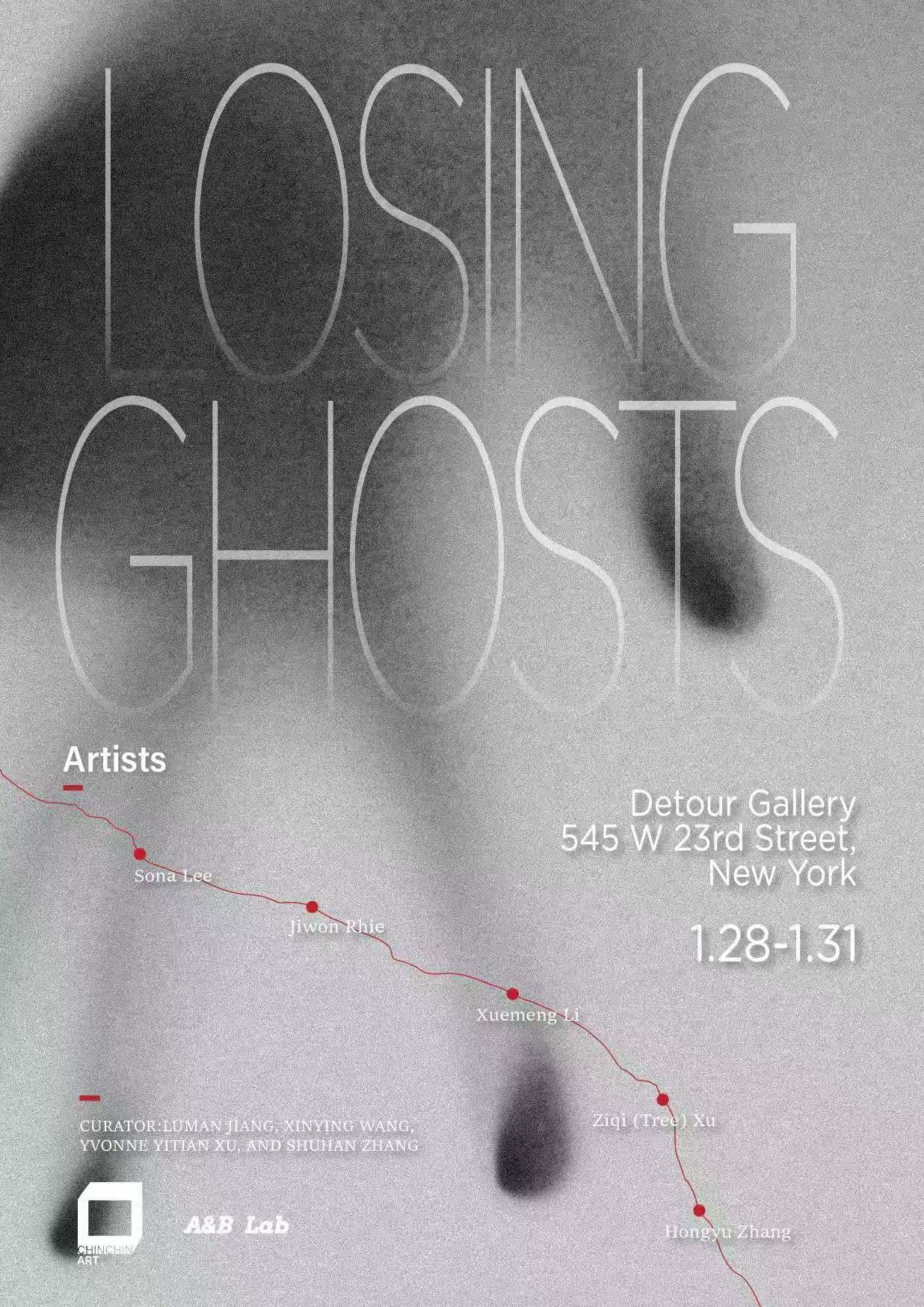
Poster for Losing Ghosts. Courtesy of CHINCHINART.
Jiwon Rhie’s work turns this temporal instability toward questions of identity and space. Her practice attends to the shifting relationship between the individual and the surrounding environment. In front of her work, one becomes aware of boundaries in continuous motion; the lines separating culture, language, and social context do not remain fixed. Belonging, accordingly, appears as a condition in flux. Identity is often understood as a stable category, yet in lived experience, it is closer to a position under constant negotiation. As one moves between different cultural and social worlds, identity too leaves behind traces that feel ghostly, as experiences that have already passed continue to shape one’s present understanding of the self.
The exhibition’s only video work, by Ziqi (Tree) Xu, offers another entry point into its conception of the ghost, one grounded in cinematic memory. Xu’s practice traces the afterlife of film language within real space. The gestures and visual attitudes that appear in the video carry recognizable cinematic residues, yet they have been detached from their original narrative context and reactivated within a different spatial setting. The pacing is slow and lingering, with the camera repeatedly returning to subtle gestures and scenes, giving the act of viewing the quality of an extended search. Images drawn from popular culture gradually enter the register of personal experience, and fictional scenes begin to overlap with ordinary space. By following the ways in which these images are reactivated within lived environments, Xu points to a particular mechanism of memory; many memories do not arise from direct experience, but from forms of visual culture absorbed over time. When such images reappear within real space, they alter one’s perception of body and environment, allowing fictional narratives to leave lasting traces within personal geography and everyday life.
Across these different media, the exhibition constructs an experiential field organized around time and memory, allowing experiences that have receded from the present to persist in reality as traces. In these works, memory surfaces repeatedly across image, material, and space, keeping the boundary between past and present in a state of motion. As these ghostly traces continue to appear within lived experience, a question comes into focus: when certain experiences never fully leave, are we remembering them, or are we the ones being held in place by them?
Yihan Yan
Yihan Yan is a designer and researcher working at the intersection of arts management, museum practice, and cultural communication, with experience in exhibition planning, public engagement, and brand research. Her research focuses on audience experience, cultural narrative, and the role of design within art institutions, combining visual awareness with strategic communication to analyze contemporary cultural ecosystems.