
You May Stay. Maybe.
Shuhan Zhang
In Devon Pin-Yu Chen’s solo exhibition The Dog Is Busy Having Hotel Breakfast, the hotel does not appear merely as a neutral site of leisure or consumption. Rather, it is reconfigured as an experimental space structured around the condition of “being permitted to enter.” Here, the hotel operates simultaneously as a concrete setting and as a highly coded social apparatus: who is allowed to stay, who is entitled to be served, and whose presence is assumed to be legitimate are determinations that form rapidly within the space, yet are rarely articulated explicitly. Chen compresses this structure into a scenography composed of ceramic sculptures, extracting “breakfast” from the realm of everyday experience and gradually revealing it as a moment in which belonging and qualification become visible.
The exhibition’s central premise revolves around a dog that enters the hotel space. Visually, this figure does not produce overt conflict; instead, it appears almost naturalized. In The Serious Dog (2026), this presence is concretized: a dog, scaled nearly to human size, stands within the space with a slightly restrained posture. It appears both as a “guest” placed within the scene and as something that retains a certain stiffness, never fully assimilated. It is precisely beneath this surface of seeming normalcy that perception begins to shift. The dog cannot be fully understood as a subject, nor can it be easily categorized as a simple other. It occupies an ambiguous position, both cared for and yet persistently distanced from the position of “entitled” presence. As it enters the institutionalized comfort of the hotel, relationships that once seemed stable begin to loosen. The viewer is left uncertain whether they are encountering an anthropomorphic scenario or a structural model of how rights are distributed.
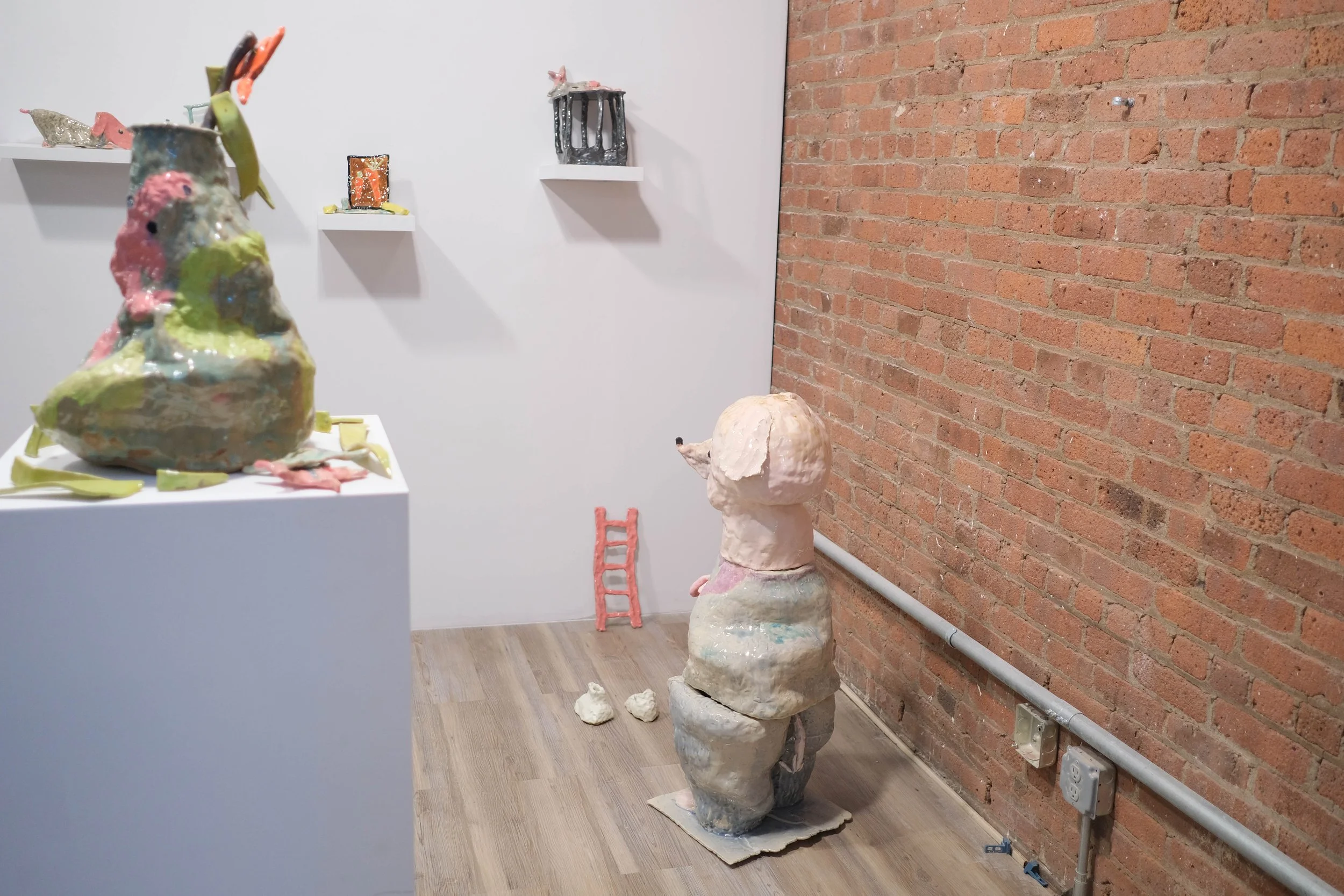
Installation view of The Dog Is Busy Having Hotel Breakfast. Courtesy of Devon Pin-Yu Chen.
Ceramic, as a material, functions here not only as a medium but as an active participant in producing this instability. Its physical density and temporal slowness render each scene as both a fragment of reality and a suspended moment. The smaller sculptures and object-like forms intensify this condition: in Cat In A Box (2026), a cat is enclosed within a container; in Metal Pencil Case (2026), a familiar everyday object is translated into an image-bearing surface. These elements hover between familiarity and estrangement. They resemble items carried during travel, yet appear overly sealed, quiet, and withdrawn. They seem to have entered the space, but never fully settle within it, suggesting a condition of being carried without ever being placed. The space thus begins to reveal itself as a mechanism of selection and exclusion, rather than a neutral container.
Drawing on Michel Foucault’s analysis of spatial regulation and disciplinary structures, the hotel can be understood as an environment of micro-management acting upon the body. Behavior here is rarely shaped through explicit commands; instead, it is continuously formed through implicit expectations and structures of visibility. Who may stay, how one is served, what gestures appear natural, these judgments are enacted and internalized without needing to be spoken. When a dog takes a seat at the table, and when its companions become objects that resist interpretation, this seemingly stable system begins to shift. No overt rupture or breakdown occurs, yet the boundaries of the normative order begin to loosen. The alignment between body and behavior no longer holds seamlessly, revealing the contingency and selectivity embedded within the system itself. In this process, the viewer also comes to recognize their own position within this structure, not only observing who is allowed in, but participating, however subtly, in the ongoing reproduction of what counts as acceptable.
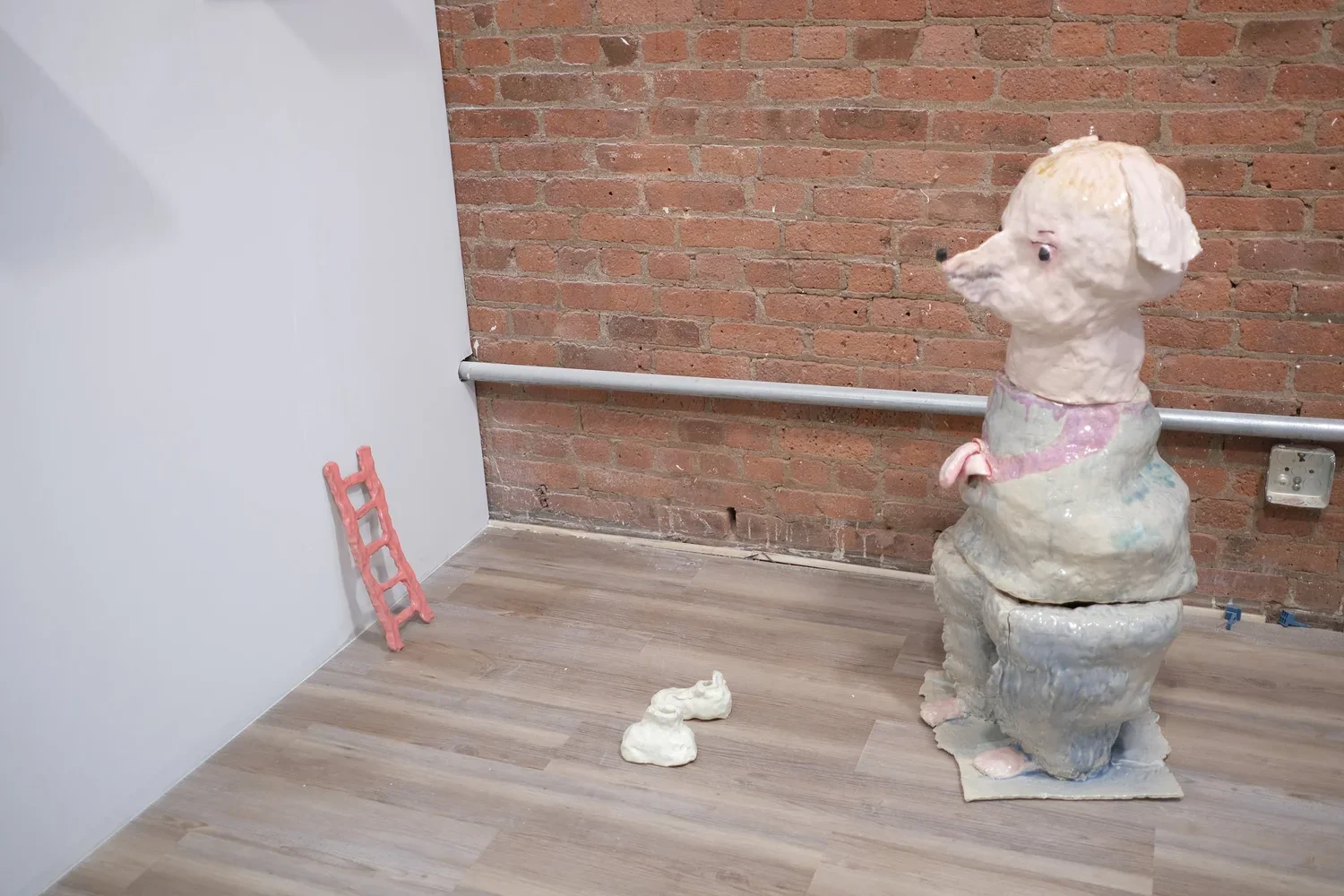
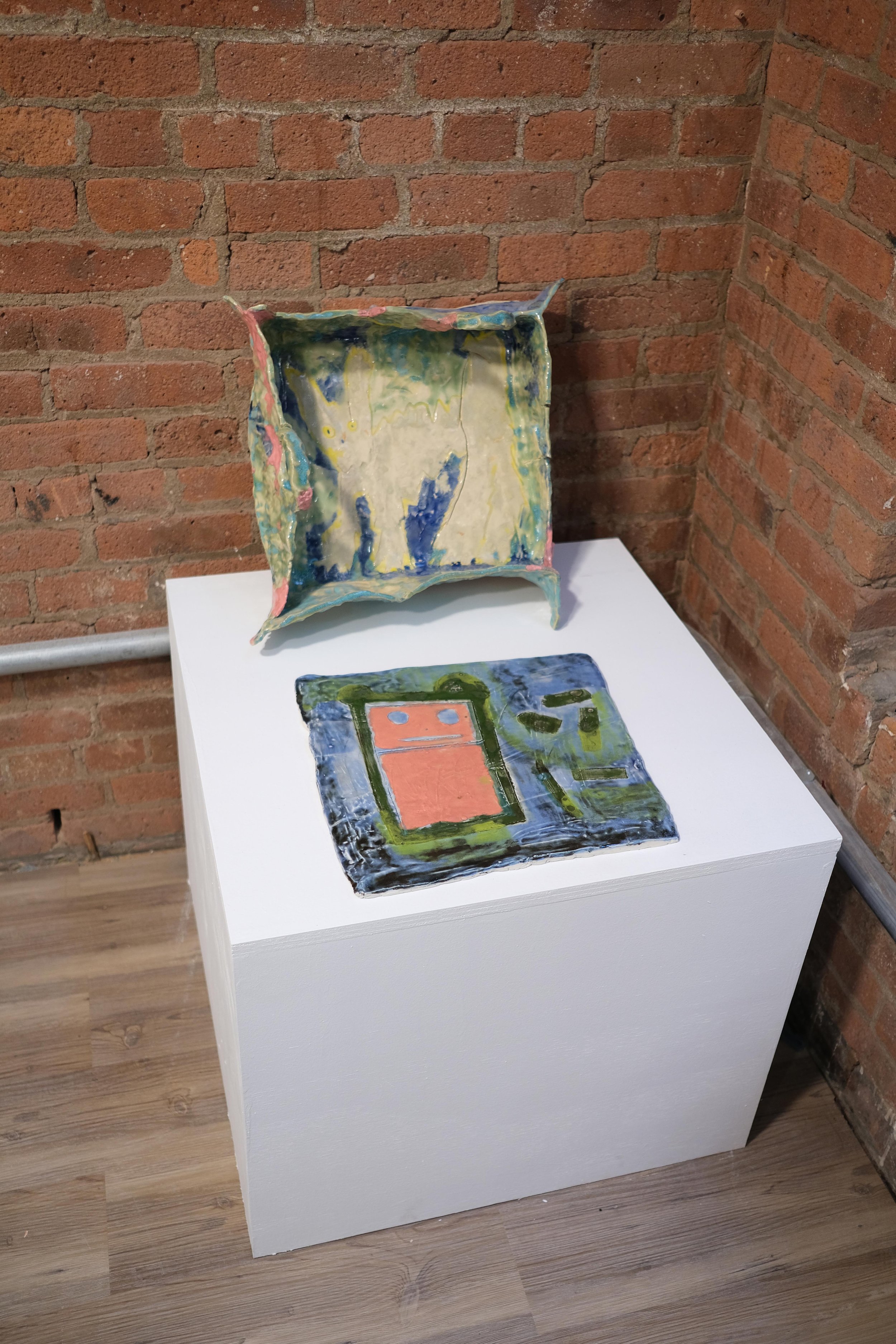
Installation view of The Dog Is Busy Having Hotel Breakfast. Courtesy of Devon Pin-Yu Chen.
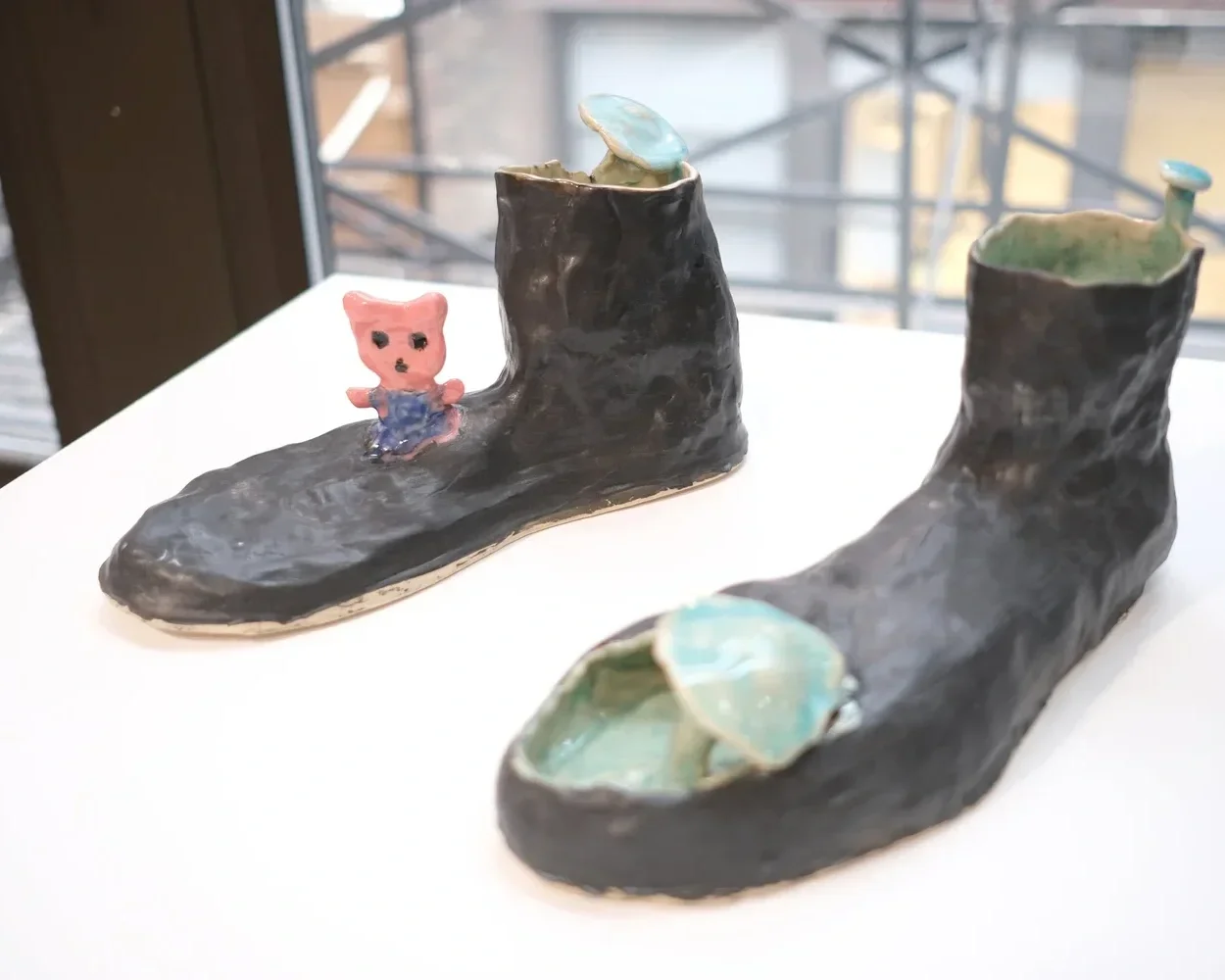
The latter part of the exhibition extends this structure through references to Taiwanese folk belief. In Boots With Hungry Ghost (2026), ghostly figures appear in miniature form, embedded within everyday objects, simultaneously hidden and difficult to ignore, occupying a space between visibility and invisibility. Within the framework of Ghost Month, these wandering presences point to another extreme condition: they exist, yet cannot be accommodated; they are seen, yet cannot be fed. If hotel breakfast suggests a system of institutionalized care, these ghosts occupy its outer edge. Rather than forming a simple opposition, the two conditions together trace a continuum that raises the question of who can be accommodated and who cannot.
Within this structure, the dog gradually shifts away from a singular narrative role and comes to function more as a device for testing boundaries. It exposes the constructed nature of what might otherwise appear natural, while destabilizing the act of viewing itself. The Dog Is Busy Having Hotel Breakfast does not assert its position through direct critique. Instead, through subtle and continuous displacements, it keeps the viewer moving between what feels self-evident and what resists explanation. In this movement, belonging no longer appears as a fixed condition, but as something continually produced and undone.

Shuhan Zhang
Shuhan Zhang (b. 2002, Jiangsu, China) is a curator, writer, and founder of CHINCHINART. She is currently an M.A. candidate in Visual Arts Administration at New York University and holds a B.A. from the Central Academy of Fine Arts. Her research focuses on digital art, cultural platforms, and the contemporary art market, examining how technological infrastructures reshape modes of viewing, value production, and art circulation. She has curated exhibitions including After the Face, Lithic Coordinates, Losing Ghosts, A Lure, A Lament, and Spreading Growth. Her writing has been published in Tussle Magazine, IMPULSE Magazine, Art Spiel, and Whitehot Magazine, with a focus on exhibition criticism and contemporary art discourse.