
A Conversation with Phil Zheng Cai
Structures, Practice, and Exhibition-Making
Editor’s Note
This interview is based on a live conversation. The text has been lightly edited for clarity, while preserving the speaker’s original tone and meaning.
On March 26, 2026, ArtEchive conducted a conversation with Phil Zheng Cai, a partner at Eli Klein Gallery, focusing on the relationship between curatorial practice, institutional structures, and the contemporary art ecosystem.
The discussion reflects on how different roles, commercial, curatorial, and research-based, coexist and diverge within the art field. Moving between gallery work and independent practice, Phil Zheng Cai addresses questions of authorship, decision-making, and long-term research, while also sharing insights into exhibition-making, structural constraints, and the positioning of emerging artists within the system.
interviewee
-
Phil Zheng Cai
Partner at Eli Klein Gallery, writer and curator
Phil Zheng Cai (American, b. Shanghai) is a curator and writer based in New York. He holds a BA in Social Science from the University of Wisconsin–Madison and an MA from Sotheby’s Institute of Art. He has held positions at Mary Boone Gallery and Phillips Auctioneers, and is currently a partner at Eli Klein Gallery.
Cai has curated exhibitions in the United States and internationally. Most recently, he developed and curated Residency Unlimited’s 2026 New York artist residency and exhibition, Working Conditions, which examines how artists’ labor, precarity, and day-job economies shape contemporary art production in New York. His exhibitions have received critical attention in Hyperallergic, The Brooklyn Rail, Artnet News, WhiteHot Magazine, Musée Magazine, Cultbytes, Art Asia Pacific, Tatler, and Impulse Magazine, among others. The catalog for his exhibition (In)directions: Queerness in Chinese Contemporary Photography is held by institutions including the Metropolitan Museum of Art, ICP, the Dallas Museum of Art, the Leslie-Lohman Museum Library, and over thirty university libraries worldwide. He has participated in panels and lectures at the Asia Society Museum, SCAD Museum of Art, Columbia University, and Sotheby’s Institute of Art, and has served as a visiting critic at NARS, Residency Unlimited, Parsons, SVA, UNC Chapel Hill, and EFA Studio Program.
His writing includes catalog essays such as “Nomad Photography” (Parsons MFA Photography Thesis Catalog, 2024), as well as exhibition reviews and critical essays published in IMPULSE Magazine, T Magazine China, WhiteHot Magazine, and Widewalls, among others. He translated The Story of Philosophy by James Garvey (Shanghai Yuandong Press, 2020).
Cai’s curatorial initiative Open Kitchen focuses on systematic critique, providing recontextualized commentaries within the traditions of institutional critique, highlighting the non-severability of framework and context. Its interview series “Open Kitchen Negatives” examines the concepts, origins, and ramifications of “missing parallels.”
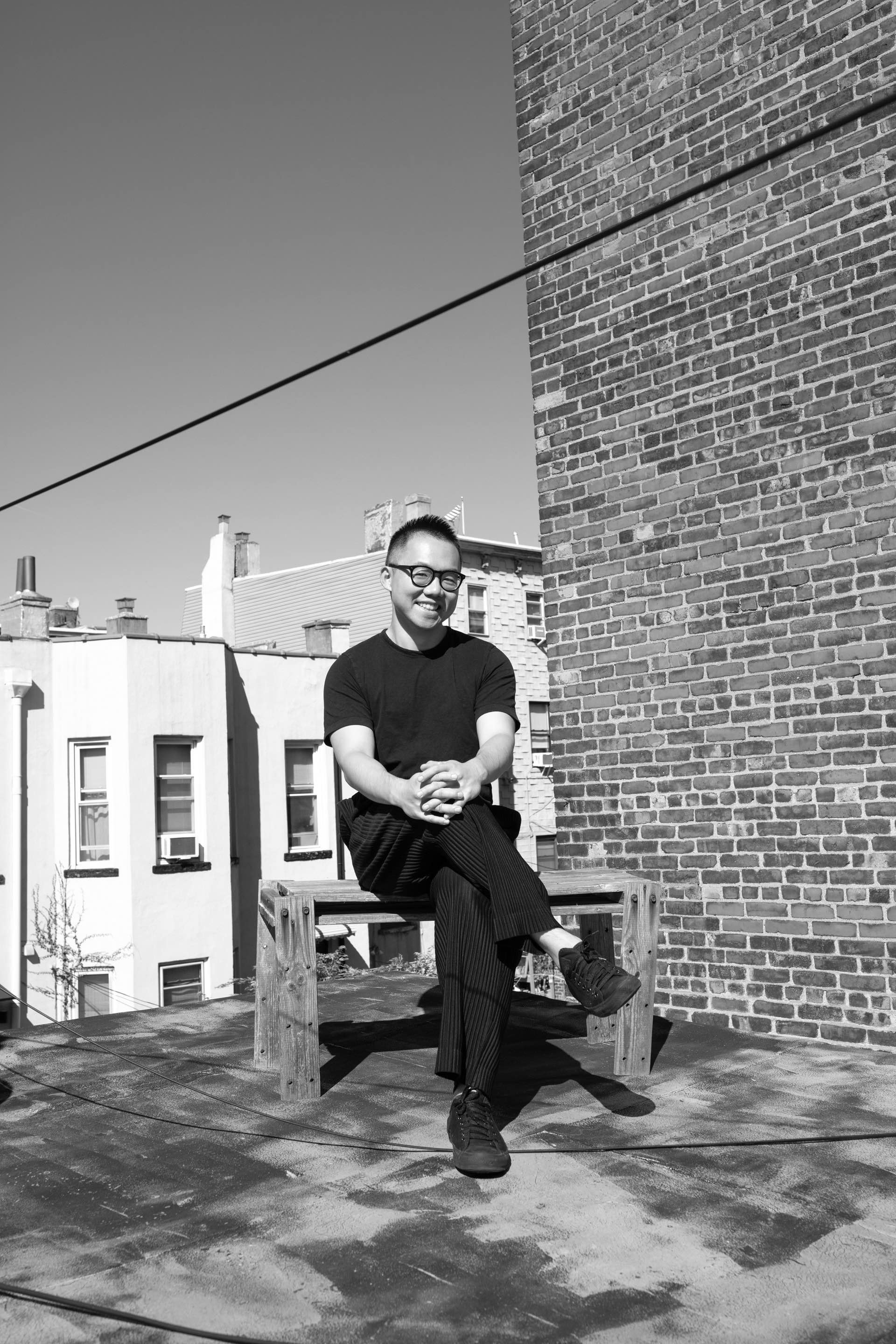
Phil Zheng Cai currently works and lives in New York.(Portrait by Alec Dai.)
ArtEchive
Thank you for taking the time to speak with us today. This conversation is organized by ArtEchive as part of our ongoing interview series.
We’re interested in using this conversation to think through how different roles—curatorial, commercial, and research-based—intersect within the contemporary art system. Rather than treating these as separate positions, we want to understand how they overlap, conflict, and inform one another in practice.
Today’s interview begins with your personal experience and moves toward broader questions of exhibition-making, institutional structures, and long-term research. We’ll also touch on how curators position themselves within the system, and how younger practitioners might navigate these conditions.
Structures, Practice, and Positioning
ArtEchive
You’ve taken on multiple roles, working in a gallery, curating, writing, doing research, and also serving as a juror. How do these different positions relate to each other?
Phil Zheng Cai
For me, the most important thing is a kind of division.
On one side, there is the gallery. It’s a commercial structure. You have to think about representation, sales, and how to support artists sustainably. That’s always a priority in that context.
On the other side, there is my own practice—my research, curating, writing, and translation. That part is much more independent. Sometimes it’s not even about money. Sometimes you’re just investing your own time and resources.
In a place like New York, where everything moves very fast, having your own direction becomes very important. Otherwise, it’s easy to just follow what’s happening around you.
When I serve as a juror, I follow the standards of the institution I’m working for. I look at what they want, and I make my judgment accordingly. I wouldn’t use either my own research direction or commercial concerns as the primary standard in that context.
ArtEchive
Are there any new directions you want to try in the future?
Phil Zheng Cai
For me, it’s more a matter of continued development. These two sides will both continue. As for how they are distributed, or how they eventually appear in front of people, that can take many different forms.
For example, last year someone approached me and invited the gallery to participate in an art fair called Split Level. At the time, it was actually a very small fair. The opportunity really came because they were interested in my curatorial work, and the invitation came through a personal connection. But I felt that bringing the gallery into that context was the best response. So in that case, my gallery role moved to the front. It became a solo presentation of Yang Shuai, and in the end it came together very well.
So that is one example. Of course, there are examples that move in the opposite direction too. Both sides have their own logic, but the form they finally take can vary. As long as they remain connected to these two directions, the final form can be different.
Current Discourses and the Present
ArtEchive
Are there any current topics or discussions that you find particularly important right now?
Phil Zheng Cai
I still go back to my own framework first.
My work is more about systemic critique. So sometimes it connects to current topics, and sometimes it doesn’t.
I don’t think it’s useful to follow trends just for the sake of it. What matters is how those discussions can become part of your own longer term framework.
Right now, people talk about things like the Global South and nomadism. But for me, these only become meaningful if they can be integrated into a larger framework. Otherwise, they stay on the surface.
From Ideas to Exhibitions
ArtEchive
How do you develop an idea into an exhibition?
Phil Zheng Cai
The first thing is sensitivity to the idea itself. Some ideas are interesting, but they are very thin. They only work on one level. You have to be able to recognize that.
A strong idea usually has layers. It’s like a good artwork. There is a main line, but there are also hidden lines—things that are not directly stated, but can be discovered.
Those hidden structures are very important. They give the exhibition more depth.
And research usually doesn’t destroy an idea. More often, it reinforces it. You realize that similar things have been done before, but that doesn’t mean you can’t do it again. Context changes everything.
Working with Conditions
ArtEchive
Exhibitions can start from very different conditions, sometimes from a concept, sometimes from artists, sometimes from constraints. How do you approach that?
Phil Zheng Cai
I think flexibility is key.
As a curator, you’re always dealing with limitations—space, budget, logistics, artists. That’s part of the work.
For me, I’m always building things in parallel. I have a list of ideas, a list of artists, and ongoing research. When an opportunity comes, you bring them together.
Another thing people don’t always talk about is the chemistry between artists. It matters more than people think. Even if works look good together, the collaboration might not work.
Sometimes it’s useful to give up some control. For example, letting one artist suggest others. That can open up connections you wouldn’t find on your own.
Advice for Younger Curators and Artists
ArtEchive
What advice would you give to younger curators and artists?
Phil Zheng Cai
First, you need your own direction. A line of research. Otherwise, everything becomes reactive.
Second, connections are important, especially in New York. But they shouldn’t be the foundation of your work.
It’s actually very easy to build an exhibition based on networks—people who already know each other, artists with strong visibility.
But I’m more interested in exhibitions that create unexpected relationships. For example, putting together artists at very different stages, and letting them speak to each other.
That kind of dialogue is more meaningful to me.
(End)