
Time Machine
Polyphonic Temporality and Embodied Memory in Cao Fei’s Hongxia Project
Written by Audrey Hanjie Hua
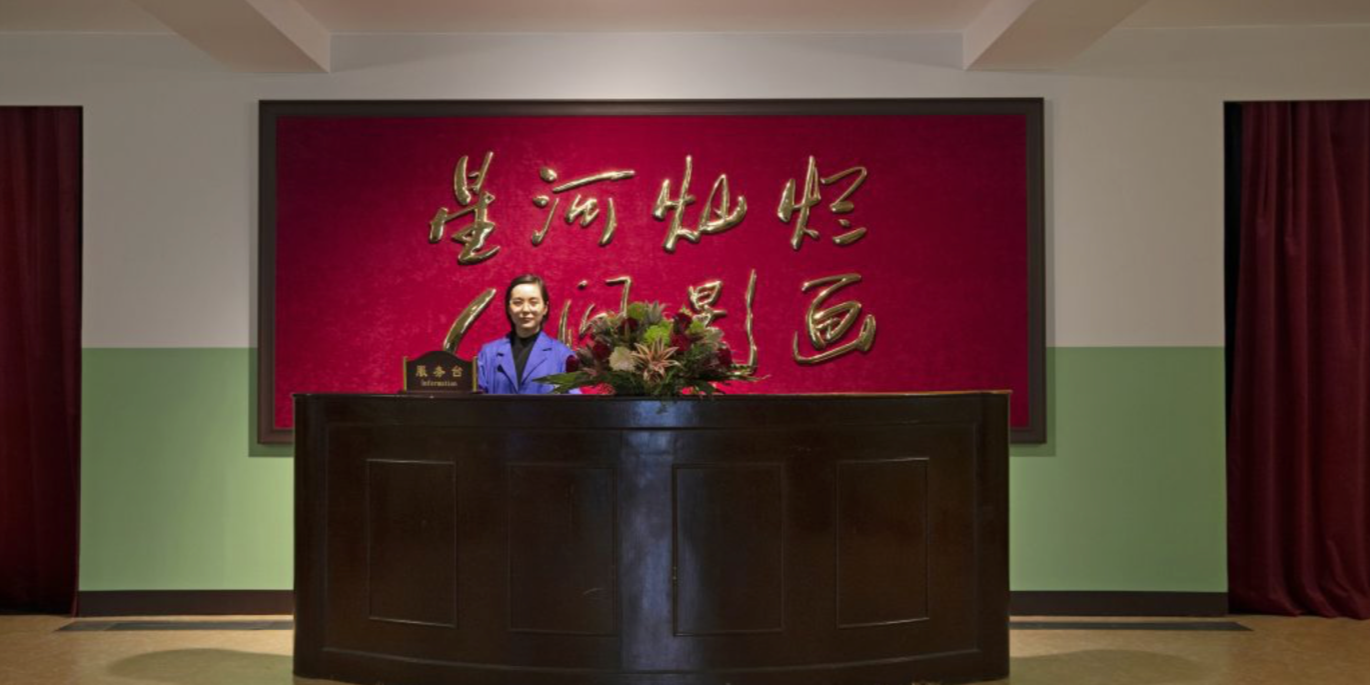
Cao Fei, Blueprints. Installation view, Serpentine Gallery, 2020. Photo credit: Gautier Deblonde.
This research examines Cao Fei’s keen excavation of urban transformation, media culture, and technological change across past decades in China through two major projects RMB City (2007-22), and the Hongxia (2019-24) project, alongside the artist’s mid-career interactive retrospective Cao Fei: Tidal Flux (2024) at the Museum of Art Pudong, Shanghai. Through heterotopic and heterochronic approaches, architectural modularity, media variability, media apparatus, socialist cinematic experience, and polyphonic temporality, Cao Fei exposes alternative realities embedded in history while testing future capacities. Through visual and conceptual deconstruction and reconstruction, Cao Fei recovers the individual dimensions of socialist memory through her distinctive artistic practice and ethnographic engagement with social media and local spaces and communities. These interactions open fluid narratives and interpretations that culminate in the Hongxia project, which activates lived experience and collective memory against the grain of the linear, progressive developmental ideology. The increasing nuance from RMB City (2007-22) to Hongxia (2019-24) project also reflects the artist’s attentiveness to historical moments and the material conditions of the technological possibility and urban landscape. Through these projects, Cao Fei captures the sense of contemporaneity particular to each moment of Chinese life and each developmental phase of the nation.
Physical Inhabitation as a Creative Act
The Hongxia project begins with an act of physical inhabitation. In 2018, Cao Fei chose Hongxia Theatre, a building slated to be demolished, as her new studio. It was a former communal cinema built to serve the workers of a state-owned electronics factory in Beijing's Jiuxianqiao district. As China is experiencing rapid urban transformation to “modern city”, Hongxia Theatre was seen as a part of a past that was being erased in the name of pursuing an urbanized future. After PRC formed, Hongxia Theatre is part of the Beijing Zhaowei Electronics Group, which is one of 156 important engineering projects that the Soviet Union helped China build during the period of the first Five-Year Plan, a Soviet-style centralized economic plan (1953–1957) focused on rapid industrialization and the construction of a socialist modern state. This factory developed and produced China’s first automatic telephone switchboard, first vacuum-tube computer, and first large-scale computer. The Hongxia Theatre was located at the heart of this activity, functioning as a social space until its permanent closure in 2008 in the run-up to the Beijing Olympics.
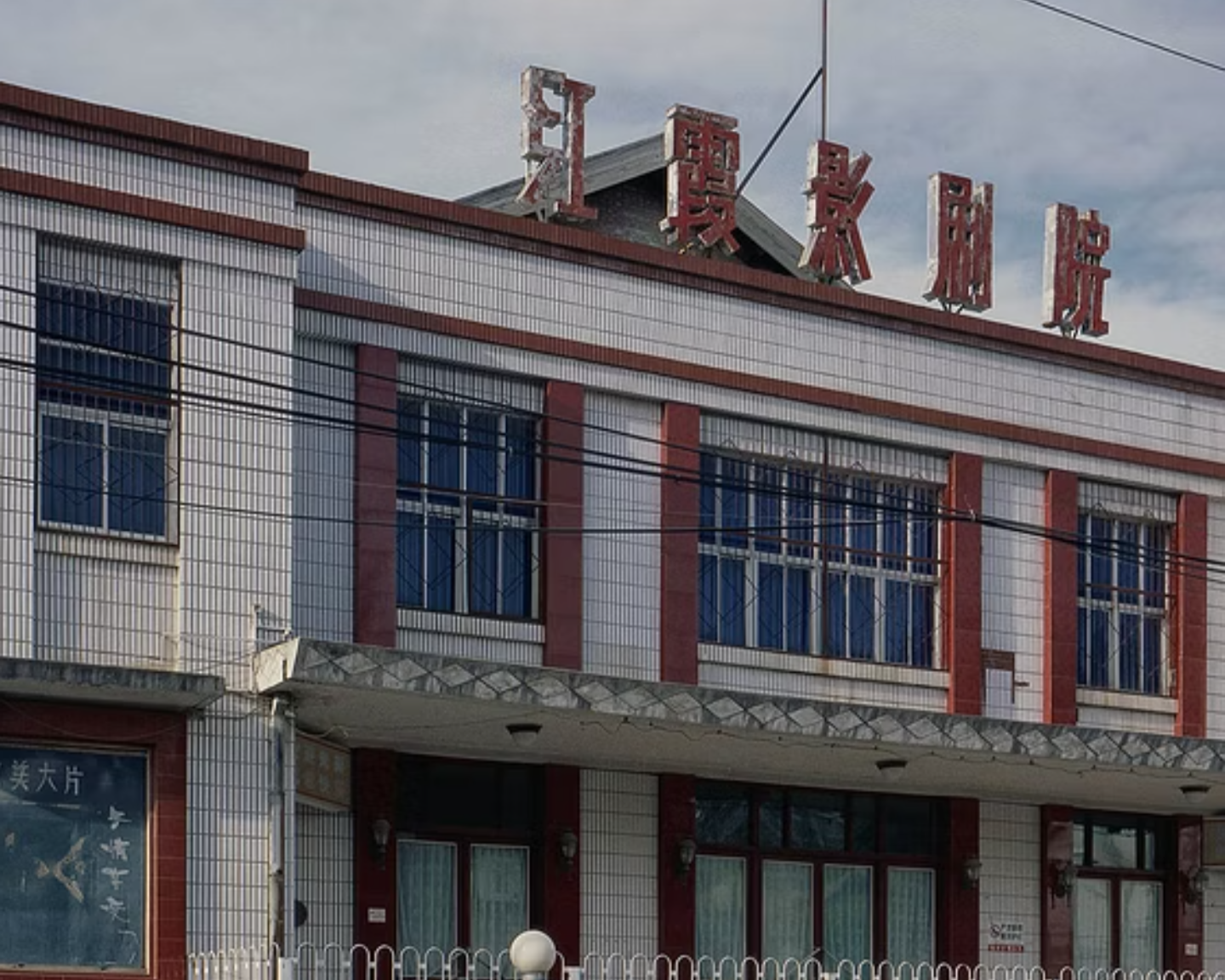
Hongxia Theatre (红霞剧场), Jiuxianqiao District, Beijing, built during the First Five-Year Plan era (1950s). Image reproduced from Cao Fei, HX (London: The Pavilion / Serpentine Galleries, 2020).
Cinema off Screen—Cinematic Context and Individual Experience
This dynamic is then carried into the video works, where the movement from collective to individual becomes explicit. Nova (2019) directly positions audiences as a spectator unable to make contact with reality and experiencing the yearning for human connection across the digital void. The film's atmospheric qualities, including its neon contrasts, its acoustic drifting, its closing song of longing, work directly on individual feeling, producing a private emotional response shaped by each viewer's own relationship to the socialist past the film evokes. The Eternal Wave (2020) takes this further, replacing the shared position of the audience with full bodily immersion through VR. Each viewer enters alone, moving through the reconstructed spaces of Hongxia Theatre and piecing together its narrative through their own choices and movements. The communal ritual of socialist cinema, the gathering, the shared screen, the collective atmosphere, has been gradually replaced by a singular, embodied, and entirely individual experience. What Zhou identifies as the unintended consequence of socialist cinematic spectatorship, the communal ritual that produced intensely private memories beyond state control, Cao Fei now produces deliberately, reconstructing the conditions of atmospheric spectatorship and allowing them to generate experiences that exceed what the official framework of the project can contain. In this sense, the Hongxia project does not simply document or represent the negotiated experience of socialist cinema. It enacts it, making the gap between collective ideology and individual memory not a historical observation but a living, embodied reality for the contemporary viewer.
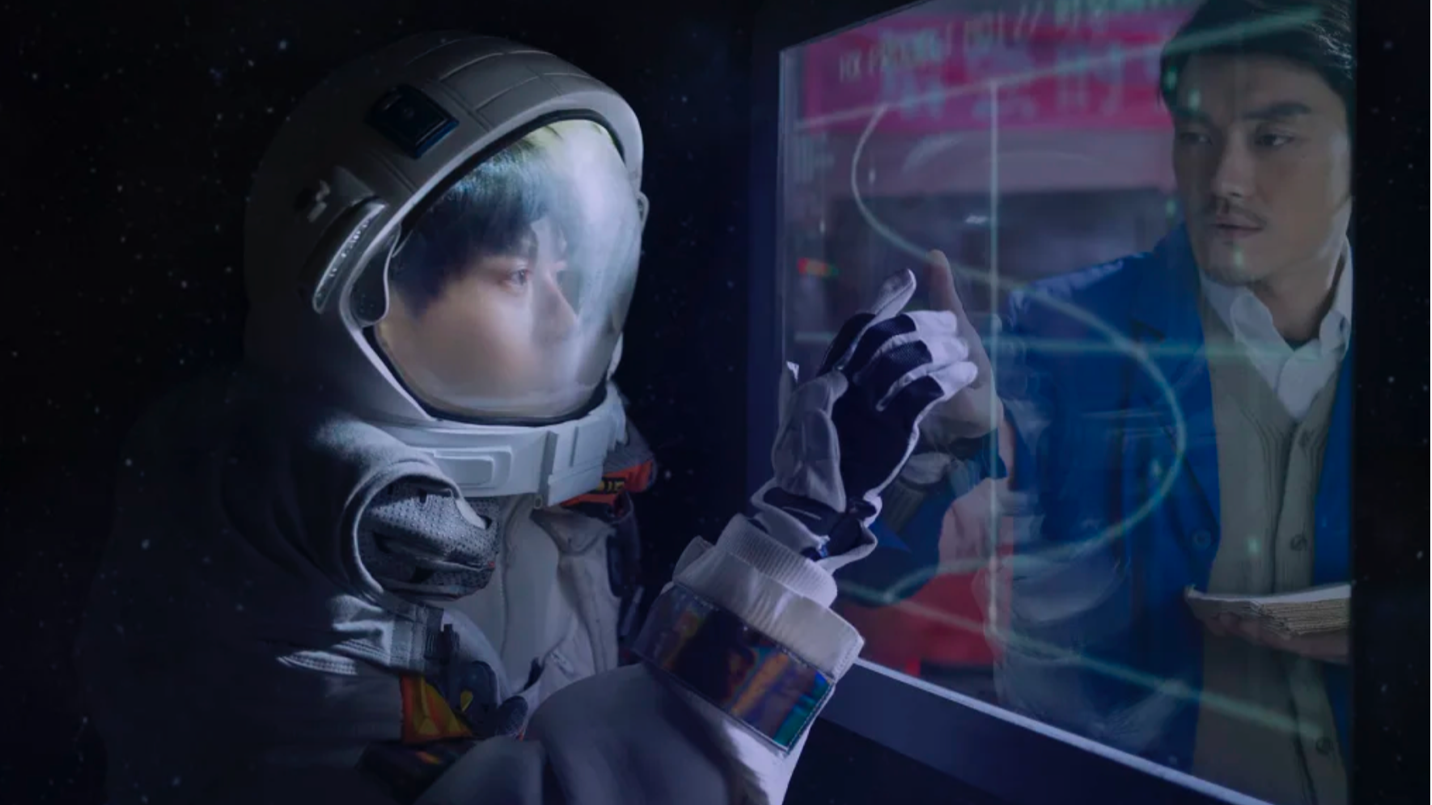
Cao Fei, Nova, 2019. Film. Courtesy the artist, Vitamin Creative Space and Sprüth Magers.
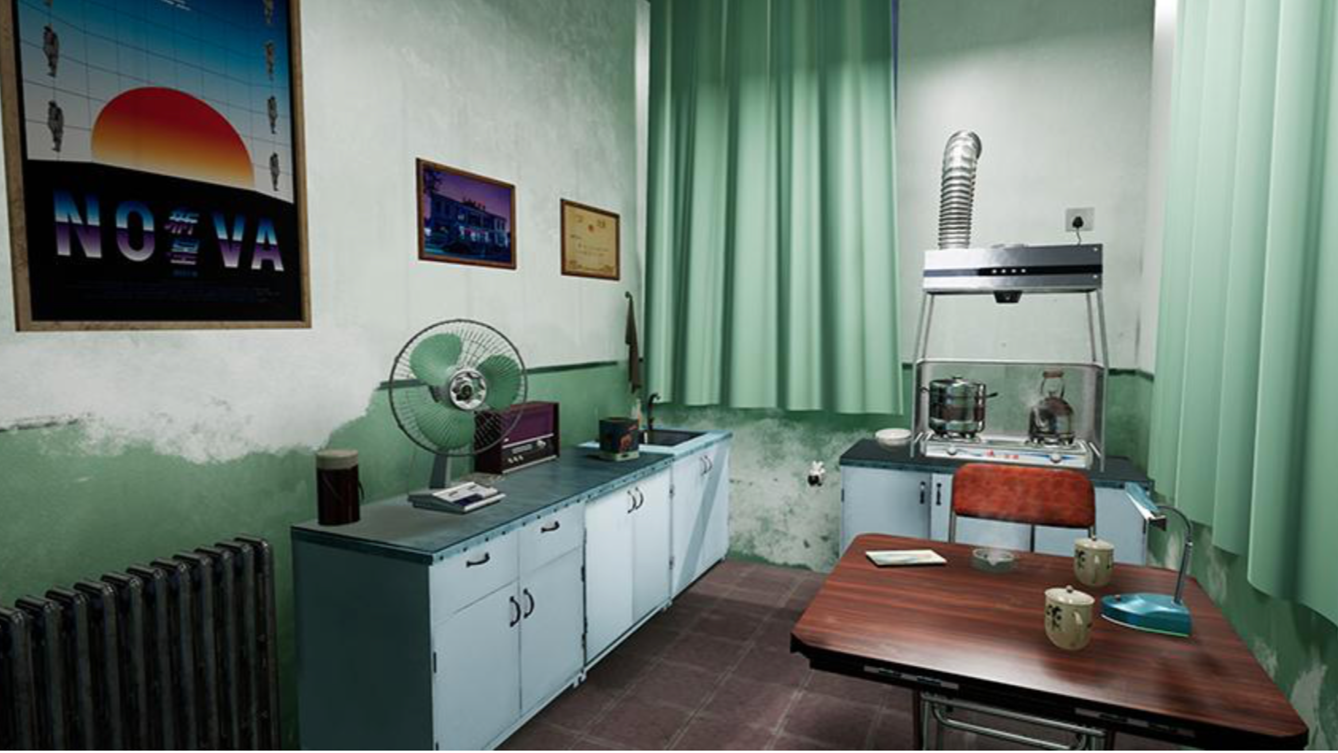
Cao Fei, The Eternal Wave, 2020. Virtual reality installation. Courtesy of the artist and Acute Art.
Time Machine – Polyphonic Narratives
The old media objects and elements from the past within the Hongxia Theatre project do not merely recall a vanished socialist past. The Hongxia installation operates like a time machine that creates polyphonic experience by combing multiple layers of historical identities, different temporalities, blurring fact and fiction, and cybernetically activating the viewer’s senses. Through juxtaposition and distortions, Cao Fei not only reaffirms Hongxia Theatre’s existence and preserve its history, but more importantly, creates a polyphonic perspective and yearning beyond the progressive timeframe.
Together, these three layers, multiple historical identities, multiple temporalities, and multiple registers of reality and imagination, construct a temporal machine whose effect on the viewer is cumulative and embodied. They have been placed inside multiple layers of identities, space, and time simultaneously, in which are suspended between a past that has been demolished, a future that never arrived, and a present that holds both in view at once. This is the temporal dislocation that China's rapid urban transformation produces in the lives of the people it displaces, now made experiential and immediate through the apparatus of media and art. And it is from within this dislocation that Cao Fei's alternative reality takes shape.
Alternative Reality—Nostalgic for the Future
Across the Hongxia project (2019-24) as a whole, there is a political and ideological dimension where Cao Fei's formal choices mirror the nonlinear temporality of Chinese political imagination from Mao to Xi. Through the interplay of collectiveness, individuality, and resistance, I argue that Cao Fei employs Hongxia Theatre as a whole to destabilize the official ideology and progressive development from within. This artistic intention opens an alternative reality where displaced individuals, forgotten histories, and unrealized socialist ideals seep back into the present. Thus, it ultimately recovers the liveness, vibrancy, and humanity embodied in progressive, technological, linear development of both past and future.
In her article, Ellen Larson introduces the concept of “nostalgia for the future,” a mode of temporal longing that is neither purely backward-looking nor forward-looking, but instead occupies an unstable position between the two. This connects the notion of utopia as embodied in Hongxia and Cao Fei’s related video works to the trajectory of Chinese political ideology from Mao Zedong to Xi Jinping. Within this framework, nostalgia and utopian longing are traced back to political imaginaries such as Mao’s future-oriented revolutionary movements and Marx’s (1818–83) vision of historical development. Both Mao’s and Xi’s political discourses are shown to be simultaneously oriented toward the past and the future at the same time. While Xi Jinping’s rhetoric is framed as forward-looking, it also carries a sense of yearning for a “future-past,” what Ellen Larson describes as a historicized and utopian desire for the future rooted in past dreams and processes of collective memory and consciousness. Among the archival materials Cao Fei collected are space race posters from the socialist era—images that represent the collective technological optimism of a moment when the future felt not only imaginable but imminent, when the conquest of space stood as the most powerful symbol of what socialist modernity could achieve. These posters did not belong to an abstract political discourse. They circulated within the everyday visual culture of communities like Jiuxianqiao—displayed in factory corridors, community spaces, and theatres like Hongxia, saturating the environment of workers whose daily labor in the electronics industry was understood as a direct contribution to this larger national and technological project. It was the future these workers believed they were building circuits in the factories around them. In this sense the space race posters function in the exhibition exactly as Larson's concept of proleptic nostalgia describes they generate a longing directed not backward toward what existed but forward toward what was promised and never came. This temporality is also channeled and embodied by the fictional narrative of Nova which features an astronaut drifting between time periods in an astronaut's uniform, suspended as a spectator between the theatre's past, present, and future. He is also a counterpart to these posters: the human embodiment of a collective technological dream that official progressive ideology proclaimed and then abandoned, floating now in the eternal cyberspace of a future that never materialized.
This concept of the "future-past" is further materialized through the center installation Blueprints and its direct engagement with the tension between ruins and unfulfilled promises. Conditioned on the physical state of "obsolescence” from the restored and retro space, the installation title Blueprints directly addresses the tension of unfulfilled promises and fantasy embodied in Chinese history since PRC. Specifically, this tension is concentrated on the large red velvet signboard with gilt Chinese inscriptions reading "Splendid Galaxy" and "Human World Motion Pictures." The signboard is itself a formal embodiment of the future-past: its vintage and retro aesthetic places it visually in the socialist past, while its language, "Splendid Galaxy," with its reach toward cosmic futurity, projects forward into the same revolutionary and technological horizon that once defined the collective imagination of the Jiuxianqiao community. Between past and future, the sign board also embodies an attitude toward present that only appears after rethinking and past and future through this time machine—one that refuses both mourning and deference, and instead treats life itself as something vivid, comic, and cinematic. "Human World Motion Pictures" suggests that the everyday life unfolding within this space is already a film worth watching. In "After Legitimacy," Joshua Neves articulates two forms of urbanization that together produce a fundamental dislocation of human experience: ruins, which push experience into a lost past, and blueprints, which defer it into a not-yet future. Both diminish the feeling of presence, leaving most people suspended in a fractured present, displaced in time and space without stable ground in either direction. Here, on the other hand, the former phrase on the signboard celebrates the most embodied life experiences of everyday people. Workers in the past and audiences at present who gathered here, with their desires, their humor, their romances, and their dreams, were not merely a means of production or vehicles of ideology but protagonists of their own story. In this sense the signboard captures something that neither ruins nor blueprints can accommodate: the liveness and vibrancy of a present moment fully inhabited, where people are not displaced into a lost past or a deferred future but are simply, irreducibly, alive.
On a broader perspective, through the concept of distribution impulse and seepage, describing how alternative, informal, unofficial practices are not against official ideology directly, but instead, diluting them and making it porous and unstable by contaminating or redirecting the language. Cao Fei does not oppose the official narrative of socialist progress from the outside. Instead, she works through subtle displacement and unexpected juxtaposition. A real large-scale computer placed within the installation sits visibly out of place alongside the vintage interior. At the same time, she inhabits its own language of collective memory, technological futurity, and revolutionary idealism, and from within that language recovers everything it has suppressed. The alternative reality she constructs was never truly absent from official ideology. It was always already present within it, waiting, like the disappeared gazes of Hongxia's workers, to stare back.
Taken together, the Hongxia project demonstrates how Cao Fei transforms a historically specific site into a complex artistic environment where memory, media, and imagination intersect. Through the restoration of Hongxia Theatre, archival research, film, and virtual reality works, the project reconstructs the social and cultural layers embedded in the space while opening it to new speculative narratives. Rather than presenting socialist history as a closed past, Cao Fei activates the theatre as a site where different temporalities coexist and interact. In doing so, the Hongxia project reveals how individual memories, unrealized ideals, and technological imaginaries continue to persist within the ruins of rapid urban transformation. By bringing these elements together, Cao Fei constructs an alternative reality that quietly destabilizes linear narratives of progress while recovering the embodied human experiences embedded within them.
About the Writer: Audrey Hanjie Hua