
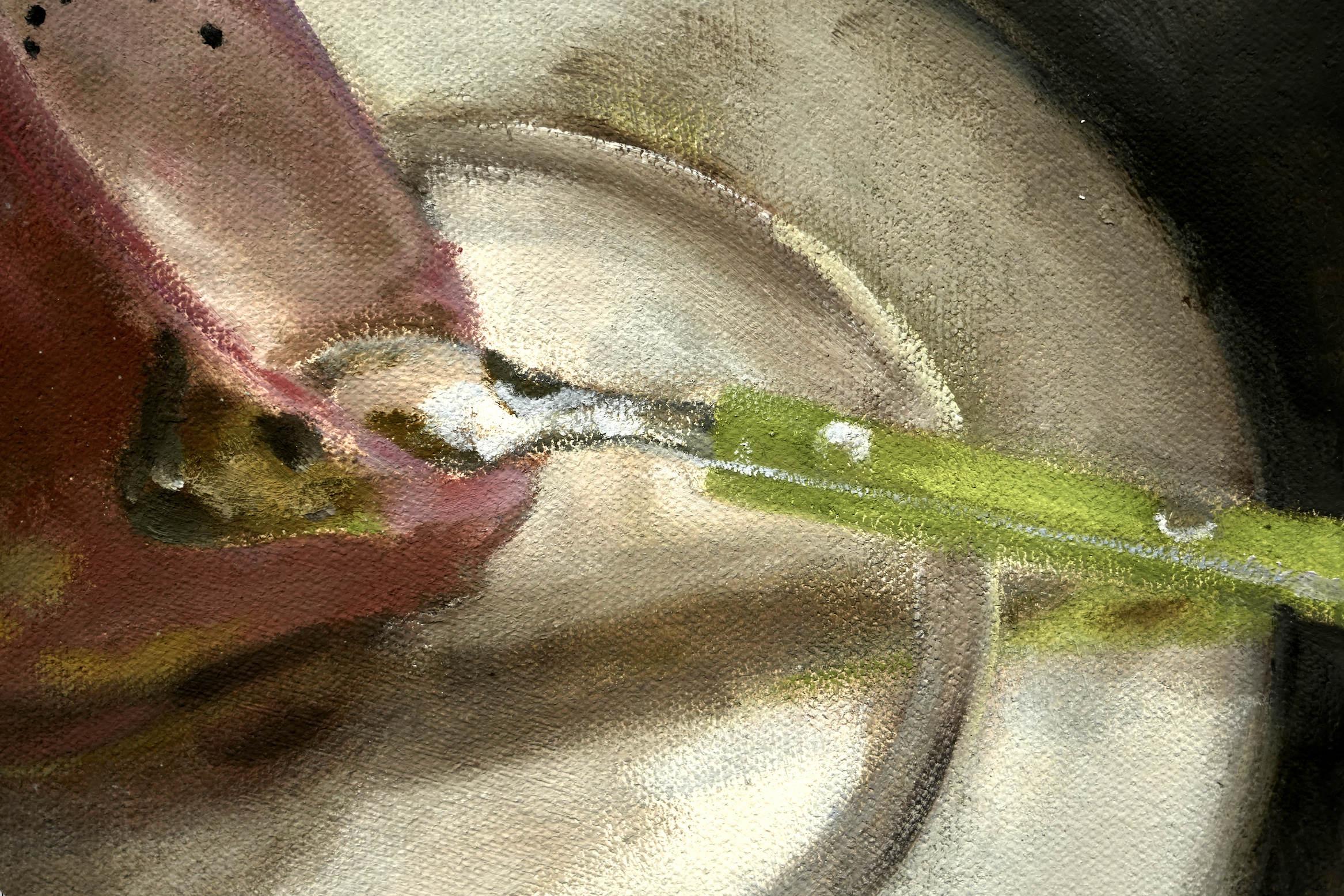
The Taste of Fading Memory
A Conversation with Shengjie jiang
Editor’s Note
This interview is based on a live conversation. The text has been lightly edited for clarity, while preserving the speaker’s original tone and meaning.
On May 20, 2026, ArtEchive held an interview with Shengjie Jinag, focusing on memory, emotional residue, migration, and the quiet psychological life of everyday objects.
The discussion explores how seemingly ordinary items, cakes, cabinets, tableware, and small animals, become emotional containers within the artist’s paintings. Rather than functioning as traditional still-life elements, these objects appear as traces left behind after specific moments, carrying warmth, absence, and emotional afterimages. Moving between sweetness and bitterness, clarity and blur, the conversation reflects on how memory continuously transforms through recollection, and how feelings associated with departure, time, and irreversibility become embedded within material forms. The artist also speaks about the emotional complexity of leaving home, the instability of memory, and the sensory influences currently shaping their practice, from the humid atmosphere of Huang Jinshu’s Rain to the changing weather and damp soil of New York in spring.
interviewee
-
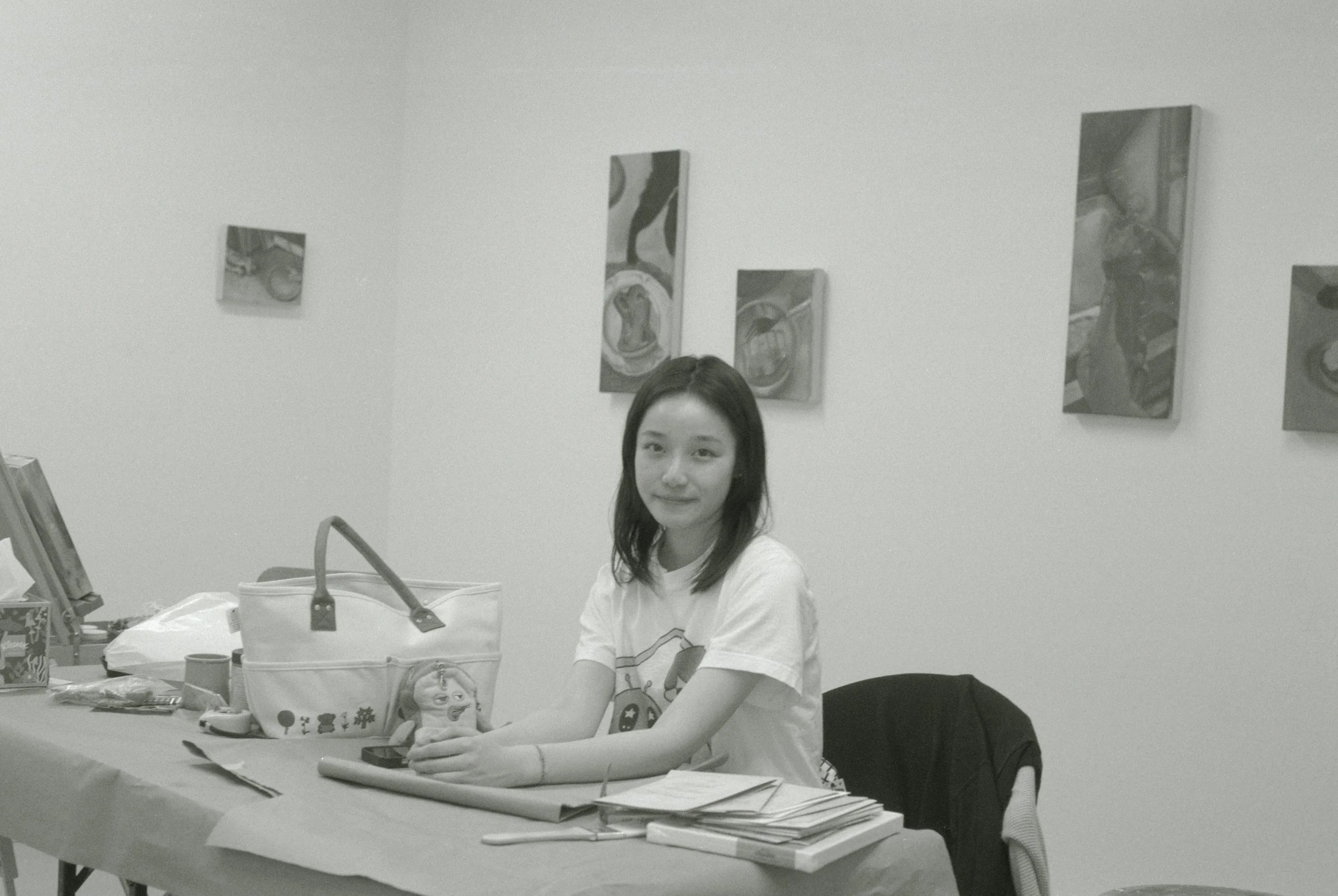
Shengjie Jinag
Artist based in New York.
Shengjie Jiang (b. 1999) is a painter currently living and working in New York. She earned her MFA in Painting and Drawing from the School of the Art Institute of Chicago (SAIC) in 2025, and her BFA in Fine Arts from the School of Visual Arts (SVA) in New York in 2023. Her first solo exhibition, The Cabinet of Hers, will be presented at Cubism Artspace in Shanghai in 2026. Her recent group exhibitions include Drown-Proofing (Chicago, 2025) and Imprints of Time (Chicago, 2025).
"This transient sense of belonging fueled a deep desire to ‘recreate a tactile sense from memory.’ I set bitterness as the emotional foundation of the work, underscoring the irreparable nature of time and memory, and the delicate balance between what is remembered and what is irretrievably lost.”
ArtEchive
Thank you for taking the time to speak with us today. This conversation is organized by ArtEchive as part of our ongoing interview series.
We approach this discussion as a way to think through how memory, emotional residue, and everyday objects operate within contemporary painting practice. Rather than treating personal experience, material fragments, and atmosphere as separate dimensions, we are interested in how they overlap and quietly shape the emotional structure of images.
Today’s interview begins with your relationship to ordinary objects, such as cakes, cabinets, cups, and small animals, and moves toward broader questions of memory, migration, softness, and loss. We will also discuss the role of blur and instability in your visual language, the emotional complexity of leaving home, and how sweetness, humidity, and sensory recollection become ways of carrying emotions that are otherwise difficult to articulate.
THE QUIET LIFE OF OBJECTS AND EMOTIONAL RESIDUE
ArtEchive
Your work often includes very ordinary elements, like cakes, cabinets, tableware, and small animals, but in your paintings, they never feel like conventional still lifes. Instead, they seem more like traces left behind after emotions have passed through a space. Why do you keep returning to these small objects?
Shengjie Jiang
For me, it’s really both. On one side, it is definitely a visual strategy. When I’m making work, I consciously think about how to bring opposing elements together. I’m interested in how different forces can occupy the same space without resolving.
But at the same time, it comes from my personal experience. I’ve always felt that I have many contradictory qualities within myself, and I’ve spent a lot of time thinking about that, especially in relation to identity. So the tension in my work isn’t just formal. It reflects how I experience the world, both internally and externally. It’s something psychological, but also something structural that I observe around me.
ArtEchive
You once wrote about “the most bitter spoonful of ice cream in the world.” I really love that metaphor because it feels both light and cruel at the same time. Why are you drawn to using “sweet” things to carry emotions that are otherwise difficult to articulate?
Shengjie Jiang
I don’t think sweetness necessarily represents happiness. Sometimes sweetness becomes bitter precisely when it becomes too intense, almost to the point where it’s difficult to swallow. For example, very rich dark chocolate ice cream. It’s sweet and soft at first, but once the cocoa becomes too overwhelming, it fills the entire mouth and turns into something almost cruel. I’m very drawn to that contradiction. It’s still ice cream and cream, but it can hold a kind of pain that cannot easily be spoken aloud.
At the same time, I don’t want bitterness to appear too directly in my work. Allowing sweet things to carry it makes the emotion softer and closer to how feelings actually exist in everyday life. Bitterness rarely arrives in a purely painful form. Very often, it hides itself inside beautiful, soft, and ordinary things.
BLUR, MEMORY, AND THE FEELING OF LEAVING
ArtEchive
Many of your images feel unstable rather than fixed or sharply defined. They resemble fading memories, or the fragmented and drifting sensations that emerge while trying to recall something. Is this sense of “unclearness” important to you?
Shengjie Jiang
Yes, it’s extremely important to me. I never want the image to function as a definitive record, because memory itself is unstable. Every time we remember something, certain details disappear, while imagination begins to fill in the gaps. For me, blur is not a form of absence. It’s actually the most truthful way memory exists.
ArtEchive
For many people, leaving home for the first time comes with a complicated and slightly bitter emotional experience. I’m curious whether this experience of “leaving home” has had a strong influence on your practice.
Shengjie Jiang
For me, leaving home initially felt like a very natural consequence of growing up and making choices. At the moment it happened, I didn’t experience an overwhelming sadness because my anticipation for the future outweighed the feeling of separation. It’s a little like an umbrella forgotten in the corner of a room after surviving a rainstorm. Only much later, when you suddenly smell the damp and mold lingering on it, do you remember the rain itself.
The bitterness of leaving home came much more slowly. It arrived through the realization that I could never completely return to the past again. Because of that irreversibility, I constantly find myself trying to hold onto things through repeated remembering, repeated searching, repeated sensing, the memory of a broken cup, a faded light, a touch that has gradually disappeared from memory. Painting becomes one way for me to keep those fragments from vanishing entirely.
RAIN, HUMIDITY, AND SENSORY MEMORY
ArtEchive
Besides painting itself, is there anything recently, a book, a memory, a smell, or even a certain emotional state, that has been continuously influencing your work?
Shengjie Jiang
Recently, I’ve been reading Rain by the Malaysian writer Huang Jinshu. Every time I open the book, the atmosphere of the South seems to rush out from its pages. Even the paper itself begins to feel humid and sticky.
At the same time, New York’s weather lately has been very unstable, with sudden rain showers appearing constantly. What I’m reading, imagining, and physically experiencing all seem filled with the smell of soil and moisture. While painting, I often find myself imagining the sensation of raindrops touching skin, or the scent of wet earth. Sometimes it feels as though a ladybug might land on my hand at any moment.
(End)