
Delving into the Depths of "Painterly Conception"
By Hui Shang
In the age of imagery, "painterly conception" represents an inquiry into the most fundamental value of the art of painting. For many, capturing life’s images has become as simple as snapping a photo with a smartphone. The basic functions of painting appear replaceable by photography or computer-generated imagery. Does this mean painting can exit the stage of history? This is indeed a cutting-edge question in art theory. A simple answer is that what distinguishes painting from mechanical or digital images is the uniqueness of its "painterly conception." Painting is, of course, the trace formed on a flat surface through the interconnected movement of hand, eye, and mind. The foundational value of painterly conception lies in the hand's depiction of what the eye perceives. This depiction can achieve likeness, bear a resemblance, or have no relation at all. The spontaneity of the hand in the process—where the brush follows the heart’s intent and becomes its voice—is something no mechanical or digital image can replace or surpass, not even a child’s drawing. The higher value of painterly conception enters the realm of stylistic creation within art history. The synergy of hand, eye, and mind reveals the accumulation of human knowledge and the sedimentation of aesthetic experience, gradually giving rise to an artistic style imbued with the unique, captivating charm of a personal visual language.
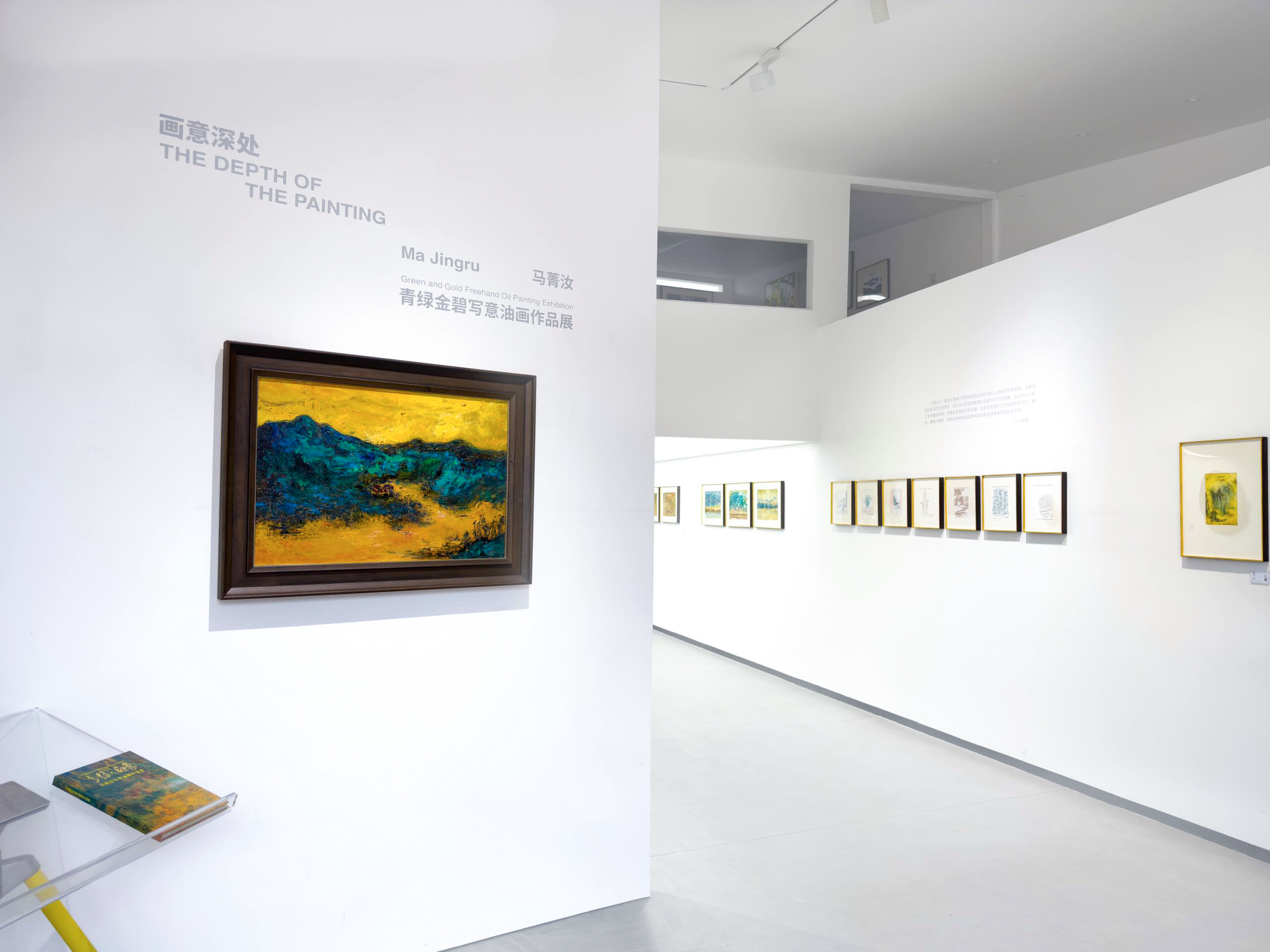
Installation View, courtesy of Jingru Ma
Ma Jingru’s oil paintings constitute precisely such an exploration of "painterly conception" in an era saturated with digital images. On one hand, she employs the classical medium of oil paint, which originated in Europe. The expressive power of oil in form and color is comparable to the piano in music, capable of rendering a vast range of tones. Yet her painterly conception demonstrates a distinct selectivity, as if limiting the piano’s keys to just a few notes. The restriction to five colors—azure, green, gold, crimson, and black—paradoxically creates a unique chromatic melody. On the other hand, using these five colors, derived from traditional Chinese heavy-color painting, inevitably signifies an inheritance and renewed exploration of the "painterly conception" of Chinese painting. This limitation of palette instead liberates the subjective expression of color. This subjectivity is not merely the articulation of personal aesthetic experience; it is shaped by the aesthetic mechanism of Chinese calligraphic brushwork—a collective subconscious of national aesthetics—forming a deeper layer of "painterly conception" within her oils. In other words, the evaluative criteria for this "painterly conception" are historical and systematic. From this foundation, Ma Jingru re-embarks on her exploration of the oil painting language, forging her personal aesthetic style between Chinese and Western art.
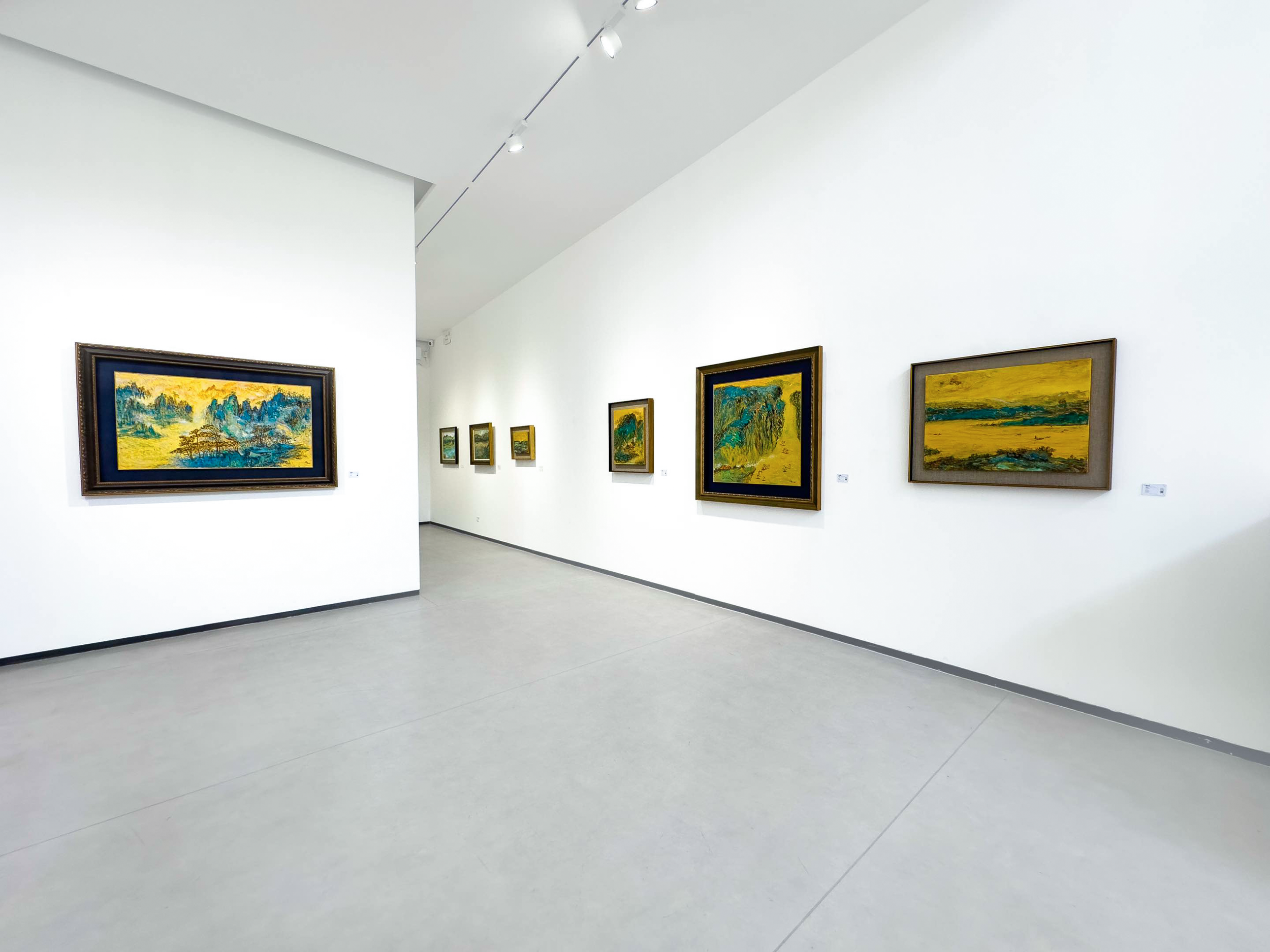
Installation View, courtesy of Jingru Ma
The localization of oil painting is an ongoing theoretical subject advanced through the practice of Chinese oil painting. This is because the "painterly conception" of Chinese painting is imbued with the essence of freehand expression, while oil painting is fundamentally a language of rational representation. Mr. Jin Shangyi has repeatedly emphasized that oil painting is a genre of representational realism. The rich expressive capacity of form and color provides vast space for representing subjects, yet this representation need not achieve perfect likeness. Instead, it embodies the artistic value of humans creating illusion or visual suggestion on a flat surface. A culture steeped in freehand expression, in employing this realist painting language, inevitably transforms and recreates it for its own purposes. As early as 1923, Liu Haisu published his cross-cultural study "Shi Tao and Post-Impressionism." His own oil painting practice attempted to integrate Chinese calligraphy into oils, substituting the sculptural buildup of color with the unadorned vigor of brushwork. In 1957, Dong Xiwen published "From the Expressive Methods of Chinese Painting to a Chinese Style in Oil Painting," emphasizing that the most essential characteristic of the nationalization of oil painting lies in applying Chinese painting methods. In recent years, terms like "freehand oil painting" and "imagistic oil painting"have become buzzwords, continually sparking widespread academic discussion. An undeniable fact is that the nationalization of oil painting cannot bypass the national characteristic of imagistic thinking. Ma Jingru’s blue-green-and-gold freehand oil paintings represent precisely a personal practice within this cultural fervor. She is a relay runner and a pioneer advancing along the path of nationalization pioneered by generations of Chinese oil painters.
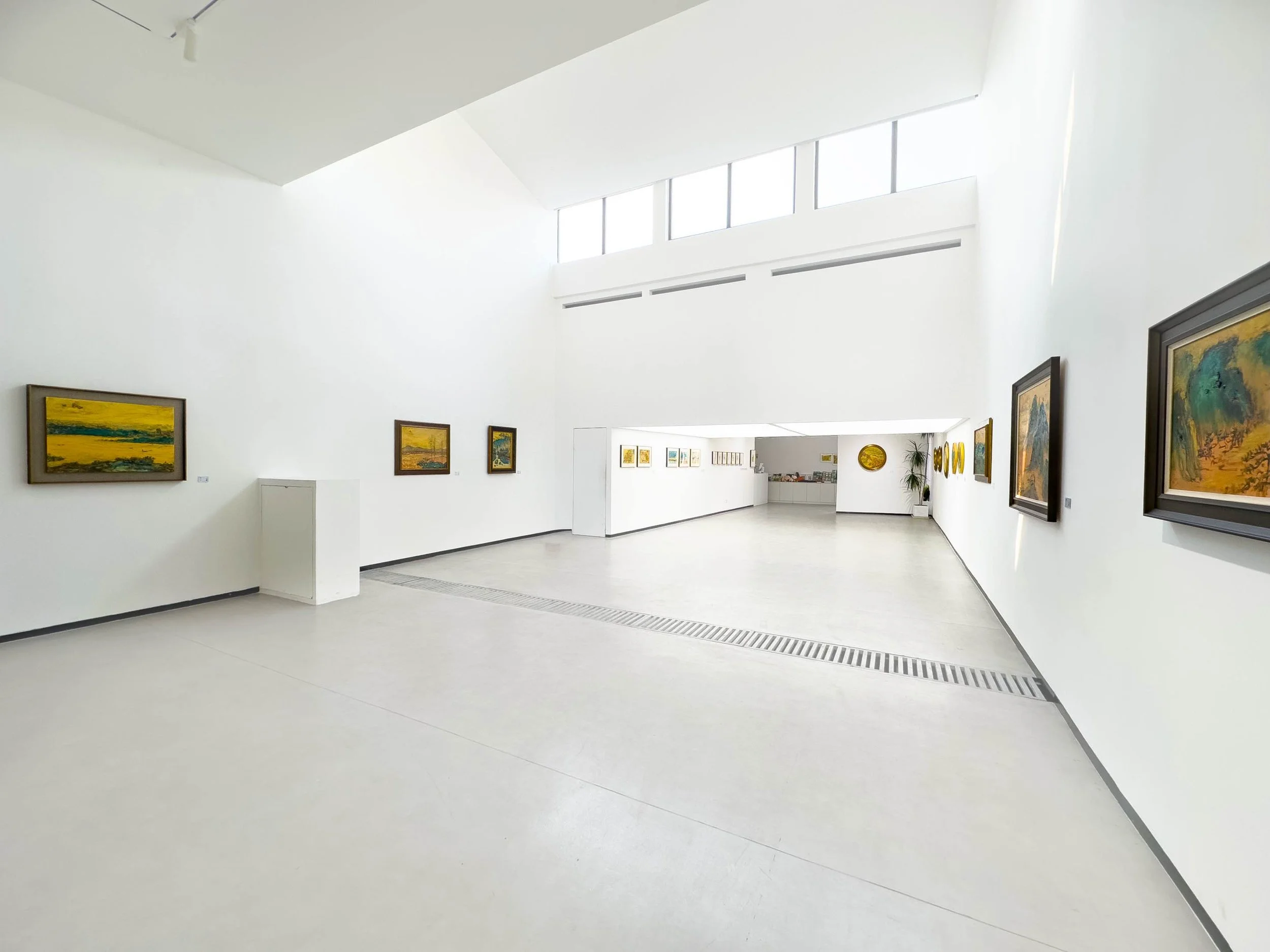
Installation View, courtesy of Jingru Ma
Her large-scale oil painting Layers of Verdant Peaks (《崇岭叠翠》), created for the Asian Infrastructure Investment Bank (AIIB) reception hall, is cherished by Chinese and international guests alike. Frequently featured in CCTV’s diplomatic coverage, this work is widely admired for its dual accomplishment: it creates atmosphere through oil painting’s mastery of light and color while capturing the spontaneous expression of Chinese freehand brush and ink. The piece inherits the color tradition of depicting dawn and dusk light, mastered by Claude Lorrain of the French Classical era. Browns and sunrise hues lend the light and shadow on rocks and trees a profound, ancient sensibility, yet it cleverly incorporates the coloring techniques of Chinese blue-green landscape painting. The solid, rugged rocks gleam with jade-like brush dots, and the painting’s vibrant spirit fully manifests the lush verdancy rendered through freehand strokes. Particularly reminiscent of ancient Chinese blue-green landscapes executed on gold-flecked paper, the cool tones of blue-green form a complementary relationship with the warm tones of gold and golden-orange—a unique pairing within China’s indigenous color system. This combination reflects both a system of shimmering light and color akin to Impressionism and embodies traditional Chinese culture’s veneration for luxurious, resplendent color beauty. Ma Jingru’s blue-green-and-gold freehand oil paintings thus straddle East and West in this manner.
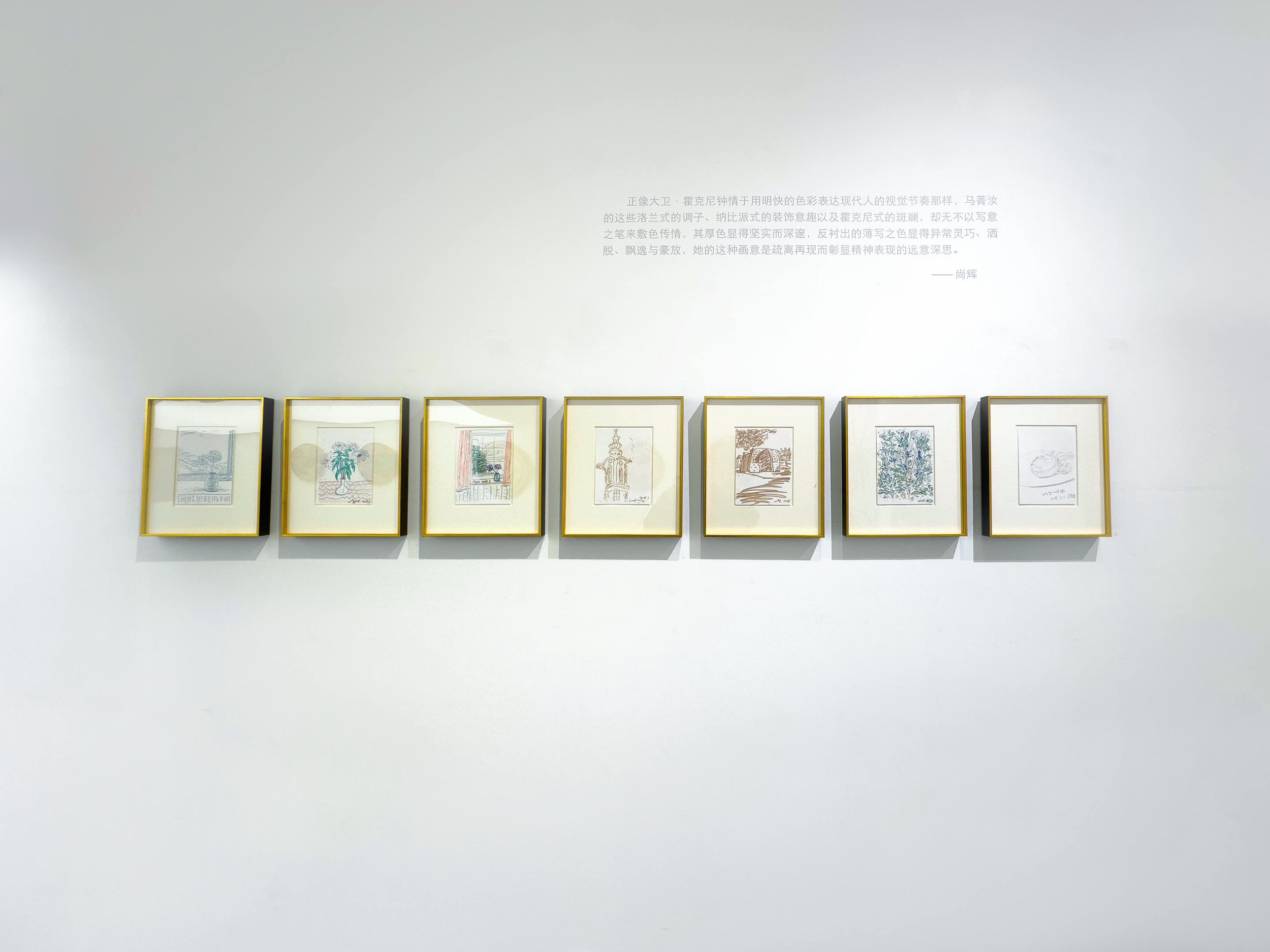
Installation View, courtesy of Jingru Ma
Beyond such large-scale hall pieces, some of Ma Jingru’s intimate, small-format works reveal an even more spirited essence of freehand expression. Works like Layered Verdant Ridges (《青峦叠翠》), Sailing Through Emerald Splendor (《碧华行舟》), Verdant Peaks Embracing Waves (《翠岭挽波》), Overlapping Mountains at Dawn (《重峦叠曙》), Mist and Radiance (《烟霞叠翠》), and Vast Verdure (《翠色苍茫》) consistently encompass majestic gorges, rushing rivers, winding mountain ranges, and shifting mists within the picture frame. These compositions often establish a vertically oriented, perspectival depth, drawing the viewer’s gaze into the distance. At the farthest reaches, brushstrokes often sweep horizontally while colors stretch vertically. The rotating oil painting brush seems to transform into a Chinese brush; the springiness of its tip frequently leaves behind "feibai" traces of brush movement on the canvas—an interplay of solid and void, where the vital energy is conveyed even before the brush touches down. This is the exquisite subtlety of Chinese calligraphic freehand brushwork. The small format allows Ma Jingru’s blue-green palette full rein for expressive "drawing". In many areas, both brushwork and color excel. Gold and blue-green are cleverly transformed into the warm and cool interplay of oils, with substantial impasto and deft touches used in mutual support. Sumptuous colors brim with vitality through dynamic, flying strokes. Sometimes the brushstroke takes precedence over form and color; other times, where form and color are suggested rather than fully rendered, the energy of the brushwork fills the space. Ma Jingru’s approach finds even more skilled and exquisite presentation in her peony and herbaceous peony flower works on circular fan-shaped formats. These paintings beneficially draw upon the boneless painting method(Painting Without Linear Definition)of Yun Nantian , though she ingeniously uses ochre and dawn hues and, through a calligraphic brush intent, captures the flowers’ delicate charm and gracefulness, rather than building them up with color. Thin application of color, substantial use of the brush—replacing piled-up color blocks with the rhythmic vitality of brushwork—fully showcases her personal originality in integrating oil paint with freehand expression.
Installation View, courtesy of Jingru Ma
Ma Jingru, who regularly plans and leads teams of young teachers on journeys through the world’s major art museums, has also developed a high level of connoisseurship for European oil painting through her extensive social art education work in galleries worldwide. Herein lies her profound understanding of the artistic allure of oil painting’s form and color, which is also why she can master oil paint without becoming ensnared in purely formal or chromatic concerns. Her introduction of gold, blue, and green into oils arose somewhat serendipitously. During a visit to Tate Britain’s major exhibition celebrating David Hockney’s 60-year career, she observed how several artistic expression methods could be harmoniously integrated within a single picture plane. In that moment, she contemplated how she might use Chinese gold-and-blue-green landscape painting to capture the light and color of Impressionism and the Nabis. Upon returning to China, she created her first blue-green-and-gold freehand landscape oil painting, Sailing Through Emerald Splendor (《碧华行舟》), thus unlocking a creative knot regarding East-West fusion. She summarizes this fusion as "using Western methods to elevate Chinese essence", focusing on transforming Chinese freehand aesthetics through the color language of European oil painting, thereby exploring the spirit of Chinese culture and its aesthetic core via an internationalized painting language.
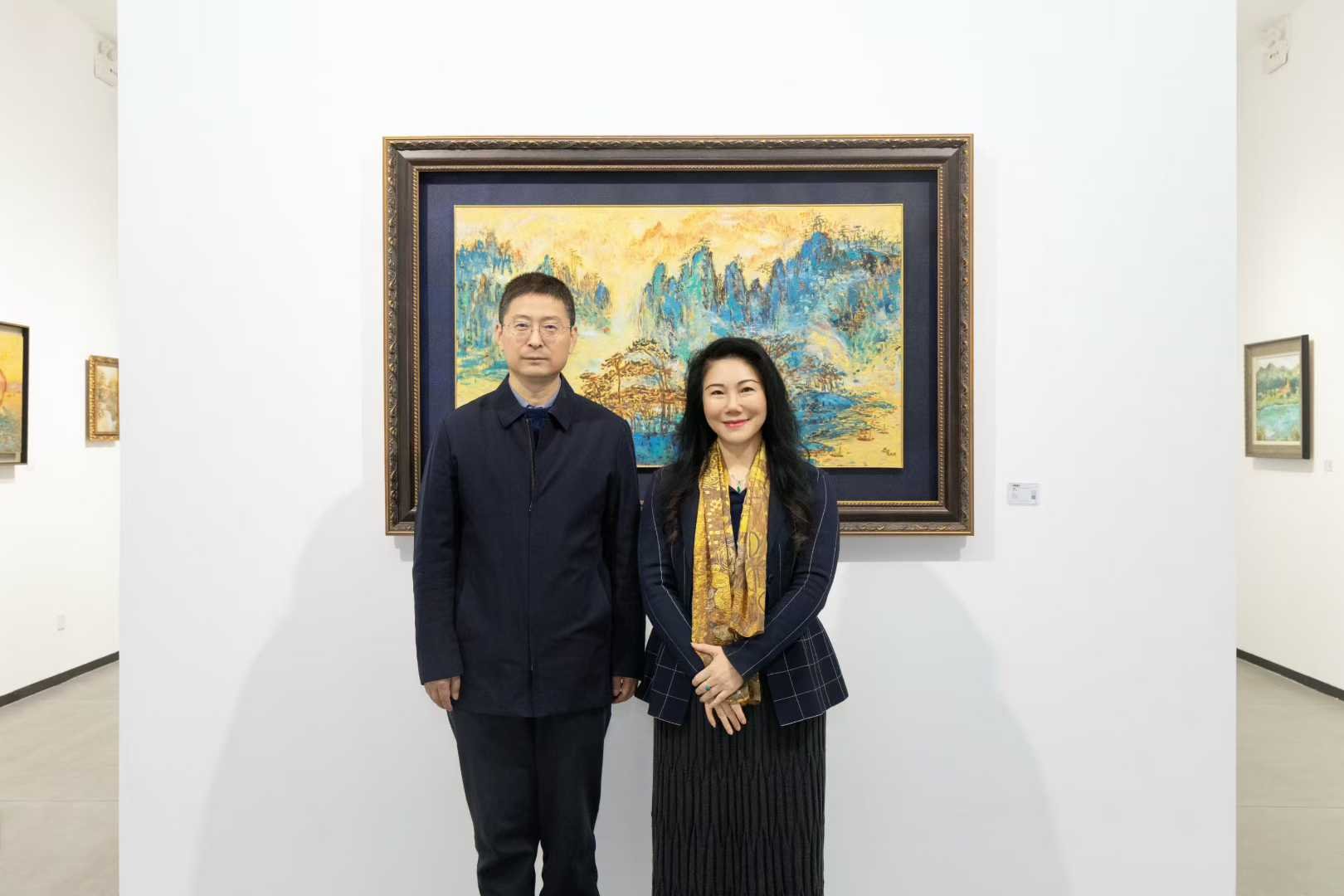
The artist with her work in the exhibition. Photo by Jingru Ma.
Thus, it is evident that the painterly conception in Ma Jingru’s oil painting is not merely about distinguishing itself from photography or digital images. It is that freehand aesthetic deeply rooted in Chinese cultural tradition, yet this freehand aesthetic is fully expressed through the universally accessible visual language of oil paint. Just as David Hockney delights in using bright colors to express the visual rhythm of modern life, Ma Jingru’s Lorrain-esque tones, Nabis-inspired decorative charm, and Hockney-esque vibrancy are all applied and used to convey emotion through freehand brushwork. Her substantial colors appear solid and deep, setting off the thinly written colors, which appear exceptionally agile, unfettered, ethereal, and bold. Her painterly conception is one of detachment from mere representation, highlighting spiritual expression and profound contemplation. Its depths not only wind through secluded paths but also harbor a fresh fusion of Chinese and Western traditions for her generation.
Hui Shang
Shang Hui (b. 1962) is a Chinese art theorist, critic, and curator from Xuzhou, Jiangsu. He currently serves as Director of the Theoretical Committee of the China Artists Association and President and Editor-in-Chief of Meishu magazine. His research focuses on modern Chinese art history, thematic art practices, and visual culture in the image era. He has held positions at the Shanghai Art Museum and Beijing Fine Art Academy Art Museum and has curated major exhibitions including editions of the Beijing International Art Biennale.