
One Does Not First Master Control, Then Begin to Create
by Shuhan Zhang
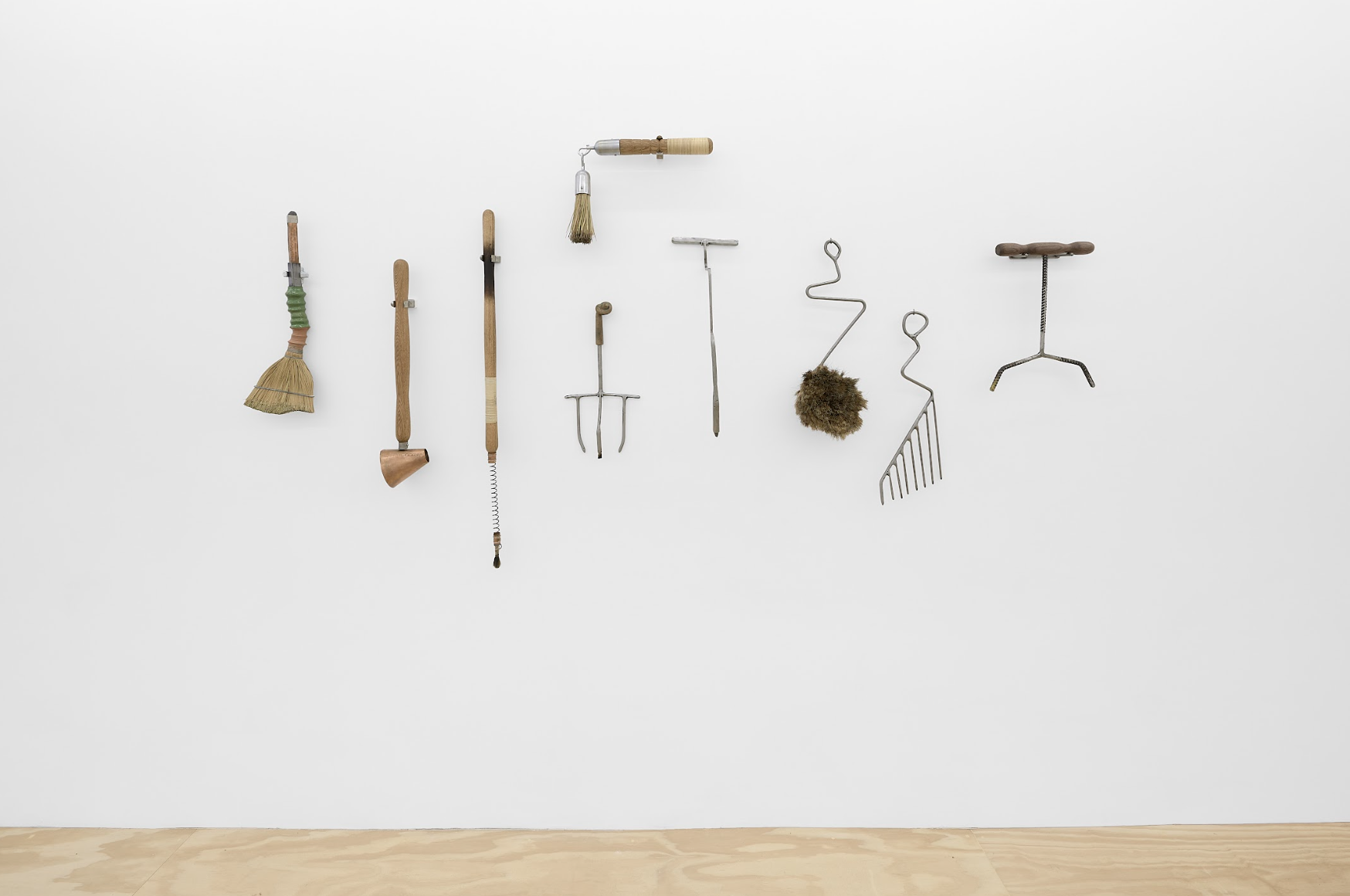
Installation View of Implements for Deviation. Courtesy of the Parent Company.
When I was learning Chinese calligraphy as a child, I could never understand why my teacher kept telling me, “Don’t press so hard.” At the time, I believed that if I was serious enough, the line should become steadier and more precise. So every time I lowered the brush onto the paper, I instinctively gripped it tightly, my wrist stiff with concentration. Yet the result was always the opposite. The brush would catch and stutter across the surface, ink pooling heavily onto the paper, the lines becoming slow and awkward. Sometimes my whole hand would already be sore halfway through, while the characters still looked strangely uncomfortable. Later, I gradually realized that truly fluid lines did not emerge through complete control. On the contrary, they often appeared at the moment when control was beginning to loosen. The hand could not be too tense; the force could not be entirely pressed down. One had to allow the brush to slip slightly across the paper, to drift, even to “make mistakes” occasionally.
Experiences like this have become increasingly rare. Most tools today are designed to eliminate uncertainty. Predictive text corrects our sentences before we finish typing, editing software smooths over imperfections automatically, and AI increasingly performs processes that once required repeated trial and error. People experience fewer and fewer situations in which they cannot immediately grasp or control the outcome. In many ways, tools no longer function as extensions of the body so much as substitutes for it.
It was precisely because of this that, upon encountering Parent Company’s exhibition Implements for Deviation, I was reminded of this condition of “not fully being able to control.”
The exhibition space itself is arranged like an inverted hardware store or utility shed. The works are pinned to walls and tool racks like instruments waiting to be picked up and used, or like categorized components within some industrial system. Wooden handles, brush bristles, metal structures, and grips all retain an unmistakable sense of functionality, prompting the viewer to assume instinctively that they should be operable. Yet upon approaching them, it becomes immediately clear that these objects never fully enter the realm of function. They resemble tools while simultaneously refusing to smoothly become tools.
Works such as DRW_02, DRA_01, and SHA_01 hang side by side like extensions of the human hand, making the relationship between tool and bodily appendage unusually direct. Humans continually attempt to extend their actions through tools to increase efficiency, expand reach, and reinforce control, but Fischer’s works repeatedly render this extension hesitant, clumsy, and unstable. Even the corporate, coded titles reinforce a cold industrial logic, leaving the works suspended between function and failure, operation and deviation.
Works such as SWP_01 make this deviation from functionality appear even more absurd. A brush-like structure that should operate vertically is instead attached to the bottom of a curved steel arm. At the same time, the top resembles the handlebars of a bicycle or pushcart, giving the object an unstable center of gravity. It still appears pushable, draggable, or usable for scrubbing, yet it becomes impossible to imagine how it could actually function effectively. DRW_04, meanwhile, resembles a collapsing instrument: steel, rope, stone, wood, and graphite are bound together into a precarious structure whose thin metal “legs” support a body that seems unable to stabilize itself. Fischer does not entirely erase functionality; rather, she keeps these objects suspended between “still operable” and “almost failing.”
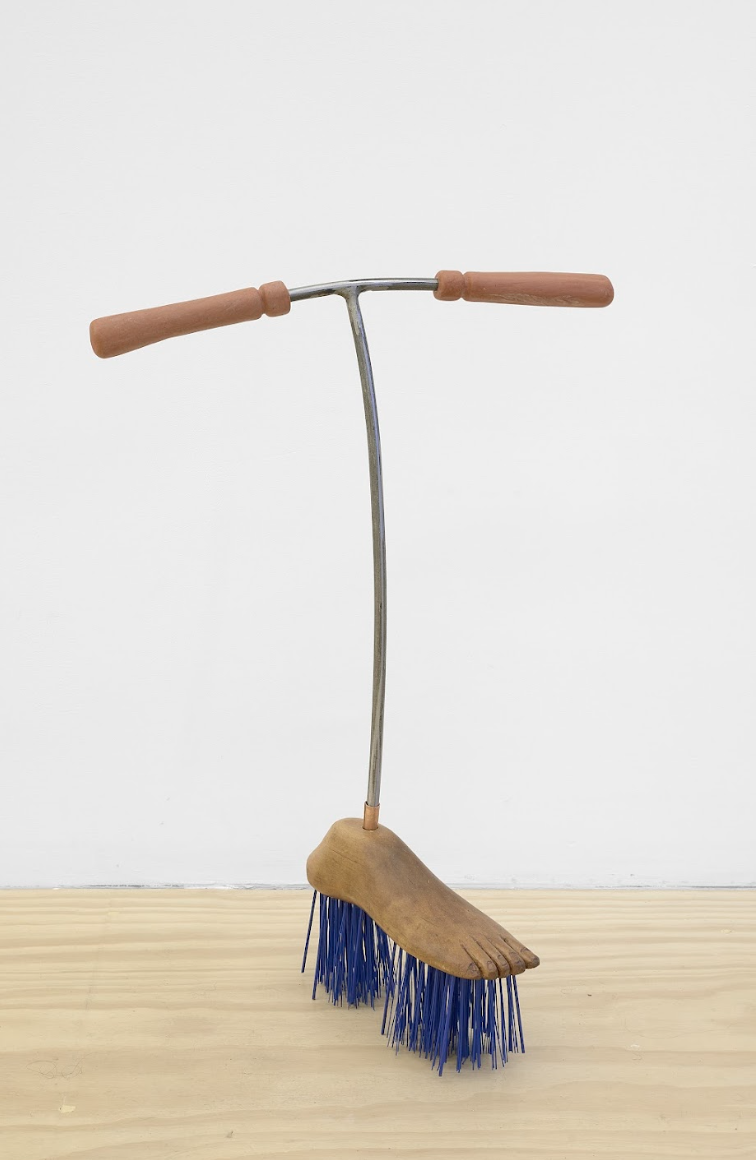
Dena Paige Fischer, SWP_01, 2026. Courtesy of the artist and Parent Company.
Even the titles carry an industrial, systematic coldness. Acronyms such as BRU, DRW, SWP, and UNA resemble warehouse codes, inventory labels, or internal production systems, distancing the works from traditional sculptural objecthood and bringing them closer to components within a functional apparatus. Yet precisely because of this, the works continually expose a deeper contradiction: humans create tools to extend movement, improve efficiency, and expand control, while Fischer’s sculptures repeatedly render that extension hesitant, awkward, and unstable.
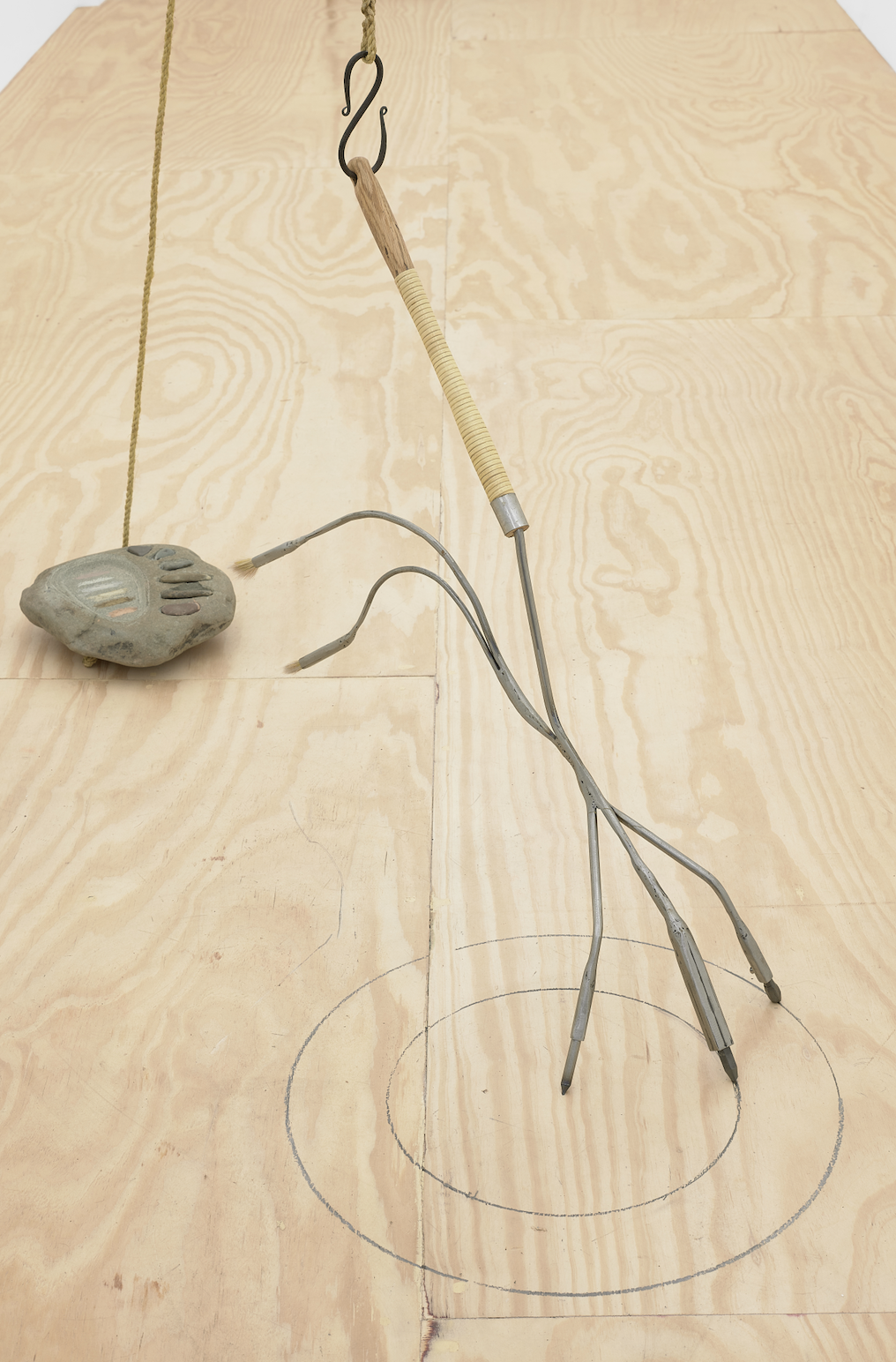
Dena Paige Fischer, DRW_04, 2026. Courtesy of the artist and Parent Company.
French philosopher Bernard Stiegler once argued that modern technology increasingly externalizes human perception and action. As technologies become more automated, people gain efficiency while gradually losing their relationship to process itself. Fischer’s work seems to bring that process back. Creation no longer appears as the precise execution of intention, but rather as a condition of constant adjustment, miscalculation, and the repeated search for bodily rhythm. In this sense, what these works record is not simply the “mark” itself, but the body relearning movement through resistance.
This also distinguishes Fischer’s work from the traditional surrealist object. Her sculptures certainly recall Gift, which produces estrangement by sabotaging utility, yet Fischer does not pursue total uselessness. Her tools retain a minimal degree of functionality. They can still operate, but they begin to deviate from the conventional logic of efficiency and control.
Hidden at the back of the exhibition is a series of prints produced using these tools. The marks are unstable and far from refined, resembling the residue of repeated failures. Yet precisely because of this, they reveal something important: many movements are not formed in the instant of mastery. Rather, they emerge gradually, through an evolving bodily relationship. One does not first achieve control and then begin to create. More often, it is through repeated moments of losing control, drifting off course, and continuously readjusting the body that a genuine rhythm slowly begins to appear.
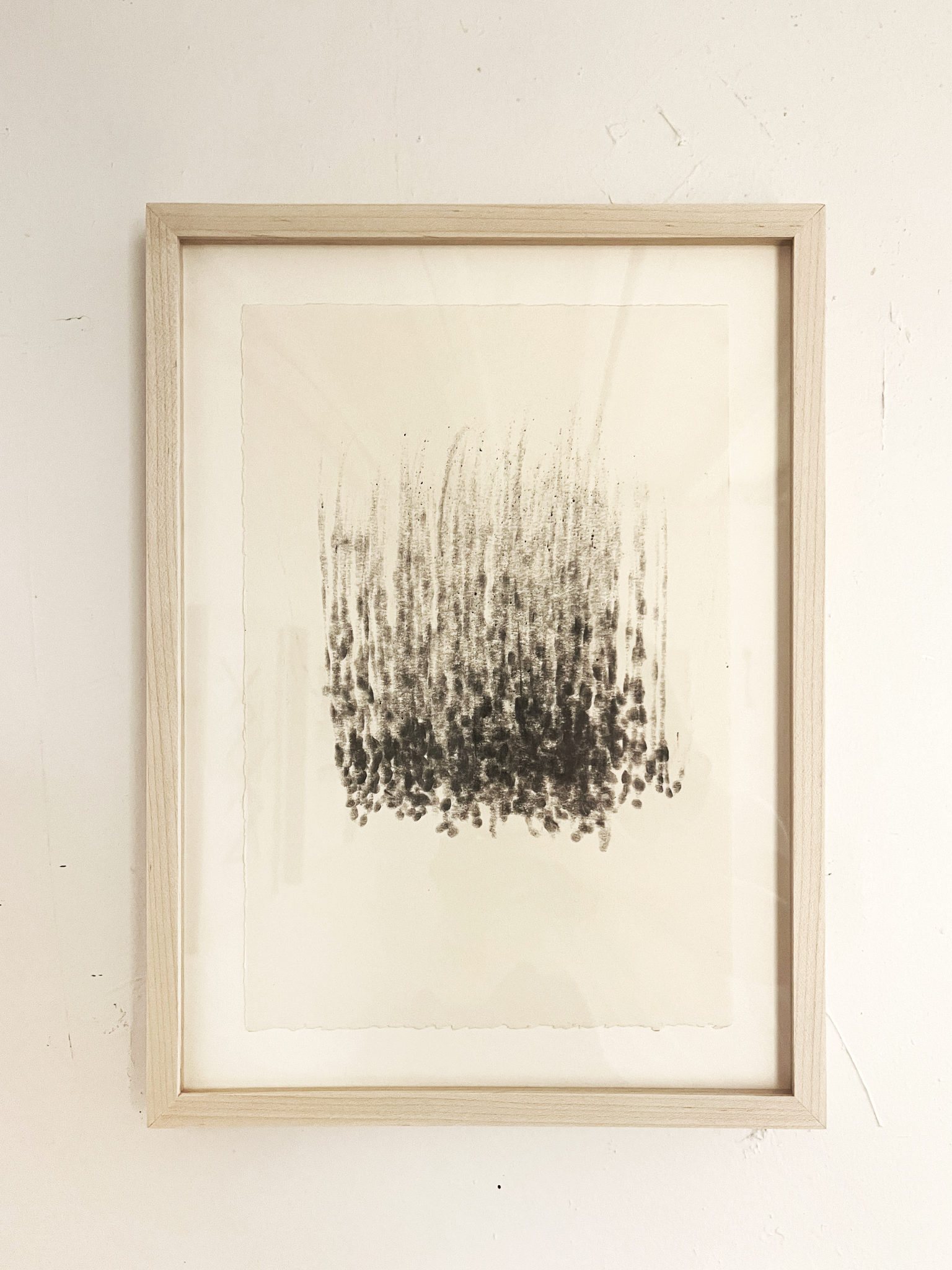
Dena Paige Fischer, Mark by DRW_02, 2026. Courtesy of the artist and Parent Company.
Dena Paige Fischer: Implements for Deviation at Parent Company, New York, on view through May 7— June 27, 2026
About the author:

Shuhan Zhang (b. 2002, Jiangsu, China) is a curator and writer. She received her M.A. in Visual Arts Administration from New York University and holds a B.A. from the Central Academy of Fine Arts. Her research focuses on digital art, cultural platforms, and the contemporary art market. She has curated exhibitions including After the Face, Lithic Coordinates, Losing Ghosts, A Lure, A Lament, and Spreading Growth. Her writing has been published in Tussle Magazine, IMPULSE Magazine, Art Spiel, and Whitehot Magazine, with a focus on exhibition criticism and contemporary art discourse.