
Please Take Me Seriously, But Not Too Seriously
A Conversation with
sherly Fan
Editor’s Note
This interview is based on a live conversation. The text has been lightly edited for clarity, while preserving the speaker’s original tone and meaning.
On May 27, 2026, ArtEchive held a conversation with Sherly Fan surrounding softness, cuteness, emotional projection, and the unstable psychological spaces embedded within contemporary visual culture.
The discussion explores how “cuteness” functions not as a superficial aesthetic category, but as a complicated emotional and social structure shaped by gendered expectations, vulnerability, projection, and the desire for safety. Moving through topics such as plush toys, pop culture, loneliness, humor, and emotional masking, the artist reflects on how seemingly harmless imagery can simultaneously carry exhaustion, desire, sadness, anger, and emotional emptiness beneath bright surfaces and candy-colored forms.
Rather than separating “serious” art from sentimental or popular visual language, the conversation approaches softness as a space where difficult emotions can become temporarily visible without immediately turning into confrontation. Throughout the interview, painting appears less as a process of producing polished images than as a way of tracing subtle psychological states that are often difficult to articulate directly. The artist also reflects on the emotional pressure facing younger artists today, including social media visibility, self-comparison, aesthetic branding, and the anxiety of constantly trying to “find” a stable artistic identity. Instead of treating style as something fixed, the conversation suggests that visual language gradually emerges through honesty, emotional precision, contradiction, and lived experience.
interviewee
-
Sherly Fan
Multi-Media Artist & Filmmaker
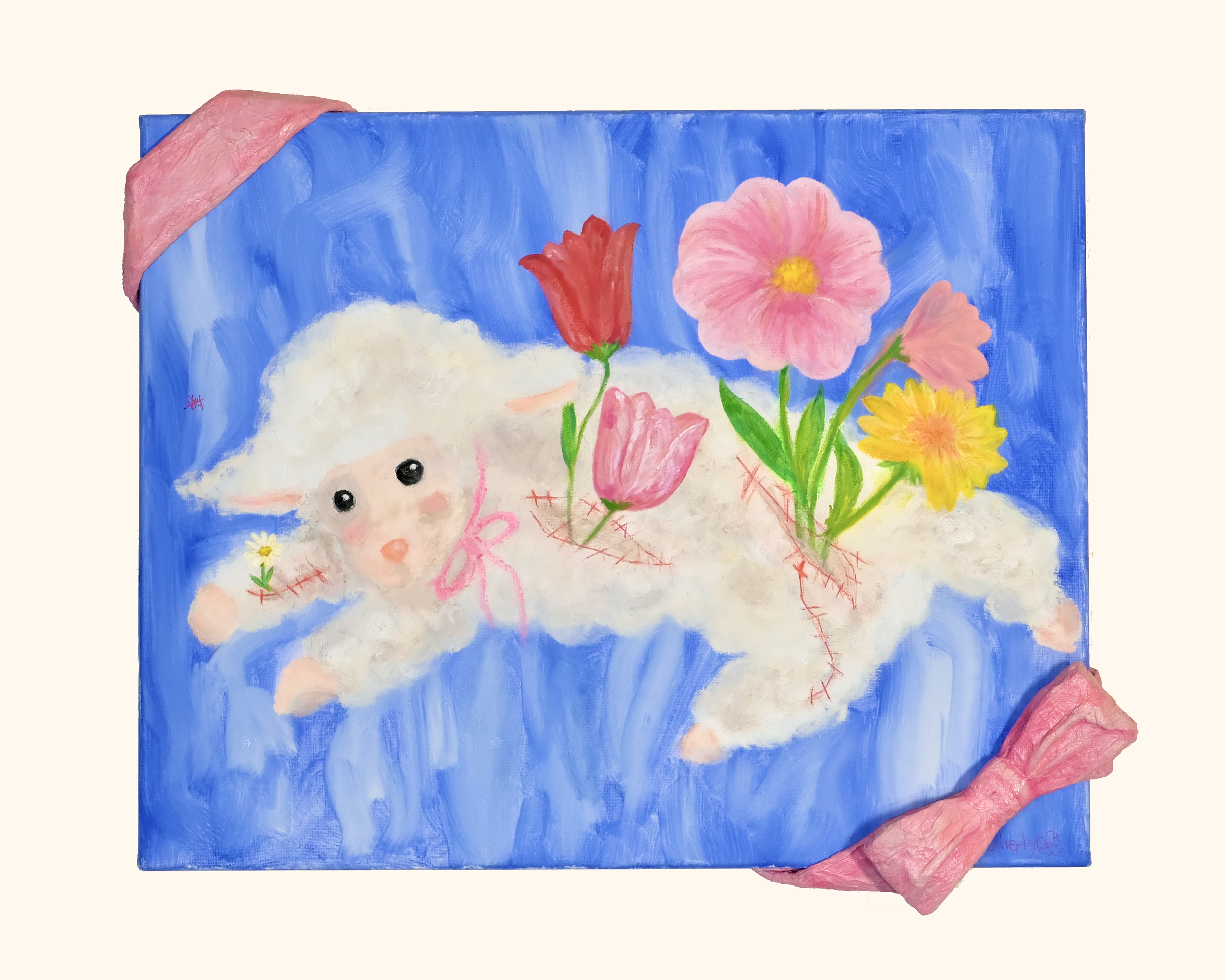
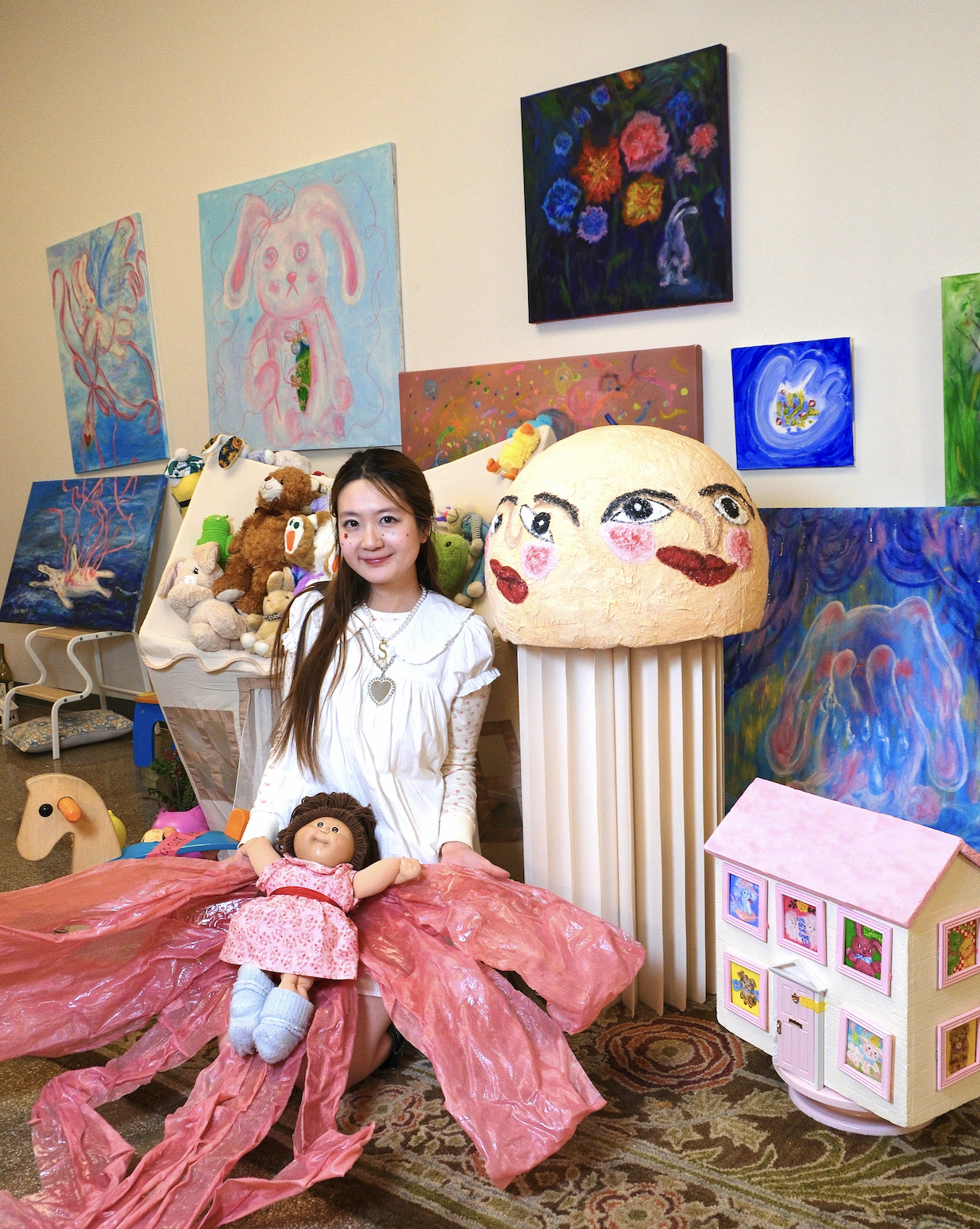
Sherly Fan (b.1996, China) is a multidisciplinary artist working across painting, sculpture, performance, and immersive installation. Her practice explores vulnerability through the visual language of cuteness, using pastel aesthetics and plush-inspired animal figures to examine emotions often dismissed as excessive, childish, or unserious.
Her works juxtapose softness with tension — fragile animals pierced by ribbons, plush figures resisting their own sweetness, and childlike forms carrying emotional weight. Drawing from lived experiences shaped by cultural and gendered expectations around restraint, Fan reclaims cuteness as both shield and resistance. The sweetness invites viewers in; the emotional weight asks them to stay.
Fan’s work has been presented at the Museum of Chinese in America (MOCA), MoMA PS1’s Printed Matter Art Book Fair, and through a residency with Arts 14C.
ArtEchive
Thank you for taking the time to speak with us today. This conversation is organized by ArtEchive as part of our ongoing interview series exploring contemporary artistic practices, emotional visual culture, and the changing conditions of image-making today.
We approach this discussion as a way to think through how softness, cuteness, humor, and emotional contradiction operate within contemporary art beyond purely aesthetic categories. Rather than treating “cute” imagery as something superficial or decorative, we are interested in how these visual languages can become spaces for projection, vulnerability, resistance, emotional masking, and the negotiation of visibility within contemporary culture.
Today’s interview begins with your relationship to cuteness, plush toys, pop culture, and feminine visual language, before moving toward broader questions surrounding loneliness, emotional performance, irony, and the pressures of self-presentation within a hyper-visible digital environment. We will also discuss how personal visual language gradually forms through lived experience and emotional honesty, the tension between attraction and discomfort within seemingly harmless imagery, and the emotional realities younger artists face while navigating social media visibility, aesthetic expectations, self-comparison, and the ongoing pressure to “find” a recognizable artistic identity within contemporary art.
Softness, Cuteness, and Visual Language
ArtEchive
Hearts, flowers, plush toys, candy-colored palettes, these elements appear frequently in your work. Many people tend to understand “cuteness” as something light or even superficial, but in your practice, it feels more like a complicated emotional structure. How do you think about the role of “cuteness” in your work?
Sherly Fan
For many Asian women, “cute” is a word that has constantly been projected onto us since childhood. People tend to assume that you like plush toys, soft things, pastel colors, sweetness. But for a long time, I actually resisted all of those things. “Cute” often felt slightly dismissive to me, as if it implied not being serious enough, not mature enough, or even being more easily overlooked in professional spaces or real-life relationships. Later, I slowly began to realize that this complexity itself is worth discussing. Why are things associated with femininity, softness, and sweetness so often not taken seriously? Why is “cute” automatically understood as something shallow?
I also gradually realized that my own resistance toward cuteness actually came from this larger social structure. I even used to dress more androgynously on purpose because I didn’t want to be categorized as the “cute Asian girl.” Later, I started reading theories related to cute studies, especially the work of Sianne Ngai and Joshua Dale. They discuss how cuteness can produce a desire to control, possess, and objectify. Many things we perceive as cute actually contain a sense of distortion: oversized eyes, infantilized proportions, vulnerability. Behind these aesthetics are very complicated power dynamics.
At the same time, though, cuteness really can function as a very effective emotional shelter. It feels like a soft escape. Many people need this kind of gentle, safe visual space that does not immediately hurt them. So for me, cuteness simultaneously contains control, vulnerability, desire, comfort, objectification, and emotional projection. I’m deeply drawn to that contradiction.
I think many young artists today use cute visual languages, but very few people seriously discuss the complexity of cuteness itself. It is not just a style, but an emotional structure, a way of looking, and even a social experience. I hope to continue exploring this subject more deeply, because it has fascinated and troubled me for many years.
ArtEchive
How did your very distinctive visual language and emotional atmosphere gradually develop? Were there any particular life experiences, internet cultures, visual influences, or turning points that shaped your work in significant ways?
Sherly Fan
I think the way every artist sees the world is deeply connected to their own personal experiences growing up. I’ve always wanted to be honest in my work. For me, making art is not something “great” or heroic, but more like a way of understanding myself and understanding the world. I used to believe art could change the world, but now I actually think that idea can be a little too arrogant. What matters more to me now is whether I can honestly share what I genuinely feel in the present moment. Because of that, my process rarely begins with a fully fixed plan. Usually I only make a very simple sketch and then start painting directly. A lot of the time, the work slowly grows out of emotion itself.
Of course, the popular culture I encountered while growing up had a huge influence on me. I loved Britney Spears when I was younger, and I was also deeply drawn to many female figures in pop culture. I think they subconsciously shaped the way I think about femininity, emotional expression, and desire.
A lot of people also ask me whether I have cats or dogs because they think my characters resemble animals. But actually, many of my references come less from animals themselves and more from plush toys, dolls, and anthropomorphized objects. I’ve always been fascinated by the idea of projection. A plush toy is technically just an object, yet people automatically project emotions onto it. Depending on the angle of its eyes, the shape of its mouth, or the posture of its body, people begin to imagine that it feels happy, hurt, lonely, or emotionally neglected. I find that mechanism of looking incredibly interesting.
Another important aspect is that, as a Chinese artist, I used to feel conflicted about my own visual language. The imagery in my work is not traditionally “Chinese” in an obvious sense. Many of my visual references come from American, Japanese, and Korean popular culture, but this hybridity is part of my lived experience. For my generation, cultural identity is often formed through a mixed visual language shaped by media, migration, and everyday life.
I think of my work as a kind of imagined safe space — a candy-colored, soft, sweet environment that still allows negative emotions to exist. Within that world, I can express anger, sadness, desire, and shame more safely. Especially as an Asian woman, there are many times when you don’t even feel allowed to admit your own desires. So these characters, plush toys, and sweet-looking scenes all become emotional containers in a way.
Humor Beneath the Surface
ArtEchive
There’s always a sense of absurdity, humor, or even irony in your work. Do you feel that you are intentionally pushing against the overly serious modes of expression often found in contemporary art?
Sherly Fan
I think absolutely, yes. I’ve always had a complicated relationship with the idea of “being serious.” On one hand, of course everyone wants to be taken seriously, respected, and seen. But at the same time, I genuinely love states that feel playful, relaxed, or even slightly childish. Because I think people are often only able to create something truly special when they are not trapped inside excessive seriousness.
So I feel that my work is always expressing two things at once. On one side, it’s asking: “Can you take me seriously?” But on the other side, it’s also saying: “You don’t have to take everything so seriously.” I think when people place too much weight onto something, the thing itself can actually collapse under that pressure. Too much anxiety, expectation, and imposed meaning begin to surround it. Because of that, I’d rather approach heavy subjects through a lighter, more humorous, and more playful language.
Sometimes I even feel that there is a slight sense of self-mockery in my work — a kind of self-aware humor. Because I think many emotions are inherently absurd, and that absurdity itself is also part of reality.
ArtEchive
Although your work is visually bright and soft, it often still creates a feeling of loneliness or emotional emptiness. How do you think this emotional contrast emerges?
Sherly Fan
A lot of friends who visit my studio tell me that the characters in my paintings always look “kind of pitiful.” Some of them are torn apart, some look like they are melting, some seem as if they are drowning, and others appear exhausted or emotionally emptied out. Even when they look cute on the surface, something still feels slightly wrong. I think only a very small number of my works make the characters look genuinely happy. And even in those “happy” images, there’s usually another emotion hidden underneath.
I think, to some extent, I intentionally want to “trick people into entering.” At first glance, the work looks sweet, safe, soft, and harmless. But if you continue looking, you start to realize: why does it seem to be in pain? Why does it feel like it’s about to fall apart?
This contrast is also connected to my own emotional habits. I tend to hide my emotions instinctively. Especially as Asian women, many of us learn to package ourselves in ways that feel gentle, harmless, and likable, because that often feels safer. But at the same time, the real emotions are still there underneath.
So I want the work to preserve that soft and approachable entry point, while also allowing feelings like suppression, exhaustion, anger, and loneliness to become visible. I don’t want to express these emotions in an overly aggressive or confrontational way. Instead, I want viewers to slowly enter into that emotional state over time.
Staying Honest in a Hyper-Visible World
ArtEchive
When creating your work, do you care more about the visual appeal of the image or the more private and emotional aspects behind it? Do these two things ever conflict with each other?
Sherly Fan
I think I care more about the emotion itself. For example, a character’s gaze, the feeling of almost crying, or a very subtle sense of despair, those things are extremely important to me. Even if the image looks simple or cartoon-like, I still care deeply about whether the emotion has been expressed accurately.
For example, some of my rabbit characters are made with only a few simple lines, but I still want their eyes to carry a blurry, tear-like feeling. Or sometimes a character may appear to be aggressive on the surface, but at the same time, I want viewers to sense hesitation, regret, attachment, or pain within them as well.
I really hope the work can hold my emotional state as truthfully as possible in that moment. As for being “pretty” or “cute,” those things are, to some extent, more like visual languages that naturally emerge, rather than the primary thing I focus on.
ArtEchive
Many young artists today face anxiety caused by social media, visibility pressure, and constant online comparison. What advice would you give to younger artists who are still trying to develop their own visual language?
Sherly Fan
First of all, I would say: don’t force yourself to “find a style.” I think people today too easily turn “having a style” into something that must be achieved immediately. But honestly, style is often something other people identify in your work afterward. It’s not something you can fully obtain just by deliberately chasing it. Human beings are constantly changing. The work I make now is already very different from what I made ten years ago. Even if people can still tell it was made by the same person, I could never truly return to the emotional state or mindset I had back then. So I think the things that emerge honestly in each phase of your life are actually very valuable. Don’t rush to define yourself. The more intentionally you try to manufacture a “style,” the easier it becomes to lose the things that genuinely belong to you.
Another thing is that I think making art is ultimately about deciding what kind of world you want to create. A lot of people will tell you what could ruin your career, what styles are more likely to succeed, or what kinds of work are more accepted by the market. But increasingly, I feel those things are not the most important part. What matters most is: what do you actually want to express? And are you willing to be honest with your own work?
So I think the most important thing is simply to keep going, and to face yourself as honestly as possible.
(End)