
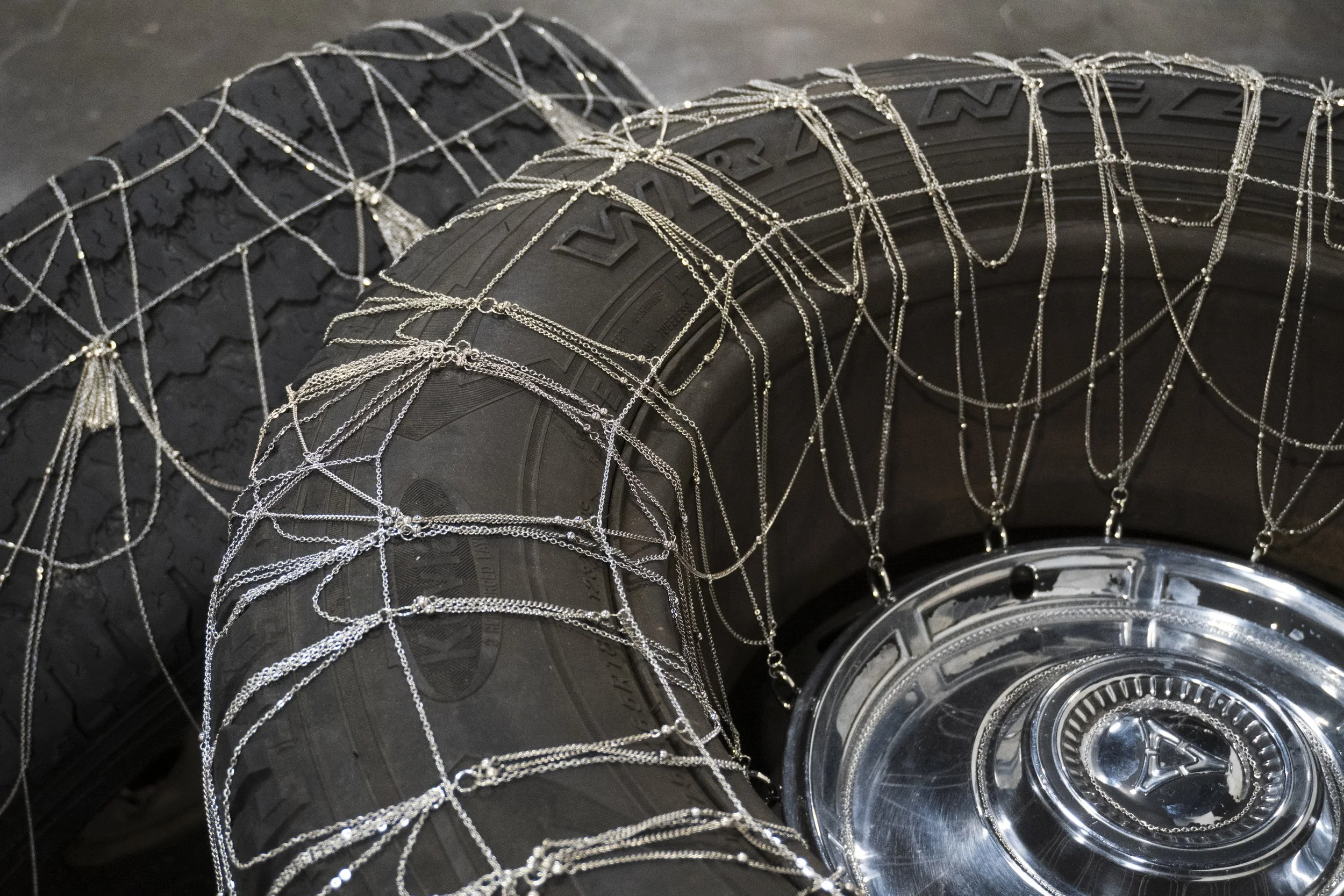
Manufactured Nostalgia
A Conversation with
Edgar Solórzano
Editor’s Note
This interview is based on a live conversation. The text has been lightly edited for clarity, while preserving the speaker’s original tone and meaning.
ArtEchive held a conversation with artist Edgar Solórzano on his transition from architecture to sculpture, and how research, memory, and scale continue to shape his practice.
Moving between personal history and larger geopolitical forces, the conversation looks at how American culture, nostalgia, and inherited desires entered Solórzano’s childhood in Mexico after NAFTA. Through sculpture, installation, and site-specific work, he reflects on how emotion can be shaped by cultural products, material relationships, and the contradictions between attraction and discomfort.
The interview also touches on artistic transition, material agency, and the practical realities of sustaining a creative life.
interviewee
-
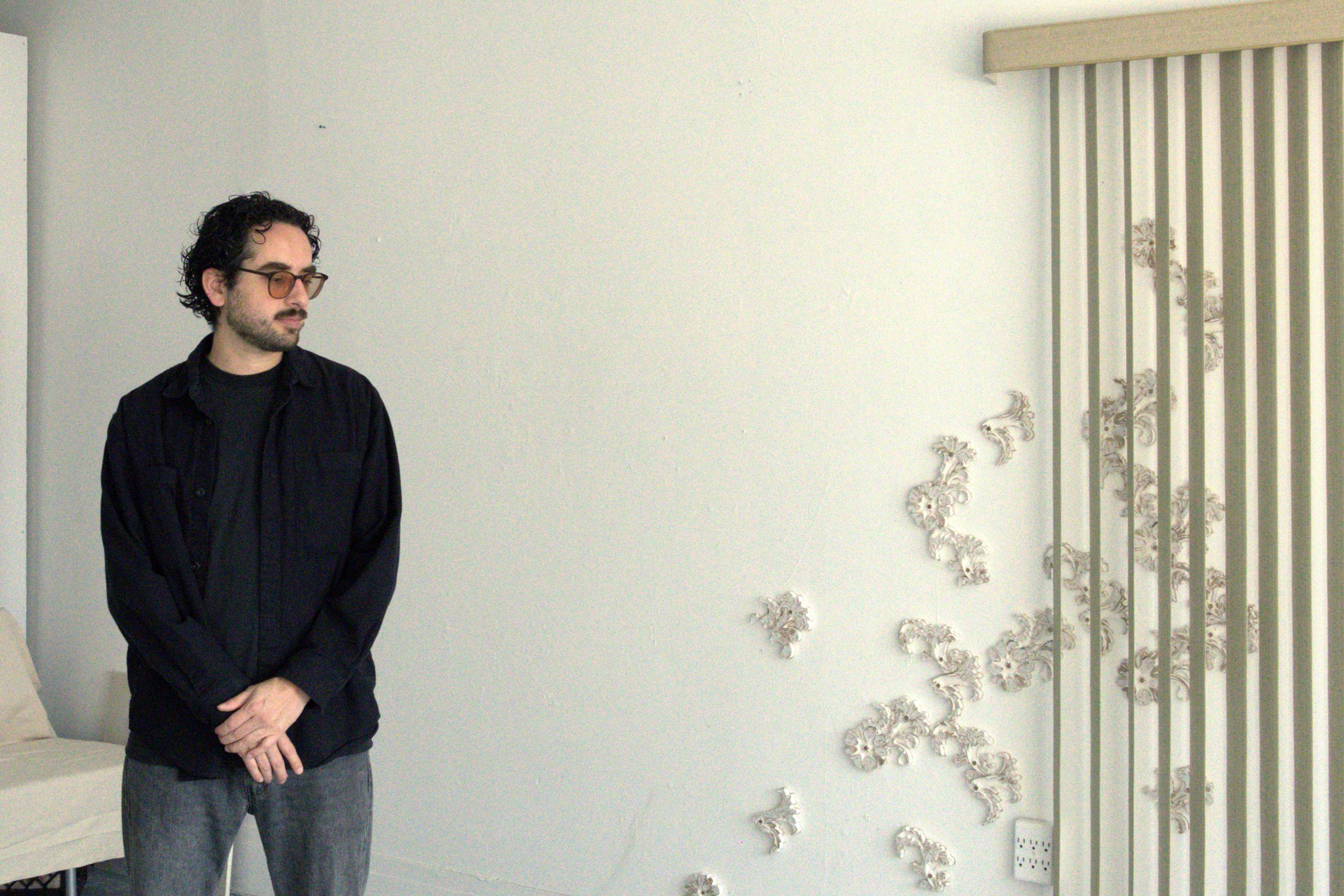
Edgar Solórzano
Artist based in Mexico City.
Edgar Solórzano was born in 1989 in Mexico City, where he currently lives and works. He studied Architecture at the National Autonomous University of Mexico (UNAM) and at the Bauhaus Universität Weimar (BUW), where he began his practice as an artist. He is currently studying the Master of Fine Arts (MFA) in Sculpture at the Rhode Island School of Design (RISD).
He is a recipient of the “Fulbright - García Robles” scholarship, and the “Young Creators” scholarship from the Ministry of Culture, he obtained First Place in the Abierto Lumen Biennial, he was a finalist on two occasions at the JA Monroy Biennial, he participated with SOMA in “Landscapes” at the Jumex Museum (CDMX), he collaborated in the “Fictional Architecture” project at the Arte Alameda Laboratory (CDMX), and attended the program Piso 16: Laboratory of Cultural Initiatives, UNAM.
His work has been exhibited individually and collectively in Mexico, Spain, Germany, USA, and Colombia, and is part of public and private collections in Mexico, Colombia and USA.
Architecture, Scale, and Research
ArtEchive
You originally came from architecture. How did you find your way into sculpture?
Edgar Solórzano
I found my way into visual arts about 8–9 years ago, right after quitting my last architecture job. At first, I used to make more two-dimensional work about spatial experience and spatial memory, with a much closer reference to my architecture training. After that, I slowly transitioned into a more sculpture- and installation-based practice.
I consider that my architecture training still shapes my current practice a lot, especially in the way I do research. Architecture is a context-based practice, and in the same way, my projects start with lengthy research on materials and context. While doing the research, I then allow my focus to diverge in a whimsical and rhizomatic way, weaving parts of the research in non-linear ways, which I enjoy a lot.
Another part of my practice that I believe is shaped by my architecture training is the shift of scale. I enjoy zooming in and out from the macro to the micro while doing research, jumping from global considerations to intimate ones, and back again.
Personal Memory, Global Forces
ArtEchive
Memory is central to many of your works. How do you balance larger narratives with personal history?
Edgar Solórzano
I enjoy doing research and working around generational, global, and/or national narratives, but the only way for me to access their emotional effects is through personal or familiar experience. Sometimes I can better understand global dynamics through the lens of these experiences, and sometimes I can better understand familiar dynamics through the lens of historical global dynamics.
I consider this switching of lenses a very useful tool to avoid getting lost in abstract generalizations and to avoid excessive navel-gazing and self-reference.
Humor, Tension, and Manufactured Nostalgia
ArtEchive
There are often strong material and conceptual tensions in your work. How do you understand these tensions?
Edgar Solórzano
I think these kinds of tensions are present in our material and emotional reality all the time. How we are affected by things, and how we affect them in return, is never linear or one-dimensional. We can both desire and feel disgusted by something; we can both aspire to and reject something at the same time.
These states of murky or contradictory feelings aren’t necessarily a temporal in-betweenness, but sometimes they simply show a complex system of relationships that mirrors how complicated our reality and our relationship to it can be. Although not always in the open, I work a lot with humor, and mocking or laughing about these contradictions makes them much easier to accept.
ArtEchive
How did the infiltration of American culture into Mexico become a central line of thinking in your recent work?
Edgar Solórzano
I think I got attracted to this topic because of this exact complexity. While I was growing up, I was exposed to a massive amount of US American culture because of NAFTA, the North American Free Trade Agreement, signed in 1994. This exposure created both aspirations and aversions within my family and generation, and, in response, I felt both included and rejected by it as I grew up.
Therefore, I got interested in this topic unintentionally. While developing work for a solo show I had in Mexico City in 2024, I couldn’t remember what movies I used to watch in a grand aunt’s TV room with my siblings, but I was sure it was one of the classic Mexican Cinema Golden Age movies. After asking my brother, his response was, “Yeah sure, it was Terminator 2 and Independence Day.”
Realizing that I was glamorizing my own memories made me start questioning why I was doing it, but also why I felt such an emotional, warm attachment to these foreign movies. After I started doing research, I realized how much of this was manufactured, and I started getting interested in the forces behind it.
If feelings towards one's own and foreign commodities can be manufactured as part of geopolitical mechanics, either by global or national, or even local, forces, moral pressure is one of the most effective tools for adopting or rejecting imported values and roles. I don’t think I offer solutions to that. I enjoy thinking that my work mostly functions as a methodology that dissects my own experiences, and that methodology can be applied to other contexts.
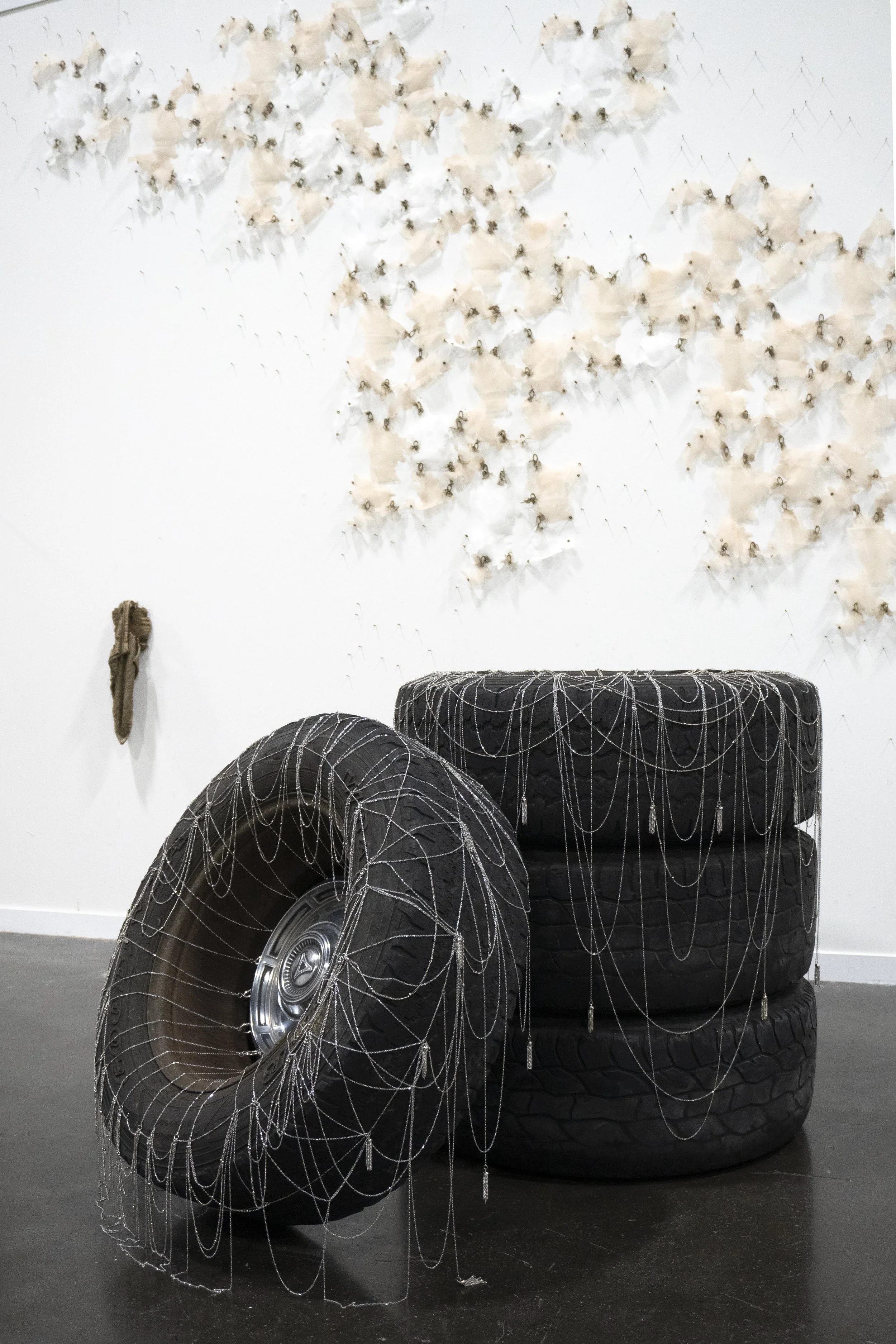
Installation view of Ritual of lather and rust, Cave canem, and Induced molting. Photo by Edgar Solórzano.
Material Agency and Artistic Continuity
ArtEchive
Your practice moves across architecture, sculpture, installation, and site-specific performance. What leads you toward a new form or medium? Do you still define yourself as a sculptor?
Edgar Solórzano
Yes, I think I’m still primarily a sculptor, since I have a lot of interest in material relationships and agency. I borrow a lot from new materialism and actor-network theory for my conceptual frameworks. In these theories, ideas, language, space, objects, and humans all have agency that affects one another, acting as materials in a way.
Usually, the selection of these materials happens during the research process, and I start picking the things that I resonate with or react to the most.
ArtEchive
Are there any roles or fields you would like to explore in the future? What advice would you give to young art workers entering the field or going through a transition?
Edgar Solórzano
I’ve done some exhibition design in the past, which I enjoy a lot. As far as advice, I would suggest getting an alternative source of income to avoid putting all the emotional and economic pressure on your art, at least at the beginning. It is easy to fall for early sales or exposure, and then it can be hard to let go of that kind of work, since it’s already paying the bills.
But also, if you do decide to do it, it’s totally fine, and nothing is set in stone. You can always switch paths and start again, or differently. Art can take different forms in our lives, and I believe it’s better to shape how art operates in our lives, instead of how our lives operate for art.
(End)