
A Conversation with Judy Chung
It’s Me, But Not Quite: Judy on Tension, Identity, and the Soft Power of the Cute
Editor’s Note
This interview is based on a live conversation. The text has been lightly edited for clarity, while preserving the speaker’s original tone and meaning.
On April 23, 2026, ArtEchive held an interview with Judy Chung, focusing on the roles of tension, identity, and visual language in her artistic practice.
The discussion explores how opposing forces, such as cuteness and unease, control and instability, coexist within her work as both aesthetic strategies and reflections of lived experience. Moving between personal narrative and constructed imagery, Judy Chung reflects on cultural displacement, fragmented subjectivity, and the use of recurring characters as extensions of the self. She also shares insights into her recent Cafeteria series, the psychological dynamics embedded in everyday environments, and her approach to creating works that remain visually accessible while sustaining deeper ambiguity and discomfort.
interviewee
-
Judy Chung
Artist based in Brooklyn, New York.
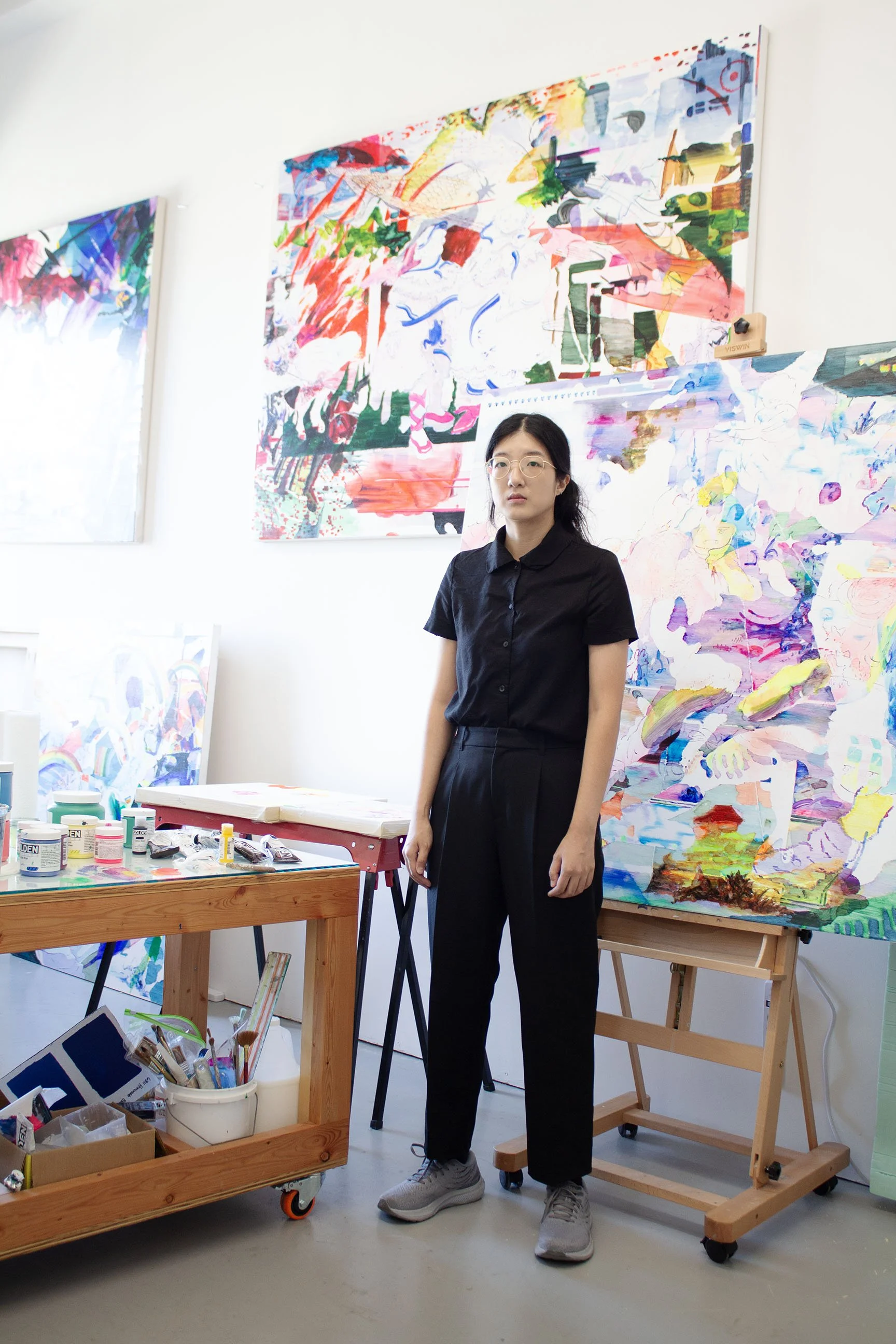
Judy Chung (b. 1990, Seoul, Korea) lives and works in Brooklyn, New York. She received her Master of Fine Arts from Columbia University in 2018 and her Bachelor of Fine Arts from Pratt Institute in 2013. In 2026 she had her solo exhibition, Cafeteria, at RAINRAIN, New York.
Her work has been shown internationally in exhibitions including Tone Check: The Skins of Contemporary Korean Painting at Eli Klein, NY, What do Angels Look Like? at RAINRAIN, NY, Victoriassecret at Helena Anrather, NY, and there’s something about PAINTING at Tatjana Pieters Gallery, Belgium.
Her work has been featured in Artforum, IMPULSE Magazine, TUSSLE Magazine, and Hot Coffee Conversations, among others.
ArtEchive
Thank you for taking the time to speak with us today. This conversation is organized by ArtEchive as part of our ongoing interview series.
We approach this discussion as a way to think through how personal experience, visual language, and psychological structures intersect within contemporary artistic practice. Rather than separating these dimensions, we are interested in how they overlap, generate tension, and shape the conditions of image-making.
Today’s interview begins with your individual experience and moves toward broader questions of identity, perception, and representation. We will also touch on your use of recurring characters, the dynamics embedded in everyday environments, and how your work navigates the space between visual accessibility and emotional ambiguity.
TENSION, FRAGMENTATION, AND THE SOFT POWER OF THE CUTE
ArtEchive
Your work often brings together different kinds of tension—such as cuteness and grotesque elements, or control and loss of control. How do you think about these contrasts? Do they function more as a visual strategy, or are they rooted in lived experience?
Judy Chung
For me, it’s really both.
On one side, it is definitely a visual strategy. When I’m making work, I consciously think about how to bring opposing elements together. I’m interested in how different forces can occupy the same space without resolving.
But at the same time, it comes from my personal experience. I’ve always felt that I have many contradictory qualities within myself, and I’ve spent a lot of time thinking about that, especially in relation to identity.
So the tension in my work isn’t just formal. It reflects how I experience the world, both internally and externally. It’s something psychological, but also something structural that I observe around me.
ArtEchive
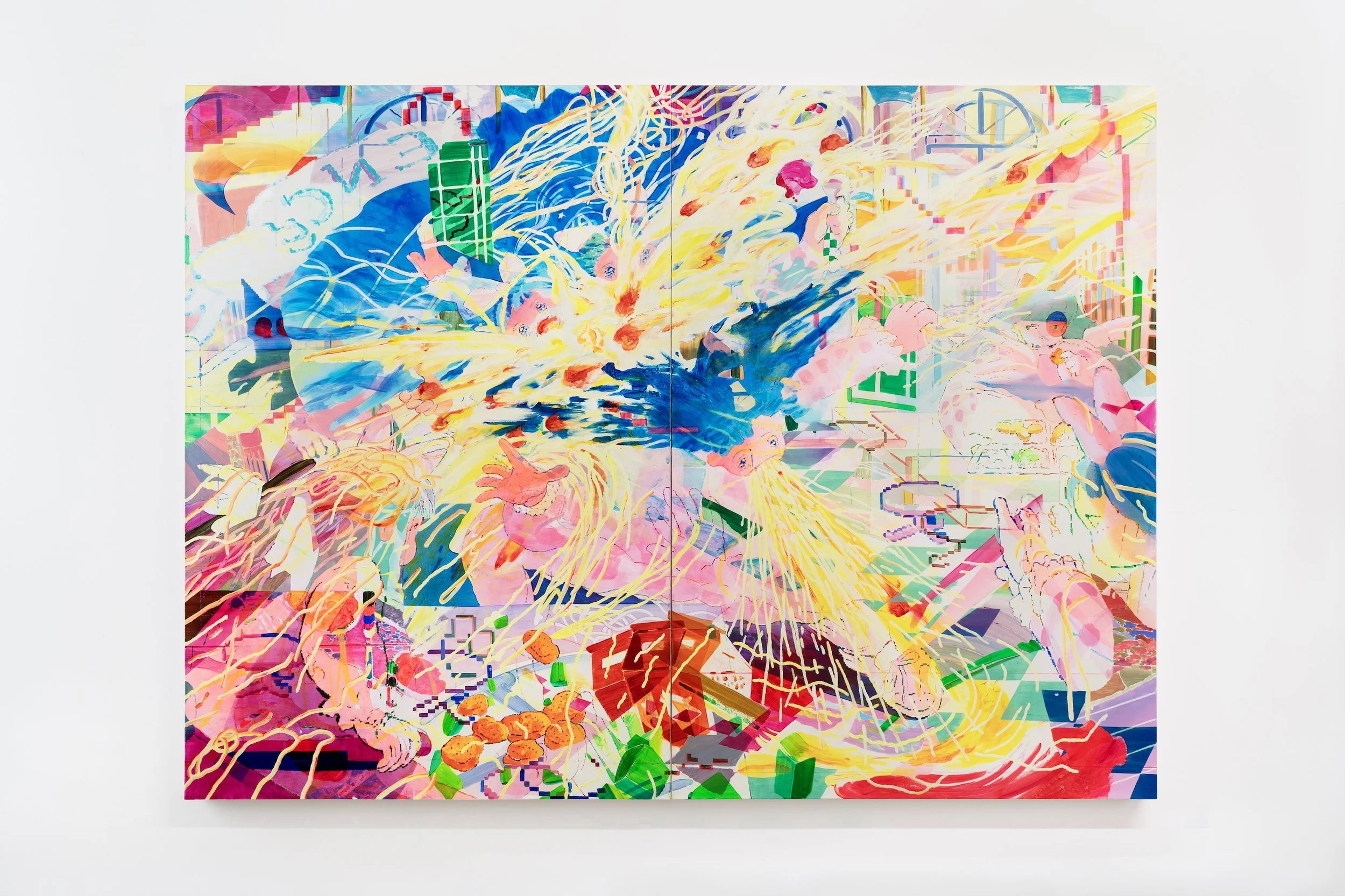
In your recent exhibition Cafeteria at RAINRAIN, you used a school cafeteria as a central setting. It feels both everyday and shaped by subtle power dynamics. What drew you to this space, and how does it relate to how you think about identity?
Judy Chung
It really comes out of personal experience.
I moved around quite a bit when I was younger, so I was often the “new kid.” That made me very aware of my environment—constantly trying to figure out how to fit in, what behaviors were acceptable, and what wasn’t. A lot of that learning happened through trial and error, just by interacting with other people and navigating different systems.
School is such a formative space in that sense. You’re always absorbing information, but no one really teaches you how to socialize. You have to figure it out on your own, often through friction, through small collisions with others and with the structures around you.
The cafeteria felt like a particularly interesting setting within that. It’s one of the few moments where you’re not directly controlled by authority, even though you’re still under supervision. Everyone is gathered in the same space, and interactions become a bit more unfiltered.
That’s where a lot of subtle power dynamics emerge. Things that might seem trivial later, like what you wear, how you style yourself, even the objects you carry, can feel extremely important at that moment. They shape how you’re perceived and how you relate to others.
Situating the work in a cafeteria became a way to think about identity as something constantly negotiated, formed through everyday interactions rather than fixed in advance.
ArtEchive
Your images feel immediately engaging, but also slightly unsettling at the same time. How do you think about that tension in the viewing experience?
Judy Chung
That goes back to the idea of opposing forces.
It’s definitely intentional. I want the work to feel accessible at first, bright, cute, visually inviting, but then become more unsettling the longer you look.
The world is already quite heavy and depressing, so I’m interested in creating something that initially softens that impact. But I don’t want it to stay there.
Cuteness is powerful. It’s a kind of soft power, and it makes things more digestible, even when the subject matter is difficult or uncomfortable.
For me, using “cute” imagery was actually a breakthrough. I used to avoid it because I was afraid it would seem childish or not serious enough. But eventually I realized that it was something I genuinely liked.
So now I embrace it. It allows me to talk about serious or even taboo subjects in a way that feels more open, less didactic.
CULTURAL DISPLACEMENT AND FRAGMENTED SUBJECTIVITY
ArtEchive
You’ve spoken about growing up between Korea and the U.S. How does that experience of cultural displacement enter your visual language? Does it show up more in narrative, or in form and perception?
Judy Chung
I don’t directly represent it in an obvious way—I think that would be a bit too literal.
But it’s definitely woven into the work.
It shows up through the narratives I construct and the characters I create. Many of them are fragmented or incomplete—they feel like parts of a whole rather than fully formed individuals.
I’m less interested in the specific cultural differences between Korea and the U.S., and more in the psychological and structural consequences of moving between places so often.
That experience made me very sensitive to how people behave in different environments, and very aware of my own position within those spaces—always trying to fit in, and often feeling like I might be doing something wrong.
So that displacement appears across narrative, form, and perception. It’s not explicit, but it shapes everything.
characters as avatars and psychological fragments
ArtEchive
Your work often features recurring characters or avatars. Do you see them as extensions of personal experience, or as something more collective or psychological?
Judy Chung
They’re both.
They definitely come from personal experience, and they’re all parts of myself. I think of them as different avatars or personas, different facets of my thoughts and personality.
At the same time, they also form a collective. Even though they’re separate, together they still represent “me.”
I also draw on archetypes from cultural media, like characters from video games or familiar narrative roles. But I like to distort them.
For example, in one of the cafeteria paintings, there’s a knight figure. Normally, that character would be heroic and selfless. But in my version, she’s exhausted, calculating, and self-interested.
I’m interested in taking those familiar archetypes and pushing them into more ambiguous, uncomfortable territory.
advice for emerging artists
ArtEchive
Do you have any advice for young artists who are still developing their practice?
Judy Chung
I think the most important thing is honesty. It sounds simple, and a lot of artists say it, but it really matters—not following trends, not making work just because it’s fashionable. At the end of the day, you’re the one who has to live with the work. People come and go, but the work stays with you, so you need to be able to stand by it.
At the same time, I don’t think we fully understand ourselves as much as we assume. A lot of what we think comes from social conditioning or external influence, so it takes effort to step back and ask what you actually feel. It’s okay not to have clear answers, to feel confused, or to not take a fixed position. The world isn’t black and white.
The work that resonates with me most is work that allows for that ambiguity—work that opens up a space for dialogue rather than trying to deliver a definitive answer. I don’t really respond to work that tells you what to think. That feels limiting to me.
(End)