
Accumulation and Resonation: Aftermath by Jungeun Park
by April Liu
The first thing I encountered in Aftermath was the skeleton of a wild animal. Its scale and exposure made it impossible to ignore. The bones were stripped clean, cold in both material and presence. It was immediately clear that this was not an abstract symbol but the residue of an event. Something had happened, and the exhibition did not attempt to soften that fact.
The word Aftermath appeared in the handwritten wall text by curator and participating artist Jungeun Park. The title placed the exhibition in suspension. The show unfolded as sustained attention to what remains after irreversible acts.
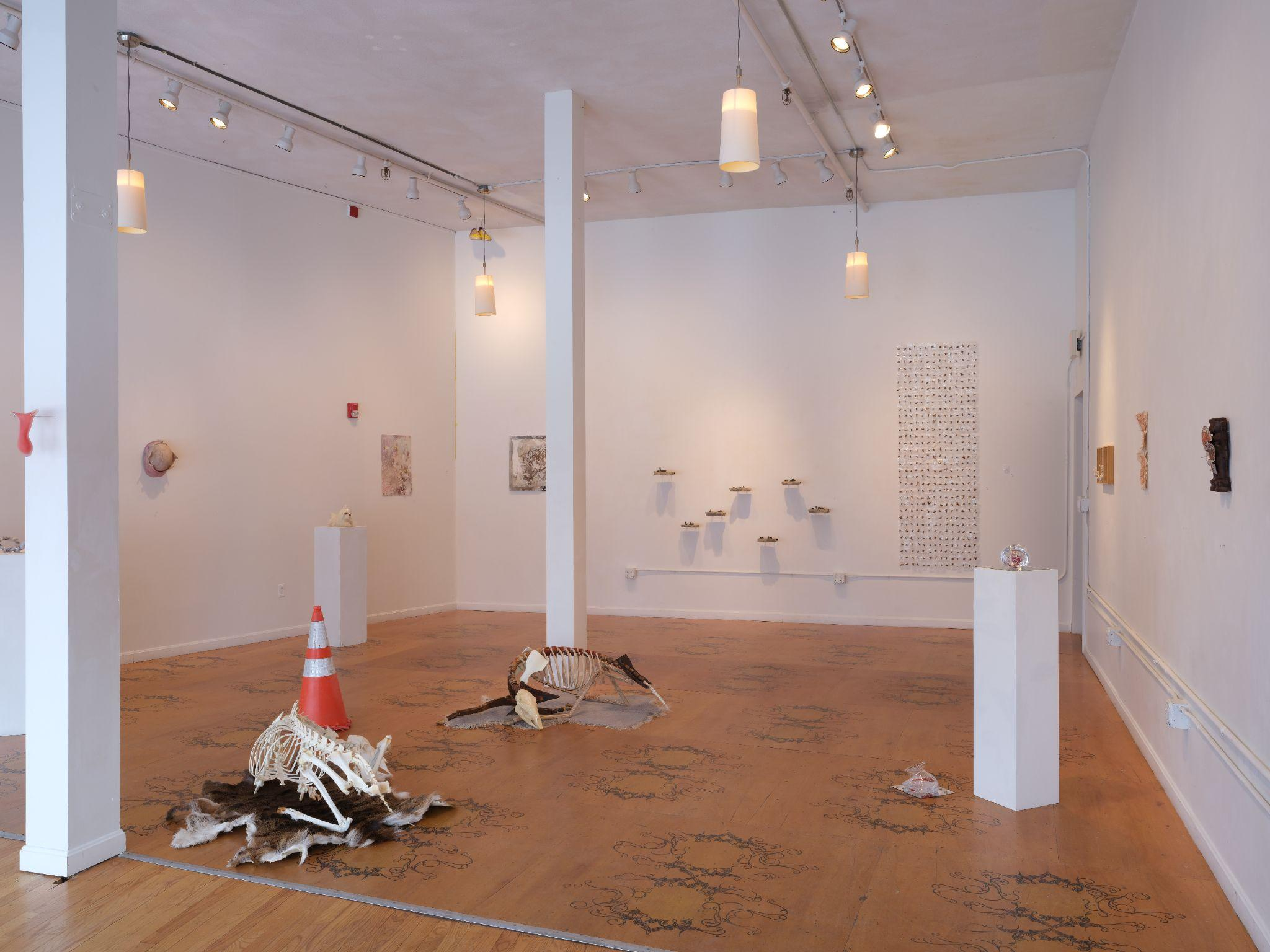
Installation view of Aftermath. Courtesy of Wenhan Hu.
Several glass works by Jungeun Park took on the forms of flesh, veils, and umbilical cords. Their surfaces were taut and exposed. These were uneasy gestures toward birth. The works suggested beginnings already marked by vulnerability, where life and fragility are inseparable.
Nahom Ghebredngl’s works were constructed from collected trash, hair from his own body, and gum he had previously chewed. These materials were processed into pigment and structure, forming layered horizontal and vertical strata across panels. The compositions initially appeared intuitive, but over time revealed a clear internal logic. The works mirrored natural processes of accumulation as a method.
Maha Mohan’s contributions operated differently. Their restraint was precise. Fractures, gaps, and withheld gestures created a quiet pressure within the space. The works did not assert themselves immediately. Their lack of resolution lingered, drawing attention to what was deliberately left incomplete.
Returning to the skeleton, it became clear that the bones were roadkill collected by Carrie Kouts. Nearby, another work assembled the bodies of lanternflies, insects classified as pests and systematically destroyed. These materials did not accuse. They implicated. Responsibility emerged through proximity.
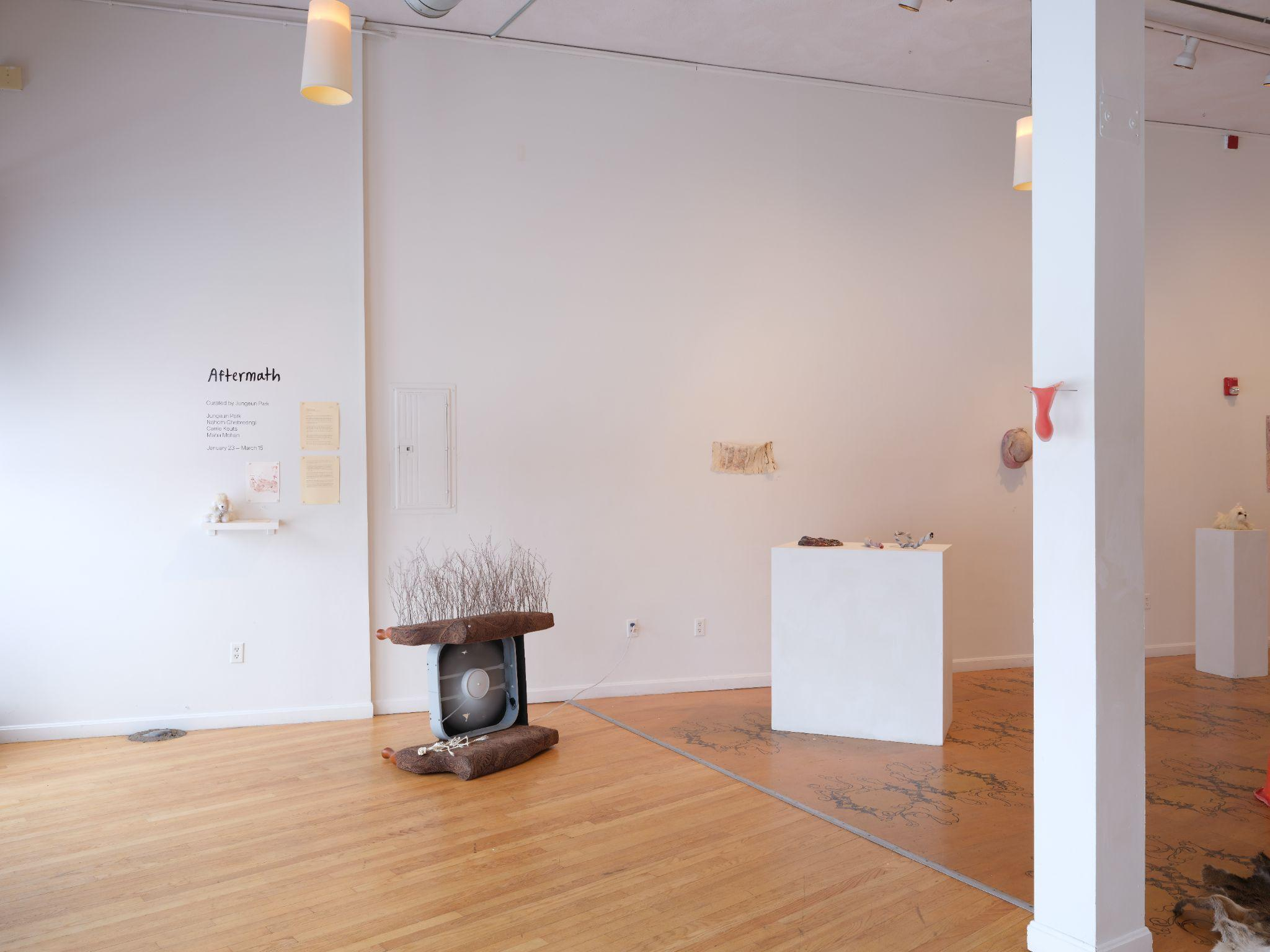
Installation view of Aftermath. Courtesy of Wenhan Hu.
By the end of Aftermath, the title no longer suggested a fixed temporal position. The exhibition resisted closure. There was no singular aftermath, no stable point from which meaning could be resolved. The works remained within states of accumulation, loss, and continuation. What the exhibition offered was not consolation, but sustained attention to what persists after irreversible states, when resolution is no longer possible.
Aftermath does not present a conclusion. It lingers in states of accumulation and continuation, a logic that also shapes Park’s approach to curating. In the conversation that follows, she reflects on how curating emerged from this position and how the process became central to her practice.
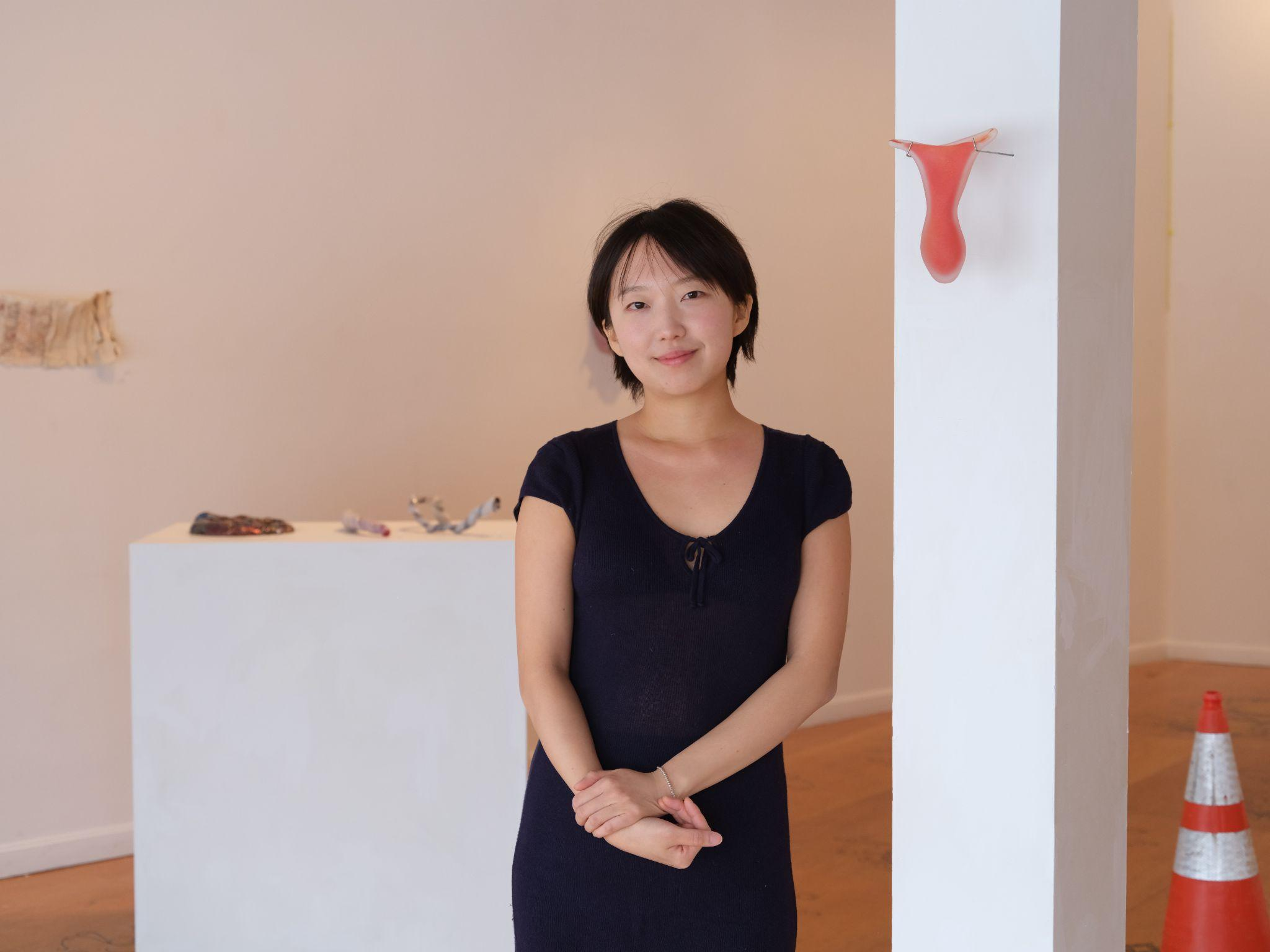
Jungeun Park with her works. Courtesy of Wenhan Hu.
Why Curating
I began curating through a long accumulation of experiences as an artist. Since 2018, I have participated in exhibitions across a wide range of themes, formats, and degrees of completion, spanning approximately eight years. Over time, I began to feel a growing tension. Sometimes exhibitions clicked perfectly, and I loved those moments. Other times I would leave feeling that something was missing. I often felt the work could have been pushed further or connected more carefully to its message.
That feeling became a productive discomfort. I wanted to create exhibitions myself. I wanted to build spaces where works could respond more closely to one another and where ideas could be pushed deeper.
This shift began with an unofficial exhibition titled Chalice of Being, held last spring at RISD Farm. The show was informal and experimental. A RISD classroom by the beach was used for five days, and it took place before thesis season, when many works were still in draft form. We prepared our catering from nearby Shaw’s on an old foldable table and invited RISD students to play unrefined mixes through an average speaker borrowed from the school. It was both a play and a process, not a finished result. It was rough, but it felt alive.
After that, I began reaching out to venues. Machine Magnet told us they were booked for the year but offered us a space the following one. That moment felt pivotal. They saw potential in our approach, and the exhibition became real.
Learning from the Inside
Preparing exhibitions changed how I understood curating. Even on a small scale, the work was intense. Communication had to be structured, with clear drafts, shared information, and deadlines.
A clear example of this shift was my relationship to time. As an artist, delays often remain a personal matter. As a curator, however, time becomes a collective responsibility. One person’s delay affects the entire group. This difference revealed the weight and accountability embedded in the curatorial role.
Through this process, I learned about logistics, coordination, documentation, and planning for presentation and archiving. Even if I return to participating only as an artist, this experience has permanently changed how I see exhibitions, shifting my position from simply contributing work to creating, leading, and guiding.
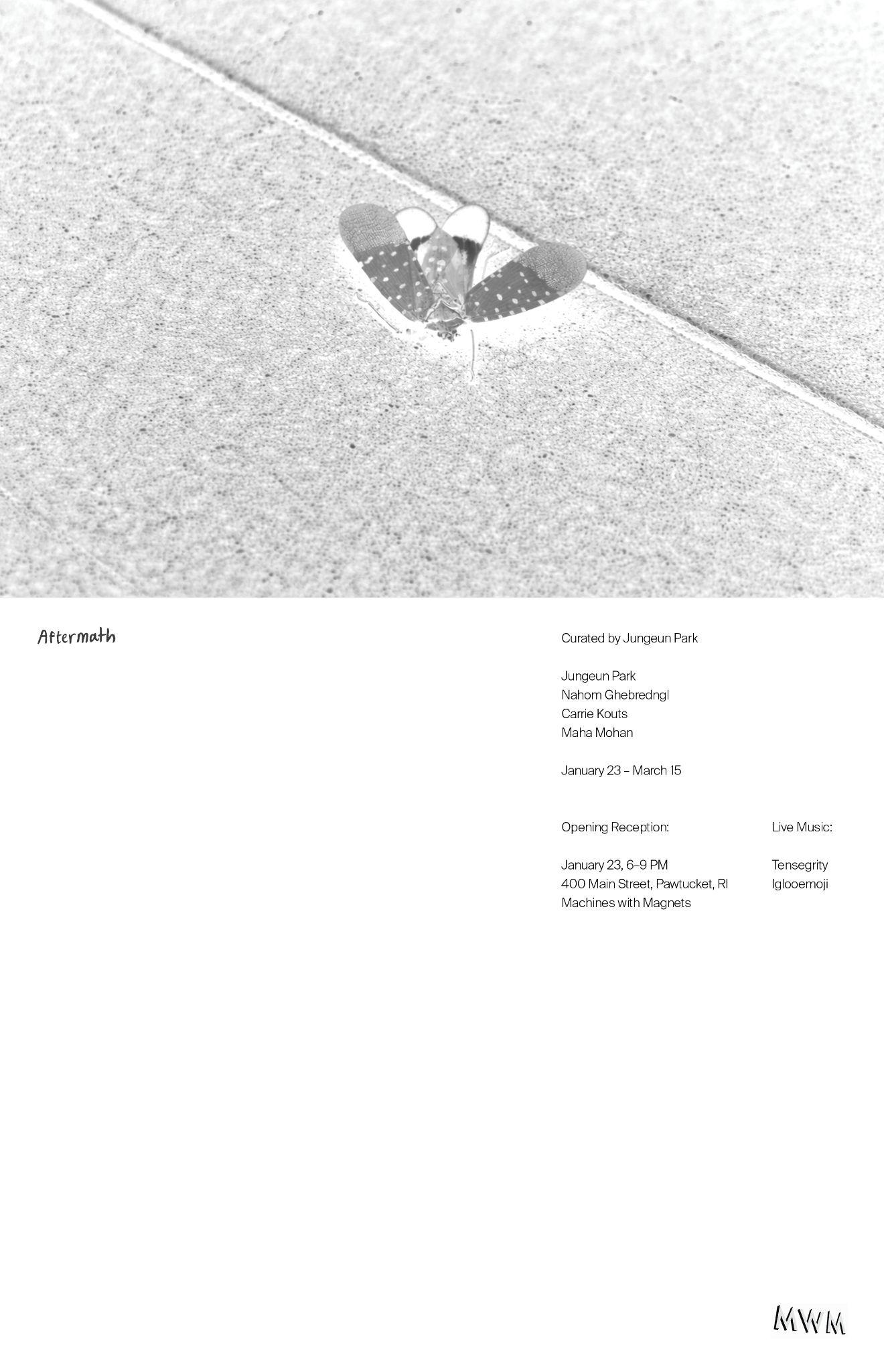
Poster for Aftermath. Courtesy of Jungeun Park and Dohee Kim.
Curatorial Direction
As a curator, I feel each work as if it were my own. Because I make work myself, which derives from my personal background, I understand that artists’ works are often deeply rooted in personal thought, memory, and even trauma.
Working across various media and installation setups, I often sense how a piece wants to exist in space and how it can be shown at its best.
Much of my thinking centers on the body, both human and nonhuman, and on things we usually take for granted. I am interested in mundanity. What seems ordinary or inevitable can become strange or unsettling when examined closely. The pink inside the mouth, for example, is not simply pink. It is a color of diluted blood.
This perspective shaped the exhibition. Many artists worked with materials and subjects that are everywhere but often ignored, including dust, trash, roadkill animals, and abstract conditions such as unrest, pain, and emotional residue. These subjects often sit outside our immediate attention, yet return persistently throughout our lives.
Bodies After Irreversible Events
The exhibition Aftermath focused on bodies after irreversible events such as birth, loss, death, injury, or abandonment. These moments permanently alter us, yet we rarely confront them directly. One artist’s practice grew out of childhood experiences of emotional deprivation, needs that can never be fulfilled retroactively.
The exhibition did not offer comfort or solutions. It did not claim that everything would be okay. Instead, it acknowledged discomfort and unresolved states as part of lived reality.
What Art Can Do
Curating Aftermath was about offering insights we have long neglected, about our way of being. We often position ourselves as if we were absolute beings on earth, yet in reality, we are vulnerable bodies coexisting with countless other forms of life.
Through four distinct voices, the exhibition presents bodies whose conditions have already been decided, as well as bodies that have drifted out of care and attention. In doing so, Aftermath seeks to reveal the quiet, often unacknowledged violence embedded in what we consider normal.
I do not see art as a way to tell people what to think. People make their own decisions in the end. Rather, art can offer perspectives that are otherwise unavailable. With this in mind, the exhibition invites viewers to remain with discomfort and to look more closely. At the aftermath of what is fixed and irreversible, we suggest care - as a pause that prevents us from moving on unchanged.
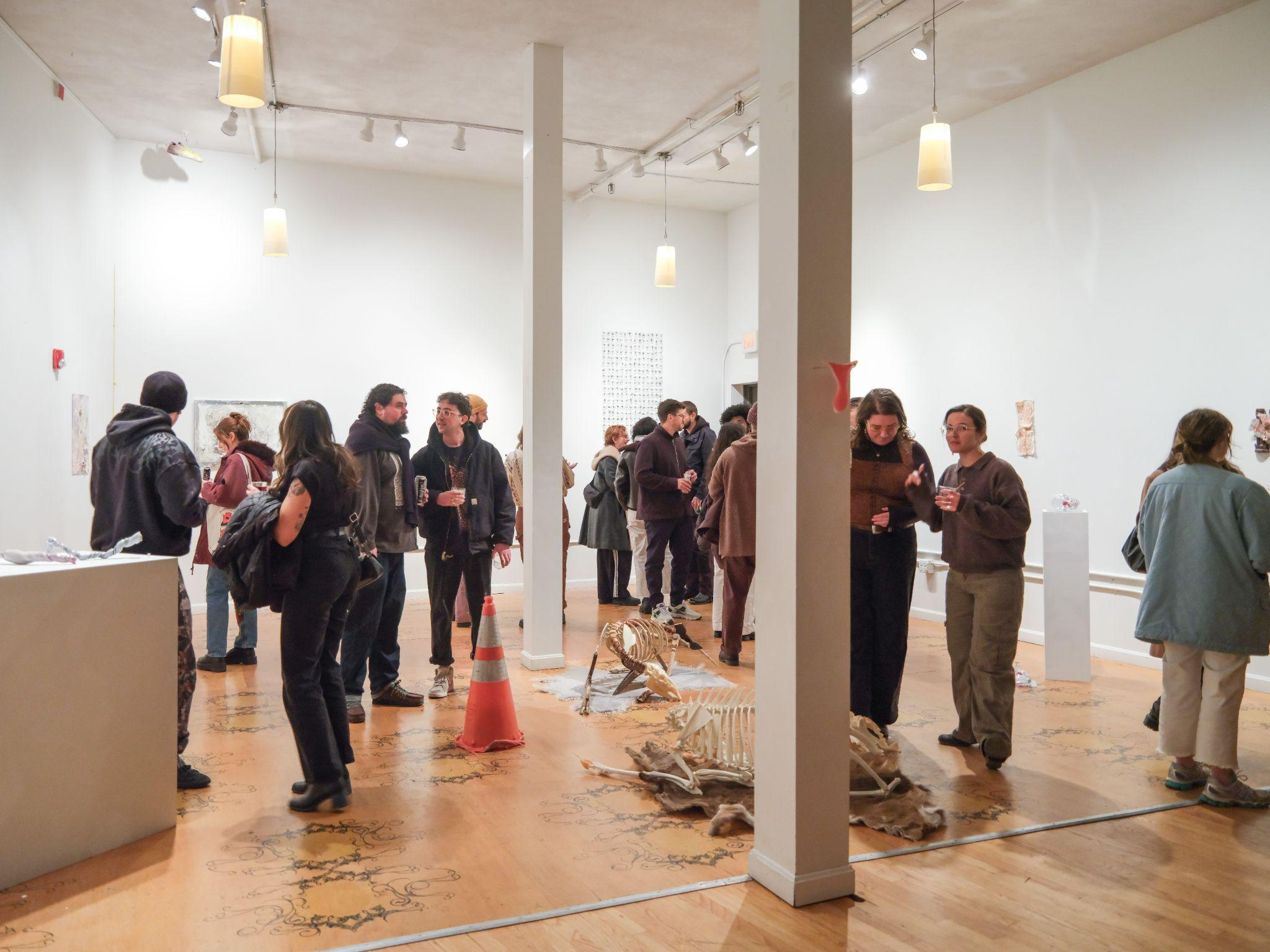
Installation view of Aftermath. Courtesy of Wenhan Hu.