
A Conversation on Cultural Work, Identity, and Visibility (Part II)
Education, Technology, and the Politics of Support
Editor’s Note
This interview is based on a live conversation. The text has been edited for clarity and flow, while keeping the speakers’ original meaning and tone.
On March 21, 2026, CHINCHINART, ArtEchive, and Symora Art hosted a panel at 110 Lafayette St, #201, New York, featuring Tina Wang, Pin-Hsuan Tsang, and Jiayin Chen in a conversation on women’s cultural labor and the contemporary art ecosystem.
In the second part of the conversation, the speakers turn toward pedagogy, technology, media conditions, and the question of what meaningful support for women in the art world might actually require. Across different fields, they reflect on instability, visibility, and the deeper structures that shape recognition and value.
Panelist
-
Tina Wang
Art Critic, President of AAJA New York
Xintian Tina Wang is a journalist, cultural critic, and author whose work examines gender, sexuality, arts, business, and technology. Her writing has appeared in The New York Times, TIME, NBC News, ARTnews, and other major outlets, amplifying underrepresented voices. Her reporting and documentary work have received recognition from the Gracie Awards and the Boston Short Film Festival, and she was named one of Gold House’s 2024 AAPI Journalists to Watch.
Wang serves as President of the Asian American Journalists Association (AAJA) New York Chapter, leading initiatives on media equity and community storytelling. She holds an MS in Journalism from Columbia University and a BS in Advertising from Boston University.
-
Pin-Hsuan Tsang
Ph.D. Candidate in Art Education at Penn State University
Pin-Hsuan Tseng is a Ph.D. Candidate in Art Education at Penn State University, with minors in Women’s, Gender, & Sexuality Studies and Curriculum & Instruction. Her scholarly work has been published in Research in Arts Education, Visual Arts Research, and in multiple edited book chapters.
She has received numerous international recognitions, including the Art Education Research Institute (AERI) Honorable Mention Dissertation Award (2025), the Pennsylvania Art Education Association Fellows Clyde M. McGeary Scholarship (2024), and the Dr. John Roe Sustainability Impact Award (2024).
-
Jiayin Chen
Founder of SCREEN
Jiayin Chen is a curator, writer, and cultural entrepreneur passionate about engaging with artists who utilize digital technologies, ranging from moving images, immersive media to NFTs.
Chen is the founder of SCREEN, the first bilingual online art platform dedicated to digital art, established in 2014.
Yellow Tent, Trauma, and Transnational Space
Moderator
You brought a yellow tent with you today. Could you tell us a little about it?
Pin-Hsuan Tsang
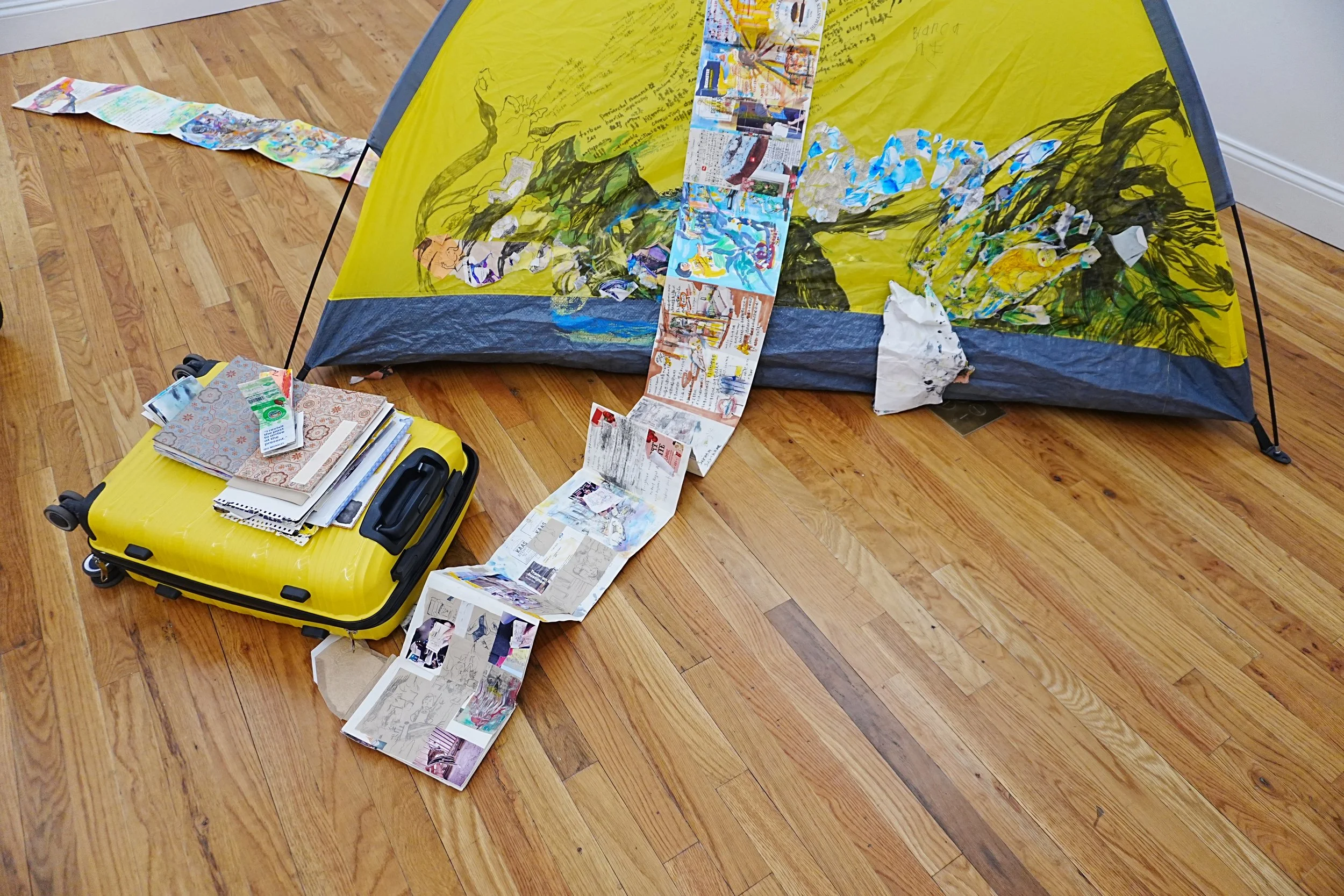
This is my yellow tent. You can come closer to the project, because I feel that body gesture is very important to the work.
The project is called Yellow Tent / Tension. I am playing with language here, because “tent” and “tension” come from the same Latin root, tendere, which also suggests attention or attending to something.
The project connects back to my first experience of racism in the United States. A man called me “little yellow woman” in public, very close to here actually, in a very offensive way. It happened during my first month in the U.S., and he ran away immediately afterward. That moment stayed with me deeply.
This was almost four years ago, at the beginning of my PhD. I began asking myself, as an artist and researcher, how I could transform that first experience of racism into an artwork. That became the starting point of my dissertation, which explores the trauma of East Asian immigrant women.
I began by asking what the “tension” is for East Asian immigrant women in the United States, and what deserves our “attention.” I set up the yellow tent in my small apartment and started thinking about space. How do we claim women’s space? How do I think through my transnational identity both inside and outside this structure?
But the tent is not only a tent. It is also my diary. I keep a daily diary in Mandarin in the form of a 折页, an accordion book. I write and draw every day, and then I tear those pages apart. The fragments are attached to the tent panels.
The word “tear” holds several meanings for me. It can refer to tears from the body, it can suggest tearing down in a hierarchical sense, and it is also a verb of making. All of those meanings are present in this project.
I worked with ten East Asian immigrant women from Japan, South Korea, China, and Taiwan. I traveled with the yellow tent to different places, carrying it almost like hand luggage. TSA staff would often stop me and ask about it, and I would tell them the story and explain what the project was.
Art Education and Fluid Boundaries
Moderator
Your research sits at the intersection of art education, gender studies, and curriculum design. How can art education reshape the way future generations understand cultural perception and intersectionality?
Pin-Hsuan Tsang
That is both the big question and the central dilemma of my work. Institutionally, I am based in art education, and before beginning my PhD I was a visual art teacher in Taiwan for ten years. So one of my identities is educator, not only artist. My minors are in women’s and gender studies, and in curriculum and instruction.
Behind all of these fields, I keep asking what these categories really mean. What is women’s and gender studies? What is art education? What is contemporary art? They all share certain concerns, and they are all constantly in flux.
As an artist, researcher, and writer, you often discover that the thing you are making does not fit neatly into any one category. The boundaries are blurred.
That is one reason the yellow tent became such an important image for me. I think through the tent in terms of inside and outside, and through transnational story-making. A tent changes depending on the weather, the place, the people, and the surrounding environment. When strong wind comes, the panels become unstable.
When we engage in story-making with participants, we also ask what kind of boundaries are at work. Are they imposed by the nation-state, by official borders, by institutions? Or can they be defined differently, perhaps even by ourselves? I do not see fixed boundaries between these fields.
Media, Risk, and Speaking Carefully
Moderator
Around identity and representation in your field, how have these conversations changed in recent years, and what gaps or challenges remain?
Tina Wang
What Pin-Hsuan described speaks to how rare it can be to speak openly in a space like this. These days, journalists are being silenced in many ways. There are fewer stories being told freely.
Personally, I have become much more careful about what I write and which topics I engage in. I can share one example. When I came back from China recently, I hid all of my social media posts about Trump before crossing the border, because I had written a lot about immigration policy. I did not know whether my phone might be checked or what kind of consequences that could bring.
So we are in a moment where fewer journalists speak without concern. There are not many publications that consistently focus on underrepresented communities. Some still do, and those are the publications worth paying attention to and supporting. At the same time, because of the administration and because of funding cuts, artists themselves are also becoming more cautious and are choosing safer topics to present.
That is why I think cultural workers like Jiayin and Pin-Hsuan are doing important work by bringing these voices into public view.
Technology, Platforms, and Uneven Visibility
Moderator
Digital platforms are constantly evolving and reshaping how art circulates and how voices gain visibility. From your experience, do these new technological platforms create more space for women and other historically underrepresented voices in the art world, or do they tend to reproduce existing patterns of visibility and power?
Jiayin Chen
It really depends on the technology. The internet and online publishing have definitely made it easier to discover artists, and in that sense they have increased visibility for women artists and other underrepresented groups.
But once you look more closely, the issue becomes where value accumulates and who has actual pricing power. That is a different question.
I used to work at Artnet, and when I looked into the data, it became very clear that the art world reflects the larger social structures we live in. Depending on how you measure it, women artists account for only about four to fifteen percent of global auction sales and sales volume. Even though gallery representation has improved, with women making up over forty percent of many rosters, the overall sales value remains much lower, around thirty percent. That means male artists still command stronger demand and higher prices.
Museum acquisition patterns show a similar inequality. Historically, only around eleven percent of works collected by museums have been by women artists.
At the same time, there are more encouraging signs in ultra-contemporary art, especially among artists born after 1974. There, women account for a much larger proportion of top lots and overall market activity, in some cases around forty percent or more. I think one important factor is the rise of women collectors. According to the data, women collectors are spending more in the ultra-contemporary segment, and their tastes are beginning to shape what gains visibility and value.
This also relates to what people call the great wealth transfer. As younger generations inherit wealth, they bring different priorities and different beliefs into collecting.
Still, I think it is important to be cautious. Whenever a new technology appears, people tend to imagine that it will create a more democratic field. Usually that optimism is exaggerated. Structural change comes more slowly. Greater representation does not necessarily mean greater equality. Attention is still unevenly distributed, and algorithms often reinforce what already has visibility rather than helping truly marginalized artists break through.
Sustainability, Ecology, and Hydro-Feminism
Moderator
Many of your works relate to sustainability and ecology in art education. How do you see environmental thinking intersecting with gender and cultural labor in the arts?
Pin-Hsuan Tsang
This question probably comes from my bio, because I received a Sustainability Award at Penn State. One of my projects is called the Marine Debris Encyclopedia.
The project began in Taiwan. Before I came to the United States, I was teaching at a middle school in Gong Liao, very close to the Pacific Ocean. I would often walk along the shoreline and notice that much of the marine debris had labels and brand names from different countries.
I began collecting this debris with my students and with members of the community. We categorized it based on where it seemed to come from, what the labels said, what colors and materials it had, and then we documented it and published the material online as the Marine Debris Encyclopedia.
Something very interesting happened in the process. The teenagers recognized many of the objects immediately. They would say, “Normally I would need money to buy this, but now I can get it from the beach.” That shifted the whole question. What is marine debris, and what is treasure? What is an object? What is value?
That brought me back again to the question of boundaries. What is the boundary between treasure and trash? Between what must be purchased and what washes ashore? As a teacher, I saw how this opened a wider conversation about consumption, money, and environmental thinking.
What I love about the project is that it also becomes a form of transnational storytelling. Marine debris can drift for years, even decades. It comes from Japan, China, the United States, and many other places. These objects cross borders through the ocean. They do not obey national boundaries. So the project asks what kinds of stories these objects carry in everyday life.
I am currently writing an article on this work. It will probably be published next year. It is about hydro-feminism, or what I am calling the hydro-feminist teacher. I am thinking about how hydro-feminist theory can enter both pedagogy and research practice.
What Support Should Look Like
Moderator
What is one change you would most like to see in order to better support women in the art world?
Jiayin Chen
As I mentioned earlier, I do think something is changing. More women collectors are shifting the power dynamics of the art market, and there are more emerging women artists whose work reflects a different historical moment. That makes me cautiously optimistic.
In general, I think awareness is always the first step. People need to acknowledge the problem before anything deeper can change.
Pin-Hsuan Tsang
When I hear that question, I first want to ask how we support each other. I am a PhD student, and in many ways I feel structurally unpaid. As international emerging scholars, we often do not have enough financial support.
So perhaps before asking how to support women in the art world in the abstract, we should ask how to support one another in concrete ways, financially, but also emotionally.
Tina Wang
From a media perspective, I do not want us to be constantly labeled. I do not want to see headlines saying, “the first woman artist to do this” or “the first Black artist to do that” or “the first Asian artist to do something else.” People should not always have to enter through a label.
At the same time, I do think there should be more fellowships for artists from underrepresented communities, whether that underrepresentation is based on gender, sexuality, culture, or ethnicity. Those voices deserve to be heard, and in the current system, those forms of support still matter.
Jiayin Chen
I would add that diversity itself is now being challenged as a value. We have spent years trying to support underrepresented groups and to emphasize representation, but representation does not automatically equal fairness.
The responsibility that comes with diversity is deeper than simply increasing numbers. Inequality is rooted in culture over a very long historical period, so change happens slowly.
When Picasso’s total sales can exceed those of all women artists combined, for example, or when art history still teaches greatness primarily through male figures, the question becomes much larger. Even as women, we have to ask how we cultivate taste, judgment, and artistic value outside a male-dominant narrative.
(End)